Short Ram Intake vs Cold Air Intake: Which Is Better?

by Marcus Chen

Dropping intake air temperature by just 10°F adds roughly 1% to your engine's output — and the real-world gap in a short ram intake vs cold air intake comparison can hit 20 to 40°F under hard acceleration. That gap is horsepower you're either collecting or leaving behind. Both upgrades demolish a stock airbox. But they work differently, install differently, and reward different drivers. Before you buy anything, read this. If you want product picks alongside the explanation, our guide to the best cold air intake systems covers the top kits across every price bracket.

This guide focuses on the decision itself: what each system does, where each one wins, and which one belongs in your car right now.
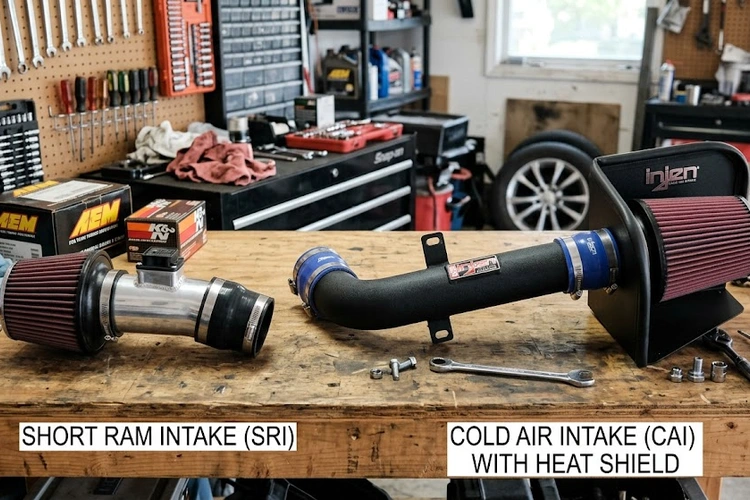
Short ram intake vs cold air intake side by side in engine bay
Figure 1 — Short ram intake (left) vs cold air intake (right): same goal, very different execution and air temperature results.

Short Ram Intake vs Cold Air Intake: Which Fits Your Build?

The stock airbox is engineered to be quiet, cheap to manufacture, and easy to service. It is not engineered to make power. Both aftermarket options fix that problem. But the fix looks completely different depending on which route you take.

What Is a Short Ram Intake?

A short ram intake (SRI) replaces your stock airbox with a short aluminum or plastic tube topped with a cone filter. The whole assembly lives inside the engine bay, close to the engine itself.

  • Tube length: Typically 6 to 18 inches
  • Filter location: Inside the engine bay, near the throttle body
  • Air temperature: Warm — it's pulling heat-soaked air from around the engine
  • Install time: 20 to 45 minutes on most vehicles
  • Cost: $40 to $150 for reputable kits

The short tube means less restriction and better throttle response. You'll feel it immediately at low RPM. You'll also hear it — that aggressive induction roar is real. But the air it's pulling in is warm. Warm air is less dense. Less dense air carries less oxygen per cubic foot. And oxygen is what your engine burns.

What Is a Cold Air Intake?

A cold air intake (CAI) uses a longer tube to relocate the filter away from engine heat — typically behind a fender liner, near the front bumper, or down into the wheel well. The goal is one thing: reach colder, denser outside air.

  • Tube length: 2 to 4 feet in most setups
  • Filter location: Low in the engine bay or routed into a fender
  • Air temperature: 20 to 40°F cooler than a short ram under sustained load
  • Install time: 45 minutes to 2 hours, depending on the vehicle
  • Cost: $150 to $400 for quality kits

Cooler air is denser. Denser air packs more oxygen into each intake stroke. More oxygen means a stronger, more complete combustion event. That's where the bigger horsepower gains come from — not from the tube, but from the temperature drop it creates.

Side-by-Side Comparison

Feature Short Ram Intake Cold Air Intake
Air temperature Warm (engine bay air) Cool (outside or fender air)
Typical HP gain 3–7 HP 8–20 HP
Throttle response Sharp improvement at low RPM Smooth improvement across RPM range
Intake sound Loud, aggressive induction roar Moderate induction noise
Install difficulty Easy — beginner-friendly Moderate — some disassembly required
Heat soak risk High in stop-and-go traffic Low to moderate
Hydrolock risk Very low Low–moderate if poorly routed
Price range $40–$150 $150–$400+
Best suited for Sound, budget, fast install Max power, hot climates, track use

Print that table. It tells you 90% of what you need to know. The rest of this guide fills in the other 10% — the context that turns a table into a decision.

Myths That Are Costing You Horsepower

The intake aftermarket runs on hype. Two myths in particular send people toward the wrong purchase. Don't fall for either of them.

Myth: More Noise Means More Power

This one is everywhere. It's wrong. Loud intakes feel fast. The aggressive induction growl from a short ram makes every gear pull sound like you're going faster. But dyno numbers don't care about sound.

  • A loud short ram pulling hot underhood air on a 95°F day can actually lose power compared to the stock airbox.
  • The sound you hear is air velocity and turbulence. It is not a measure of volumetric efficiency — the ratio of actual air intake to theoretical maximum capacity.
  • A quiet, properly routed cold air intake will outperform a loud short ram in every back-to-back dyno pull when temperatures climb.

Buy for numbers, not noise. The sound is a bonus — not the product.

Myth: Cold Air Is Always the Better Choice

Cold air intakes have real weaknesses that product listings quietly skip over. Know them before you buy.

  • Hydrolock risk: If your filter sits too low and you drive through standing water, your engine can ingest water. Water doesn't compress. One hydrolock event destroys connecting rods and pistons. This isn't rare — it's a known, documented failure mode.
  • Heat soak at idle: Sitting in stop-and-go traffic for 20 minutes reduces airflow through the longer tube. The filter retains heat. The temperature advantage shrinks or disappears at idle.
  • Fitment issues: Some engine bays genuinely have no clean routing path to cooler air. Forcing a cold air tube into a cramped bay with a 90-degree bend negates the performance benefit.
  • Higher cost of installation errors: A vacuum leak on a cold air install involves more tube length, more couplers, and more potential leak points. Getting it wrong has bigger consequences.

If your cold air filter sits below the bumper line, add a bypass valve or reroute above the frame rail — one puddle crossing at speed can hydrolock your engine and turn a $200 upgrade into a $4,000 rebuild.

Your First Intake: Simple Setup vs. Full Cold Air System

Your skill level and your toolbox both matter here. The right intake is the one you can install correctly. A botched cold air install with a vacuum leak is worse than a stock airbox.

Best Pick for Beginners

If you're new to working on your engine bay, start with a short ram intake. The reasons are practical:

  1. You need basic hand tools only — usually a flat-head screwdriver and a 10mm socket.
  2. The install is true bolt-on. Loosen the stock airbox clamps, remove the box, bolt in the new tube and filter, tighten everything down.
  3. If you make a mistake, the stock airbox goes right back in. No permanent changes, no damage.
  4. You learn how your engine bay is laid out — where the throttle body sits, where vacuum lines run, what the MAF (mass airflow sensor, which measures incoming air volume) looks like.
  5. The improvement is immediate and noticeable on your first drive.

This is a genuine learning install. It builds the confidence and familiarity you need before you tackle more complex work. If you've already been chasing symptoms like car losing power when accelerating, you have the troubleshooting instincts to handle an intake install without issues.

When You're Ready to Go Further

Once you're comfortable in the engine bay, a cold air intake is worth the extra effort. The steps aren't complicated — just more of them.

  1. Remove the stock airbox and resonator (the plastic sound-deadening box usually hiding in the fender area).
  2. Plan your routing path: fender well, bumper opening, or under the battery tray are the most common routes.
  3. Dry-fit the entire tube run before tightening anything. Check for clearance against moving parts, hot exhaust components, and the steering rack.
  4. Connect all vacuum lines and the MAF sensor connector. Check twice.
  5. Tighten every clamp, start the engine, and listen for hissing or whistling that signals an air leak.
  6. Re-torque all clamps at 50 miles. Rubber couplers compress slightly under heat cycling.

If you're building a performance-focused car and eyeing forced induction next, read our breakdown of turbocharger vs supercharger options. A quality cold air intake is the natural starting point for that build path — it feeds both naturally aspirated engines and boosted setups more efficiently.

Real Numbers from Real Engine Bays

Manufacturer claims run high. Real dyno results are lower but still meaningful. Here's what consistent independent testing actually shows.

What Dyno Runs Actually Show

  • Short ram intake on a naturally aspirated engine: 3 to 7 HP at peak RPM. The bigger improvement is throttle response and mid-range pull, not raw peak power.
  • Cold air intake on a naturally aspirated engine: 8 to 20 HP at peak RPM. The gains are most visible above 4,000 RPM where airflow demand is highest.
  • Turbocharged engines with cold air: 15 to 25 HP in many cases. Cooler, denser air feeds the turbo compressor more efficiently, which compounds the power gain.
  • Small displacement engines (1.4–2.0L): A 5 HP gain matters more here than on a V8. A 4% improvement on a 130 HP engine is significant in day-to-day driving.
  • Short ram on a forced-induction car: Minimal gain. The turbo or supercharger is already compressing air. Starting with warmer air just reduces the efficiency of that compression.

One honest caveat: a stock ECU (engine control unit, the car's main computer) may not immediately optimize for the new intake. Some vehicles see better gains after a tune that adjusts the fuel map to take advantage of the denser charge air.

Daily Driver Results

Track numbers don't always translate to what you feel on the road. Here's what each intake actually delivers in real use:

  • Short ram: Snappier throttle response from idle. Better acceleration feel at 1,800–3,500 RPM. Consistent induction sound at all speeds. Minimal gain in highway passing power.
  • Cold air: Stronger mid-to-high RPM pull, especially above 3,500 RPM. Noticeably better passing power at highway speeds. Slight fuel economy improvement at steady cruise because the engine runs more efficiently.
  • Heat soak comparison: After 20 minutes in stop-and-go traffic, a short ram loses 2 to 4 HP. The filter and tube are saturated with underhood heat. A cold air intake retains most of its gains because the filter stays physically separated from the heat source.

If you live somewhere hot and commute in traffic, the cold air advantage compounds every single day. The short ram advantage shrinks to almost nothing on the worst days.
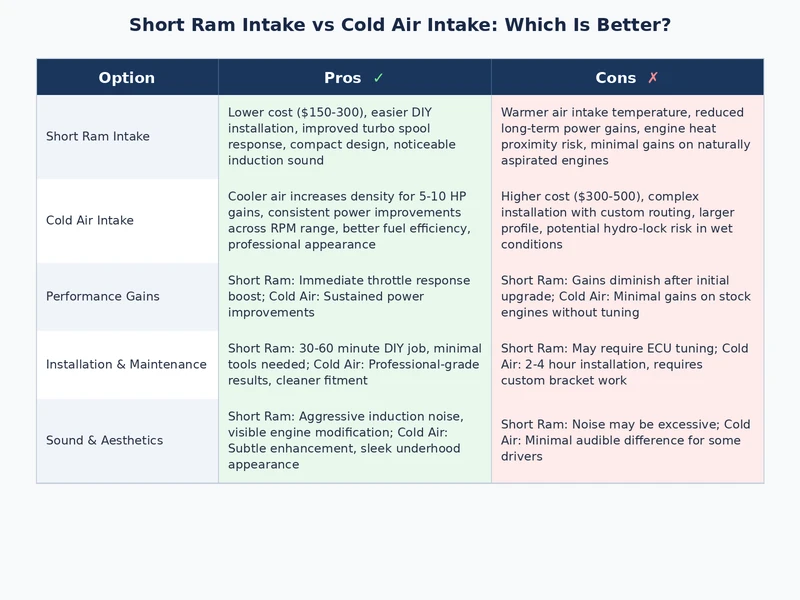
Short ram intake vs cold air intake dyno power curve comparison chart
Figure 2 — Cold air intake vs short ram: dyno power comparison on a 2.0L naturally aspirated engine shows the RPM range where each intake makes its gains.

Diagnosing Intake Problems Before They Get Expensive

Aftermarket intakes introduce new failure points. The stock airbox is sealed, robust, and hard to mess up. Aftermarket kits have couplers, clamps, and reusable filters that all need attention. Know what to watch for.

Common Issues with Both Intakes

  • Vacuum leaks at couplers: A loose clamp or cracked silicone coupler lets unmetered air bypass the MAF sensor. Your engine runs lean (too little fuel for the air). Power drops, fuel economy worsens, and long-term engine wear increases. Tighten every clamp immediately after install and again at 100 miles.
  • MAF sensor contamination from filter oil: Oiled performance filters like K&N use a thin layer of oil to trap particles. Too much oil migrates to the MAF sensor wire element and causes false readings. Your engine may run rich (too much fuel). Apply the minimum recommended oil. Re-oil every 50,000 miles on street cars — not every wash cycle.
  • Resonance droning: Some tube lengths create a standing wave at specific RPM ranges. You'll hear a hollow drone or howl at a consistent engine speed. Changing the tube angle, adding a resonator, or using a heat shield often eliminates it.
  • Loose cone filter: If the filter isn't properly clamped to the tube, hard acceleration can blow it off or partially dislodge it. Check filter seating monthly.
  • PCV line disconnection: The crankcase ventilation (PCV) line must be reconnected to the new tube. Many people miss this on cold air installs. A disconnected PCV line causes rough idle, oil mist in the intake, and eventually fouled spark plugs.

If you notice new symptoms after your intake install — rough idle, misfires, poor throttle response — check all vacuum connections and coupler clamps before replacing anything else. Symptoms that look like bad fuel injector symptoms are often vacuum leaks in disguise. Rule out the simple fix first.

When the Check Engine Light Comes On

A check engine light after an intake install means your ECU detected something outside normal parameters. Most intake-related codes fall into one of four buckets:

  1. P0101 or P0102 — MAF sensor range or performance: Usually caused by a vacuum leak, a disconnected coupler, or an over-oiled filter. Inspect all connections. Clean the MAF sensor with dedicated MAF cleaner spray if you suspect oil contamination.
  2. P0171 — System too lean (Bank 1): Air is entering the intake downstream of the MAF without being measured. Find the vacuum leak. Common locations: coupler clamps, the PCV reconnection point, or a cracked silicone joint.
  3. P0172 — System too rich (Bank 1): Almost always an over-oiled filter contaminating the MAF. Clean the MAF and reduce filter oil on the next recharge.
  4. Random misfires after cold air install: First suspect: the crankcase vent line is disconnected. Second suspect: a loose clamp creating an intermittent vacuum leak under load.

Fix the root cause before clearing the code. Clearing codes without fixing the problem just resets your symptom clock — it doesn't fix the car.

Know When to Upgrade — and When to Hold Back

There is no universal right answer. The right intake depends on your car, your climate, your goals, and your budget. Use these rules to make the call clearly.

Go Cold Air When…

  • You live somewhere hot. If your summers regularly exceed 85°F, the temperature differential between a CAI and SRI is real and consistent.
  • You spend significant time at highway speeds. The lower filter position in a fender or bumper opening gets constant fresh airflow at speed.
  • Your engine is turbocharged or supercharged. Cooler charge air is more critical when you're compressing it.
  • You're planning a full performance build — headers, exhaust, tune. A CAI integrates better with a supporting cast of mods.
  • Maximum measurable dyno output matters more to you than budget or install simplicity.
  • You want a mod that holds its gains across varied driving conditions, not just on cool mornings.

Go Short Ram When…

  • You want a fast, beginner-friendly upgrade that takes under an hour.
  • Your engine bay has no clean routing path for a longer cold air tube.
  • You drive short distances or mostly at low speeds where heat soak matters less.
  • Budget is your primary constraint. A quality short ram at $100 outperforms a cheap cold air kit at $60 in real-world reliability.
  • The intake sound and low-RPM throttle snap matter more to you than absolute peak power.
  • You want to learn the install process before committing to a more involved cold air system.

There's also a scenario where neither upgrade makes sense yet. If your engine is already showing problems — oil consumption, misfires, power loss under acceleration — an intake upgrade will not fix it. Solve the underlying mechanical issue first. Both upgrades reward a healthy engine. They do not rehabilitate a sick one. Don't stack performance parts on a broken foundation.

Frequently Asked Questions

Does a cold air intake really add horsepower?

Yes, but gains vary by vehicle and engine type. On most naturally aspirated engines, expect 8 to 15 HP at peak RPM. Turbocharged engines often see 15 to 25 HP because cooler, denser air improves turbo efficiency significantly. Always verify with independent dyno data rather than relying on manufacturer claims alone.

Will a short ram intake damage my engine?

Not if installed correctly. The main risk is a vacuum leak from a loose coupler or under-torqued clamp, which causes a lean-running condition that stresses internal components over time. Install it properly, re-check all connections at 100 miles, and a short ram intake won't harm your engine.

Can I start with a short ram and upgrade to cold air later?

Yes. The two systems aren't permanently committed. Starting with a short ram is a legitimate strategy: learn the install process, feel the improvement, then upgrade to a full cold air kit when budget allows. You'll need a complete new kit when you upgrade — not just a longer tube — because the diameter, routing, and filter mount will differ between systems.

Cold air wins on raw power — but the intake that actually earns its money is the one matched to your engine, your climate, and where your build is actually headed.

About Marcus Chen

Marcus Chen is a performance and tuning specialist with 12+ years of hands-on experience modifying everything from daily drivers to track cars. He specializes in suspension setup, wheel-and-tire fitment, and squeezing every drop of performance from stock platforms without sacrificing reliability.

Get some FREE car parts & gear.. Or check out the latest free automotive manuals and build guides here.

Disable your ad blocker to unlock all the hidden deals. Hit the button below 🚗