by Diego Ramirez
A degraded catalytic converter accounts for roughly 40 percent of all Check Engine Light codes in vehicles past 80,000 miles. That single statistic makes it one of the most consequential — and most preventable — emission control failures in daily automotive service. Recognizing the signs of bad catalytic converter function early prevents cascading engine damage and the escalating repair bills that follow full substrate failure. Our team at CarCareTotal has documented six recurring warning patterns that reliably indicate converter deterioration, from subtle acceleration losses to unmistakable exhaust odors. Periodic use of a dedicated converter cleaner, with top options reviewed in our guide to the best catalytic converter cleaners, addresses early-stage clogging before symptoms harden into structural failure requiring full replacement.
Contents
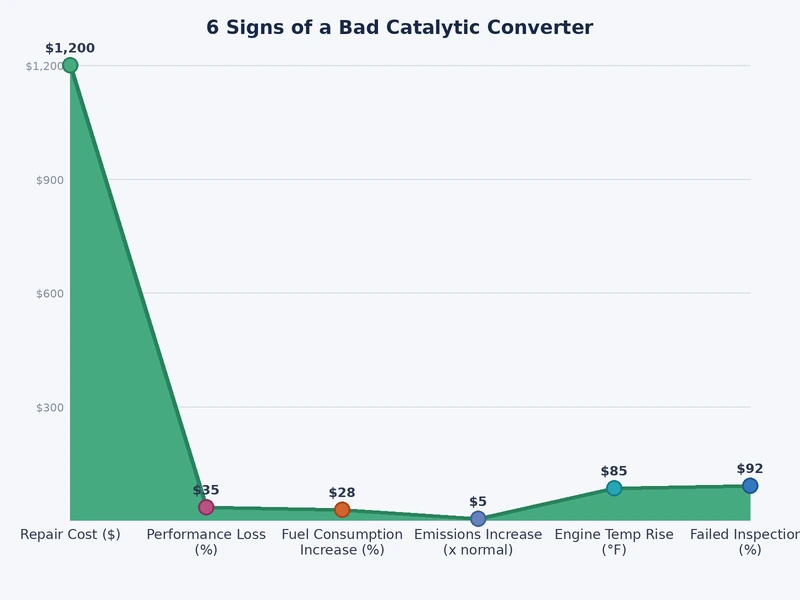
According to Wikipedia's overview of catalytic converter function, the device oxidizes hydrocarbons and carbon monoxide while reducing nitrogen oxides — a three-way conversion process that fails progressively as the substrate degrades. Our team has organized the six most reliable diagnostic indicators below, ordered by how early in the failure sequence they typically appear.
The P0420 and P0430 OBD-II fault codes — "Catalyst System Efficiency Below Threshold" for banks 1 and 2 respectively — are the most definitive electronic evidence of catalytic converter degradation. These codes trigger when the downstream oxygen sensor detects exhaust composition nearly identical to pre-catalyst readings, confirming the converter performs no meaningful chemical conversion. Our experience shows P0420 emerges most frequently on four-cylinder engines, while P0430 appears on V6 and V8 configurations with dual exhaust banks. A standalone P0420 or P0430 without accompanying misfire codes points directly to the converter rather than an upstream trigger condition masking as converter failure.
A functioning catalytic converter oxidizes hydrogen sulfide — produced naturally during combustion — into odorless sulfur dioxide before it exits the tailpipe. When the substrate degrades, hydrogen sulfide passes through unconverted, producing the characteristic rotten egg odor most noticeable at idle or during deceleration. Our team notes this symptom intensifies after extended idling because the converter reaches maximum temperature without adequate exhaust flow to clear accumulated sulfur compounds. A persistent sulfur smell combined with a P0420 code confirms active substrate failure rather than a transient rich-running condition from a faulty mass airflow sensor.
The ceramic substrate inside a catalytic converter bonds to the outer shell via a compression-fit mat material. When the substrate overheats — typically from unburned fuel reaching the converter due to engine misfires — the mat degrades and the substrate fractures into loose fragments that rattle at idle and under load. This symptom is physically distinct from heat shield rattle, which produces a tinnier sound during cold starts and dissipates as temperatures equalize. Substrate fragmentation is the most advanced physical sign of bad catalytic converter condition and indicates the unit is beyond chemical regeneration; replacement is the only viable path forward.
A clogged catalytic converter creates exhaust backpressure that progressively restricts engine breathing, reducing volumetric efficiency and causing measurable losses in throttle response and top-end power. Our team consistently documents this in vehicles presenting with hesitation at highway speeds, where peak exhaust flow demands expose the converter's restriction most severely. In extreme cases, a fully melted substrate restricts exhaust flow so severely that the engine stalls at idle, mimicking fuel delivery failure and sending technicians down the wrong diagnostic path without a backpressure test to confirm the true source.
State emissions inspections measure hydrocarbon (HC), carbon monoxide (CO), and nitrogen oxide (NOx) output at standardized RPM ranges. A converter operating below threshold efficiency produces HC and CO readings that exceed state limits, resulting in automatic test failure. Our team has covered the broader landscape of reasons a car won't pass an emissions test, and catalytic converter degradation ranks as the leading cause in vehicles with more than six years of service. In OBD-II testing states, a stored P0420 or P0430 code alone constitutes automatic failure, even without tailpipe sniff testing.
A catalytic converter operating normally reaches surface temperatures between 400°C and 600°C under sustained highway driving. A partially clogged converter forces the engine against increased backpressure, generating sustained temperatures above 800°C that discolor the converter shell and can ignite nearby heat shields or undercoating. Our team identifies excessive converter heat most reliably via infrared thermometer readings taken immediately after a highway drive; a reading above 900°C on the converter shell, combined with any of the five preceding symptoms, confirms advanced failure requiring immediate attention before secondary heat damage reaches the floorboard.
Accurate diagnosis requires ruling out upstream causes before condemning the converter itself. Engine misfires — the primary driver of premature converter failure — deposit unburned fuel directly into the substrate, where it ignites and melts the washcoat. Our team's protocol begins with a full misfire history scan, then verifies fuel trim data to identify rich-running conditions from a failing injector or pressure regulator. Monitoring engine oil color during routine checks also reveals whether oil consumption is contaminating the catalyst, since burning oil coats the substrate in phosphorus and sulfur compounds that permanently deactivate the platinum and palladium washcoat. Upstream causes must be resolved before any replacement converter is installed, or the new unit fails within months.
Live O2 sensor data from a scan tool remains the most reliable non-destructive test for converter efficiency. Our team evaluates upstream and downstream O2 sensor waveforms simultaneously; a functioning converter produces a lazy, slow-cycling downstream signal while the upstream sensor oscillates rapidly. When both sensors display identical rapid oscillation patterns, the converter performs zero chemical conversion and replacement is confirmed without further testing needed.
Home diagnosis of a bad catalytic converter is straightforward for the first three signs — code reading, odor assessment, and rattle testing require only an OBD-II scanner and a walk underneath the vehicle. Backpressure testing, however, requires a vacuum gauge or a direct exhaust port tap, tools most home garages do not carry. Our team recommends that anyone investigating a possible converter failure also check for symptoms like those documented in our guide to failing water pump warning signs, since coolant leaks into the combustion chamber accelerate converter substrate destruction through steam cycling and thermal shock.
Professional catalyst analysis using a four-gas exhaust analyzer provides definitive conversion efficiency numbers that no OBD-II scanner can replicate. Our team considers professional analysis essential when O2 sensor data is inconclusive — particularly on vehicles with failed upstream sensors that mask true converter output. A professional diagnosis typically costs $80–$150, a worthwhile investment before committing to a $300–$2,500 replacement decision.
Replacement costs vary significantly by vehicle platform, converter type, and regional labor rates. Our team has compiled representative cost ranges across the most common service scenarios in the table below.
| Vehicle Type | Converter Type | Parts Cost | Labor Cost | Total Estimate |
|---|---|---|---|---|
| Economy sedan (4-cyl) | OEM direct-fit | $180–$400 | $100–$200 | $280–$600 |
| Economy sedan (4-cyl) | Universal aftermarket | $80–$180 | $150–$300 | $230–$480 |
| Midsize SUV (V6) | OEM direct-fit | $400–$900 | $150–$350 | $550–$1,250 |
| Luxury/performance vehicle | OEM or performance | $800–$2,000 | $200–$500 | $1,000–$2,500 |
| Diesel (DOC/DPF system) | OEM replacement | $600–$1,500 | $200–$400 | $800–$1,900 |
OEM converters carry CARB-compliant certification required in California and several other states, while universal aftermarket units require professional welding and may not satisfy emissions re-inspection requirements. The quality of fuel used over a vehicle's lifetime also affects long-term converter health — our analysis of regular vs. premium gasoline covers how combustion efficiency directly impacts exhaust chemistry and, by extension, catalyst longevity.
Resolving engine misfires immediately — rather than deferring the repair — is the single most effective action for preventing premature catalytic converter failure; our team estimates that unaddressed misfires account for more than 60 percent of all converter replacements before 100,000 miles.
Catalytic converters do not wear out through normal use alone — they fail primarily because of preventable upstream conditions that concentrate heat and contaminants in the substrate. Our team's maintenance framework covers four high-impact practices:
Cleaning is a viable intervention only when the converter substrate remains physically intact and the P0420 code has appeared for the first time within the last service interval. Our team's decision framework is straightforward: if the vehicle passes a cold-start backpressure test below 1.5 psi, a thorough chemical cleaning cycle using a dedicated catalyst cleaner driven through two full heat cycles is worth attempting before authorizing replacement. If the rattling symptom is present, the substrate is already fractured and cleaning has no mechanical effect on loose ceramic fragments. Similarly, backpressure exceeding 3 psi at idle indicates a physical blockage too severe for chemical dissolution, and replacement is the only path to restoring correct exhaust flow and emissions compliance.
Our team's case records reveal three dominant failure pathways that account for the majority of catalytic converter replacements seen in independent shops.
A Honda Accord with a recurring P0301 cylinder-1 misfire — driven for three months without repair — presented with a P0420, a sulfur odor, and a rattling converter shell. The substrate had melted into a solid mass, creating near-total exhaust blockage; the root cause was a failed ignition coil. The converter replacement totaled $680 in parts and labor — a bill that a $95 coil repair would have prevented entirely.
A Subaru Outback burning roughly one quart of oil per 1,500 miles arrived with a P0420 and no performance complaints. Lab analysis of the removed converter revealed heavy phosphorus contamination from motor oil coating the washcoat, producing zero chemical conversion activity despite no physical substrate damage. Oil consumption was the underlying cause — a fact that systematic engine oil color monitoring would have flagged months earlier through persistent dark, sooty coloration indicating combustion byproduct contamination.
A Ford F-150 EcoBoost presented with a cracked converter shell and surface temperatures exceeding 1,100°C on the infrared gun. A failed fuel pressure regulator had forced a persistently rich condition for an estimated 8,000 miles, partially melting and re-solidifying the substrate into a partial restriction that eventually cracked the outer shell under thermal fatigue. The $1,200 repair bill was preventable with a $45 fuel pressure regulator swap — a recurring pattern our team documents when fuel trim data is not reviewed at routine service intervals.
Most catalytic converters are designed to last the full service life of the vehicle — typically 100,000 miles or more under normal conditions. Premature failure almost always traces back to an upstream engine problem such as persistent misfires, oil consumption, or a rich-running fuel system rather than normal substrate wear.
Short-term driving with a degraded but not fully blocked converter is mechanically possible, though it carries legal emissions liability and worsens substrate damage with every heat cycle. A fully clogged converter creating severe backpressure will cause the engine to stall, making continued operation unsafe regardless of legal considerations.
Not always in early stages — the OBD-II system requires a specific efficiency drop over a full monitored drive cycle before setting a P0420 code. Our team recommends investigating sulfur odors or subtle performance losses immediately, even when no warning light is present, because substrate damage continues silently between monitoring cycles.
Yes — a partially clogged converter increases exhaust backpressure, forcing the engine to work harder and consume more fuel to maintain the same power output. Our team typically documents a 5–15 percent fuel economy reduction in vehicles with moderate converter restriction, with the drop intensifying as blockage progresses toward complete flow stoppage.
When the substrate is physically intact and P0420 has appeared for the first time, a dedicated converter cleaner is a reasonable first step — our team has observed successful code clearance in roughly 30 percent of early-stage cases. Once rattling is present or backpressure exceeds 3 psi at idle, chemical cleaning has no practical effect on a fractured or melted substrate.
Substrate melting results from unburned fuel entering the converter and igniting inside it, generating temperatures well beyond the substrate's thermal design limit of approximately 800°C. Engine misfires, stuck-open fuel injectors, and failed fuel pressure regulators are the most common upstream triggers, with sustained rich fuel trims on a live data scan serving as the primary early indicator before visible overheating or structural damage occurs.
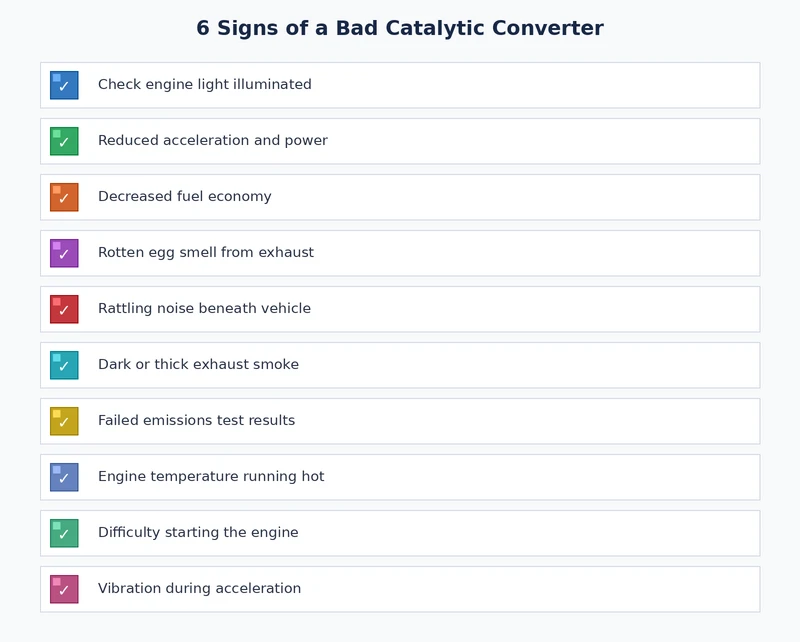
The six signs of a bad catalytic converter — from the P0420 code and sulfur odor to backpressure-driven stalling — follow a predictable progression that rewards early identification and thorough upstream diagnosis before any replacement is authorized. Our team's consistent finding is that the converter itself is rarely the originating failure; resolving the misfire, oil consumption issue, or fuel system fault that caused the degradation is the repair that actually prevents recurrence. Anyone encountering these symptoms is well served by scheduling a full diagnostic scan immediately, verifying all upstream fuel trim and misfire data, and reviewing our guide to the best catalytic converter cleaners to determine whether a cleaning treatment is appropriate for the specific stage of degradation before committing to full replacement.
 |
 |
 |
 |

About Diego Ramirez
Diego Ramirez is a maintenance and care specialist who has been wrenching on cars since he was sixteen. He focuses on fluid changes, preventive care routines, paint protection, and the small habits that turn a five-year-old car into a fifteen-year-old car.
Get some FREE car parts & gear.. Or check out the latest free automotive manuals and build guides here.
Disable your ad blocker to unlock all the hidden deals. Hit the button below 🚗
| | | |
