by Sarah Whitfield
A speedometer not working almost always comes down to one of six culprits: a bad vehicle speed sensor, a broken speedometer cable, a blown fuse, damaged wiring, an ECU fault, or a failing instrument cluster. Most are diagnosable at home with an OBD-II scanner and basic tools.
Driving without a functioning speedometer isn't just inconvenient — it's a legal issue in most states and a real safety concern. Whether your needle is frozen at zero, bouncing erratically, or just consistently wrong, the fix is usually straightforward once you know what you're dealing with.
Contents
Not all speedometer failures look the same. Knowing which type of failure you have narrows down the cause faster than any diagnostic tool.
The most obvious sign is a needle that's completely stuck — usually at zero or pinned against the upper stop. This typically means total signal loss from the vehicle speed sensor or a broken cable in older vehicles. One strong clue: if your odometer also stops counting miles at the same time, that's almost certainly a VSS or cable problem, not an isolated cluster issue.
Sometimes the speedometer doesn't die — it just behaves badly. Readings that jump around, lag significantly behind your actual speed, or top out lower than you're actually going often point to an intermittent sensor signal or a wiring fault. This type of failure tends to get worse over time, not better.
If other gauges are acting up alongside your speedometer, that's a meaningful clue. A temperature gauge that's rising unexpectedly or an illuminated oil pressure warning light appearing at the same time suggests a broader instrument cluster or power supply issue rather than an isolated sensor fault.
The VSS is the most common culprit in modern vehicles. It reads the rotation speed of your transmission output shaft and sends that data to the ECU, which drives the speedometer needle. When it fails, the needle drops dead or goes erratic — and you'll almost always see a check engine light with codes like P0500, P0501, or P0502.
The good news: VSS units are usually easy to access and inexpensive. Parts typically run $20 to $60, and replacement is DIY-friendly on most vehicles.
Pre-1990s vehicles — and some early-2000s trucks — used a mechanical cable connecting the transmission to the speedometer head. When this cable breaks or frays, the needle drops immediately and stays there. You may have heard a faint rattling or chattering noise from behind the dashboard in the days before it failed. That's the cable warning you.
Before you do anything else, check your fuses. Most vehicles have a dedicated fuse for the instrument cluster or gauges — your owner's manual will tell you exactly which one. A blown fuse often takes out multiple gauges simultaneously. If your speedometer, fuel gauge, and tachometer all quit at once, start here. It's a five-minute check and costs nothing.
Wiring faults are the sneakiest cause on this list. Corroded pins, chafed insulation, or a loose connector can interrupt the signal between the VSS and the ECU without triggering a consistent fault code. These failures are often intermittent — the speedometer works sometimes and fails others. Vehicles in cold, wet, or high-salt climates see this far more often.
If the VSS and wiring both check out, the ECU or PCM may not be processing the speed signal correctly. This is less common but does happen after water intrusion, a voltage spike, or a software fault. You'll typically see multiple warning lights and symptoms — similar to the confusing multi-system failures that happen when a car cranks but won't start for no obvious mechanical reason.
The cluster itself can fail. Small stepper motors move each gauge needle — and these wear out over time, especially in older GM vehicles from the early 2000s. In this case, the speedometer needle may fail while every other gauge in the cluster continues working perfectly. That isolated failure pattern is the giveaway.
| Cause | Key Symptom | DIY Difficulty | Avg. Part Cost |
|---|---|---|---|
| Vehicle Speed Sensor | Dead needle + CEL codes P0500–P0502 | Easy | $20–$60 |
| Broken Speedometer Cable | Sudden needle drop, dashboard rattle | Easy–Moderate | $15–$40 |
| Blown Fuse | Multiple gauges fail at once | Easy | Under $5 |
| Wiring/Connector Damage | Intermittent readings, worse in wet weather | Moderate | Varies |
| ECU/PCM Fault | Multiple warning lights, multi-system issues | Difficult | $200–$800+ |
| Faulty Instrument Cluster | One needle fails, others work fine | Moderate | $100–$400 |
Fuse replacement, VSS swaps, and cable replacements are well within DIY territory. A basic OBD-II scanner — available for under $30 — can pull fault codes in minutes and confirm a VSS problem before you spend a dime on parts. That's almost always the right first move.
Pro tip: Always scan for codes before replacing anything. A P0500 points directly to the VSS — but a P0606 tells you it's an ECU fault, and buying a new speed sensor won't help.
Electrical issues like these follow similar diagnostic logic across different systems. A windshield wiper failure or a power steering problem both use the same approach: check the fuse, check the connector, then check the component itself.
ECU reprogramming, instrument cluster replacements, and complex wiring repairs are best left to a shop with proper diagnostic equipment. A technician can scope the VSS signal in real time — something a basic code reader can't do. Budget $150 to $400 for a cluster replacement, and more if the ECU is involved.
This is the most dangerous assumption you can make. A dead speedometer often signals a faulty VSS — and that same sensor feeds data to your transmission for shift timing, your ABS system, and your cruise control. Ignoring a speedometer not working can silently degrade systems you rely on every day. If your brake warning light is also on, the VSS may already be affecting your ABS.
Speedometer recalibration is a real and useful procedure — but it's for after you change tire sizes or swap axle ratios. It corrects a gradual, consistent inaccuracy built into the system. If your speedometer stopped working suddenly, recalibration won't touch it. A sudden failure is a hardware or signal problem, full stop.
For more technical background on how speedometer systems work across different vehicle types, the Wikipedia article on speedometers covers the mechanical and electronic fundamentals clearly.
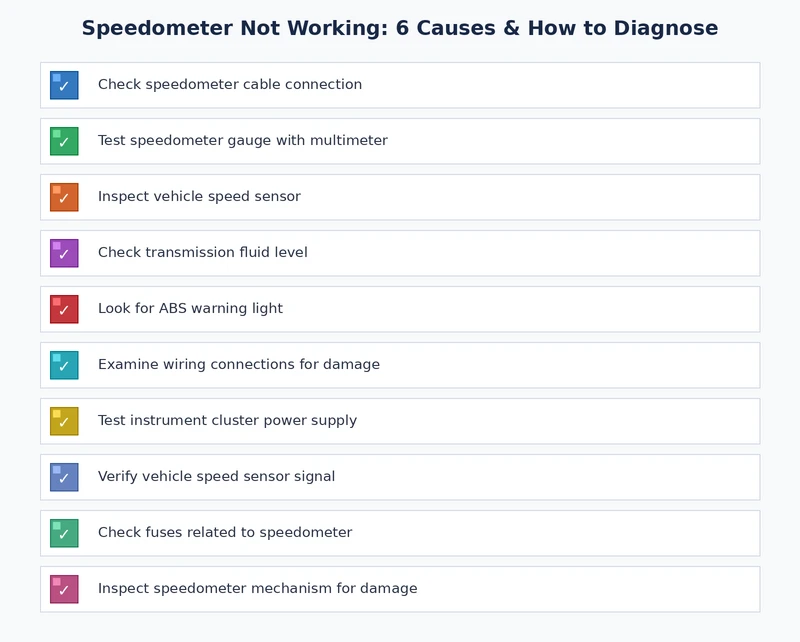
Work through these steps in order — each one either confirms or eliminates a cause before you move on:
One important note: a failing VSS affects more than your speedometer. Some vehicles use it to calculate fuel delivery timing, which can create symptom overlap with a failing fuel pump. If you're also seeing rough idle or hesitation alongside the dead speedometer, scan for both types of fault codes before committing to a repair.
The best long-term strategy is keeping your transmission fluid clean. Contaminated fluid can coat and degrade the VSS sensor tip over time. Inspect wiring harnesses during routine oil changes — especially in zones near the exhaust manifold or wheel wells where heat and moisture cause the most wear.
Other sensors can sometimes give early warnings of broader electrical trouble. Our DPFE sensor guide covers another commonly overlooked sensor that shares diagnostic overlap with VSS-related faults. Catching a weak VSS signal before it fails completely keeps you from dealing with a dead speedometer at highway speed.
Technically you can, but it's not a good idea. Without a functioning speedometer, you're guessing at your speed — which makes it easy to accidentally exceed limits and opens you up to a ticket. More importantly, a dead speedometer often means a faulty VSS that may already be affecting your ABS or transmission shifting.
It depends entirely on the cause. A blown fuse costs under $5. A vehicle speed sensor runs $20 to $60 in parts, plus a shop labor hour if you're not doing it yourself. An instrument cluster replacement typically costs $150 to $400, and ECU-related repairs can push past $800 depending on your vehicle.
Yes, almost always. A faulty VSS typically stores codes in the P0500–P0503 range and triggers the check engine light. That said, intermittent wiring faults can cause the speedometer to act up without consistently storing a code, so a clean scan doesn't automatically rule out a wiring problem.
Yes. The vehicle speed sensor sends shift-timing data to the transmission control module. A bad VSS can cause delayed upshifts, harsh or erratic gear changes, or the transmission getting stuck in a single gear. It's one of the more practical reasons not to ignore a speedometer not working.
Broken speedometer cables are mostly a pre-1990s issue. The signs are a needle that drops suddenly to zero and stays there, sometimes accompanied by a chattering or rattling noise from behind the dashboard. If your vehicle was built after the mid-1990s and uses an electronic VSS, it won't have a physical cable at all.
On certain older vehicles, yes. Stepper motor repair kits are available online for around $20 to $40, and the swap is well-documented for common GM trucks and SUVs from the early 2000s. Newer vehicles with digital or fully electronic clusters are more involved and often require professional recalibration after any cluster work.
A speedometer not working is rarely just a dead needle — it's your car telling you that something deeper in its sensor network needs your attention before other systems quietly start to follow.
 |
 |
 |
 |

About Sarah Whitfield
Sarah Whitfield is a diagnostics and troubleshooting specialist who spent ten years as an ASE-certified technician before joining the editorial team. She specializes in OBD-II analysis, electrical gremlins, and the kind of intermittent problems that make most owners give up.
Get some FREE car parts & gear.. Or check out the latest free automotive manuals and build guides here.
Disable your ad blocker to unlock all the hidden deals. Hit the button below 🚗
| | | |
