by Sarah Whitfield
The DPFE sensor — short for Differential Pressure Feedback EGR sensor — measures exhaust gas flow through the EGR valve by detecting pressure differentials across a metering orifice. When this sensor fails, DPFE sensor symptoms and diagnosis become urgent tasks for Ford, Lincoln, and Mercury owners. Our team tracks this failure pattern across the troubleshooting cases we cover and finds it ranks among the most consistently misdiagnosed faults in Ford's powertrain history.
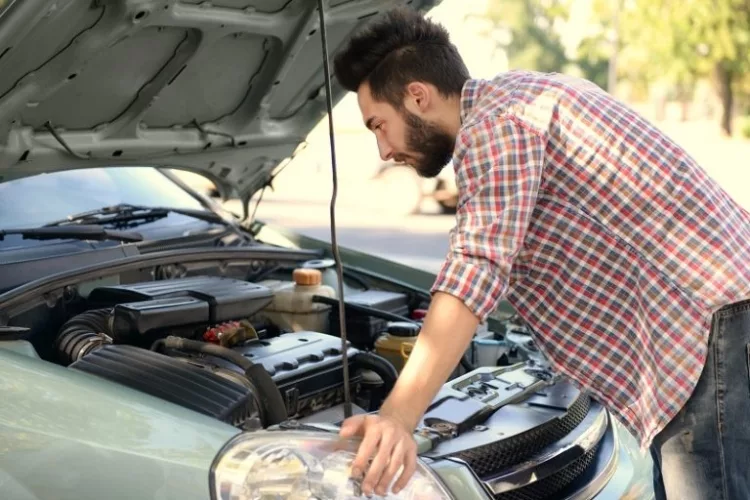
Ford Motor Company used the DPFE sensor extensively from the mid-1990s through the mid-2000s on engines ranging from the 4.0L to the 5.4L Triton. The sensor feeds a continuous voltage signal to the powertrain control module (PCM), which uses that data to regulate EGR valve timing and duration. A failed sensor corrupts this feedback loop, triggering fault codes and drivability problems that closely mimic a dozen other failures.
Understanding the sensor's exact function is the fastest path to accurate diagnosis. Our team has found that most misdiagnoses stem from treating the check engine light as the problem rather than testing the sensor directly. Systematic component isolation — not part-swapping — is the standard our team applies to every EGR-related complaint.
Contents
The EGR system routes a controlled portion of exhaust gas back into the intake manifold. This lowers peak combustion temperatures and reduces nitrogen oxide (NOx) emissions. According to Wikipedia's documentation on exhaust gas recirculation, EGR is one of the primary NOx reduction strategies used in modern gasoline engines. The DPFE sensor is Ford's specific implementation of real-time EGR feedback monitoring.
The sensor mounts between two hoses connected to the inlet and outlet ports of the EGR valve's delta orifice tube. When the EGR valve opens, exhaust gas flows through the orifice and creates a pressure differential. The DPFE sensor converts that differential into a voltage signal — typically between 0.45V and 4.5V — and sends it continuously to the PCM.
The PCM uses this voltage data to confirm three things:
When the signal falls outside the expected range, the PCM sets a fault code and may disable EGR operation to protect the engine from uncontrolled recirculation.
The most direct evidence of DPFE sensor failure comes from OBD-II scan data. Our team encounters these fault codes most frequently on affected Ford platforms:
| Code | Description | Most Likely Root Cause |
|---|---|---|
| P0401 | EGR Flow Insufficient Detected | Clogged passage, failed sensor, stuck-closed valve |
| P0402 | EGR Flow Excessive Detected | Sensor voltage out of range, stuck-open valve |
| P1400 | DPFE Sensor Circuit Low Input | Sensor internal failure, damaged signal wire |
| P1401 | DPFE Sensor Circuit High Input | Sensor failure, open circuit in harness |
| P1405 | DPFE Sensor Upstream Hose Off or Plugged | Cracked or disconnected upstream hose |
| P1406 | DPFE Sensor Downstream Hose Off or Plugged | Cracked or disconnected downstream hose |
P1405 and P1406 are particularly important. These codes point directly to the hoses rather than the sensor itself. Our team treats these as a mandatory hose inspection trigger before any component replacement is authorized.
Beyond stored codes, DPFE sensor failure produces recognizable drivability symptoms. Our team documents these most consistently:
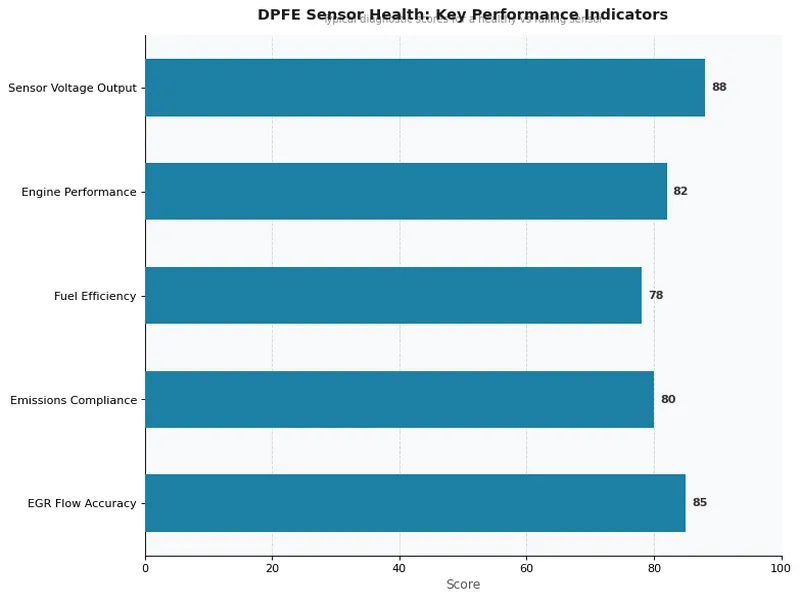
Similar hesitation and fuel delivery symptoms appear when low fuel pressure is the root cause. Voltage testing is essential to isolate the DPFE sensor from fuel system failures before any repair order is written.
The most common diagnostic error our team observes is pulling codes and ordering parts without examining the sensor's two rubber hoses. These hoses run from the DPFE sensor to the EGR valve's delta orifice tube. Engine heat degrades the rubber over time. Cracks, splits, or disconnections produce fault codes — including P1405 and P1406 — that are identical to those generated by a failed sensor.
Our team's standard protocol begins with a hose inspection before any electrical testing or component condemnation. A cracked hose costs under five dollars. A DPFE sensor costs forty to eighty. Confusing the two is an expensive mistake.
A stuck EGR valve — either open or closed — generates abnormal pressure readings that pass through a perfectly functioning DPFE sensor to the PCM. The PCM logs the fault. The sensor gets replaced. The valve remains stuck. The codes return.
Pro insight: Our team always tests the EGR valve with a hand vacuum pump before ordering a DPFE sensor — a valve stuck open mimics sensor failure precisely, and no amount of sensor replacements will fix a mechanical valve problem.
Misfire-adjacent codes from EGR disruption also resemble lean-condition faults documented in cases involving a P0174 system-lean code. Both scenarios require systematic component isolation. Replacing parts in sequence without testing each component first is a diagnostic dead end our team avoids entirely.
Electrical gremlins that mimic sensor faults also appear in cases involving components like a bad starter relay — reinforcing that no single symptom points to one definitive cause without supporting voltage data.
DPFE sensor testing with a digital multimeter falls within reach for experienced home mechanics. The process is straightforward when approached methodically.
The test procedure our team uses:
A sensor producing no voltage change when EGR is commanded open has failed. A sensor reading above 4.5V or below 0.45V at baseline is also outside specification. Both conditions confirm replacement is warranted.
Professional shops running Ford IDS (Integrated Diagnostic System) can display live DPFE voltage alongside EGR commanded position and actual position simultaneously. This data stream comparison eliminates guesswork in seconds.
Our team recommends professional diagnosis when:
A vehicle that stalls unexpectedly — a pattern our team has documented in detail in hot-weather stalling cases — warrants a professional visit to rule out compounding failures that a basic scan tool cannot differentiate.
This claim is false. A malfunctioning DPFE sensor causes the PCM to over-recirculate exhaust gas or cut EGR flow entirely. Over-recirculation produces rough idle, hesitation, and combustion instability. Zero EGR flow raises combustion chamber temperatures, which increases knock risk, retards ignition timing, and reduces power output. The emissions impact is real, but it is not the only consequence of a failed sensor.
Ford vehicles generate EGR codes from three distinct failure points: the EGR valve itself, the DPFE sensor, and the EGR vacuum solenoid. All three can produce P0401 or P0402. Our team has diagnosed cases where the solenoid failed and the sensor was replaced twice before the actual fault was identified. Code-based diagnosis without component testing produces exactly this outcome.
Some vehicle owners physically block or disconnect the EGR system to eliminate fault codes. This approach fails emissions testing, accelerates carbon buildup in the intake manifold over time, and is illegal under federal law and most state regulations. Our team considers EGR deletion a liability — not a diagnostic solution.
DPFE sensor replacement is among the more affordable EGR-related repairs. Our team tracks these typical cost ranges across independent shops and dealerships:
| Service | DIY Part Cost | Shop Total (Parts + Labor) |
|---|---|---|
| DPFE sensor (Motorcraft OEM) | $50–$80 | $110–$180 |
| DPFE sensor (aftermarket) | $15–$35 | $75–$130 |
| EGR valve replacement | $60–$150 | $200–$400 |
| EGR vacuum solenoid | $25–$60 | $90–$160 |
| DPFE hose set | $5–$15 | $40–$70 |
| Full EGR system cleaning | $20–$40 | $80–$150 |
Our team strongly recommends Motorcraft OEM sensors over aftermarket alternatives for this application. Aftermarket DPFE sensors have a documented failure rate significantly higher than OEM units — particularly from offshore suppliers. The cost difference rarely justifies the risk of repeat failure.
Most repeat DPFE failures trace back to unaddressed EGR system contamination. Carbon buildup in the EGR passages increases backpressure, which stresses both the sensor and the valve. Our team's recommended prevention checklist:
Drivers managing other thermal stress concerns — including those assessing low engine coolant situations — should note that sustained high coolant temperatures accelerate carbon accumulation throughout the EGR circuit. Thermal management and EGR system health are directly connected.
Long-term EGR system reliability is ultimately a maintenance outcome. Clean oil, intact hoses, and periodic valve inspections prevent the majority of DPFE sensor failures our team sees in high-mileage Ford vehicles.
The DPFE sensor measures the pressure differential across the EGR valve's metering orifice and sends a corresponding voltage signal to the PCM. This tells the PCM how much exhaust gas is flowing through the EGR system so it can regulate valve operation in real time. Ford introduced this design as a more precise alternative to earlier EGR feedback systems that relied on simpler position sensors.
The most common codes are P1400 (DPFE sensor circuit low), P1401 (DPFE sensor circuit high), P1405 (upstream hose off or plugged), and P1406 (downstream hose off or plugged). P0401 and P0402 — indicating insufficient or excessive EGR flow — also appear frequently, though these codes can originate from the EGR valve or solenoid rather than the sensor itself.
Yes. When the DPFE sensor reports inaccurate flow data, the PCM may disable EGR operation entirely. Without EGR, combustion temperatures rise and the PCM adjusts fuel trims and ignition timing to compensate, which reduces efficiency. Most owners report a measurable drop in fuel economy alongside other drivability symptoms when the DPFE sensor fails.
No — these are two separate components. The EGR valve controls the physical opening and closing of the exhaust gas recirculation passage. The DPFE sensor monitors how much gas is flowing through that passage after the valve opens. Both components can fail independently, and both produce similar fault codes, which is why our team tests each one separately during diagnosis.
Most OEM DPFE sensors last between 80,000 and 120,000 miles under normal operating conditions. Vehicles driven in high-heat environments, or those with coolant or oil leak history, tend to see earlier failures because heat degrades the sensor's internal pressure transducer. Aftermarket units often fail earlier than this range, which is why our team recommends Motorcraft replacements specifically for this application.
 |
 |
 |
 |

About Sarah Whitfield
Sarah Whitfield spent ten years as an ASE-certified automotive technician before transitioning to full-time automotive writing, giving her a diagnostic skillset that goes well beyond what most reviewers bring to the subject. She specializes in OBD-II code analysis, electrical system troubleshooting, and the intermittent failure modes that frustrate owners and confound general mechanics. At CarCareTotal, she covers car troubleshooting guides, diagnostic tools, and repair resources for drivers dealing with warning lights, strange symptoms, and hard-to-diagnose problems.
Get some FREE car parts & gear.. Or check out the latest free automotive manuals and build guides here.
Disable your ad blocker to unlock all the hidden deals. Hit the button below 🚗
| | | |
