by Sarah Whitfield
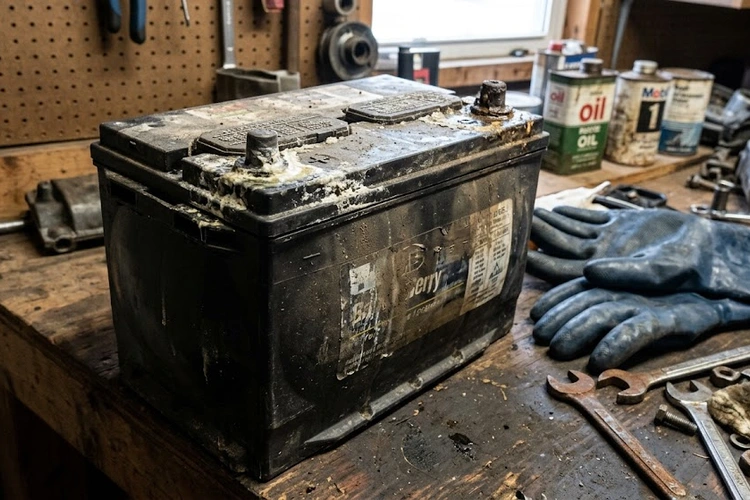
A driver pops the hood one morning to check the oil and stops cold. The battery looks wrong — the sides are visibly bowed outward, the case bloated like something is pressing hard against the plastic from inside. That distorted, inflated profile is a swollen car battery, and it demands immediate attention.
A swollen battery is not a cosmetic quirk. It signals a chemical reaction gone wrong inside the cells, and the consequences of ignoring it range from a stranded car to a genuine safety hazard involving corrosive acid and pressurized gas. Understanding exactly what causes the swelling, how dangerous it is, and what to do about it is knowledge every car owner should have. For anyone already thinking about replacement, the breakdown at how much a car battery costs covers pricing across every common battery type.
Contents
Most people discover a swollen car battery during routine maintenance — topping off fluids, jump-starting a sluggish car, or doing a quick pre-trip inspection. The swelling is unmistakable once noticed. A normal battery case is rectangular with flat, rigid sides. A swollen one has sides that bow outward, corners that look soft, and sometimes a top lid that domes upward under internal pressure.
One of the most common scenarios goes like this: a battery has been slow to crank, so the owner hooks it up to an old trickle charger before bed. By morning, the case has visibly changed shape. What happened is that the charger kept forcing current into a fully charged battery with no automatic shutoff. The excess energy broke down the electrolyte (the liquid sulfuric acid inside the cells), producing hydrogen gas. That gas had nowhere to go in a sealed case, so it pushed outward.
This is precisely why a quality car battery charger with automatic shutoff is worth the investment. A smart charger stops charging once the battery is full — no guesswork, no overnight damage.
Heat is the second major trigger. A car sits in a sun-baked parking lot for hours, day after day. The battery, already a few years old, absorbs that ambient heat continuously. Internally, the electrolyte expands, internal pressure rises, and the casing deforms. Drivers in hot climates often find this during late summer or right after a long highway drive where the engine ran hard for hours. The problem compounds when a battery is both old and frequently exposed to high temperatures.
Standard lead-acid batteries contain lead plates submerged in a sulfuric acid electrolyte solution. During normal operation, controlled chemical reactions convert that chemistry into electrical current. When the process is disrupted — by too much charge voltage, too much heat, or repeated full discharge — the reactions produce excess hydrogen and oxygen gas. In a sealed battery, that gas accumulates and builds pressure. The plastic casing eventually gives way. That is the swollen car battery in a nutshell.
Overcharging is the most common cause of battery swelling. It happens two ways. First, a failing voltage regulator inside the alternator allows the charging system to push too much voltage into the battery while the car is running. Normal alternator output sits between 13.8 and 14.7 volts. Consistent readings above 15 volts signal a problem. Second, using a cheap charger with no automatic cutoff produces the same result over a longer timeframe.
The critical mistake many drivers make is replacing a swollen battery without diagnosing the alternator first. Installing a new battery into an overcharging system just ruins the new battery within weeks. Related electrical faults — like high beams not working — can also point to a charging system issue worth investigating before buying a replacement.
Elevated temperatures directly speed up the chemical reactions inside a battery, increasing internal gas production even during normal charging. According to Wikipedia's overview of lead-acid battery chemistry, high ambient temperatures accelerate plate degradation and electrolyte breakdown — both of which contribute to swelling over time.
Deep discharge is equally damaging. Repeatedly draining a battery to near zero causes the lead plates to sulfate (develop a hard crystalline coating that resists charging). A sulfated battery requires higher voltage to accept a charge, pushing it toward the same overcharging conditions that cause swelling. Age matters too. Most car batteries last three to five years. An old battery is far more vulnerable to both heat damage and charging irregularities.
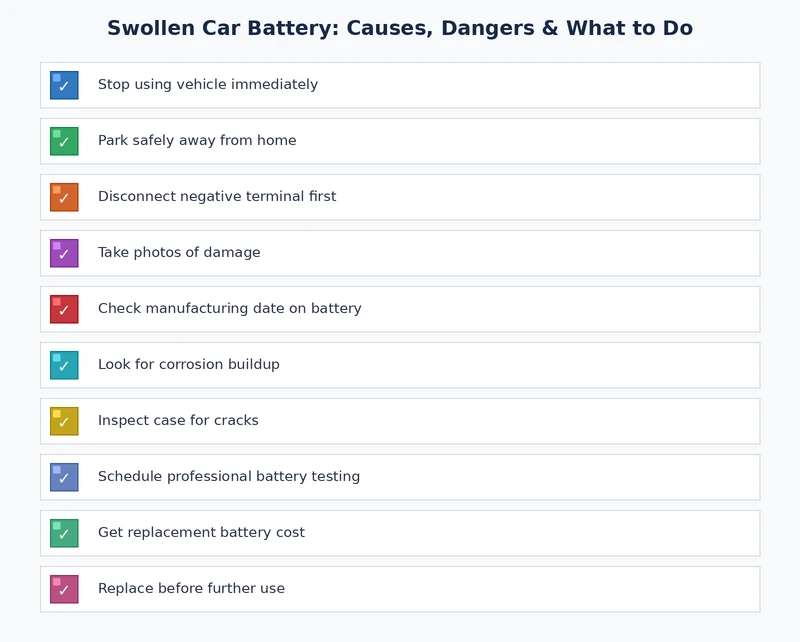
A swollen battery must be handled as a hazard, not just a worn part. The case may be under pressure. The electrolyte inside is corrosive sulfuric acid. Hydrogen gas may be present near the vents. Rough handling, dropped tools, or sparks near the terminals can cause a battery to leak acid or, in extreme cases, rupture. Taking a few minutes to do this correctly is worth it.
Work outdoors or in a well-ventilated garage. The engine must be fully off. Do not smoke or allow open flame nearby — hydrogen gas is flammable. Put on gloves and glasses before touching the battery or terminals.
Disconnect the negative terminal first (black cable, marked with a minus sign), then the positive terminal. This order prevents accidental short circuits. Loosen the hold-down bracket or clamp that secures the battery in its tray. Lift the battery straight up — do not tilt it. Tilting a swollen or cracked battery increases the risk of electrolyte spilling through case vents or stress fractures.
Place the battery directly into a sealed plastic bag or battery transport box. If any electrolyte has leaked onto the battery tray, pour baking soda solution over the area to neutralize the acid, then wipe clean with a rag. Do not transport a swollen battery in an enclosed car trunk — gas can accumulate in a sealed space. Drive it directly to an auto parts retailer. Almost every major chain accepts old batteries for free recycling, and in many states it is legally required.
Once the battery is out, inspect the tray and cables for corrosion damage. If the car has been sitting unused for an extended period — which can accelerate battery degradation — the full guide on maintaining a car that sits for months covers every step for returning it to reliable service.
Not every failing battery looks dramatically bloated. Early-stage swelling can be subtle — a slight bow in the side casing that only becomes obvious when compared to a new unit. Knowing the full range of warning signs helps catch the problem before it progresses to leaking or rupture.
A healthy battery has flat, rigid sides, sharp case corners, and clean or lightly corroded terminals. It feels solid and shows no moisture around the vents or base. A swollen battery has rounded or convex sides, soft-looking corners, and sometimes a domed top lid. There may be a faint rotten-egg or sulfur smell near the battery — the kind of unusual odor worth cross-referencing with the guide on diagnosing strange car smells, since multiple problems can produce similar scents. Heavy white or blue corrosion at the terminal posts also frequently accompanies swelling.
| Indicator | Healthy Battery | Swollen Battery |
|---|---|---|
| Case shape | Flat sides, sharp corners | Bowed sides, soft corners |
| Smell | None | Rotten egg / sulfur odor |
| Terminal condition | Clean or light buildup | Heavy corrosion common |
| Resting voltage | 12.4 – 12.7V | Often below 12V or erratic |
| Charging behavior | Accepts and holds charge | Refuses charge or overheats |
| Safe to use? | Yes | No — replace immediately |
Replacing the battery is only half the job. If the root cause is not identified and fixed, the new battery will face the exact same conditions. This is one of the most common and expensive mistakes — putting in a fresh battery without checking what destroyed the last one.
The alternator deserves the first look. With the engine running, connecting a multimeter to the battery terminals reveals the charging voltage instantly. A healthy alternator reads 13.8 to 14.7 volts. Consistent readings above 15 volts mean the voltage regulator is failing and overcharging the battery on every drive. The regulator is often replaceable separately from the full alternator, which can reduce repair cost significantly.
Other electrical faults can compound the stress on a battery. A failing blower motor resistor, for example, can create abnormal current draw through the HVAC system — the blower motor resistor symptoms guide explains the signs to watch for. Addressing these secondary issues matters for long-term battery health.
A car that repeatedly kills batteries may have a parasitic drain — an electrical component staying active after the ignition is off. Common culprits include interior lights that fail to shut off, a trunk latch that does not fully close (keeping the cargo light on), and aftermarket accessories wired without proper relay protection. A trunk that will not open or close properly is worth checking as part of this diagnosis, since a misaligned latch is an easy fix that prevents hours of electrical troubleshooting.
Testing for parasitic drain requires a multimeter in series with the negative battery cable, with everything switched off. Normal standby draw is below 50 milliamps. Anything over 100 milliamps deserves a fuse-by-fuse investigation to isolate the offending circuit.
The majority of swollen car batteries are preventable. The root causes are manageable with habits that cost almost nothing — and far less than a replacement battery. Prevention starts with two areas: how the battery is charged and how it is stored.
A smart charger is the single best investment against battery swelling. These units monitor the battery's state of charge in real time and cut off automatically once full, eliminating overcharge risk entirely. Many also offer desulfation modes that can reverse early plate damage. The best car battery charger roundup identifies the most reliable options at every price point.
When jump-starting a completely dead battery, using a dedicated portable jump starter is safer than drawing power from another vehicle. Some cars output charging voltages that fluctuate during jump starts in ways that stress the receiving battery. The best jump starters guide covers the top-rated portable units that handle dead starts cleanly without introducing voltage spikes.
Heat exposure is cumulative. Parking in shade, using a windshield sun shade, and keeping the engine bay clean all reduce the thermal load on the battery over time. For vehicles that sit unused for weeks, a battery maintainer — a very low-amperage smart charger designed for long-term connection — keeps the battery at an optimal charge level without ever overcharging it.
Checking battery age takes 30 seconds. Most batteries carry a date code on the label or a stamped month/year on the case. Any battery older than four years should get a free load test at an auto parts store. Load testing reveals whether the battery can still deliver full cranking amperage under real demand — it is a far more accurate health check than a simple voltage reading, and it catches failing batteries before they strand a car.
Yes, a swollen car battery is a genuine hazard. The internal pressure can cause acid to leak from vents or cracks, and hydrogen gas — which is flammable — may be present near the terminals. The battery should be removed carefully with gloves and safety glasses and taken to a recycling center promptly. Continuing to use a swollen battery risks leaking corrosive acid onto the engine bay and, in rare cases, a rupture.
A full explosion is rare but possible under the right conditions — specifically, a spark near a venting swollen battery. The hydrogen gas released during overcharging is flammable. A short circuit, a tool touching both terminals, or even a static discharge in extreme circumstances can ignite that gas. This is why all work near a swollen battery should be done outdoors, away from open flame, with the car off and no sparks near the terminals.
Look at the sides of the battery case. A healthy battery has flat, rigid sides with sharp corners. A swollen battery has sides that bow outward — sometimes slightly, sometimes dramatically. The top of the case may also dome upward. A rotten-egg smell near the battery and heavy terminal corrosion are additional signs that swelling may be occurring or about to occur.
A swollen battery will eventually fail completely — often suddenly, leaving the car unable to start. More concerning, a swollen battery is prone to leaking sulfuric acid, which damages surrounding components including cables, the battery tray, and nearby plastic parts. Over time, a cracked case can release enough acid to cause serious corrosion damage in the engine bay. There is no safe version of "just leave it for now."
No. A swollen battery cannot be safely recharged, and there is no practical repair. The internal structure has already been compromised — whether through plate damage, electrolyte breakdown, or cell failure. Attempting to recharge a swollen battery risks making the internal gas pressure worse. Replacement is the only correct course of action once swelling is confirmed.
Cold weather itself does not typically cause swelling the way heat does. However, cold temperatures reduce battery capacity significantly, which causes some drivers to charge a cold battery at higher voltages or for longer periods — creating the overcharging conditions that lead to swelling. Freezing can also crack a battery case if the electrolyte freezes, which is more common in deeply discharged batteries since discharged electrolyte has a higher freezing point than a fully charged one.
Most replacement car batteries cost between $100 and $250 depending on the vehicle type, battery group size, and brand. Premium AGM (absorbed glass mat) batteries for luxury or start-stop vehicles can run $200 to $350. Installation at a shop adds $20 to $50 in most cases, though many auto parts retailers install batteries for free at the point of purchase. The full cost breakdown is covered in detail at how much a car battery costs.
Most car batteries last three to five years under normal conditions. Swelling can occur earlier if the charging system has a fault, if the car is regularly driven in extreme heat, or if the battery is routinely discharged deeply. A battery older than four years should be load-tested annually. Age alone does not cause swelling, but it makes a battery far more vulnerable to the conditions that do.
A swollen car battery is the vehicle's way of saying the problem started long before the bulge appeared — fix the cause, not just the symptom.
 |
 |
 |
 |

About Sarah Whitfield
Sarah Whitfield is a diagnostics and troubleshooting specialist who spent ten years as an ASE-certified technician before joining the editorial team. She specializes in OBD-II analysis, electrical gremlins, and the kind of intermittent problems that make most owners give up.
Get some FREE car parts & gear.. Or check out the latest free automotive manuals and build guides here.
Disable your ad blocker to unlock all the hidden deals. Hit the button below 🚗
| | | |
