by Diego Ramirez
Motor oil degradation causes an estimated $2 billion in preventable engine damage every year in the United States, and the type of oil chosen at every service interval plays a direct role in that figure. The debate over synthetic blend vs full synthetic oil is one of the most common questions mechanics hear from drivers standing at the parts store aisle, unsure which bottle actually matters. Both options outperform conventional petroleum-based oil in most performance categories, but they serve different budgets, different driving styles, and different engine types in ways that make one clearly better for each situation. Understanding the core differences makes this a simple decision rather than a confusing one.
The choice also connects directly to how frequently oil changes are needed — a topic covered in depth in this guide on how long engine oil lasts in a car, which explains how oil age and heat cycles interact to break down protection over time. Both synthetic blend and full synthetic oil extend drain intervals beyond what conventional oil allows, but they do so to very different degrees.
Contents
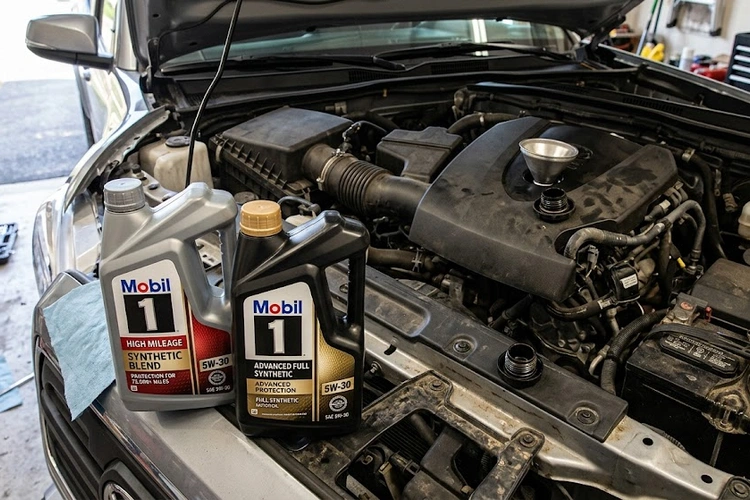
The simplest way to understand both products is to look at what goes inside each bottle. Motor oil starts as base stock — either refined petroleum, synthetic compounds, or a combination of both — then receives an additive package that controls viscosity (thickness), oxidation resistance, and wear protection under real-world engine conditions.
Synthetic blend oil, often labeled semi-synthetic, mixes conventional petroleum base stock with a portion of fully synthetic base stock, typically in a ratio of roughly 70 percent conventional to 30 percent synthetic. The synthetic fraction raises performance above what straight conventional oil offers without pushing the retail price to full synthetic territory. Most synthetic blends carry an API (American Petroleum Institute) SN or SP service classification and deliver adequate protection for naturally aspirated (non-turbocharged) engines operating under normal driving conditions. The blend formulation became popular in the 1990s as automakers began extending factory oil change intervals beyond the old 3,000-mile standard.
Full synthetic oil uses entirely synthetic base stocks — most commonly Group IV polyalphaolefins (PAO) or Group III hydrocracked petroleum refined to near-synthetic purity — paired with a more advanced additive package than blends carry. The result is an oil that flows faster at cold starts, resists thermal breakdown at high temperatures, and maintains consistent viscosity across a much wider operating range. Turbocharged engines, direct-injection motors, and high-performance vehicles benefit most from full synthetic formulations because these engines generate heat and pressure that degrade lesser oils quickly.
| Specification | Synthetic Blend | Full Synthetic |
|---|---|---|
| Base Stock | ~70% conventional + ~30% synthetic | 100% synthetic (Group III or IV) |
| Typical Drain Interval | 5,000–7,500 miles | 7,500–15,000 miles |
| Cold-Start Protection | Good | Excellent |
| High-Heat Stability | Moderate | High |
| Turbo Engine Suitability | Not recommended | Recommended |
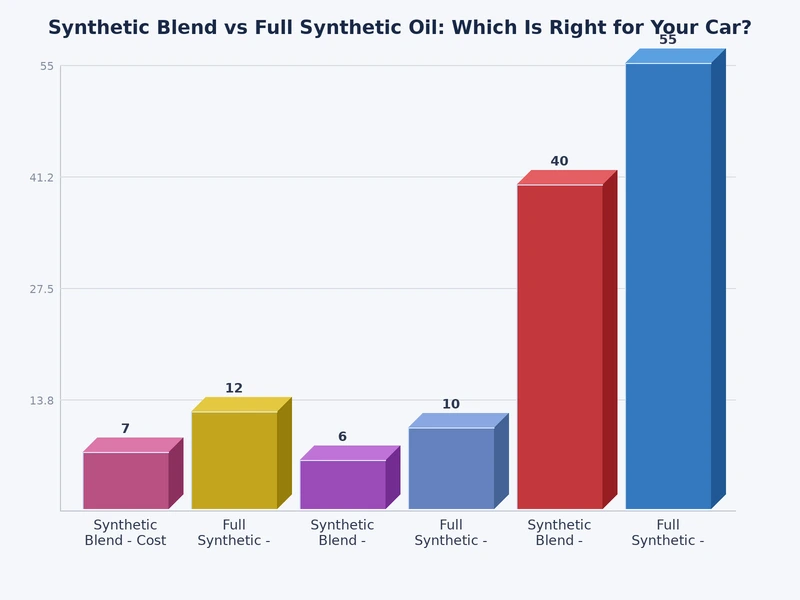
| Average Price Per Quart | $6–$9 | $9–$15 |
| Average 5-Quart Change Cost | $30–$45 | $45–$75 |
Synthetic blend oil occupies a comfortable middle ground for everyday drivers who want better protection than conventional oil but prefer to keep service costs low. The advantages are straightforward:
The drawbacks are equally clear. Synthetic blend oil breaks down faster under sustained heat and load, shortening drain intervals compared to full synthetic. Engines running under persistent stress — frequent towing, extended stop-and-go city traffic, or high ambient temperatures — accumulate more wear over the same mileage when running a blend rather than full synthetic.
Full synthetic oil delivers measurably better protection across nearly every performance metric, and the gap widens in demanding operating conditions. The advantages include:
The primary drawback is purchase price. A full synthetic oil change costs $20 to $40 more than a synthetic blend service at most shops, and that gap accumulates quickly for drivers who change oil more frequently than the manufacturer requires.
A quart of synthetic blend typically sells for $6 to $9, while a comparable full synthetic quart costs $9 to $15. For a standard five-quart passenger car oil change, the total oil cost difference sits between $15 and $30 before factoring in a filter, drain plug washer, or shop labor. Premium full synthetic brands like those reviewed in the Castrol Edge vs Mobil 1 comparison show how top-shelf full synthetic products stack up in both price and performance ratings across real-world conditions.
The annual cost picture changes significantly once extended drain intervals are factored in. A driver covering 15,000 miles per year using full synthetic at a 10,000-mile interval schedules roughly 1.5 oil changes per year. The same driver using synthetic blend at a 5,000-mile interval schedules 3 changes — often spending more in total annual cost, even before accounting for shop time and disposal fees. This long-term arithmetic mirrors the same logic behind the regular vs premium gas debate, where upfront price differences shrink or reverse when the full ownership picture is considered.
The owner's manual provides the most authoritative guidance on which oil type a specific engine requires, and that recommendation overrides any general advice. Turbocharged engines nearly always specify full synthetic because the turbocharger (a device that compresses intake air using exhaust energy) reaches temperatures that degrade a blend within a few thousand miles. Vehicles with direct injection also benefit from full synthetic's cleaner additive chemistry, which reduces the risk of LSPI (low-speed pre-ignition) — a serious knock event that can damage pistons and connecting rods in modern small-displacement engines. Older, naturally aspirated engines in good mechanical condition driven under 10,000 miles per year are often well-served by synthetic blend, provided the owner respects the manufacturer's drain interval guidance.
In regions where temperatures regularly fall below 0°F, full synthetic's superior cold-flow properties reduce the thick, sluggish behavior that accelerates startup wear with a blend. In desert climates where summer temperatures routinely exceed 110°F, full synthetic's thermal stability keeps viscosity consistent when a blend might thin out beyond its rated grade under sustained heat. Drivers who primarily make short trips under five miles see more oil degradation per mile than highway drivers, because the engine never fully warms up and fails to burn off moisture and fuel contamination — conditions that favor full synthetic's more durable additive package.
Changing oil at home is one of the most accessible maintenance tasks available, and the tool list is short enough to fit in a small storage bin. The following items cover a complete DIY oil change for most passenger cars:
The basic process involves warming the engine briefly to thin the oil for faster draining, removing the drain plug and old filter to empty the crankcase, installing a new filter and reinstalling the drain plug with a fresh washer, then refilling through the fill cap and checking the dipstick level before running the engine. The entire job takes 20 to 30 minutes with the right setup and a clean workspace. Checking the drain plug washer for deformation at each service prevents slow leaks that can go unnoticed for weeks and lead to low-level engine damage over time.
Using the wrong oil — whether the wrong viscosity, the wrong type, or oil that has exceeded its service life — produces a recognizable set of symptoms that owners should act on immediately. A louder-than-normal ticking or knocking noise at cold startup indicates inadequate lubrication during the most wear-intensive phase of engine operation. An illuminated oil pressure warning light, a burning oil smell from the engine bay, or faster-than-expected consumption between changes all point to a lubrication mismatch that needs correction before internal components sustain lasting damage. According to the Wikipedia entry on motor oil, viscosity grade is the single most critical specification to match when selecting engine oil, and sustained operation on an incorrect grade produces measurable long-term wear accumulation.
The immediate correction for a wrong oil choice is a drain-and-fill using the correct product — no engine flush is necessary if the incorrect oil has been running for fewer than 1,000 miles. For longer-term mismatch situations, running a fresh fill of the correct oil for 500 to 1,000 miles before the next change helps displace residual contamination from the oil passages and crankcase. Any tar-like sludge deposits visible on the inside of the oil fill cap indicate that the PCV (positive crankcase ventilation) valve may be partially blocked, accelerating sludge formation and warranting inspection and replacement as part of the correction process.
Mixing the two types does not cause immediate engine damage, since both use compatible additive chemistry and base stock families. However, mixing dilutes the performance properties of the full synthetic and shortens the effective drain interval. The better practice is to drain and refill with one consistent oil type at each service interval.
No special preparation or engine flush is required when switching from synthetic blend to full synthetic oil. Simply drain the old oil, replace the filter, and fill with the correct viscosity full synthetic. The higher detergency of full synthetic will gradually clean residual deposits from previous fills over subsequent drain intervals.
Most manufacturers recommend changing synthetic blend oil every 5,000 to 7,500 miles under normal driving conditions. Severe-duty conditions — frequent towing, extreme temperatures, short daily trips — reduce that interval to 4,000 to 5,000 miles. Always follow the specific recommendation in the vehicle owner's manual rather than generic industry guidelines.
Full synthetic oil is generally worth the extra cost for high-mileage engines because its superior detergency helps manage sludge buildup, and its stable viscosity protects worn tolerances better than a blend. Some full synthetic products include high-mileage additive packages with seal conditioners that help reduce oil consumption in older engines with slightly deteriorated gaskets.
Synthetic blend oil does not damage older engines. The concern about synthetic oil and older engines primarily involved early full synthetic formulations from the 1970s and 1980s, which used ester-based stocks that could swell certain gasket materials. Modern synthetic blends and full synthetics are compatible with all gasket materials found in vehicles produced in the last three decades.
Full synthetic oil is the correct choice for turbocharged engines without exception. Turbochargers spin at up to 200,000 RPM and reach extremely high temperatures that break down synthetic blend oil far faster than the rated drain interval. Using a blend in a turbocharged engine risks oil coking (burning oil into carbon deposits) in the turbo bearing housing, which leads to premature turbocharger failure.
Long-term studies and fleet data consistently show that full synthetic oil reduces engine wear at cold start and under sustained heat compared to both conventional and synthetic blend oils. Engines maintained exclusively on full synthetic from new show measurably less bore wear and bearing surface degradation over 100,000-mile intervals, which translates directly to extended engine service life.
The viscosity grade should match exactly what is specified in the owner's manual — switching to full synthetic does not change the required grade. Most modern passenger cars specify 5W-30 or 0W-20, while older engines and trucks often call for 5W-40 or 10W-30. Using a different grade than specified, even in a premium full synthetic, can reduce fuel economy and alter oil pressure in ways the engine was not designed for.
 |
 |
 |
 |

About Diego Ramirez
Diego Ramirez is a maintenance and care specialist who has been wrenching on cars since he was sixteen. He focuses on fluid changes, preventive care routines, paint protection, and the small habits that turn a five-year-old car into a fifteen-year-old car.
Get some FREE car parts & gear.. Or check out the latest free automotive manuals and build guides here.
Disable your ad blocker to unlock all the hidden deals. Hit the button below 🚗
| | | |
