by Sarah Whitfield
Tire-related crashes kill more than 700 people every year in the United States, according to the National Highway Traffic Safety Administration. A significant share of those incidents trace back to something preventable: tire wearing unevenly. Most drivers notice a shimmy or a slight pull and assume it's nothing. But uneven wear shortens tire life, hurts fuel economy, and can compromise grip at exactly the wrong moment. This guide breaks down the six most common causes, what each wear pattern looks like, and what it means for safety and cost. For a broader look at common car problems and their fixes, the troubleshooting section is a useful starting point.
Contents
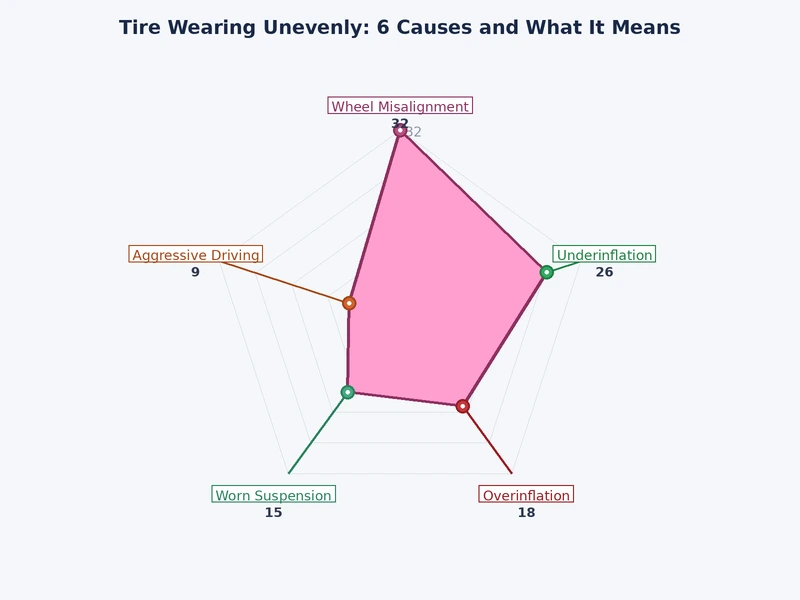
Most uneven tire wear traces back to one of six problems: inflation, alignment, suspension, wheel balance, rotation habits, or driving style. Each cause leaves a distinct mark on the tread surface, which makes it possible to narrow down the diagnosis just by looking at the rubber.
Incorrect inflation is the most common culprit and the easiest to fix. When a tire runs underinflated, the outer shoulders carry more load than the center, so both edges wear faster than the middle. Overinflation does the opposite — the center bulges slightly into the road and grinds down first while the edges look barely touched.
The correct pressure is stamped on a sticker inside the driver's door jamb, not on the tire sidewall (the sidewall number is the maximum pressure, not the target). Checking pressure monthly takes under five minutes. Drivers who want a quick way to top up at home often find a portable tire inflator pays for itself fast in extended tire life.
Alignment describes the precise angles at which the tires contact the road. When those angles shift — after a hard pothole strike, a curb hit, or worn steering components — the tires no longer roll straight. They scrub sideways with every rotation, grinding one edge far faster than the other.
The vehicle may still drive fine with mild misalignment. A faint pull to one side or a steering wheel that no longer sits centered are early hints. A four-wheel alignment check costs roughly $50–$100 at most shops and can prevent a full set of tires from wearing out prematurely.
Shocks and struts (the hydraulic cylinders that absorb road bumps) do more than smooth the ride. They keep each tire pressed firmly against the pavement. When they degrade, the tire begins to bounce slightly instead of rolling clean, leaving a wavy, scalloped pattern across the tread called cupping.
Drivers who spot cupping alongside a rougher ride may also want to check for other suspension wear. A guide on how to inspect a CV axle is a helpful companion read, since worn axle joints can produce similar vibration and sometimes appear alongside tired shocks on higher-mileage vehicles.
Every wheel and tire pairing carries small weight imbalances from manufacturing. Wheel balancing corrects this by adding counterweights around the rim. When those weights fall off — or when balancing is skipped after a tire swap — the wheel spins unevenly at speed, creating patchy flat spots around the tread circumference.
The most recognizable sign is a steering wheel or seat vibration that appears at specific highway speeds, usually between 55 and 70 mph. Balancing runs $15–$25 per wheel and should be done whenever new tires are mounted.
Front and rear tires wear at different rates. On front-wheel-drive vehicles, the front tires handle steering, braking, and acceleration, so they wear considerably faster than the rears. Without regular rotation, the fronts can be exhausted while the rears still have thousands of miles of tread left — a waste of money and an uneven handling setup.
Most manufacturers recommend rotating every 5,000 to 7,500 miles. Many shops roll rotation into an oil change appointment at minimal extra cost.
Hard braking scrubs the front tires' contact patch in the same spot repeatedly. Fast cornering overloads the outer shoulder of the front tires. Rapid acceleration on a rear-wheel-drive car spins and heats the rear tires unevenly. These habits compound quickly over high-mileage city driving.
Smooth, gradual inputs make a measurable difference in how long tires last. It is also worth noting that mechanical problems — such as a failing brake booster that alters pedal feel — can cause harder braking than intended, quietly accelerating front tire wear over time.
Reading the tread is the fastest way to identify what is causing tire wearing unevenly. Each pattern points to a specific problem.
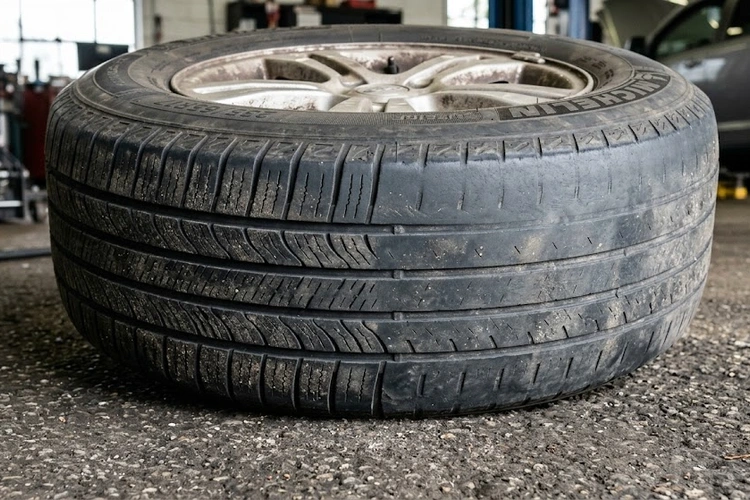
Wear concentrated down the middle of the tread, with both edges still looking healthy, almost always means overinflation. The tire is too rigid and only its center is pressing against the road. Wear on both outer edges with a healthy center is the opposite story — underinflation — where the soft tire flattens under load and pushes the contact patch outward to the shoulders.
When only one edge — inner or outer — is worn significantly more than the rest, the likely cause is a camber (the tilt of the wheel relative to vertical) or toe (how much the wheel points inward or outward) alignment problem. This type of wear often develops silently, without any noticeable handling symptom until the damage is advanced.
Cupping looks like a series of shallow scooped-out valleys running around the circumference of the tire. It is the signature pattern of worn shocks or struts that can no longer dampen wheel bounce. A hand run around the full circumference will feel the dips clearly even before they are visible to the eye.
| Wear Pattern | Location on Tire | Most Likely Cause | Recommended Fix |
|---|---|---|---|
| Center wear | Middle tread strip | Overinflation | Reduce to door-jamb spec |
| Edge wear (both sides) | Both outer shoulders | Underinflation | Inflate to spec; check monthly |
| One-sided edge wear | Inner or outer edge only | Wheel misalignment | Four-wheel alignment |
| Cupping / scalloping | Wavy pattern around circumference | Worn shocks or struts | Replace shocks/struts |
| Diagonal patches | Angled flat spots | Wheel imbalance | Balance all four wheels |
| Heel-to-toe wear | Alternating high and low tread blocks | Normal wear + skipped rotation | Rotate every 5,000–7,500 miles |
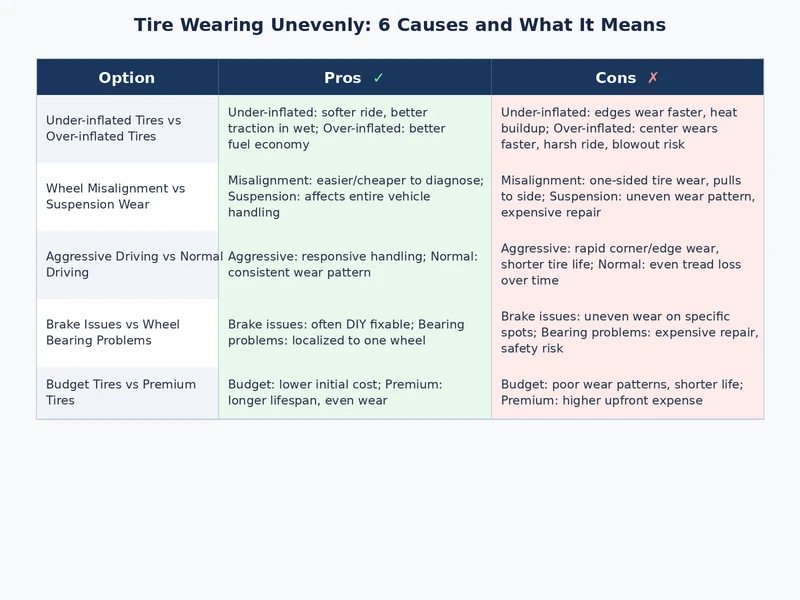
Even drivers who are aware of the problem sometimes make choices that push the damage along faster. Two errors come up again and again.
Rotation is one of the most skipped items on most maintenance schedules, yet it ranks among the highest-return ones. On front-wheel-drive vehicles, skipping rotation means the front tires can wear out in roughly half the time they should. The resulting imbalance between axles also affects handling in sudden maneuvers. Keeping wheels clean makes it easier to spot early wear — a quality wheel cleaner removes the thick brake dust that can obscure the tread edge during a visual check.
Many drivers confuse alignment with balance and sometimes neglect both. Wheel balance corrects for small weight differences around the wheel; alignment corrects the angle of the suspension. Both are necessary, and neither substitutes for the other. Ignoring imbalance usually shows up first as a vibration at highway speed, which can quietly develop into flat-spot wear across thousands of miles. Drivers dealing with multiple symptoms at once — uneven wear alongside, say, reduced power on uphill stretches — often save time and money by requesting a full vehicle inspection at one visit rather than addressing each issue separately.
Catching tire wearing unevenly early does not require specialized shop equipment. Two inexpensive tools handle most home diagnostics reliably.
A digital tire pressure gauge costs around $10–$15 and is accurate to within 0.5 PSI. A tread depth gauge goes further, measuring remaining tread at multiple points across the width — inner edge, center, and outer edge — revealing uneven wear before it becomes a safety concern. Both tools are small enough to keep in a glove box or tucked alongside a car detailing kit in the trunk.
A quick visual check while the car is parked catches most serious wear patterns. The method is straightforward: crouch beside each tire and look straight across the tread from front to back. Scan for any area where the tread blocks look lower or shinier than the rest. Then run a hand around the full circumference and feel for any dips, ridges, or flat spots.
Prevention costs far less than replacement. A few consistent habits address most causes of uneven wear before they take hold.
Pairing tire rotation with oil changes is the simplest scheduling trick available. For most modern vehicles that lands every 5,000 to 7,500 miles, and many shops offer rotation at a steep discount when bundled with an oil change. Drivers who stay on top of oil intervals tend to catch tire wear earlier — an overview of how long engine oil actually lasts is a handy companion read for anyone calibrating their maintenance schedule.
A hard pothole strike or curb hit can shift a wheel out of alignment in an instant. Getting an alignment check within a few hundred miles of any significant impact is a habit worth building. Most shops complete it in under an hour. After winter — a season filled with hidden road hazards — a spring alignment check is one of the most practical ways to prevent tires from wearing unevenly through the months ahead. Any time suspension or steering components are serviced, alignment should be verified before putting significant miles on the vehicle.
Once rubber has worn unevenly, it cannot be restored. The correct approach is to fix the root cause — pressure, alignment, or suspension — then rotate the remaining tires to distribute what is left, or replace them if tread depth has fallen below the safe threshold.
Severe misalignment or chronic underinflation can produce visible uneven wear in as little as 5,000 to 10,000 miles. Mild cases may take 20,000 miles or more before the pattern becomes obvious during a routine inspection.
Minor uneven wear with adequate tread depth remaining is generally manageable for short distances, but the underlying cause should still be addressed promptly. If any part of the tread has worn below 2/32 of an inch, the tire should be replaced before highway driving.
No. New tires installed on a misaligned or out-of-balance vehicle will develop the same wear pattern again within a few thousand miles. The root cause must be corrected at the same time the tires are replaced.
Yes, and it is more common than most drivers expect. Camber and toe alignment settings are adjusted per wheel, so a single wheel can be out of spec while the others are correctly positioned. The result is heavy one-sided wear on that tire alone.
A compact spare (the small temporary donut type) rotates at a different diameter than the full-size tires, which can stress the differential and indirectly affect wear if driven beyond the recommended 50-mile limit at reduced speed. Full-size matching spares do not carry this risk.
Monthly checks are the standard recommendation. Temperature swings also matter — tire pressure drops roughly 1 PSI for every 10°F decrease in outside temperature, so pressure that was correct in summer may be meaningfully low by midwinter without a single leak present.
 |
 |
 |
 |

About Sarah Whitfield
Sarah Whitfield is a diagnostics and troubleshooting specialist who spent ten years as an ASE-certified technician before joining the editorial team. She specializes in OBD-II analysis, electrical gremlins, and the kind of intermittent problems that make most owners give up.
Get some FREE car parts & gear.. Or check out the latest free automotive manuals and build guides here.
Disable your ad blocker to unlock all the hidden deals. Hit the button below 🚗
| | | |
