by Sarah Whitfield
Transmission slipping symptoms are your clearest early warning that the system transferring engine power to your wheels is beginning to fail. When your engine revs climb but your car moves slower than it should, that gap between engine output and road speed is your gearbox signaling a problem you cannot afford to ignore.
Your automatic transmission relies on hydraulic pressure (fluid-driven force inside the gearbox) to hold each gear firmly while you drive, and when that pressure drops or internal friction surfaces wear down, the gears begin to slip instead of hold. The cascade of problems that follows can range from a simple fluid top-off to a complete transmission overhaul, which makes early diagnosis worth your time. One of the most common triggers is a fluid issue, so reviewing the warning signs of low transmission fluid symptoms alongside this guide gives you the full picture before you start any diagnosis.
Contents
Knowing which warning signs to look for helps you act before a minor issue becomes a major repair, and each of these six transmission slipping symptoms points to a specific problem developing inside your gearbox.
When your tachometer (the gauge displaying engine speed in revolutions per minute) climbs sharply while your speedometer barely moves, your transmission is losing its grip on the gear it should be holding. This symptom is most noticeable during highway on-ramp merges or firm acceleration to pass another vehicle, where the engine roars ahead while your car hesitates rather than surging forward as it normally would.
A one-to-three-second pause between shifting from Park into Drive and your car actually moving forward is a textbook sign of a slipping automatic transmission, and it deserves attention the first time you notice it rather than the fifth. Some drivers experience the opposite problem — a sudden lurch or jolt into gear — which points to low fluid pressure or worn clutch packs (the stacked friction discs inside the gearbox) struggling to find their grip under load.
Overheated transmission fluid produces a sharp, acrid odor that is distinct from burning oil or rubber, and detecting that smell after a drive means your fluid is either low, degraded from heat and age, or contaminated with debris. Slipping generates excess friction inside the gearbox, and that friction converts into heat that destroys fluid far faster than normal driving ever would, accelerating wear on every component the fluid is designed to protect.
Modern automatic transmissions communicate with your car's ECU (engine control unit), and when sensors detect abnormal shift patterns or pressure drops, the check engine light illuminates and stores a trouble code that any OBD-II scanner can read. Codes in the P0700–P0799 range often point directly to transmission control system faults, and cross-referencing those codes with the physical symptoms you're experiencing narrows the diagnosis to a specific component rather than leaving you guessing at the cause.
If your car hesitates, grinds, or moves reluctantly when you select Reverse, your transmission's reverse clutch pack is likely slipping or worn, and this symptom almost always worsens if you continue driving without addressing it. Drivers who find their car won't go in reverse but drives fine are often dealing with the same degraded hydraulic pressure that causes slipping in forward gears, though the reverse circuit tends to show failure first in many transmission designs.
A high-pitched whine during acceleration or a dull clunk when the transmission shifts indicates internal components are under stress from repeated slipping, and these sounds should never be written off as normal transmission behavior. If you are already noticing a humming noise while driving that intensifies during gear changes, your transmission and drivetrain are both worth inspecting at the same time, since both systems can generate overlapping sounds that complicate diagnosis when examined separately.
Reading a list of symptoms is useful, but understanding exactly how transmission slipping presents itself during your normal commute helps you recognize the problem the moment it appears rather than weeks after it started.
When you press the accelerator firmly to pass a slower vehicle on the highway, a slipping transmission may briefly drop out of the gear it was holding, rev the engine loudly, and then snap back into gear with a shove — a sensation that feels like momentary powerlessness followed by a delayed burst of acceleration. Drivers who notice their car losing power when accelerating at highway speeds often discover the transmission is the source rather than the fuel or ignition system, especially when the power loss correlates precisely with gear changes.
City driving exposes transmission slipping in a different way, because frequent low-speed gear changes put the clutch packs under repeated stress with very little recovery time between each shift. You may feel the car shudder gently or surge unexpectedly at low speeds, which is easy to attribute to a rough idle or engine misfire until you notice the pattern is always tied to a gear change rather than a steady engine load. Some drivers report their car shaking while driving in stop-and-go conditions as the transmission hunts between gears without fully committing to either one.
Some of the most instinctive responses to transmission slipping symptoms actually accelerate the damage, so understanding what not to do is just as important as knowing the correct fix.
Transmission fluid is both the lubricant and the hydraulic medium that gives your gearbox its grip on every gear, so continuing to drive without verifying the fluid level when you first notice slipping is the single most preventable mistake you can make in this situation. A fluid check takes fewer than ten minutes, and discovering the level is low gives you an immediate, low-cost solution to try before assuming the gearbox itself is mechanically damaged.
Warning: If your transmission fluid appears dark brown or smells burnt rather than looking clear or light pink, a simple top-off will not fix the problem — the fluid needs a full drain and refill, and the gearbox likely needs inspection for underlying heat damage.
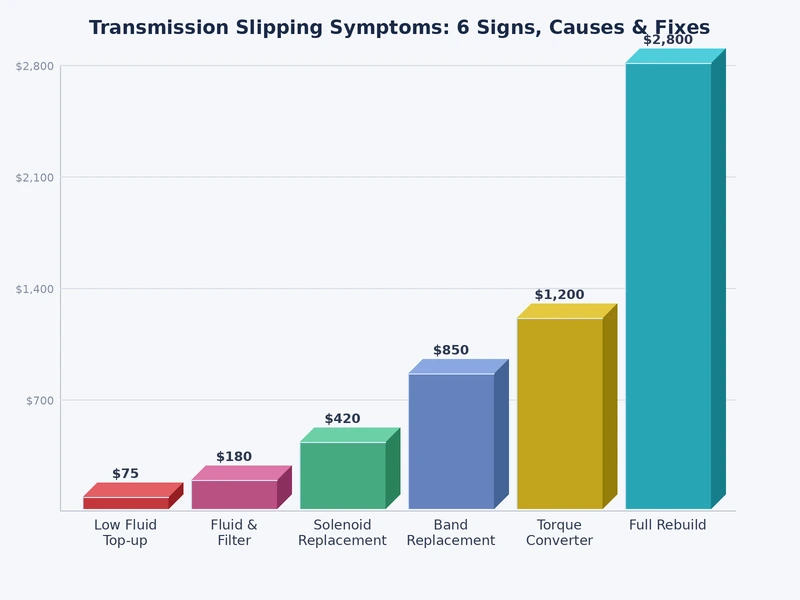
Every mile you drive with a slipping transmission is additional heat and friction acting on components that are already struggling to function, and what might have been a $200 fluid service can become a $3,000 rebuild if you delay the repair long enough. Drivers who ignore early symptoms until they find their car won't shift out of park have often already crossed the line from a serviceable fluid or solenoid repair into a full transmission replacement that could have been avoided with earlier action.
A methodical approach to diagnosis saves you from replacing parts you don't need and helps you communicate precisely with a technician when the repair requires professional equipment and expertise.
With the engine warmed up and running, pull the transmission dipstick (typically marked with a red or orange handle), wipe it clean on a white rag, reinsert it fully, and pull it again for an accurate reading — if your vehicle has a sealed transmission without a dipstick, you will need a shop to perform this check using a fill-port measurement. The fluid should sit between the MIN and MAX marks and appear clear or light pink in color, because dark brown or opaque fluid signals heat damage that is compounding the slipping you are already experiencing.
An OBD-II scanner (the plug-in diagnostic tool that reads your car's onboard computer) costs between $30 and $150 for a reliable consumer model, and it can pull transmission fault codes that identify the failing component rather than leaving you with only physical symptoms to work from. According to the National Highway Traffic Safety Administration, electronic transmission controls have grown increasingly sophisticated, meaning stored codes can now point to specific solenoids (the electronic valves controlling fluid flow) or pressure sensors rather than just flagging a vague transmission fault.
| Symptom | Most Likely Cause | First Fix to Try |
|---|---|---|
| RPM surge without speed increase | Low fluid or worn clutch packs | Check and top off transmission fluid |
| Delayed engagement (1–3 seconds) | Low hydraulic pressure | Fluid level and condition inspection |
| Burning smell after driving | Overheated or degraded fluid | Full fluid drain and refill |
| Check engine light (P07xx codes) | Faulty solenoid or pressure sensor | OBD-II scan, then solenoid test |
| Trouble shifting into Reverse | Worn reverse clutch pack | Fluid check, then transmission service |
| Whining or clunking during shifts | Worn bands or internal bearings | Inspection by a transmission technician |
You can complete a meaningful first-pass inspection of a slipping transmission with equipment most home mechanics already own, which helps you determine whether the job is within your skill level or whether a shop is the right call from the start.
A transmission dipstick, a clean white rag for assessing fluid color and smell, and an OBD-II scanner form the minimum toolkit for a useful preliminary diagnosis of any slipping transmission. Rounding that out with a drain pan, a narrow-mouth funnel matched to your transmission's fill port, and one quart of the exact fluid type specified in your owner's manual gives you everything needed for a fluid change — which on its own resolves a significant share of slipping cases without touching anything internal.
If a fresh fluid service and a clean OBD-II scan do not stop the slipping, the problem is almost certainly mechanical — worn clutch packs, damaged bands (the steel straps that hold planetary gears in position), or a failing torque converter (the fluid coupling between your engine and transmission) — and these repairs require specialty tools and lift equipment that go well beyond a standard home garage setup. Getting two or three written estimates from transmission-specialist shops typically yields a more accurate and competitive price than a general repair garage, since transmission-only shops carry the parts inventory and experience to diagnose the root cause rather than replacing components speculatively.
A handful of widely circulated beliefs about transmission slipping lead drivers toward expensive decisions that either delay proper repairs or cause additional damage to an already compromised gearbox.
Many drivers assume that any transmission slipping symptoms they notice mean the entire gearbox needs to come out and be rebuilt, but a large percentage of slipping cases are resolved with a fluid drain and refill, a solenoid replacement, or a transmission service costing a few hundred dollars rather than several thousand. The severity of the slipping and how long it has gone unaddressed are the two factors that determine whether you are looking at a minor service or a major repair, which is precisely why acting on the first symptom rather than the fifth consistently produces the smaller repair bill.
Aftermarket additives marketed as stop-slip or seal-conditioner products sometimes reduce slipping symptoms temporarily, but they do not address the mechanical or hydraulic causes driving the problem, and some formulations can swell seals or alter fluid viscosity in ways that create new issues alongside the one you were trying to fix. Drivers who rely on additives as a long-term solution often find that the underlying problem has continued to worsen beneath the surface, leading to a more extensive repair than an earlier proper service would have required — and if you also notice rough idle symptoms alongside the slipping, addressing root causes rather than masking symptoms is always the more reliable path forward.
Once you have addressed the immediate cause of the slipping, a few consistent maintenance habits give your transmission the best possible chance of lasting through the life of the vehicle without repeating the same failure.
Most automatic transmissions benefit from a fluid drain and refill every 30,000 to 60,000 miles under normal driving conditions, though vehicles used for towing, mountain driving, or heavy stop-and-go commuting should be serviced closer to the shorter end of that range. Fresh fluid maintains the hydraulic pressure your gearbox needs to hold gears cleanly, and it prevents the heat buildup that breaks down clutch pack friction surfaces over time. Staying on schedule with this service also helps you catch early wear signs — much like addressing car shaking at idle early prevents deeper drivetrain damage from developing unnoticed.
Allowing your engine sixty to ninety seconds to warm up before driving in cold weather reduces viscosity stress on cold transmission fluid that has thickened overnight, and avoiding aggressive full-throttle launches from a stop takes meaningful strain off your clutch packs during the most vulnerable moment of every gear change. Coming to a complete stop before shifting between Drive and Reverse is a habit that pays dividends in transmission longevity, because shifting while the vehicle is still rolling forces the gearbox to absorb the vehicle's forward momentum rather than letting your brakes handle that load as they are designed to do.
The most common causes of transmission slipping are low or degraded transmission fluid, worn clutch packs (the internal friction discs that grip each gear), faulty solenoids (the electronic valves controlling fluid flow), and damaged transmission bands. In most cases, a fluid inspection is the correct first step because low or burnt fluid is the simplest and most affordable cause to address before investigating mechanical components.
Yes, low transmission fluid is one of the leading causes of transmission slipping because the gearbox relies entirely on hydraulic pressure — created by fluid under pressure — to hold each gear in place. When the fluid level drops, that pressure weakens, and the transmission begins to slip between gears or delay engagement. Topping off the fluid with the correct type often resolves mild slipping immediately if caught early.
Driving with a slipping transmission is not recommended because every mile adds heat and friction to components that are already under stress, accelerating wear and increasing the likelihood of a complete failure. Short, necessary trips at low speeds are generally less damaging than highway driving, but the safest course is to diagnose and address the cause as soon as slipping symptoms appear rather than continuing to drive and risk a more expensive repair.
Repair costs vary widely depending on the cause: a fluid drain and refill typically runs $100–$250, a solenoid replacement costs $150–$400 including labor, and a full transmission rebuild ranges from $1,500 to $4,000 or more depending on the vehicle. Catching the problem at the fluid or solenoid stage is significantly less expensive than waiting until internal mechanical components fail, which is why early diagnosis consistently produces the lower repair bill.
Checking the fluid level and performing a fluid drain and refill are straightforward DIY tasks that require only basic tools and the correct fluid type for your vehicle. Replacing a shift solenoid is within reach for a mechanically comfortable home mechanic with OBD-II scan data to guide the diagnosis. However, repairs involving clutch packs, transmission bands, or the torque converter require the transmission to be removed and disassembled, which is generally best left to a specialist with the correct tooling and experience.
 |
 |
 |
 |

About Sarah Whitfield
Sarah Whitfield is a diagnostics and troubleshooting specialist who spent ten years as an ASE-certified technician before joining the editorial team. She specializes in OBD-II analysis, electrical gremlins, and the kind of intermittent problems that make most owners give up.
Get some FREE car parts & gear.. Or check out the latest free automotive manuals and build guides here.
Disable your ad blocker to unlock all the hidden deals. Hit the button below 🚗
| | | |
