by Sarah Whitfield
A humming or droning noise that changes with vehicle speed points to a wheel bearing. A clicking or popping sound that gets worse when turning points to a CV joint (constant velocity joint — the component that transfers engine power to the wheels while allowing steering movement). Knowing the difference between wheel bearing vs CV joint noise is the fastest way to avoid replacing the wrong part.
Both components live near your wheels. Both degrade over time. But they fail differently, under different conditions, and with different consequences. Replacing the wrong part wastes hundreds of dollars and leaves the real problem unfixed.
If clicking or clunking sounds are already present, our guide on CV axle noise symptoms covers related causes worth ruling out before you schedule any repair.
The cost difference is real. Wheel bearing replacement typically runs $150–$400 per wheel. CV joint or full axle replacement costs $200–$600. You can find a detailed breakdown on our CV joint replacement cost page. Either way, you need to know which part is actually failing before spending anything.
Contents
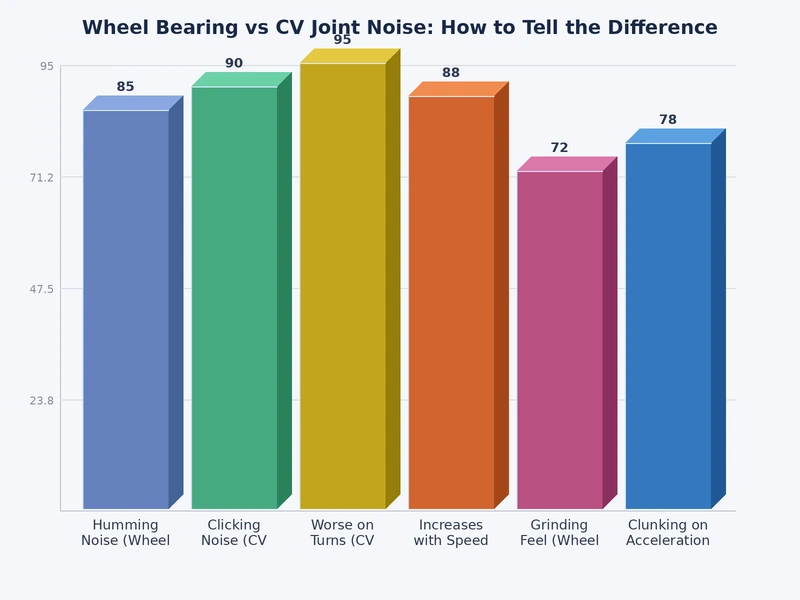
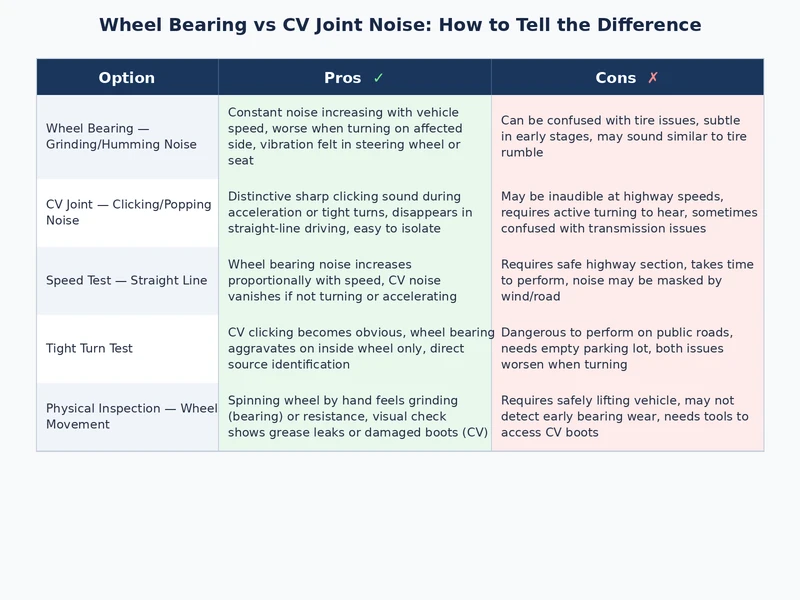
Start here. Match what you hear to the characteristics in the table below. One accurate observation from behind the wheel cuts the diagnosis time in half.
| Characteristic | Wheel Bearing | CV Joint |
|---|---|---|
| Primary sound | Humming, droning, growling | Clicking, popping, clunking |
| Main trigger | Vehicle speed | Steering input (turning) |
| Worst when | Cornering at speed or changing lanes | Tight turns at low speed |
| Present in straight-line driving | Yes — constant hum | Rarely — usually quiet |
| Shifts side with body lean | Yes — louder on the loaded side | No — stays on the same side |
| Vibration felt in cabin | Common at highway speed | Uncommon |
| Typical repair cost | $150–$400 per wheel | $200–$600 per axle |
| Safety risk if ignored | High — can allow wheel separation | High — can cut drive power suddenly |
A bad wheel bearing produces a low, steady hum. It sounds like driving on grooved pavement — a constant drone that never fully disappears. The pitch and volume track with speed. Accelerate and it intensifies. Drop to a crawl and it fades. That speed-dependence is the clearest identifier.
You may also feel a faint vibration through the floorboard or steering column at highway speeds. Many drivers mistake this for an unbalanced tire. The difference is telling: tire-balance vibration often eases above 65 mph, while a bearing hum continues to worsen as speed climbs.
According to Wikipedia's overview of wheel bearings, these components support the vehicle's full weight while enabling smooth rotation — meaning even modest wear produces measurable noise and detectable play at the hub.
A failing CV joint clicks. The sound is sharp and rhythmic — a rapid-fire click-click-click that appears when you pull out of a parking space or execute a tight turn. It is loudest at low speeds with a near-full steering lock.
At highway speed in a straight line, a worn CV joint is often completely silent. That silence is misleading. The joint is still failing — it just isn't experiencing the angular stress that turning creates. Ignore it long enough and the joint can fracture while driving, which eliminates drive power to that wheel without warning.
The most important diagnostic question is simple: does the noise change when you change speed, or when you turn the wheel?
A wheel bearing noise changes with speed. It also shifts in pitch when you move the steering wheel a few degrees left or right while driving at highway speed. The load on the bearing changes as the car leans through a curve. The bearing on the outside of the curve takes more weight — and if it's worn, that's when it gets louder.
A CV joint noise changes with steering angle, not speed. The tighter you turn, the more the joint flexes, and the more pronounced the clicking becomes. In a straight line at any speed, the joint is at its lowest stress point. Give it a sharp turn and it responds immediately.
Here is a practical observation worth committing to memory. When you steer left at speed, the car leans right, transferring weight to the right wheel. The right wheel bearing takes more load. If that bearing is bad, the hum gets louder when you steer left — because that's when the right bearing is under maximum pressure.
So if weaving left increases the noise, the bad bearing is on the right. If weaving right increases it, the bad bearing is on the left. This pattern is reliable on front-wheel-drive and rear-wheel-drive vehicles, and it gives you side-specific information before you ever lift the car.
You do not need a lift or special tools for a strong preliminary diagnosis. These three tests deliver meaningful information from the driver's seat alone.
At 40 mph on a safe, open road, gently sweep the steering wheel about two inches in each direction. Smooth, slow inputs — not sudden jerks. Listen for any change in the hum. A wheel bearing noise shifts in pitch or volume with this movement. A CV joint noise does not respond to small steering inputs during straight-line driving. If the sound tracks your steering movement, you have a bearing problem.
Make a controlled, gradual lane change to the left at highway speed, then one to the right. Note which direction makes the noise louder. The bearing under increased load is on the opposite side from your steering direction. This test identifies both the presence of a bearing problem and which corner it's in, giving your shop a starting point before they even get the car on a lift.
Accelerate to about 55 mph, then shift to neutral and coast. A wheel bearing hum continues during a coast because the wheels are still spinning at speed. A noise driven by engine torque — such as a transmission or differential issue — often fades when you go neutral. If the hum persists through the entire coast, the source is rotating with the wheels, which points squarely at a bearing or tire.
With the car on jack stands — never just a floor jack — grab the suspect wheel at the 12 and 6 o'clock positions. Push and pull firmly. Any movement at all is a failed wheel bearing. A healthy bearing has zero play. Now grab the wheel at 9 and 3 o'clock and try the same thing. Play in this direction points to a tie rod or ball joint, not the bearing.
Spin the wheel by hand with the transmission in neutral. A healthy bearing spins smoothly and silently. A worn one growls, catches, or produces a gritty sensation mid-rotation. You can often feel this through your hands even before you hear it clearly.
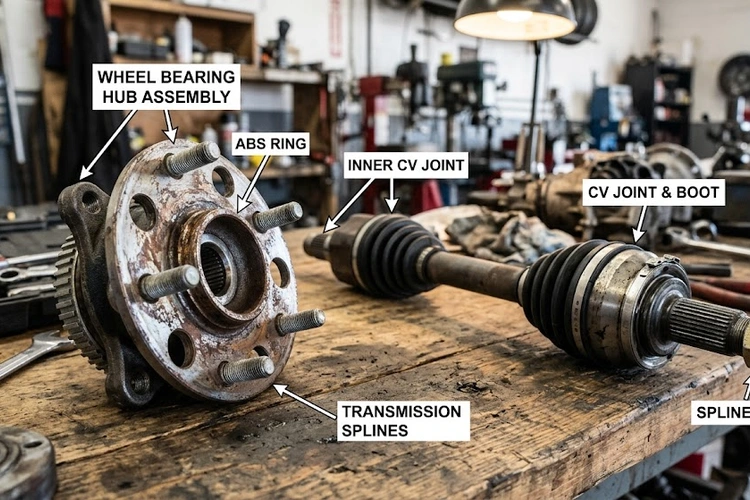
Crouch behind each front wheel and examine the rubber boot (the pleated rubber sleeve wrapped around each end of the CV axle). A healthy boot is intact, fully sealed, and plump with grease. A torn or cracked boot with black grease splattered on surrounding components tells you the CV joint has been running contaminated. Grit enters through the tear, the joint runs dry, and metal-on-metal wear begins within miles.
Check both the inner boot (near the transmission) and the outer boot (near the wheel hub). Either can fail. Even if the joint is not yet clicking, a torn boot means the clock is running. A boot-only repair caught early is significantly cheaper than a full axle replacement.
On most modern vehicles, the ABS (anti-lock braking system) reluctor ring — the toothed ring the sensor reads — is integrated directly into the wheel bearing hub. A severely worn bearing corrupts that sensor signal and triggers the ABS warning light. If your ABS light is illuminated alongside a wheel-area hum, treat the bearing as the primary suspect. Our guide on ABS not working symptoms covers the full range of causes, but a failing wheel bearing is among the most common triggers on vehicles over 80,000 miles.
Cabin noise does not travel in a straight line. It bounces off the firewall, dashboard, and door panels before reaching your ears. Many drivers — and even some technicians — replace the bearing on the side that sounds closest, only to find the noise continues. Always confirm the side using the load-shift test before authorizing any repair.
A shop can also perform a bearing load test on a lift, running the vehicle at speed while checking each hub with a mechanic's stethoscope or an electronic contact microphone. That eliminates guesswork when the driving tests are inconclusive.
Loose wheel fasteners are another overlooked variable. An undertorqued lug nut allows the wheel to shift slightly under load, producing vibration and humming that mimics a failing bearing exactly. Our article on loose lug nut symptoms walks through how to identify and eliminate this possibility before chasing more expensive repairs.
Most drivers head straight to a road test and skip the under-car visual entirely. A torn CV boot takes 60 seconds to spot without any tools. Black grease on the inside of the wheel, on the control arm, or sprayed across the backing plate tells you the joint is already running contaminated. Skipping this step means missing an obvious failure and chasing sounds that have a clear physical cause sitting right in front of you.
Check both inner and outer boots on each front axle. On front-wheel-drive vehicles, all the steering and power delivery runs through those front axles — wear affects both ends. On all-wheel-drive vehicles, check the rear boots too.
Wheel bearings fail early from impact loading — hard pothole strikes, curb hits, and rough off-road travel. Each impact sends a shock through the bearing that can flat-spot or micro-crack the internal balls or rollers. Avoid potholes where you can. If you hit one at speed, monitor for hum in the days following. Early-stage bearing noise is subtle. Catching it early means a bearing swap rather than a full hub assembly replacement.
CV joints degrade fastest from two things: torn boots and extreme angle operation. Spinning your wheel at full steering lock while stuck in mud or snow puts the outer CV joint at maximum flexion while under full torque load. Minimize full-lock maneuvering under power. If you hear a click starting when turning from a full stop, inspect the boots that same day — not next week.
Most manufacturers do not publish a replacement interval for bearings or CV joints — they are replace-on-failure components. But a proactive visual inspection schedule makes a measurable difference in repair costs. Check CV boots at every oil change. It takes 30 seconds. A torn boot caught before the joint runs dry can mean a $80 boot repair instead of a $400 axle replacement.
For wheel bearings, ask your shop to check for play at every tire rotation — typically every 5,000–7,500 miles. Any detectable play under hand pressure means the bearing is failing. Act on it. A bearing with play also compromises braking stability and steering response, particularly in emergency stops where every component in the wheel end needs to be solid.
Yes. A severely worn front wheel bearing often transmits vibration through the steering column, especially at highway speeds. It feels similar to an unbalanced tire, but the distinction is clear: tire-balance vibration typically eases above 65 mph, while a bearing vibration continues to intensify with speed.
There is no reliable mileage figure. Some bearings hum for months before failing; others deteriorate within days of becoming audible. Any bearing with play or grinding should be replaced without delay. At the extreme, a collapsed bearing can allow the wheel to wobble or separate from the hub — a serious and sudden safety failure.
Not usually — until the damage is severe. A worn CV joint is quietest during straight-line highway driving and loudest during tight, low-speed turns. If a CV joint is producing noise during straight-line driving at all speeds, it is at an advanced stage of failure and should be replaced immediately.
Sometimes. If the tear is caught very early — before meaningful grease loss and before road grit enters the joint — a boot-only replacement can be a legitimate repair. If the joint has been running without lubrication for any significant distance, most shops recommend a full axle replacement, since internal wear cannot be assessed without complete disassembly.
Yes. On most modern vehicles, the ABS reluctor ring is built into the wheel bearing hub assembly. A severely worn bearing disrupts the ring's position relative to the sensor, producing a corrupt speed signal that triggers the ABS warning light. If your ABS light is on alongside wheel-area noise, inspect the bearings first.
Yes, somewhat. All-wheel-drive vehicles have CV joints on all four corners rather than just the front axles. That doubles the number of possible CV noise sources. The diagnostic logic remains identical — clicking on turns points to a CV joint, humming at speed points to a bearing — but isolating the exact corner often requires a lift and hands-on inspection of all four wheels.
 |
 |
 |
 |

About Sarah Whitfield
Sarah Whitfield is a diagnostics and troubleshooting specialist who spent ten years as an ASE-certified technician before joining the editorial team. She specializes in OBD-II analysis, electrical gremlins, and the kind of intermittent problems that make most owners give up.
Get some FREE car parts & gear.. Or check out the latest free automotive manuals and build guides here.
Disable your ad blocker to unlock all the hidden deals. Hit the button below 🚗
| | | |
