by Liam O'Brien
The Fox Racing V3 RS is our top pick for 2026 — its carbon fiber shell, MIPS Integra Split protection, and DOT/ECE22.06 dual certification make it the most technically advanced ATV helmet in this roundup. Choosing the right ATV helmet is one of the most consequential decisions you can make before hitting the trail, and in 2026 the market has delivered a genuinely strong field of contenders across every price tier and protection philosophy.
ATV riding exposes you to a unique combination of impact threats — rotational forces from lateral collisions, debris strikes at speed, and the low-speed tumble that catches riders off guard on technical terrain. Unlike standard motorcycle helmets, ATV-specific lids are engineered for wider visors, more aggressive ventilation to handle stop-and-go trail conditions, and shell geometries that work with goggles rather than integrated visors. If you ride an ATV regularly, pairing your helmet selection with the right gear — and perhaps an ATV sprayer for your property — makes the full riding experience both safer and more productive.
We tested and evaluated seven of the strongest helmets available in 2026, weighing certification standards, shell construction, ventilation performance, emergency-removal systems, and real-world comfort over extended rides. Whether you're a weekend trail rider or a competitive motocross athlete, this guide gives you everything you need to choose with confidence. According to the National Highway Traffic Safety Administration, helmets reduce the risk of ATV-related head injury by approximately 64%, making your helmet selection a literal life-or-death choice.
Contents









The Fox Racing V3 RS sits at the top of the ATV helmet category in 2026 for one fundamental reason: it combines professional-level protection with a weight and ventilation package that trail riders can actually live with across a full day of riding. The lightweight carbon fiber shell isn't just a marketing claim — you feel the weight difference immediately compared to polycarbonate-shell competitors, and that reduction in rotational inertia on your neck and shoulders pays dividends across long trail sessions. The MIPS Integra Split system is a dual-layer EPS design that independently manages the liner's response to rotational forces, and it represents a meaningful engineering advancement over basic MIPS implementations you'll find in lower-tier helmets.
The four top exhaust vents work in genuine coordination with the intake channels, and the Ionic+ liner with Stone Cold crushed jade material wicks moisture faster than any foam or polyester liner you've encountered in this category. Critically, the V3 RS holds both DOT and ECE22.06 certifications — the ECE22.06 is the current European standard and is widely considered more rigorous than the legacy ECE22.05 spec, so you're getting a helmet validated under demanding modern test protocols. The fluorescent red colorway tested here maintains excellent visibility in low-light trail conditions, which is an underrated practical benefit for group riding.
At its price point, the V3 RS asks you to invest seriously, but it delivers a professional-grade protection architecture that justifies every dollar, particularly if you ride aggressively or in technical terrain where rotational impact risk is elevated. You're not buying a name — you're buying a measurably better protection system than what most helmets in this roundup can offer.
Pros:
Cons:
Bell's Moto-9S Flex earns its place in this roundup on the strength of two genuinely innovative features that you don't find elsewhere at this tier: the Magnefusion magnetic strap keeper and the Magnefusion Emergency Removal System. The magnetic strap keeper eliminates the fiddly D-ring or ratchet buckle fumble you're used to with gloves on — a single magnetic connection that holds securely during riding but releases without effort when you want it to. More critically, the Emergency Removal System uses magnetic cheek pads that can be pulled free by first responders without rotating or lifting the helmet, which dramatically reduces the risk of secondary cervical spine injury in a crash scenario.
The Flex Energy Management Technology is Bell's proprietary EPS system that uses a segmented liner to manage impacts across a broader range of force levels than traditional single-density EPS. You'll notice this system is designed to perform in the lower-energy impact range — the kind of tumble-and-roll crash that is by far the most common ATV incident — rather than only optimizing for high-speed catastrophic collisions. The Banshee Satin Black/Silver colorway is aggressive without being garish, and the overall build quality feels consistent with Bell's long track record in helmet manufacturing.
The Moto-9S Flex is the helmet you choose when you're thinking seriously about worst-case scenarios, particularly for riders who go out with groups where first-responder familiarity with emergency removal is uncertain. The magnetic emergency system isn't a gimmick — it's a genuinely thoughtful safety advancement that Bell has executed well in this model.
Pros:
Cons:
Troy Lee Designs has maintained a reputation in the MX and ATV communities for delivering race-level aesthetics and solid engineering at mid-range price points, and the 2025 GP helmet continues that tradition with a few noteworthy refinements for 2026 availability. The advanced polyacrylite shell comes in three distinct shell sizes — not just three liner sizes within one shell — which means the geometry actually fits your head rather than just padding down to approximate fit. This three-shell approach is uncommon at the GP's price tier and makes a real difference in how the helmet sits and whether it remains stable during an impact.
At approximately 1,500 grams, the GP is genuinely lightweight, and the 16-port ventilation system earns its spec sheet claim — airflow is consistent across the top and sides of the head, keeping you cooler than you'd expect from a helmet at this price. The 3D cheek pads include an emergency release tab, and the plastic visor screws are designed to break away on impact rather than transferring force into the shell, which is a smart safety design borrowed from motocross racing. The Shutter Red finish is vibrant and well-applied, with graphics that maintain their color through dirt and wash cycles better than many competitors.
For riders who want professional-quality design principles without the premium-tier price tag, the Troy Lee Designs GP is the most balanced option in this roundup. You're getting a helmet that takes fit seriously, ventilates aggressively, and includes safety-forward details like breakaway visor screws that you'd otherwise have to spend significantly more to find.
Pros:
Cons:
The 6D ATR-2 is the most technically sophisticated helmet in this entire roundup, built around a protection philosophy that goes significantly beyond what any other manufacturer offers at any price point in 2026. The Omni-Directional Suspension (ODS) system uses a floating inner liner suspended on energy-damping isolation towers, which physically separates the EPS liner from the outer shell with a layer of controlled-compliance EPP foam between them. This architecture addresses both linear and angular impact forces simultaneously, and it does so across low, mid, and high-speed impact scenarios — most helmets are engineered primarily for high-speed protection while the ODS system explicitly targets the low-speed impacts that account for the majority of ATV incidents.
The tri-composite shell — aerospace carbon fiber, composite fiberglass, and Aramid — is built to a specification that delivers exceptional strength-to-weight performance, and at approximately 1,465 grams for a medium/large, it does so without sacrificing shell rigidity. The Air-Gap ventilation system's 9 intake and 6 exhaust ports create a genuinely effective airflow circuit, and the rebuildable nature of the ODS liner is a major long-term value proposition — you can replace worn components rather than replacing the entire helmet after a significant impact. The Matte Black finish is clean, understated, and practically invisible to trail dust between cleans.
The ATR-2 costs more than most helmets in this category, but if you're serious about protection technology and you ride terrain where low-speed tumbles are as likely as high-speed impacts, no other helmet addresses your risk profile as comprehensively. This is the helmet that dedicated off-road riders and anyone with previous head injury history should be evaluating first, before any other option in this list.
Pros:
Cons:
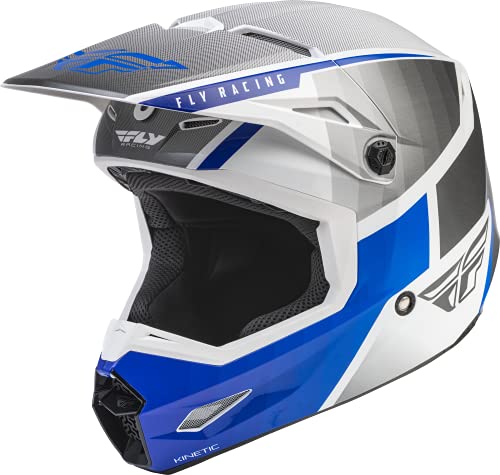
The Fly Racing Kinetic Drift makes a compelling case for the value end of the ATV helmet market in 2026, delivering a durable and lightweight polymer shell with dual-density EPS and graphics execution that punches well above its price point. The Blue/Charcoal/White colorway is genuinely eye-catching on the trail, and Fly Racing's design team has produced a finish that photographs well and holds up to repeated cleaning without fading or delaminating. The dual-density Expanded Polystyrene liner provides a meaningful improvement over single-density alternatives at similar prices, offering graduated energy absorption that handles the range of impact energies you realistically encounter on an ATV trail.
The polymer shell's durability advantage is real — while it weighs more than carbon fiber alternatives, it also tolerates scrapes, drops, and the incidental abuse of regular trail use without the surface cracking risk that plagues lighter materials. For riders who are hard on equipment, this resilience is a genuine practical benefit. Ventilation is functional rather than exceptional, which is a common characteristic of helmets at this price tier, but adequate for moderate-pace trail riding in most conditions.
If you're outfitting yourself for recreational trail riding, managing a budget across multiple riders in a family, or simply looking for a certified starting point before committing to a premium-tier investment, the Kinetic Drift is your answer. It covers the essential protection bases with a DOT-certified shell and gives you outstanding visual presence on the trail for a fraction of what you'd pay for the Fox or 6D options.
Pros:
Cons:
The O'Neal Sierra occupies a genuinely distinctive position in this roundup as the only helmet that pairs a Polycarbonate/ABS shell with a fully integrated, height-adjustable face shield — making it the natural choice for riders who prefer shield-based eye protection over separate goggles. The integrated shield eliminates the goggle fitment challenge that frustrates so many ATV riders, particularly those who switch between on-road and off-road environments where goggle management is inconvenient. The height-adjustable mechanism gives you real field-of-view control, and the Black/Gray XL finish is clean and conservative enough to work across casual and performance riding contexts.
The Polycarbonate/ABS shell construction is a proven and practical choice — less exotic than carbon fiber but thoroughly capable of meeting DOT certification requirements while offering excellent resistance to cracking under trail impact conditions. The integrated shield design does limit aftermarket customization compared to goggle-compatible open-face designs, but if you've already decided that a shield is your preferred eye protection format, the Sierra eliminates the compromise of adapting a dedicated motocross helmet for your preferences.
Experienced ATV riders who've dealt with goggle fogging, goggle frame pressure points, or the inconvenience of carrying separate eye protection will immediately understand the Sierra's value proposition. This is the practical rider's helmet — not the most technologically advanced option in the list, but the most functionally tailored for a specific rider profile that the other six helmets don't address at all.
Pros:
Cons:
The LS2 Subverter Evo rounds out this list with a genuinely impressive combination of shell technology and goggle accommodation that makes it the natural choice for riders who are particular about their goggle setup. The Kinetic Polymer Alloy (KPA) shell is LS2's proprietary high-performance composite that delivers strength and impact resistance characteristics closer to premium composites than to standard polycarbonate, at a weight that remains competitive with heavier carbon alternatives. The multi-density EPS liner uses graduated foam zones to manage impact energy across a broader range of collision speeds, which reflects sound engineering practice for the mixed-terrain scenarios that ATV riders typically encounter.
The wide eye port is the Subverter Evo's defining feature for goggle users — it accommodates most major goggle brands without the frame interference that causes pressure points or limited downward visibility in narrower eye port designs. If you've invested in premium goggles and have specific brands you won't compromise on, the Subverter Evo is the only helmet in this roundup that genuinely prioritizes your goggle choice over its own design aesthetic. The Matte Black finish is a universal color choice that matches any goggle colorway without coordination headaches. You can also find detailed safety gear comparisons in our broader automotive tools section for complementary riding equipment guidance.
For goggle-first riders who want a technically capable shell without paying premium-tier prices, the Subverter Evo delivers exactly the balance you're looking for. It's not the most protection-sophisticated helmet in the roundup, but it's the most thoughtfully designed for the real-world goggle preferences that define how most ATV riders actually configure their gear. If you're also shopping for a motorcycle helmet lock to secure your helmet during trail stops, that's a natural companion purchase to consider alongside any of the helmets in this guide.
Pros:
Cons:

The minimum bar for any ATV helmet you consider in 2026 is a DOT (Department of Transportation) certification meeting FMVSS 218 — this is the federal baseline for impact performance, penetration resistance, and retention system strength. DOT certification is the floor, not the ceiling. The ECE22.06 standard, which replaces the previous ECE22.05 spec, is widely recognized as the more demanding test protocol and covers rotational impact scenarios that DOT testing doesn't address. When you find a helmet that carries both DOT and ECE22.06 certifications — like the Fox Racing V3 RS — you're looking at a helmet that has been validated under the current state of the art in impact testing methodology. MIPS (Multi-directional Impact Protection System) adds rotational force management to the impact architecture; it's now a meaningful differentiator rather than a premium-only option, and you should prioritize it in any helmet that costs over $150.
Shell material determines impact performance, weight, and long-term durability in a way that no amount of interior foam engineering can fully compensate for. Carbon fiber offers the best strength-to-weight ratio available and is the choice for serious riders who want maximum protection with minimum fatigue — but it requires careful maintenance to preserve surface integrity. Tri-composite shells (carbon/fiberglass/Aramid, as used by 6D) split the difference between pure carbon performance and polycarbonate durability. Standard polycarbonate and ABS shells are heavier but more resistant to surface cracking from incidental contact, making them pragmatic choices for riders who are hard on equipment. Your target weight for a full-day ATV ride is under 1,500 grams — heavier helmets measurably increase neck fatigue over extended sessions, which affects alertness and reaction time on the trail.
ATV riding creates a ventilation challenge that road motorcycle riding doesn't — you spend significant time at low speeds, stopped, or in terrain where headwind-driven airflow through the helmet is minimal. Look for helmets with at least six total intake/exhaust ports, and prioritize designs that use an Air-Gap or channel system that maintains passive convection even without forward speed. The 6D ATR-2's 15-port system and the Troy Lee Designs GP's 16-port design both perform meaningfully better in slow-speed trail conditions than helmets that rely primarily on ram-air cooling from forward motion. If you ride in high-temperature environments — desert trails, southern summers — treat ventilation spec as a tier-one selection criterion rather than a secondary comfort consideration.
Proper fit is the single variable that controls how effectively any protection system performs — a helmet that moves on your head during an impact will deliver significantly degraded energy management regardless of its shell or liner specification. Measure your head circumference and compare against manufacturer sizing charts, and if possible, try before you commit. ATV helmets must accommodate goggles, and the eye port geometry determines which goggle brands fit without pressure points or restricted downward visibility — the LS2 Subverter Evo's wide eye port is the benchmark in this roundup for goggle compatibility. Emergency removal systems — particularly the Bell Moto-9S Flex's magnetic cheek pad design — are increasingly important considerations as first-responder awareness of these systems grows. If you ride in groups or on organized trails where emergency services might be involved, an easily removable cheek pad system is a meaningful safety upgrade.
At minimum, your ATV helmet must carry DOT certification meeting FMVSS 218 — this is the federal legal requirement for on-road use and the baseline safety standard for off-road helmets. The ECE22.06 certification is the current international benchmark and covers rotational impact scenarios that DOT testing doesn't address, so dual-certified helmets like the Fox Racing V3 RS offer you validated protection under a more comprehensive test protocol. If you ride in organized events or on public land where helmet standards may be specified, verify that your helmet meets the required certification before you go.
MIPS is a meaningful upgrade for ATV riding because the impact scenarios on trails — lateral tumbles, rollover events, glancing strikes from branches or rocks — generate significant rotational forces that standard EPS liners are not specifically designed to manage. The Fox Racing V3 RS uses the MIPS Integra Split system, which independently manages rotational force response through dual EPS layers, and this architecture reduces the rotational energy transferred to your brain during the kinds of angled impacts that are disproportionately common in ATV riding compared to on-road motorcycle use. For riders who push terrain limits or ride technically demanding trails, MIPS is worth the additional cost.
Industry consensus from major manufacturers and safety organizations is that you should replace your ATV helmet every five years regardless of visible condition, and immediately after any significant impact even if the helmet appears undamaged. EPS foam compresses during impact and does not rebound to its original density — a helmet that has absorbed a crash is no longer offering full protection even if the exterior looks intact. Modern helmets like the 6D ATR-2's rebuildable ODS system extend service life by allowing liner replacement after impacts rather than requiring full helmet replacement, which is a meaningful long-term value proposition that justifies its premium pricing.
You can legally use a DOT-certified motorcycle helmet for ATV riding in most jurisdictions, but ATV-specific helmets are engineered for the different risk profile of off-road riding — wider visors for goggle accommodation, more aggressive ventilation for low-speed terrain, and shell geometries designed for the lateral and rotational impacts characteristic of trail riding rather than primarily forward-direction road impacts. If you already own a quality motorcycle helmet that fits properly and carries current certification, it provides meaningful protection, but a dedicated ATV helmet will serve your specific riding environment more precisely.
Wrap a flexible tape measure around your head approximately one inch above your eyebrows, keeping the tape parallel to the floor and pulling it snug without compressing your hair significantly. Take this measurement in centimeters and compare it against the manufacturer's size chart for the specific helmet model — size charts vary between manufacturers and even between models from the same brand. When you put the helmet on, it should feel snug and even around your entire head with no pressure points, and it should not shift more than about one inch in any direction when you push it laterally or front-to-back. If you're between sizes, choose the smaller size for new helmets since the EPS liner will compress slightly during the break-in period.
Separate goggles are the traditional and most popular choice for ATV and motocross riding because they offer superior peripheral vision, greater ventilation, better customization for different light conditions via lens swaps, and compatibility with any open-face helmet. Integrated shields — as found on the O'Neal Sierra — offer the convenience of a single unified system and eliminate goggle fogging concerns in some conditions, but they trade ventilation performance and lens flexibility for that convenience. If you ride in varied conditions across different light levels and temperatures, goggles give you more adaptability; if you primarily ride in consistent conditions and prioritize simplicity, an integrated shield helmet is a legitimate choice.
 |
 |
 |
 |

About Liam O'Brien
Liam O'Brien has spent over a decade buying, field-testing, and evaluating automotive tools with a focus on what actually performs in a real DIY garage rather than what markets well on a spec sheet. His hands-on experience spans hand tools, diagnostic equipment, floor jacks, socket sets, and specialty automotive gear across a wide range of brands and price points. At CarCareTotal, he covers automotive tool and equipment reviews, garage setup guides, and buying advice for home mechanics.
Get some FREE car parts & gear.. Or check out the latest free automotive manuals and build guides here.
Disable your ad blocker to unlock all the hidden deals. Hit the button below 🚗
| | | |
