by Liam O'Brien
Motorcycle theft affects over 40,000 riders in the United States every year — and helmets are among the most commonly stolen items because they're easy to grab and worth serious money. A quality helmet runs $200 to $600 or more, which makes a $20–$40 lock an obvious investment. Yet most riders still leave their helmet dangling from a mirror or stuffed under their arm every time they park. In 2026, there's no excuse for that kind of risk when the options available are more secure, more versatile, and more compact than ever.
Choosing the right motorcycle helmet lock comes down to how you ride, where you park, and how much hassle you're willing to accept. Clamp-style locks bolt directly to your frame tubes and stay on the bike permanently. Cable and combination locks are ultraportable but trade some security for convenience. Keyed systems offer faster operation; combination locks mean one less key on your ring. The six products we tested for this guide cover all of those scenarios, so whether you're commuting in the city, touring long distance, or weekend riding in the suburbs, you'll find a clear recommendation here.
We put each lock through real-world evaluation: ease of installation, daily usability, resistance to obvious defeat methods, and build quality under weather and vibration. If you care about protecting your gear — and you should — the car and motorcycle accessories market has come a long way. Read on for the full breakdown.








If you want a set-it-and-forget-it solution, the Kuryakyn 4619 is the lock you buy once and never think about again. It clamps directly to your motorcycle's frame tubes, engine guards, or any cylindrical section measuring 1-1/4" to 1-1/2" in diameter. The gloss black finish is clean enough to look factory-installed on most bikes, and the tamper-proof security screws mean someone can't simply unscrew the bracket with a standard bit. Installation takes about ten minutes with basic tools, and once it's on, it's genuinely part of the bike.
In daily use, the Kuryakyn 4619 operates with a simple keyed barrel lock. You hook your helmet's D-ring or chin bar strap through the hasp, lock it, and walk away. There's no combination to remember, no cable to coil up, and no extra hardware to carry. The gloss black housing resists corrosion well, and the spring-loaded hasp snaps open and shut cleanly even after months of weather exposure. It's sized to fit most full-face, modular, and open-face helmets without issue.
The one trade-off here is commitment. This lock lives on your bike permanently — you can't transfer it to a rental or a friend's machine without a wrench. For riders who own one bike and want maximum day-to-day convenience, that's a non-issue. But if you ride multiple motorcycles, you'll need a lock per bike. At its price point and build quality, that's still a reasonable investment. This is the lock most touring riders and daily commuters end up choosing once they get tired of portable cable solutions.
Pros:
Cons:
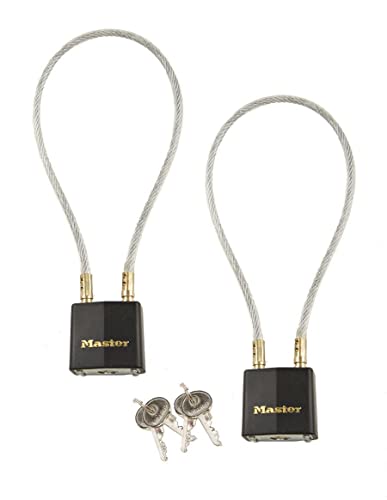
The KVAEY helmet lock punches well above its price class. The body is machined reinforced aluminum alloy — not the cheap zinc-pot casting you find on bargain locks — and the result is a unit that feels solid without being heavy. It mounts to your bike via included screws and works for standard handlebar or frame attachment points. The 2-key package means you have a spare from day one, which is the kind of practical thinking that earns user trust over time.
Beyond straight helmet locking, KVAEY built in genuine multi-purpose utility. The hooked hasp can carry a handbag, a small grocery sack, or even an umbrella — useful when you've got nowhere else to stash things and the trunk is full. That's not a gimmick; urban commuters will use that feature regularly. The lock mechanism itself is a keyed barrel with enough cylinder depth to resist basic picking attacks, and the alloy body won't crack under impacts that would split a plastic housing.
The optional 2-piece package adds a braided anti-theft cable, which extends your locking radius — handy if your bike's attachment point is set back from where the helmet strap naturally hangs. For riders who want solid construction without spending Kuryakyn money, this is the clear pick. It won't win on premium fit and finish, but it handles the core job reliably and adds real-world versatility that more expensive locks lack.
Pros:
Cons:
Master Lock has been in the security hardware business since 1921, and the #99KA is a product that reflects decades of refinement. This is a dedicated helmet lock designed to clamp onto your bike's frame, handlebars, or passenger grab rails. What makes the 99KA stand apart from generic helmet locks is the keyed-alike purchasing option: you can buy up to four 2-packs (eight locks total) that all operate on the same key. For riders who run multiple bikes or want one key for the whole household's motorcycles, that's a significant practical advantage.
The lock body itself is compact and purpose-built. Master Lock's cylinder is a known quantity — it's not going to win awards for high-security pick resistance, but it's far beyond what a casual opportunist carries on a parking lot walkthrough. The mounting design is straightforward, the hasp is sized for most helmet chin bars and D-rings, and the overall build quality is consistent with what you'd expect from a brand that puts its name on every hardware store shelf in America. It's also weather-resistant enough for year-round riding in most climates.
The keyed-alike system is where this lock earns its recommendation. If you and your riding partner both own bikes, or if you're a mechanic who manages a fleet of bikes at a shop, ordering matched sets eliminates key confusion entirely. One key. All your locks. Master Lock handles the fulfillment when you purchase directly from them — something worth noting since marketplace sellers can't guarantee matching.
Pros:
Cons:
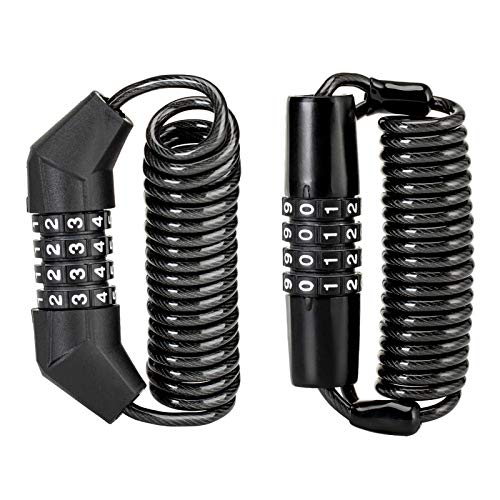
The ROCKBROS 4-Digit Cable Lock is the answer for riders who don't want anything permanently mounted to their bike. It's a coiled cable lock with a 4-digit resettable combination — no keys to lose, no mounting hardware to install, and it weighs almost nothing in a jacket pocket. The cable itself is 4.6mm diameter PVC-coated steel, thick enough to deter casual tampering and protected against scratching your helmet's paint or finish. You get two in the pack, which means one for each helmet if you're riding with a passenger regularly.
Setting your combination is straightforward — the collar-turn method described in the manual works as advertised, and it only takes a minute. ROCKBROS is right that you should photograph your code; it's good advice for any combination lock. In daily use, the coiled design extends to wrap around a grab rail, mirror stalk, or seat latch, and retracts compactly when you stow it. The 4-digit code space (10,000 combinations) is meaningfully more secure than 3-digit alternatives without adding significant complexity.
This lock is honest about what it is: a deterrent against opportunistic theft, not a high-security solution. No cable lock in this size and price range stops a determined thief with bolt cutters. But the reality is that most helmet theft is opportunistic — someone walking past a parking lot decides to grab an easy target. A cable lock that takes 30 seconds to cut is still far more protection than no lock at all, and the dual-pack value makes this especially practical for commuter pairs or riders who share a garage with a family member. If you also ride with dogs in tow, you might appreciate gear that's similarly lightweight and practical — check out our picks for the best dog car seats for your vehicle too.
Pros:
Cons:
Hiplok builds the Z LOK Combo for riders and cyclists who are tired of carrying a lock that weighs more than their snack. This is a security tie-style lock — think of it as an evolved twist tie with a reinforced steel core inside a flexible polymer sleeve. At 45cm of locking length, it handles most helmet chin bar and strap configurations cleanly, and the 3-digit resettable combination means you're never hunting for a key. The blue colorway is distinctive, which means you'll never confuse it with another piece of kit in your bag.
The Z LOK format is genuinely different from traditional cable or clamp locks, and it earns its place in this category for specific use cases. It coils flat, weighs almost nothing, and stores in a jersey pocket, handlebar bag, or jacket zippered pocket without any bulk. For adventure touring riders who travel ultralight, or cyclists who also ride motorcycles and want one lock across both disciplines, the Z LOK is uniquely practical. The optional bracket accessory lets you mount it to a bike frame when you want dedicated storage.
Security-wise, be honest with yourself: the Z LOK is a lightweight deterrent lock. The steel core resists a casual tug but isn't engineered for sustained attack. Hiplok positions it correctly as a "security tie" — it's for situations where you're stepping away briefly and want something between your helmet and no protection at all. For high-crime areas or overnight parking, combine it with a more substantial solution. For everything else — café stops, quick errands, event parking — the Z LOK is the most convenient helmet security option in 2026.
Pros:
Cons:
The Urban UR140 earns the versatility award outright. It ships as a complete kit: a 4-digit combination carabiner lock, a T-buckle helmet adapter for quick-release attachment, and a braided steel security cable. Three locking methods in one package means you can adapt to almost any parking situation without carrying separate gear. The carabiner body has rubber protection around the gate to prevent scratching your helmet's shell or visor — a small detail that reflects genuine product thinking.
The T-buckle adapter is the standout feature. It clips directly into your helmet's chin strap system (works with most quick-release and micrometric buckles), so you don't have to thread a cable through the D-ring or chin bar awkwardly. This speeds up the lock-and-go process considerably, which matters when you're parking in a busy urban area and don't want to fiddle with hardware. The braided steel cable extends your reach to handlebars, frame rails, or street furniture when your bike's natural attachment points aren't accessible.
The 4-digit combination gives you 10,000 possible codes and is resettable to your preference. The carabiner gate is rated for practical load, and the whole assembly is compact enough to clip to your belt loop or bag when you're not using it. If you ride different bikes, travel by multiple modes of transport, or just want one lock that handles every scenario, the UR140 delivers without compromise. It's the lock we'd recommend to a new rider who isn't sure yet what their riding patterns will look like — it adapts as you do. Speaking of adapting your ride setup, it pairs well with other smart accessories; our guide to the best OBD2 scanners covers another category worth investing in for 2026.
Pros:
Cons:

The market has expanded considerably in 2026, but the core buying criteria haven't changed. Here's what actually matters when you're choosing between options.
Your first decision is lock type, and it's driven by how you ride. Permanent clamp locks (like the Kuryakyn 4619 and KVAEY) bolt to your frame and offer the cleanest daily experience — helmet on, helmet off, done. They require compatible frame tube diameters and one-time installation, but after that, convenience is hard to beat. Cable and combination locks (ROCKBROS, Urban UR140) are completely portable and work with any bike you happen to ride. Security-tie designs (Hiplok Z LOK) sit at the ultralight extreme — maximum portability, minimum bulk, some security trade-off.
If you own one bike and ride it daily, a clamp lock is the right call. If you split time between multiple bikes, rent machines on trips, or want flexibility, go portable. Most serious riders eventually own one of each: a clamp lock for their daily rider and a cable lock in their jacket for everything else.
Be realistic about your threat model. According to NHTSA, the vast majority of motorcycle theft — including helmets — is opportunistic rather than planned. A determined thief with the right tools can defeat any helmet lock available at consumer price points. What you're really defending against is the person who walks past your bike and grabs the easiest target available. Any lock that requires more than 30 seconds and dedicated tools to defeat will send most opportunists to the next unlocked helmet.
That said, there's a meaningful difference between a 3-digit (1,000 combinations) and 4-digit (10,000 combinations) code lock. Tamper-proof mounting screws on clamp locks matter if you're concerned about the bracket being removed entirely. Braided steel cable resists cutting better than standard steel wire. These differences don't make any lock theft-proof — they make your helmet a less attractive target than someone else's.
Clamp-style locks specify compatible tube diameters — the Kuryakyn 4619, for example, requires 1-1/4" to 1-1/2" diameter tubes. Measure your frame tubes, engine guards, or grab rails before ordering. For cable and carabiner locks, check whether the cable reach is long enough to span your bike's locking point to your helmet's chin bar or D-ring — most are adequate, but compact sportbikes with minimal frame furniture can challenge short cables. If you're using a T-buckle adapter like the one included with the Urban UR140, verify your helmet's buckle type (standard snap buckle vs. micrometric vs. D-ring) matches the adapter design.
A helmet lock lives outside, on a motorcycle, in all weather. The lock cylinder needs to resist rain intrusion and corrosion. Aluminum alloy bodies handle this better than zinc alloy or plastic. Keyed cylinders should have protective dust covers or weather seals. PVC coating on cables prevents both corrosion and finish scratching. If you ride through winter or in high-humidity environments, check for weatherproofing specifically — budget locks that look fine in summer can seize or corrode within a season of wet-weather use. The same attention to durability applies to other bike accessories; it's worth reading our guide to the best jumper cables if you're building out your roadside kit too.

They prevent opportunistic theft — which is the most common kind. A locked helmet requires dedicated tools and time to steal, which most casual thieves won't commit to. No helmet lock at consumer price points stops a determined professional with the right tools, but locking your helmet makes you a harder target than the unlocked helmet two spaces away. That's enough protection for the vast majority of real-world situations.
Permanent clamp-style locks with tamper-proof mounting hardware (like the Kuryakyn 4619) offer the most resistance because they integrate directly with the bike's frame and can't be removed without defeating both the lock cylinder and the mounting screws. Among portable options, 4-digit combination locks with braided steel cables outperform 3-digit or standard steel wire alternatives. Security is always a spectrum — layer your protection if your area has elevated theft risk.
Portable cable locks and carabiner-style locks (like the ROCKBROS and Urban UR140) work on virtually any motorcycle, bicycle, or even luggage rack. Clamp-style locks require compatible frame or engine guard tube diameters. Always check the specified diameter range before purchasing a clamp lock — most cover 1-1/4" to 1-1/2", which handles most cruisers and touring bikes, but sportbikes with smaller diameter frame tubes may not be compatible.
Look beyond the obvious. Grab rails, passenger footpeg mounts, luggage rack bases, and seat latch bolts all make viable anchor points for cable locks. Engine guards on cruisers are ideal for clamp-style locks. For sportbikes with minimal frame furniture, a carabiner lock with an extended cable (like the Urban UR140 kit) gives you enough reach to work with smaller or more recessed anchor points. If you're genuinely stuck, a portable combination cable wrapped through the helmet's chin bar and around a handlebar is always a fallback.
It depends on your habits. Keyed locks (Kuryakyn, KVAEY, Master Lock 99KA) are faster to operate and don't require remembering a code — but lose the key and you have a problem. Combination locks (ROCKBROS, Hiplok, Urban UR140) eliminate that risk and let you share access without handing over a physical key. The Master Lock 99KA's keyed-alike purchasing option is the best of both worlds for multi-bike households: one key, multiple locks, maximum convenience.
The Urban UR140 or the Hiplok Z LOK Combo. Both are compact enough to pack without consuming meaningful space, work on rental bikes and hotel bike racks, and don't require any installation. The UR140 edges ahead for most touring riders because the three-way locking system (carabiner, cable, T-buckle) adapts to whatever anchor points you encounter on the road. The Hiplok Z LOK wins if weight is your absolute priority — ultralight touring, adventure riding, or cycling segments between moto legs.
 |
 |
 |
 |

About Liam O'Brien
Liam O'Brien has spent over a decade buying, field-testing, and evaluating automotive tools with a focus on what actually performs in a real DIY garage rather than what markets well on a spec sheet. His hands-on experience spans hand tools, diagnostic equipment, floor jacks, socket sets, and specialty automotive gear across a wide range of brands and price points. At CarCareTotal, he covers automotive tool and equipment reviews, garage setup guides, and buying advice for home mechanics.
Get some FREE car parts & gear.. Or check out the latest free automotive manuals and build guides here.
Disable your ad blocker to unlock all the hidden deals. Hit the button below 🚗
| | | |
