Audio ›
by Joshua Thomas
The Pioneer TS-A1681F earns our top recommendation for budget car speakers in 2026, delivering 4-way sound separation and 350W peak power at a price point that undercuts most 2-way competitors. If you are shopping for a factory speaker upgrade, this is where to start.
Replacing worn-out OEM speakers remains one of the highest-impact car audio upgrades you can make per dollar spent. Factory units typically use paper cones, minimal magnets, and single-driver designs that roll off sharply above 10 kHz. Even a modest aftermarket coaxial set will extend frequency response, improve sensitivity, and handle significantly more power from your head unit or external amplifier. The 6.5-inch form factor dominates the budget segment because it fits the widest range of vehicles without custom fabrication — most sedans, trucks, and SUVs from the last two decades accommodate this size in at least one location.
We evaluated seven 6.5-inch speaker sets across power handling, frequency response, build quality, ease of installation, and real-world listening performance. Every model here costs well under $100 per pair, yet the engineering differences between them are substantial. Whether you prioritize raw output, tonal accuracy, or drop-in simplicity, this guide will help you identify the right fit for your vehicle and listening preferences.
Contents






The Pioneer TS-A1681F is the only 4-way design in this roundup, and that architectural advantage is immediately audible. Dedicated drivers for bass, midrange, high-mid, and treble frequencies allow each range to be reproduced without the crossover compromises inherent in 2-way coaxials. The result is a soundstage that feels more layered and three-dimensional than anything else at this price tier. With 350W peak and 80W continuous power handling, these speakers scale well whether you are running them off a head unit or feeding them with a dedicated amplifier channel.
Frequency response stretches from 35 Hz to 29 kHz — an impressively wide bandwidth that captures sub-bass rumble and ultrasonic harmonics alike. In practice, the low end is tighter and more controlled than what you typically hear from budget speakers, though dedicated subwoofer integration would still benefit listeners who favor bass-heavy genres. The treble presentation is smooth rather than harsh, avoiding the sibilant peaks that plague many inexpensive tweeters.
Pioneer includes installation adaptors in the box, which streamlines fitment across a broad range of vehicles. The mounting depth is manageable for most door cavities, though you should verify clearance if your vehicle has shallow door panels. Build quality is solid — the basket and magnet assembly feel robust, and the cone material resists moisture well in humid climates.
Pros:
Cons:
Kenwood has long been a trusted name in aftermarket car audio, and the KFC-1666S demonstrates why. This 2-way coaxial pairs a polypropylene woofer with a treated cloth surround and a 1-inch PEI balanced dome tweeter — a combination that prioritizes tonal accuracy over raw volume. The woofer cone material is stiff enough to minimize distortion at moderate volumes yet flexible enough to produce a natural midrange. If you listen to acoustic music, podcasts, or vocal-heavy genres, the Kenwood rewards you with an even-handed presentation that does not favor any particular frequency band.
The treated cloth surround is a notable design choice at this price point. Foam surrounds, which are more common in budget speakers, degrade over time from UV exposure and temperature cycling. Cloth is more durable in automotive environments and maintains consistent compliance over years of use. The PEI tweeter handles the high end without becoming fatiguing — a real concern when you are spending hours behind the wheel. Kenwood also includes grilles, which protect the cones from accidental contact during installation and everyday use.
Installation is straightforward. The mounting dimensions match standard 6.5-inch cutouts, and the wiring connections use standard spade terminals that mate easily with factory harness adapters. Power handling is adequate for head unit use but not exceptional — heavy amplifier loads would be better served by a speaker with higher RMS capacity.
Pros:
Cons:
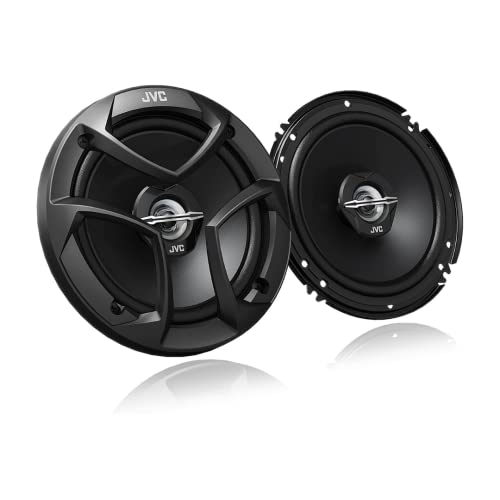
The JVC CS-J620 consistently ranks among the best-selling budget car speakers, and the reason is simple: it delivers competent performance at an aggressively low price. The 6.5-inch mica cone woofer paired with a 1-inch PEI tweeter produces a sound signature that punches above its weight class. Mica-reinforced cones are stiffer than standard paper, which translates to reduced distortion and better transient response — you hear the attack of a kick drum more cleanly, and vocal consonants are rendered with greater precision.
Sensitivity is rated at 92 dB, which is among the highest in this roundup. High sensitivity means these speakers extract more volume from a given wattage input, making them an ideal choice if you are running them directly from a factory head unit without an external amplifier. The frequency response spans 35 Hz to 22 kHz — narrower than the Pioneer at the top end but still more than adequate for the vast majority of recorded music. The hybrid surround construction blends rubber and cloth for a balance of flexibility and longevity.
At 300W peak and 30W RMS, the power handling numbers suggest that these speakers are optimized for low-power sources. They will not tolerate sustained high output from a powerful amplifier. But for the buyer who simply wants a meaningful upgrade over stock speakers without investing in additional amplification, the CS-J620 is hard to beat. The black ABS composite grills add a clean aesthetic touch while protecting the drivers. Consider pairing these with a quality car seat protector and other interior upgrades for a complete cabin refresh.
Pros:
Cons:

BOSS Audio has built its reputation on accessibility, and the CH6530 embodies that philosophy. This 3-way coaxial delivers 300W peak power through a dedicated woofer, midrange driver, and tweeter — a driver complement that splits the difference between the Pioneer's 4-way design and the simpler 2-way configurations elsewhere in this list. The 3-way crossover network distributes frequencies across these drivers more effectively than a 2-way can, resulting in better midrange presence without sacrificing treble clarity.
The installation story is where the CH6530 truly shines. With a mounting depth of just 2.1 inches and a 5.5-inch mounting hole, these speakers fit into tight door cavities that would reject deeper-bodied competitors. The 4-ohm impedance matches virtually every factory and aftermarket head unit. At 6.6 x 6.6 x 2.4 inches overall, the form factor is compact and predictable — you are unlikely to encounter clearance issues with window regulators or door mechanisms. For first-time installers or anyone who wants a quick swap without custom modifications, this is one of the simplest upgrades available.
Sound quality is respectable but not class-leading. The CH6530 prioritizes volume and coverage over nuanced detail. It fills the cabin with sound effectively, but critical listeners may notice a slight harshness in the upper midrange at higher volumes. For commuting, casual listening, and background music, however, the performance is more than adequate relative to the price.
Pros:
Cons:
KICKER has earned its loyal following through decades of building car audio products that simply work, and the DSC650 carries that tradition forward. These 6.5-inch coaxials feature polyethylene naphthalate (PEN) domed tweeters — a material that offers superior rigidity and thermal stability compared to standard PEI or mylar domes. PEN tweeters maintain their shape and acoustic properties even under sustained high-temperature conditions inside a sealed car door, which makes them a smart long-term investment.
The woofer cone construction delivers a sound profile that KICKER fans will recognize: punchy, forward, and slightly warm. The low end has genuine impact without becoming boomy, and the midrange sits in a natural pocket that works well with everything from rock and hip-hop to talk radio. Imaging is respectable for a coaxial design, with the tweeter positioning contributing to a reasonably wide soundstage that does not collapse when you move your head position.
Where the DSC650 stands out from lesser-known brands is in consistency and quality control. KICKER's manufacturing standards mean you are less likely to receive a unit with imbalanced drivers, rattling voice coils, or premature surround failure. The 4-ohm impedance is universally compatible, and the speaker's power handling sits comfortably in the range where both head units and modest amplifiers can drive them effectively. If you value peace of mind and brand accountability alongside your audio performance, these deserve serious consideration.
Pros:
Cons:
Skar Audio has carved out a niche by delivering serious power handling at budget prices, and the RPX65 exemplifies that approach. With 60W RMS per pair (30W per speaker), these coaxials handle continuous power better than the JVC and compete closely with speakers costing significantly more. The 1-inch KSV voice coil is a key part of this capability — KSV (Kapton Silicon Voice) coils tolerate higher temperatures than standard copper-wound designs, which means less thermal compression and more consistent output during extended listening sessions.
The microfiber paper mid-woofer cone paired with a butyl rubber surround is an interesting material choice. Microfiber paper is lighter than polypropylene, which improves transient response and efficiency. The butyl rubber surround is more resistant to environmental degradation than foam, providing long-term durability in the harsh conditions inside a car door — temperature swings, moisture, and vibration. The sonic character leans toward a warm, slightly bass-forward presentation that complements most popular music genres without becoming muddy.
Skar packages these as a pair with straightforward mounting hardware. The fitment is standard 6.5-inch, and the 4-ohm impedance ensures compatibility across the board. For buyers who plan to add an amplifier down the road, the RPX65's higher RMS handling provides headroom that cheaper speakers simply cannot match. Just as you would protect your vehicle's paint with a quality car wax, investing in speakers that tolerate real power protects your audio investment as your system evolves.
Pros:
Cons:
MTX engineered the THUNDER65 with two features that directly address the acoustic challenges of car interiors: a concave cone design and a pivoting tweeter. Most car speakers fire into the footwell, a door panel, or a dashboard surface rather than directly at your ears. The concave cone shape widens the sound dispersion pattern, ensuring that the midrange and bass frequencies reach you more evenly regardless of mounting angle. This is a meaningful engineering advantage that most budget competitors simply do not address.
The pivoting tweeter takes this concept further. It can rotate up to 15 degrees in any direction, allowing you to aim the high frequencies toward the listening position during installation. Proper tweeter aim dramatically improves imaging and soundstage — the stereo image snaps into focus, instruments occupy distinct positions in the mix, and the overall presentation sounds less like speakers bolted into doors and more like a cohesive audio environment. For vehicles where the speaker mounting positions are particularly awkward, this feature alone justifies choosing the THUNDER65 over its peers.
Power handling sits at 120W peak and 60W RMS per speaker, with a polypropylene cone and a frequency response of 48 Hz to 20 kHz. The low-end extension starts higher than some competitors, which means the THUNDER65 rolls off bass earlier — a worthwhile tradeoff if you are pairing these with a subwoofer, but noticeable if you are running them as your sole low-frequency source. The 2.063-inch mounting depth is shallow enough for most applications, and MTX's extended low-frequency reproduction tuning squeezes respectable bass from the available cone area. If you also use your vehicle for road trips, you might appreciate having a solid car phone holder mounted alongside your upgraded audio for hands-free navigation.
Pros:
Cons:
The number of "ways" refers to how many distinct driver types handle different frequency bands. A 2-way coaxial uses a woofer and tweeter. A 3-way adds a dedicated midrange driver. A 4-way splits the spectrum even further. More drivers generally mean smoother frequency transitions and reduced distortion, because each driver operates within a narrower bandwidth where it performs optimally. However, more drivers also increase cost and complexity. For most budget buyers, a well-designed 2-way coaxial delivers excellent results. If you can stretch to a 4-way like the Pioneer TS-A1681F, the improvement in midrange detail and treble smoothness is audible.
Peak power ratings are marketing numbers — they represent the maximum instantaneous burst a speaker can survive, not sustained operating power. RMS (root mean square) is the figure that matters for real-world use. A speaker rated at 300W peak but only 30W RMS will distort and potentially fail if you feed it 100W continuously. Match your speaker's RMS rating to your amplifier's output. If you are running speakers off a head unit (typically 15-22W RMS per channel), virtually any speaker in this roundup will perform well. If you plan to add an amplifier later, prioritize speakers with higher RMS ratings — the Skar RPX65 and MTX THUNDER65 offer the best headroom in this group.
Sensitivity, measured in decibels (dB), indicates how loud a speaker plays at a given power input. A speaker rated at 92 dB will sound noticeably louder than one rated at 86 dB when both receive the same wattage. For head-unit-only systems without external amplification, high sensitivity is critical — it is the most direct path to more volume without adding hardware. Impedance should be 4 ohms for compatibility with the vast majority of head units and amplifiers. All seven speakers in this roundup are 4-ohm designs.
The woofer cone material shapes the speaker's sonic character. Polypropylene is the most common budget choice — lightweight, moisture-resistant, and durable. Mica-reinforced cones (like the JVC CS-J620) add rigidity for improved transient response. Microfiber paper (Skar RPX65) is lighter still but less moisture-resistant. The surround — the flexible ring connecting the cone to the basket — affects both longevity and sound. Butyl rubber and treated cloth surrounds outlast foam by years in the hostile environment inside a car door, where temperatures routinely swing between freezing and 150°F. If you live in a hot or humid climate, avoid foam surrounds entirely.
Not necessarily. Most budget coaxial speakers are designed to work with factory head units that output 15-22W RMS per channel. High-sensitivity speakers like the JVC CS-J620 (92 dB) extract maximum volume from low-power sources. However, adding even a modest 4-channel amplifier will unlock cleaner sound at higher volumes, better bass control, and greater dynamic range. If your head unit has preamp outputs, amplifier integration is straightforward.
A basic installation requires a Phillips screwdriver, a panel removal tool (or flat trim pry tool), wire strippers, crimp connectors or solder with heat shrink, and electrical tape. Most vehicles also require a vehicle-specific wiring harness adapter and mounting bracket adapter — both are inexpensive and available for virtually every make and model. A multimeter helps verify polarity if your factory wiring is not color-coded.
Most 6.5-inch aftermarket speakers fit standard 6.5-inch (165mm) factory locations with the help of mounting bracket adapters. Some vehicles may require minor trimming of the mounting ring or spacer rings to accommodate deeper speaker baskets. Check your vehicle's mounting depth — the distance from the mounting surface to the nearest obstruction (window regulator, door skin) — against the speaker's published mounting depth before purchasing.
With proper installation and no sustained over-driving, budget car speakers typically last 3-7 years. The surround material is usually the first component to fail — foam surrounds degrade in 3-4 years in harsh climates, while butyl rubber and treated cloth surrounds can last 7+ years. Avoiding clipping (distortion from an underpowered amplifier or head unit pushed to maximum volume) is the single most important factor in speaker longevity.
Coaxial (full-range) speakers mount the tweeter directly on top of the woofer in a single unit, making installation simple and cost-effective. Component speakers separate the tweeter, woofer, and external crossover into individual pieces, allowing the tweeter to be mounted at ear level for superior imaging and soundstage. Component systems deliver better audio quality but cost more and require more complex installation. Every speaker in this roundup is a coaxial design, which is the standard for budget upgrades.
You can, but it is not ideal. Different brands use different cone materials, crossover slopes, and voicing philosophies, which can result in an uneven tonal balance between the front and rear of the cabin. For the most cohesive sound, use the same model in all positions. If you must mix, keep the same brand in the front pair (which dominates your listening experience) and use the secondary brand in the rear fill positions.
Spend your budget on sensitivity and surround quality, not peak wattage — a speaker that sounds clean at head-unit power will always outperform one that needs an amplifier it will never receive.
 |
 |
 |
 |

About Joshua Thomas
Joshua Thomas holds a Bachelor of Science in Mechanical Engineering from San Diego State University and has spent years applying that technical foundation to hands-on automotive work — from routine maintenance to full mechanical repairs. He founded CarCareTotal in 2017 to give car owners the kind of clear, practical guidance that helps them understand what is happening under the hood and make smarter decisions about upkeep and repairs. At CarCareTotal, he oversees editorial direction and covers automotive fundamentals, maintenance guides, and troubleshooting resources for everyday drivers.
Get some FREE car parts & gear.. Or check out the latest free automotive manuals and build guides here.
Disable your ad blocker to unlock all the hidden deals. Hit the button below 🚗
| | | |
