by Joshua Thomas
Which car seat toy will actually keep your baby calm, engaged, and developing new skills during every ride — and which ones are just expensive clutter that end up on the floor of your back seat? If you have spent any time scrolling through product pages trying to figure out the difference between a crinkle toy and a sensory arch, you know the struggle is real. After evaluating dozens of options on the market in 2026, one product stood out above the rest: the Lamaze Clip On Car Seat and Stroller Toy — Freddie the Firefly, a sensory-rich classic that delivers genuine developmental value for newborns and infants through the first year.
Car seat toys serve a purpose that goes well beyond keeping your little one quiet on long drives. According to research supported by the American Academy of Pediatrics, the first twelve months of life represent one of the most critical windows for sensory development, visual tracking, and fine motor skill acquisition — and the right toy placed within reach can meaningfully accelerate those milestones. A well-designed car seat toy engages high-contrast vision, introduces varied textures and sounds, and gives babies something purposeful to reach for and manipulate, all while they are already strapped in and ready to go. When you are a parent managing errands, school runs, or longer road trips, having a reliable source of stimulation clipped to the car seat handle is genuinely life-changing. And if you are also looking to upgrade your vehicle's interior for family life, you might appreciate our guide to the best car carpet stain removers of 2026 — because where babies go, messes follow.
In this guide, you will find in-depth reviews of the seven best car seat toys available in 2026, a focused buying guide covering the features that actually matter, and answers to the most common questions parents ask before purchasing. Whether your baby is a newborn at zero months or an active sitter at nine months-plus, there is a pick on this list that fits your needs and your budget precisely.
Contents





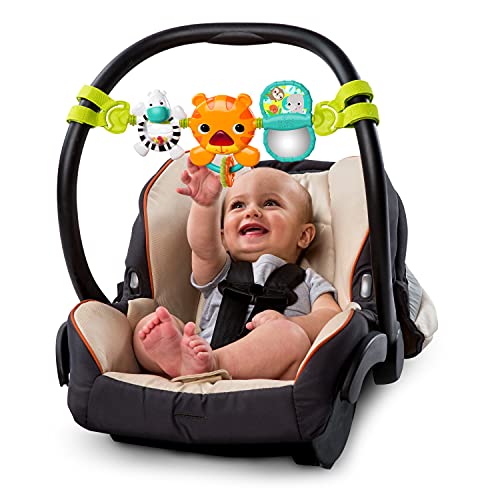


The Lamaze Freddie the Firefly has been a gold-standard car seat toy for years, and in 2026 it continues to earn that reputation through a combination of thoughtful sensory design and real developmental utility. Freddie clips securely onto car seat handles, stroller bars, and activity gyms with a sturdy plastic clasp that holds firm even when your baby is tugging and shaking with full infant enthusiasm. The toy packs a remarkable range of sensory input into a compact form: crinkle textures on the wings, a tethered ladybug teether, a built-in mirror that babies can make faces at, and high-contrast patterns that are specifically calibrated for the limited visual acuity of a newborn. The mirror attachment is particularly valuable for early visual development, giving your baby a surface to focus on, track, and eventually recognize as a reflection of themselves.
From a build quality standpoint, this toy is exceptionally durable and parent-friendly. The fabrics are machine washable, which matters enormously when you factor in how much drool and general mess accumulates on anything within arm's reach of a baby. The clip mechanism is tight enough to prevent accidental detachment during bumpy rides while still being manageable for parents to install and remove one-handed. Freddie also comes bundled with a ladybug teether — a separate tactile element that introduces a second texture and shape for your baby to explore, extending the useful life of the toy well into the teething months. For parents who want a single, multi-functional attachment that earns its place in the car from day one through the first year, this is the pick you will reach for every time.
The developmental value here is genuine and research-aligned: the high-contrast black-and-white and primary-color patterns are designed around what babies can actually perceive in their first weeks of life, and the combination of visual, tactile, and auditory stimulation in a single toy reflects the kind of multi-modal engagement that pediatric developmental specialists consistently recommend. If you are starting from scratch and need just one car seat toy, start here.
Pros:
Cons:
The Manhattan Toy Wimmer Stim Mobile to Go is one of the most deliberately scientific car seat toys available in 2026, designed from the ground up around research on neonatal visual development. The product centers on six high-contrast graphic cards that attach to a lightweight, portable mobile frame you can clip to a car seat handle or stroller bar. These cards are not arbitrary patterns — the black-and-white and bold primary-color designs are drawn from decades of research into what newborn eyes can distinguish and track in the earliest weeks of life, when babies have only limited visual acuity and are most stimulated by extreme contrast rather than nuanced color.
The mobile's compact and lightweight construction is genuinely travel-friendly in a way that larger, bulkier activity arches are not. You can pack the graphic cards flat in a diaper bag, reassemble the mobile in seconds, and rotate the cards to introduce fresh patterns as your baby's visual capabilities advance, which typically happens rapidly during the first three months. Manhattan Toy has built a strong reputation for research-backed infant products, and this mobile reflects that commitment clearly — the card designs are not decorative guesses but purposefully sequenced stimulation tools. The frame itself is sturdy for its weight class and holds the cards at a consistent, viewable angle even when the car is moving.
Where the Wimmer Stim Mobile pulls slightly ahead of simpler clip-on toys for newborns specifically is in the card-rotation feature, which lets you keep the stimulation fresh rather than presenting the same pattern every ride. It is a narrower product than Freddie the Firefly in terms of age range — once your baby can grab and manipulate objects, the non-tactile card format becomes less engaging — but as a dedicated newborn visual development tool for the first three months, it is unmatched in its category.
Pros:
Cons:
Skip Hop's Silver Lining Cloud Jitter is one of the most charming and sensory-complete car seat toys you will find in the market in 2026, and it delivers a density of engagement features that far exceeds its modest footprint. The central character — a plush, two-sided cloud with a friendly illustrated face — vibrates and shakes when the teether handle is pulled, producing a gentle jittering motion that babies find endlessly fascinating. That pull-to-activate mechanism is not just entertaining; it directly trains cause-and-effect understanding, which is a foundational cognitive milestone in the first six months of life.
Beyond the central vibration feature, Skip Hop has loaded this toy with additional sensory layers that cover every major developmental modality. A crinkle raindrop produces auditory feedback when squeezed, a sun flap with a contrasting texture invites tactile exploration, a star squeaker offers another sound source, and ribbon accents give curious fingers something to pinch and pull. The neon color pops throughout the design are intentional — bright, saturated hues fall within the visual range that infants can perceive and are attracted to before they can fully appreciate softer, more complex color palettes. The built-in loop attaches easily to stroller bars, infant carriers, and car seat handles without any additional hardware.
The build quality reflects Skip Hop's premium positioning in the infant product market. Stitching is tight, the plush surface holds up to repeated washing, and the vibration mechanism remains functional even after the kind of sustained yanking that determined babies are fully capable of delivering. If you are looking for a single toy that covers tactile, visual, auditory, and cause-and-effect development in one compact, clip-on package, the Cloud Jitter is your answer. For parents who like to coordinate their car accessories carefully, Skip Hop's design aesthetic is also consistently clean and modern — a minor point, but one worth noting if you care what your car's interior looks like on the whole.
Pros:
Cons:
Once your baby hits the nine-month mark and the simpler clip-on toys start losing their power to hold attention, the Fisher-Price Link Squad Bop & Groove Tiger steps in with the kind of interactive, high-stimulation experience that older infants genuinely need. This tiger-themed learning toy brings together more than fifty songs, sounds, and phrases covering body parts, the alphabet, and colors — a content library broad enough to stay fresh across many car rides, rather than repeating the same three jingles on every trip. The head-bop feature activates on button press and creates a rhythmic physical response that babies at this stage find deeply satisfying and predictable, which is exactly what developmental psychologists describe as the scaffold for early musical and rhythmic intelligence.
The light-up microphone is a standout feature that syncs its flashing pattern to the beat of whatever song is playing, giving your baby a visual anchor for the auditory rhythm — a multi-sensory pairing that is more sophisticated than anything you find on simpler infant toys. The record-and-playback function adds a social dimension: you can record your voice saying your baby's name or a simple phrase, and the tiger plays it back, which tends to produce the kind of delighted, sustained engagement that makes long car rides genuinely manageable. Fisher-Price built this toy as part of the Link Squad ecosystem, meaning it connects with other items in the line, though it functions completely as a standalone product as well.
The build is solid and Fisher-Price's quality control at this price point is consistently reliable, with buttons that remain responsive and audio that stays clear after extended use. You do need to manage the volume — fifty-plus songs at full volume in a small car is an experience you will want to moderate — but the included volume control handles that cleanly. This is the toy to move to when your infant starts actively demanding more complex cause-and-effect interactions, and it bridges the gap between early sensory toys and pre-toddler learning toys with genuine skill.
Pros:
Cons:
If you want a car seat toy that functions more like a full activity station than a single clip-on attachment, the Bright Starts Take Along Musical Carrier Activity Toy Bar is the most complete single-purchase solution available from a major brand in 2026. Rather than attaching at a single point, this toy spans across the car seat handle as a full bar, positioning multiple interactive elements within your baby's field of vision and reach simultaneously. The centerpiece is a tiger character whose nose lights up and plays four distinct melodies when pressed — a simple and reliable cause-and-effect mechanic that works from the earliest months and continues to engage infants well into the first year as they develop more intentional button-pressing behavior.
The spinning zebra roller ball with colorful rattle beads embedded inside is the tactile and fine motor highlight of this toy, giving babies something to grasp, spin, and shake that produces both visual movement and auditory feedback from a single action. This kind of multi-output response from a single gesture is particularly effective for the four-to-seven-month range, when babies are actively practicing coordinated hand use and developing an understanding that their actions have predictable consequences. The bar's design also positions elements at slightly different heights and distances, which naturally encourages babies to reach and shift their gaze — exactly the kind of active exploration that supports spatial awareness development.
Bright Starts has kept the installation straightforward: the toy hooks over the car seat handle without tools and adjusts to fit most standard infant car seat handle widths. The four melodies are genuinely pleasant rather than the tinny, grating loops you find on cheaper toys, and the volume is set at a level that is noticeable without being overwhelming for the parent driving up front. For parents who want maximum value from a single car seat toy purchase, this activity bar format delivers more engagement points per dollar than most alternatives on this list. You will find it earns its spot in your car care toolkit as an investment in both your baby's development and your own sanity on long drives.
Pros:
Cons:
The Baby Stroller Activity Arch Toy for infants zero to six months delivers a surprising breadth of sensory features for its budget-friendly price point, making it a compelling first purchase for parents who want to outfit a new car seat without spending at the premium tier. The arch design spans across the seat and includes a collection of hanging toys that cover the major sensory bases: rattle toys for auditory development, teether elements for oral exploration during the teething onset, and spiral toys that twist and turn when batted by an infant's unsteady but increasingly purposeful hands. The musical component activates without batteries by pulling a lanyard, making it entirely mechanical and immune to the dead-battery frustration that plagues electronic infant toys.
The manual windmill pendant is the most distinctive feature on this toy — a flower-shaped element that spins when the lanyard is pulled, providing visual motion feedback and training the grip strength required to activate it intentionally. This pull-to-spin mechanic requires just slightly more coordination than a simple swat, which makes it appropriately challenging for babies in the two-to-five-month range who are actively developing hand-eye coordination. The adjustable clips on both sides accommodate a range of seat widths, from standard infant carriers to wider bouncer frames and cribs, making this one of the most versatile attachment configurations on the list in terms of where you can use it.
The build is acceptable for the price, though the plastic components feel lighter than what you get from Bright Starts or Skip Hop at higher price points. The arch holds its shape well under normal infant use, and the hanging elements are securely attached. For parents assembling a car kit on a tight budget, or looking for a secondary toy to rotate alongside a premium clip-on, this arch delivers genuine value. It is also a solid gift option for baby showers where you want to give something practical and immediately useful without overextending your gift budget.
Pros:
Cons:
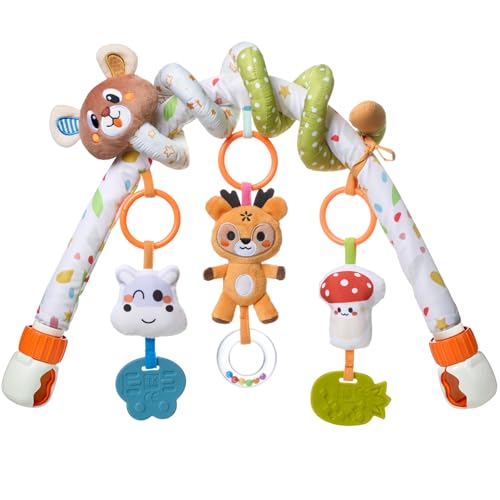
The TUMAMA Baby Activity Arch with Bear Spiral Toy earns its spot on this list through genuine modular flexibility — this is not simply an arch with some toys attached, but a reconfigurable three-in-one system that grows with your baby from zero months through the twelve-month mark and adapts to multiple environments along the way. The central arch comes with adjustable clips and houses a bear-shaped spiral toy that is removable for independent use as a standalone carseat attachment or a crib toy. The three animal pendant accessories — a mushroom, a deer, and a hippo — each detach individually, can be clipped to any compatible surface independently, and each feature a different built-in sound mechanism, giving you a pool of interchangeable sensory tools rather than a single fixed configuration.
The sound design on the three pendants is more varied than most competing arches: the mushroom produces a BIBI beep, the deer combines a BIBI sound with a hand rattle for dual-output play, and the hippo contains rattle beads inside a soft teether body that serves the gumming and chewing needs of babies approaching the four-to-six-month teething window. This differentiation across the three pendants means your baby encounters a meaningfully different sensory experience depending on which element they grab, which sustains interest more effectively than three identical jingle toys would. The visual design uses a broad range of saturated colors, which maintains strong contrast appeal from the newborn stage through the point at which babies begin to appreciate more complex color relationships.
Parents who have used activity gyms at home will appreciate how naturally this arch transitions between car seat and home environments — the bear spiral toy in particular works well as a hanging crib attachment during naps, giving you better utilization from a single purchase. For parents also thinking about other in-car entertainment upgrades as their family vehicle evolves, the TUMAMA arch is a reminder that the best gear is gear that adapts across contexts rather than serving a single narrow purpose. The clips are secure and the overall construction is sturdy enough to earn genuine confidence across the full twelve-month use window the manufacturer specifies.
Pros:
Cons:
The single most important filter to apply when choosing a car seat toy is the age range it is designed for, and more specifically the developmental stage your baby is currently in rather than just their chronological age. Newborns from zero to three months are primarily visual learners with limited hand coordination, so high-contrast patterns, mirrors, and simple crinkle textures that respond to accidental contact are the right fit at this stage. Once babies enter the four-to-seven-month range, they begin reaching intentionally, grasping and transferring objects, and responding to cause-and-effect mechanics — which is when activity arches, teether toys, and pull-to-activate features become genuinely useful rather than just decorative. Babies from eight to twelve months-plus benefit from more complex interactive toys with buttons, lights, sounds, and multiple manipulation modes, like the Fisher-Price Link Squad Tiger, which is designed precisely for this stage. Buying ahead of your baby's current developmental stage typically produces frustration rather than engagement, so match the toy to where your baby is now and plan to rotate as they advance.
The best car seat toys address multiple developmental domains simultaneously rather than focusing on a single type of stimulation. You want a toy that covers at least two or three of the following: visual contrast and color stimulation, tactile texture variety, auditory feedback (crinkle, rattle, squeak, or music), and cause-and-effect mechanics that teach intentional interaction. A toy that only rattles will lose its novelty faster than a toy that rattles, crinkles, has a teether, and includes a mirror. When you are evaluating products, count the distinct sensory inputs and interactive features — more is better up to a point of reasonable complexity, though you also want your baby to be able to engage with the features independently rather than requiring your guidance on every interaction.
A car seat toy that falls off mid-drive is not just useless — it can become a distraction hazard when you are trying to focus on the road and your baby is suddenly screaming because their toy has vanished into the footwell. Before purchasing, confirm that the toy's clip, loop, or attachment mechanism is compatible with your specific car seat handle shape and width. Most clip-on toys work across standard car seat handles, but activity arches and bar-style toys are more size-sensitive and may not fit narrower or unusually shaped handles securely. Look for attachment systems that require deliberate effort to release — the toy should hold firm during driving vibration, sudden braking, and sustained infant tugging, all of which apply real force to the attachment point.
Babies drool, chew, spit up, and generally coat everything within reach in biological material at a remarkable rate, which means the cleanability of a car seat toy is a practical concern that directly affects how long you will actually keep using it. Machine-washable fabric toys like the Lamaze Freddie the Firefly and Skip Hop Cloud Jitter are significantly more parent-friendly than toys with fabric elements that must be spot-cleaned only, and all-plastic or silicone components can typically be wiped down or rinsed easily. For toys with electronic components, verify that the speaker and battery compartment are well-sealed against the inevitable drool exposure, and check whether the battery compartment requires a screwdriver to open — a minor detail that matters when you need to swap batteries in a parking lot. Prioritize toys that you can maintain in genuinely hygienic condition without significant effort, because the maintenance burden directly determines how consistently you will reach for the toy rather than leaving it at the bottom of the diaper bag.
You can introduce a car seat toy from birth, starting with high-contrast visual toys like the Manhattan Wimmer Stim Mobile that are designed around newborn visual limitations. Babies as young as zero months respond to high-contrast patterns and basic sensory textures even before they can manipulate objects intentionally. The key is matching the toy to the baby's current developmental stage rather than waiting until they are "ready" — newborns benefit from visual stimulation that supports their developing visual tracking ability, even if they cannot yet reach out and grab the toy.
Car seat toys designed specifically for infant car seats are safe when attached correctly to the car seat handle or frame rather than to the interior of the vehicle itself. You should never tie or attach a toy in a position where it could interfere with the harness straps, cover the buckle release, or obstruct the baby's airway. Avoid toys with long cords or tethers that could wrap around a baby's neck, and remove any toy that is too large or heavy for the car seat handle's weight capacity. Stick to toys from reputable manufacturers that comply with ASTM F963 toy safety standards and explicitly state they are designed for car seat use.
One to two well-chosen toys is the practical answer for most families — more than that and you are creating clutter without adding proportional benefit. A single high-quality multi-sensory toy like the Lamaze Freddie the Firefly or the TUMAMA Activity Arch covers enough developmental ground to sustain engagement across multiple months of development. Rotating between two toys, one suited to your baby's current stage and one slightly more advanced, can help maintain novelty and extend the useful life of each purchase. Resist the impulse to buy four or five toys at once — babies develop preferences quickly and two consistently loved toys outperform a pile of ignored ones.
A clip-on toy attaches at a single point — usually to the car seat handle bar — and hangs within visual and reaching range of your baby as a single object or small bundle of attached elements. An activity arch spans across the seat as a curved bar with multiple hanging toys distributed along its length, providing a wider field of engagement and positioning several elements at different distances and heights simultaneously. Clip-on toys are more portable and versatile, working equally well on strollers, cribs, and carriers, while activity arches provide more stimulation per installation but are bulkier to transport and more size-sensitive in terms of fitting different car seat models.
Not all car seat toys require batteries — the Lamaze Freddie the Firefly, Skip Hop Cloud Jitter, and TUMAMA Activity Arch all include mechanical sound features that require no batteries at all for their crinkle, rattle, and squeeze functions. Electronic toys like the Fisher-Price Link Squad Tiger and the Bright Starts Activity Bar do require batteries, typically AA or AAA cells, and battery life varies significantly depending on usage frequency and volume settings. In practice, toys used on daily car rides tend to need battery replacement every two to four months with normal use. If battery management is a concern, prioritize toys whose core engagement features are mechanical rather than electronic, and treat the battery-powered elements as a bonus rather than the primary play mode.
Most of the products on this list are explicitly designed for cross-context use across car seats, stroller bars, and crib rails, with universal clip or loop attachments that work across all three. The Lamaze Freddie the Firefly, Skip Hop Cloud Jitter, TUMAMA Activity Arch, and the budget activity arch all specify stroller compatibility alongside car seat use, and their clip mechanisms fit the tubing diameter of most standard stroller handle bars. Using the same toy across multiple environments is a practical efficiency that most parents appreciate — it reduces the number of toys you need to own, keeps your baby in contact with familiar sensory objects in unfamiliar environments, and ensures you always have a trusted engagement tool whether you are loading the car or the stroller.
 |
 |
 |
 |

About Joshua Thomas
Joshua Thomas holds a Bachelor of Science in Mechanical Engineering from San Diego State University and has spent years applying that technical foundation to hands-on automotive work — from routine maintenance to full mechanical repairs. He founded CarCareTotal in 2017 to give car owners the kind of clear, practical guidance that helps them understand what is happening under the hood and make smarter decisions about upkeep and repairs. At CarCareTotal, he oversees editorial direction and covers automotive fundamentals, maintenance guides, and troubleshooting resources for everyday drivers.
Get some FREE car parts & gear.. Or check out the latest free automotive manuals and build guides here.
Disable your ad blocker to unlock all the hidden deals. Hit the button below 🚗
| | | |
