by Liam O'Brien
Picture this: you're driving home after a long day, glancing down at your speedometer every few minutes to make sure you're not creeping past the limit, and it hits you that this constant up-and-down eye movement is both exhausting and genuinely dangerous. You've seen head up displays in newer vehicles and wondered whether an aftermarket unit could bring that same convenience to your current car without a major investment. The good news is that in 2026, the aftermarket HUD market has matured considerably, offering solid options for nearly every budget and vehicle type.
A head-up display projects driving data directly into your line of sight on the windshield, so your eyes never have to drop to the dashboard cluster. Modern aftermarket units connect via GPS, OBD2 port, or both, and they can show you speed, RPM, water temperature, voltage, fuel consumption, and even fault codes without any permanent modification to your vehicle. Whether you drive a gas-powered commuter, a diesel truck, or a hybrid, there's a HUD on this list that will slot neatly into your setup. If you're also interested in reading live engine data through your phone, you might want to check out our guide to the best OBD2 Bluetooth adapters of 2026 alongside this one.
We reviewed seven of the most popular aftermarket head up displays available in 2026, evaluating each one on display clarity, ease of installation, data accuracy, brightness range, and overall value. You'll find options that rely purely on GPS satellites, others that tap directly into your OBD2 port for richer diagnostics, and a few that give you the flexibility to switch between both modes depending on your vehicle. Browse our tools and guides section for more car accessory recommendations whenever you need them.

Contents





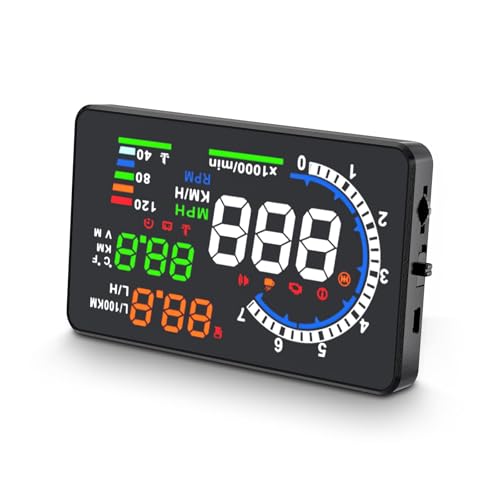

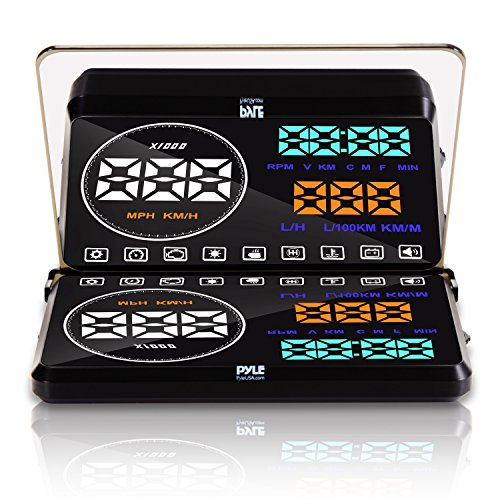


If you want the absolute simplest path to a heads-up display without touching your OBD2 port, this GPS-based unit is about as plug-and-play as it gets. It uses a dual-mode GPS and BDS (BeiDou Navigation Satellite System) setup with a 10Hz refresh rate, connecting to up to 32 satellites simultaneously to deliver real-time speed data that is both fast and stable. Because it reads position from satellites rather than the car's ECU, you get accurate speed figures regardless of whether your speedometer cable is worn or your tire size is non-stock, which is a nice bonus if you've changed your wheels.
Setup is genuinely simple: plug the USB cable into any 5V USB socket, position the unit on your dashboard, angle the display toward your windshield, and you're done within a couple of minutes. The built-in light sensor handles brightness automatically, dialing the screen down at night so the reflection doesn't wash out your view and ramping it up in direct sunlight so the numbers stay readable. The large, clean font is easy to catch in your peripheral vision without actively reading it, which is exactly the point of a HUD. This is a no-frills device — it shows speed and not much else — but for a driver who just wants to stop glancing at the cluster, that focused simplicity is genuinely appealing in 2026.
The trade-off is that you won't get engine diagnostics, RPM, coolant temperature, or fault codes, because there is no OBD2 connection. GPS speed can also lag slightly in dense urban canyons where satellite lock is intermittent, so it isn't the right choice if you work in a downtown area with tall buildings blocking the sky. For highway commuters and suburban drivers, though, the accuracy is more than adequate for day-to-day use.
Pros:
Cons:
The Yaouzicn dual-mode HUD aims to give you the best of both worlds by letting you switch between OBD2 and GPS modes with a single button press, and it largely succeeds at that goal. In OBD2 mode, it pulls live data directly from your vehicle's ECU and displays over 20 real-time metrics including speed, engine RPM, fuel consumption, coolant temperature, battery voltage, turbo pressure, and DTC fault codes. That last feature is particularly useful — being able to read and clear check engine light codes without a separate scan tool saves you a trip to the auto parts store and gives you instant insight into what's going on under the hood.
The display itself uses an anti-glare optical lens that handles direct sunlight impressively well, and the auto-dimming function transitions smoothly when you drive from bright exteriors into shaded parking structures. There is zero ghosting or double-imaging on a clean windshield, which is a common complaint with cheaper units that use lower-quality lens coatings. Compatibility is broad: OBD2 mode works with 1996 and newer gasoline vehicles in the 12V to 18V range, while GPS mode extends support to diesel engines, hybrids, trucks, and vehicles with non-standard OBD2 implementations like certain Jeep, Dodge, and Fiat models.
For drivers who want a HUD that doubles as a lightweight diagnostic tool, this Yaouzicn unit is a genuinely strong contender in 2026. The dual-mode design means you aren't locked out of data if your vehicle's OBD2 port has some quirk, and the breadth of metrics available in OBD mode rivals dedicated scan tools at a fraction of the price — though it doesn't replace a full-featured scanner for deep diagnostics. If you want to go deeper on engine health monitoring, our roundup of the best compression testers of 2026 covers another angle of the same diagnostic picture.
Pros:
Cons:
The wiiyii A8 stands out immediately because of its 5.5-inch HD display, which is noticeably larger than the typical 3-inch panel you find on budget HUD units. That extra screen real estate means the numbers and icons are bigger, cleaner, and far easier to read in your peripheral vision without having to deliberately focus on them. If you've tried a smaller HUD and found yourself squinting or tilting your head to catch the readout, the A8's display size alone might be the upgrade you didn't know you needed.
Operating on OBD2 connectivity, the A8 is compatible with OBDII and EOBD vehicles — which covers most cars produced after 2003 globally and after 1996 in North America. The displayed data set is comprehensive: vehicle speed, water temperature, battery voltage, driving distance, speed alarm, water temperature alarm, and voltage alert are all available, with easy unit switching between kilometers and miles and between Celsius and Fahrenheit. The multi-function switching lets you cycle through different display layouts depending on what you want to monitor at any given moment, so you're not locked into a single screen configuration for every drive.
Build quality on the A8 feels solid for its price tier, with a stable dashboard mount that doesn't vibrate loose over rough roads. The reflective panel is clear with minimal ghosting under most lighting conditions, though like most OBD2-only units, it won't serve you in vehicles using OBD1 or JOBD protocols. If your car was built before the OBD2 cutoff dates, you'll need to look at the GPS-mode units instead. For vehicles in the supported range, though, the A8's large display and reliable data readout make it one of the more comfortable daily-use HUDs on this list.
Pros:
Cons:
Pyle is a brand with a long history in consumer electronics, and their 5.5-inch HUD brings a robust feature set that goes beyond straightforward speed display. The unit processes data through a dual-core processor connected to your vehicle's OBDII or EUOBD port, delivering real-time readouts of speed, RPM, water temperature, voltage, fuel consumption, driving distance, and battery voltage. What pushes the Pyle a step ahead of simpler units is its comprehensive alarm system: it actively warns you about high water temperature, over-speed conditions, engine failures, and even low battery voltage, giving you a layer of proactive engine health awareness you don't get from a GPS-only unit.
The shift reminders and fatigue reminders are thoughtful additions that speak to the Pyle's safety-oriented design philosophy. Shift reminders help you optimize fuel economy by prompting you to change gear at the right RPM, while the fatigue reminder alerts you after a set driving duration — a feature that long-haul drivers and road-trippers will appreciate more than most. Auto power-on and auto power-off tied to vehicle ignition means the unit never drains your battery by staying on after you exit the car, and the KPH/MPH toggle is simple to access without navigating complex menus.
Compatibility covers OBDII and EUOBD vehicles, which means European and North American cars from 2003 onward and Asian-market cars from 2007 onward are supported. The dual-core processor keeps data updates snappy and the display responsive, without the brief lag you sometimes notice on single-core budget units when multiple metrics are updating simultaneously. If you want your HUD to be more than a speedometer and to actively participate in keeping you safe and your engine healthy, the Pyle 5.5-inch is worth serious consideration.
Pros:
Cons:
The wiiyii C5 takes a practical approach to the dual-mode concept by making the switch between OBD and GPS as frictionless as possible — a single button toggles between the two, and the unit remembers your last mode on restart. The display projects data onto a high-definition transparent reflective panel with no ghosting and a wide viewing angle, and the angle of the panel itself is adjustable so you can fine-tune where the projection appears in your field of view relative to your seated driving position. This adjustability matters more than you might expect, since drivers of different heights will naturally want the HUD sitting at slightly different vertical positions.
In OBD mode, the C5 covers the standard set of vehicle metrics: speed, RPM, fuel consumption, water temperature, voltage, clock, single trip mileage, driving time, and direction. The GPS mode adds altitude, satellite count, and acceleration and braking tests to the mix — useful data for anyone who wants to track performance metrics on a regular driving route. The one-button OBD/GPS switch is particularly valuable for diesel owners, hybrid drivers, and anyone with an older vehicle whose OBD2 implementation is non-standard, because GPS mode provides fully functional speed display without needing ECU access at all.
Brightness adjustment is available in both automatic and manual modes, which gives you more control than fully automatic-only units when you're driving in unusual lighting situations like underground parking structures with bright spots. The shading effect from the hood of the unit cuts down on ambient light reflection, keeping the display sharp even in harsh midday sun. For sheer versatility across vehicle types, the wiiyii C5 earns its place as one of the most universally compatible HUDs in this 2026 roundup. If you're shopping for other monitoring accessories for your vehicle, our guide to the best wideband gauges of 2026 covers another set of useful instrumentation options.
Pros:
Cons:
The M7 positions itself as a balanced dual-mode HUD that covers the core metrics without overcomplicating the interface, and that restraint turns out to be one of its stronger selling points. In OBD mode, it displays speed, water temperature, voltage, and driving distance, with active alarms for speeding, high water temperature, and low voltage. Switching to GPS mode maintains speed, voltage, and distance readouts while adding directional data — a clean, uncluttered presentation that prioritizes the information you actually glance at while driving over the comprehensive data wall you sometimes get on more feature-dense units.
Installation follows the plug-and-play model common to this category, requiring no tools and no permanent modifications to your car. The brightness adapts automatically to ambient light conditions, which handles the majority of real-world scenarios without requiring you to manually intervene. Unit switching between km/h and MPH is accessible on-device, and the same applies to water temperature units between Celsius and Fahrenheit — practical touches that matter if you move between regions or simply prefer one system over the other. The M7 draws inspiration from aviation HUD technology, and while that framing is somewhat marketing language, the end result is a display that's genuinely optimized for quick peripheral reading rather than deliberate focus.
The M7 is a sensible choice if you want a dual-mode HUD without paying for diagnostic depth you won't use regularly. It won't read fault codes or display RPM in its standard configuration, so if you want a unit that doubles as a check-engine-light reader, look at the Yaouzicn or Liiiyuan options instead. But for a driver who wants accurate speed, basic engine temperature monitoring, and voltage awareness in a clean package that works across vehicle types, the M7 delivers exactly that without unnecessary complexity.
Pros:
Cons:
The Liiiyuan C2 sits at the deep end of the feature pool for aftermarket HUDs, offering an OBD2 data set that extends into metrics typically reserved for dedicated performance monitors. Beyond the standard speed, water temperature, and voltage, the C2 can display intake pressure, oil temperature, air-fuel ratio, turbo pressure, and both acceleration and braking test results — data points that matter to enthusiast drivers who want their HUD to function as a real-time performance gauge, not just a speed reminder. The transparent reflective panel is described as ghost-free with a wide viewing angle, and the free-switch angle mechanism lets you adjust the panel's tilt to match your driving position.
In GPS mode, the C2 offers speed, travel time, satellite time, altitude, satellite count, direction, single trip mileage, voltage, and acceleration and braking test results. That GPS data set is unusually rich for this category, giving GPS-mode users more to look at than the bare-minimum speed display common in lesser units. The OBD2 display function covers a genuinely impressive range: total mileage accumulation, driving time, turbo pressure, intake pressure, and the ability to read and clear DTC fault codes are all accessible from the dashboard-mounted display without additional apps or Bluetooth pairing.
The C2 is the unit to consider if you're the type of driver who genuinely reads every metric and wants your HUD to tell you about air-fuel ratio during a spirited drive or intake pressure under load — the same kind of driver who might also be shopping for a dedicated wideband gauge for oxygen sensor monitoring. The caveat is that this depth of data is overkill for a commuter who just wants to avoid speeding tickets, and the interface can feel busy if you're not someone who actively engages with engine performance metrics. Choose the C2 knowing what you want from it, and it's unlikely to disappoint.
Pros:
Cons:

The single most important decision when shopping for a HUD in 2026 is figuring out which connection method suits your vehicle and your goals. GPS-only units like the first product on this list are universal — they work with any vehicle that has a USB power source, including diesels, hybrids, EVs, and pre-1996 gasoline cars that predate OBD2. They're accurate for speed display and require zero setup beyond plugging in a cable, but they can't access your engine's diagnostic data. OBD2-connected units plug into the diagnostic port under your dash and pull live ECU data, giving you RPM, temperature, fault codes, and fuel consumption that a GPS unit simply cannot provide. The catch is that OBD2 support varies — it covers gasoline vehicles from 1996 onward in North America and 2003 onward in many other markets, and some diesel or hybrid implementations have partial compatibility at best. Dual-mode units solve this by offering both connection types with a switch, so you get OBD2 richness where it works and GPS fallback where it doesn't. If your vehicle is a 2003 or newer standard gasoline car, OBD2 or dual-mode gives you the most value; if you drive anything outside that window, dual-mode or GPS-only is the safer purchase.
A HUD that you can't read in afternoon sun or that blinds you on night drives defeats its entire purpose, so display quality deserves more attention than it typically gets in spec sheets. Screen size matters because larger displays project bigger numbers into your windshield reflection, making them legible in peripheral vision without requiring deliberate focus — the 5.5-inch units on this list have a clear advantage over 3-inch competitors in this respect. Brightness range is equally critical: you want a unit that hits high enough output for bright midday driving without washing out, and that dims sufficiently at night to avoid creating a distracting glare in the windshield reflection. Auto-brightness based on a light sensor handles this transition well in most units, but the better ones also give you manual override for unusual conditions. Anti-glare lens coatings and the quality of the reflective panel both affect whether the projected image looks sharp and singular or produces the double-imaging and ghosting that makes some cheaper HUDs nearly unusable. When reading reviews for any unit, pay close attention to comments about nighttime glare, because that's the condition where cheaply coated lenses reveal themselves most clearly.
It's tempting to buy the unit with the longest feature list, but more displayed data isn't always better when you're trying to drive safely. Think carefully about which metrics you'll actively use while moving. Speed is non-negotiable and every unit covers it. Water temperature and voltage are genuinely useful safety alerts that warn you before a breakdown rather than after. RPM matters to manual transmission drivers for shift timing and fuel optimization, but it's largely irrelevant if you drive an automatic. Fault code reading is a practical convenience that can save you money if you encounter a check engine light, though it doesn't replace a full OBD2 scanner for complex diagnostics — our guide to the best OBD2 Bluetooth adapters covers more capable diagnostic tools if that's your priority. Advanced metrics like air-fuel ratio, turbo pressure, and intake pressure are genuinely useful for performance-oriented drivers but add clutter for everyone else. Pick a unit whose standard display mode shows the two or three metrics you care most about without requiring you to cycle through screens while driving.
Every HUD on this list installs without tools and without permanent modifications to your vehicle, but the quality of the mounting system and cable management varies considerably. A dashboard mount that vibrates loose on rough pavement is frustrating enough that it will end up in a drawer, so look for units that include a stable adhesive or suction pad base with angle adjustability. The OBD2 dongle that plugs under your dash on connected units should have a long enough cable to route neatly without tension, and the power cable routing to your dashboard should be manageable without blocking controls or air vents. Adjustable reflective panel angle is more important than it sounds: a driver who is 5'6" and a driver who is 6'2" need the projection to hit different eyeline heights, and a unit with no adjustment range will be frustrating for one of them regardless of every other feature being excellent. Look for units that explicitly mention angle adjustability for the reflective panel, and verify that the adjustment range covers the variation in your typical seating position before committing to a purchase.
It depends on the connection type. GPS-only HUDs work with absolutely any vehicle because they read speed from satellites rather than the car's computer, so diesel, hybrid, and electric vehicles are all supported equally well. OBD2-connected HUDs work with most diesel vehicles but with varying data availability depending on the protocol, and hybrid vehicles often have partial OBD2 compatibility. If you drive a diesel, hybrid, or any non-standard vehicle, your safest option is a dual-mode unit that lets you fall back to GPS mode when OBD2 data is unavailable or incomplete.
For reading and clearing basic DTC codes tied to the check engine light, several HUDs on this list can handle that task adequately. However, they cannot replace a full OBD2 scanner when it comes to live data stream access, freeze frame data, enhanced manufacturer-specific codes, or bidirectional control functions. Think of a HUD's fault code feature as a convenient first look at what triggered your check engine light rather than a comprehensive diagnostic tool. For deeper analysis, a dedicated scan tool or Bluetooth OBD2 adapter with a capable app will give you significantly more information.
GPS speed is typically more accurate than your car's factory speedometer in absolute terms, because your speedometer's calibration is affected by tire size, tire wear, and the mechanical tolerances of the speed sensor and gauge cluster. GPS calculates your actual ground speed from satellite position data, which is unaffected by those variables. The trade-off is that GPS speed updates at a finite refresh rate — typically 1Hz to 10Hz depending on the unit — and can lag or show brief inaccuracies in environments with poor satellite visibility like tunnels, dense urban canyons, or thick overhead foliage. For open-road and suburban driving, GPS accuracy is more than sufficient for everyday speed monitoring.
A well-designed HUD with proper auto-brightness and a quality reflective panel should not block your view in any meaningful way, because the display sits below your normal horizon line and the projection appears in the lower portion of your windshield where you don't typically look for road hazards. Nighttime glare is a legitimate concern with cheaper units that have poorly calibrated auto-dimming or low-quality lens coatings — the reflection can appear washed out or produce double imaging that is more distracting than helpful. The units reviewed here all include auto-brightness adjustment, and the better-coated lenses among them produce a single, sharp projection image at night. If you have a particularly reflective windshield treatment or tinted glass, test your unit's night performance before your first long evening drive.
OBD2 became mandatory for all new gasoline passenger vehicles sold in the United States in 1996, in Europe and other markets for gasoline vehicles from 2001 to 2003, and for diesel vehicles from 2004 to 2007 depending on region. If your vehicle was manufactured after those cutoff dates and runs a standard gasoline engine, it almost certainly has a functional OBD2 port under the driver's side dash that will work with any OBD2 HUD. Vehicles using OBD1 (pre-1996 US), JOBD (Japanese domestic market), or non-standard ECU protocols will not work in OBD2 mode and should use GPS mode instead. Most dual-mode units on this list clearly state their OBD2 compatibility dates in their product specifications.
Double imaging happens when the HUD reflects off both the inner and outer surfaces of the windshield glass, creating two overlapping projections. Most aftermarket HUDs include an anti-reflective film or a frosted mat that you apply to your windshield in the projection area to suppress the secondary reflection — if your unit includes one, use it. Positioning the unit as low on the dashboard as possible while still maintaining visibility also helps by reducing the angle of incidence on the glass. If double imaging persists despite the film, adjusting the horizontal and vertical angle of the reflective panel often resolves it. For units that use a transparent raised reflective panel instead of direct windshield projection, double imaging is generally not an issue because the display is contained within the panel itself.
The right head up display is the one that keeps your eyes on the road — buy for your vehicle type and your actual data needs, not for the longest feature list.
 |
 |
 |
 |

About Liam O'Brien
Liam O'Brien has spent over a decade buying, field-testing, and evaluating automotive tools with a focus on what actually performs in a real DIY garage rather than what markets well on a spec sheet. His hands-on experience spans hand tools, diagnostic equipment, floor jacks, socket sets, and specialty automotive gear across a wide range of brands and price points. At CarCareTotal, he covers automotive tool and equipment reviews, garage setup guides, and buying advice for home mechanics.
Get some FREE car parts & gear.. Or check out the latest free automotive manuals and build guides here.
Disable your ad blocker to unlock all the hidden deals. Hit the button below 🚗
| | | |
