by Joshua Thomas
A single worn piston ring can drop cylinder compression by as much as 30 PSI below the manufacturer's specification, which is often enough to trigger misfires, rough idling, and a check engine light that no amount of fuel additives will fix. Engine compression is the foundation of every combustion event in your motor, and when it starts to slip, everything downstream suffers — fuel economy, power output, emissions compliance, and ultimately the long-term viability of the engine itself. A compression tester is one of the most affordable diagnostic tools you can own, yet it delivers information that even the best OBD2 Bluetooth adapters cannot provide directly, because fault codes tell you a symptom while a compression test tells you the root cause.
Whether you're a weekend mechanic trying to figure out why your daily driver runs rough on cold starts, or a seasoned shop tech diagnosing a high-mileage pickup before a customer decides whether to rebuild or replace, the right compression tester makes that call decisively. The market in 2026 ranges from stripped-down screw-in gauges under twenty dollars to digital kits with multi-cylinder memory and backlit displays, and the difference between them matters more than the price tag suggests. Thread compatibility, hose length, gauge accuracy, and relief valve quality separate tools that last decades from ones that fail mid-diagnosis. We tested and reviewed seven of the best compression testers available this year — covering every budget and use case — so you can make the right investment for your garage or shop. Be sure to explore the full range of diagnostic and maintenance tools in our tools category for everything your garage needs.
Understanding compression ratios and how they relate to engine health is the foundation of meaningful diagnosis. Most gasoline engines spec somewhere between 125 and 175 PSI per cylinder, and the critical threshold is not just absolute pressure but consistency across all cylinders — a variance of more than 15 PSI between the lowest and highest reading often indicates a problem worth investigating. If you discover compression issues early, addressing them might mean a valve adjustment or a ring seal; leave them too long, and you're looking at a full engine rebuild. The tools below will give you accurate, repeatable readings so your diagnosis is never a guess.

Contents
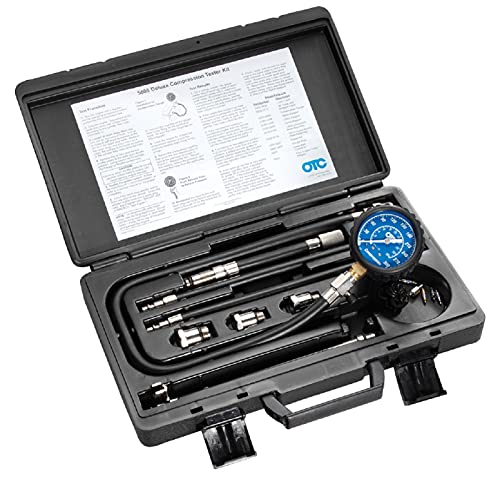


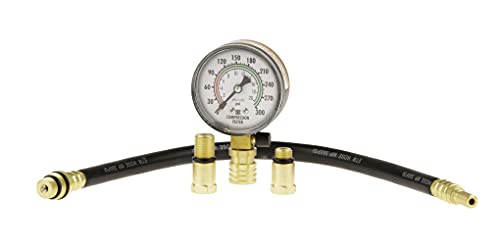



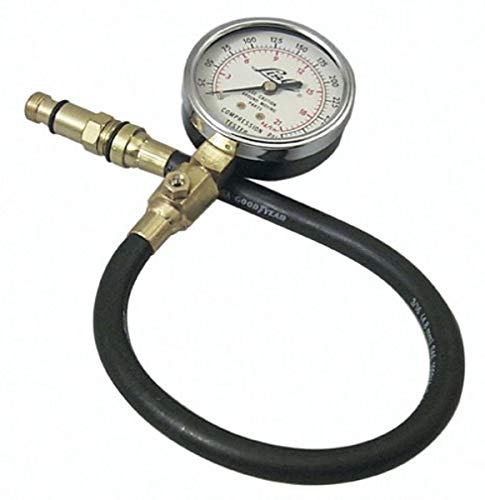



The OTC 5605 has been the go-to professional compression tester in independent shops for years, and its 2026 availability still makes it the benchmark by which other kits are measured. The centrepiece is the 2-1/2-inch dual-scale gauge, which reads in both PSI and kPa with large, clearly spaced markings that you can read without squinting even in poorly lit engine bays. OTC engineered this kit specifically for gasoline engines, and the depth of adapter coverage reflects that focus — you get both standard and specialty adapters that handle flat and tapered seat plugs, including the deep-well connector used on recessed plug-well style cylinder heads that trip up narrower kits.
The inclusion of the Ford Triton engine adapter using 16 mm thread plugs is a detail that separates the OTC 5605 from competitors who ignore that notoriously difficult application. The extra-long flex hose provides genuine reach into tight engine compartments without forcing awkward gauge angles that skew readings, and the corrosion-resistant nickel-plated finish on all metal components means this kit survives years of shop use without the threads seizing or the fittings corroding. The storage case keeps every adapter organized, so you never reach for a component and find it missing at a critical moment. If you do find a leaking head gasket, pair this with one of our reviewed gasket sealers for the repair step.
In practical testing, the OTC 5605 delivers consistent, repeatable readings across multiple cranking cycles, which is exactly what a reliable diagnosis requires. The pressure hold valve functions correctly — pressure is maintained at peak reading without creeping back down — and the quick-release bleed valve depressurizes cleanly without spraying residual combustion gasses. Professional technicians who test dozens of engines per week rely on the OTC 5605 precisely because it does not introduce diagnostic uncertainty.
Pros:
Cons:
Innova built a reputation on diagnostic tools that punch above their price class, and the 3612 four-piece kit demonstrates exactly why the brand earns that reputation in 2026. The distinguishing feature here is application breadth: this tester handles motorcycles, ATVs, snowmobiles, and marine engines in addition to conventional automotive applications, covering both domestic and import vehicles whether they use conventional, electronic, or computerized ignition systems. Most compression testers in this price range serve car and truck engines adequately but leave you hunting for supplemental adapters the moment you pivot to powersports equipment.
The properly rated fuel hose and brass fittings are not marketing language — they represent a genuine quality step above rubber hose and zinc fittings that degrade under repeated heat cycling and fuel exposure. Brass resists corrosion and maintains thread integrity over years of use in ways that cheaper alloys simply do not, which matters when a stripped fitting costs you a diagnosis mid-test. The four-piece kit configuration balances completeness against portability, giving you enough adapter coverage for the most common thread sizes without carrying a twenty-piece case to every job. The gauge face is clearly marked and easy to read at arm's length, which matters when you're cranking the engine while watching the gauge from a few feet away.
The Innova 3612 is particularly well suited to mechanics who maintain a mixed fleet — a personal car, a motorcycle, a boat, and maybe a snowmobile — because a single investment covers all of them. The quality-to-price ratio makes it one of the strongest recommendations in this round-up for versatility-focused buyers who do not want to own separate testers for separate applications.
Pros:
Cons:
The Mityvac MV5532 represents the most technologically sophisticated approach in this round-up, and for multi-cylinder engine testing in a professional or semi-professional context, the digital format delivers real workflow advantages. The electronic memory system stores peak compression values for up to twelve cylinders simultaneously, which means you crank each cylinder in sequence, move along to the next, and review all readings together in a single comparison rather than writing numbers on a notepad between each test. On an eight or twelve-cylinder engine, that efficiency gain is substantial, and it eliminates transcription errors that occasionally distort analog-recorded data.
The backlit liquid crystal display is genuinely useful in the cramped, shadowy environment beneath a hood, providing clear readings in PSI, bar, and kPa without requiring additional lighting equipment or a phone flashlight held in your teeth. The oil-resistant gauge body with rubber boot protection addresses the practical reality of shop environments — compression testers get dropped, kicked, and set down on wet surfaces, and a rubber-protected digital instrument survives those encounters far better than a bare plastic housing. The custom-molded carrying case protects the unit during storage and transport while keeping every adapter indexed and accessible.
Mityvac has long been one of the benchmark names in professional vacuum and pressure diagnostic tools, and the MV5532 carries that heritage into digital compression testing with engineering that reflects genuine field experience. The 9V battery-powered design keeps the unit independent of any vehicle power source, so you are not dealing with additional wiring or connection points during the test procedure. For professional technicians who need the most efficient path from symptom to cylinder-level data, this is the tool that delivers.
Pros:
Cons:
The BTSHUB Compression Gauge Test Set carves out a useful niche in the budget long-reach segment by combining three thread-size specific hoses — M10×1.0, M12×1.25, and M14×1.25 — with 10-1/2-inch hose lengths that genuinely reach into recessed cylinder head plug wells on modern engines with tight, cluttered compartments. The dedicated hose-per-thread approach eliminates the adapter-stacking that compromises seal integrity in some multi-adapter kits, because each hose terminates in the correct thread directly rather than relying on an intermediate coupling.
The 3-inch dual-color scale gauge reads 0 to 300 PSI and 0 to 20 kPa with a large face that remains legible at working distance, and the dual-color scale helps you instantly identify whether a reading falls in the normal operating range or signals concern. Each hose incorporates a Schrader valve insert at the cylinder end, which maintains pressure during the test so the gauge holds its peak reading accurately between the moment you stop cranking and the moment you read the dial. At this price tier, the BTSHUB kit delivers more hose coverage than most competitors, which directly translates to fewer dead-end situations when you encounter a less common thread pitch.
For the home mechanic who works on several different vehicles or regularly encounters import engines with M10 thread spark plugs — common on many Japanese and European applications — the BTSHUB kit resolves the coverage gap that limits cheaper two-adapter sets. It is not a professional shop tool in terms of gauge build quality, but it performs accurately enough for reliable diagnosis on personal vehicles, and the value-per-adapter ratio is genuinely hard to beat in 2026.
Pros:
Cons:
Lisle has been manufacturing professional-grade specialty tools since 1903, and the 20250 compression tester embodies the brand's core philosophy: solve the problem cleanly, without unnecessary complexity or unnecessary cost. This is a single-purpose, high-quality instrument designed to do one thing — check compression on gasoline engines accurately and quickly — and it accomplishes that task with the build quality and material caliber that Lisle tools are consistently known for across their entire product line. The gauge registers 0 to 300 PSI and 0 to 2100 kPa, which covers every naturally aspirated and most mildly boosted gasoline engine you will encounter in daily service.
Thread compatibility covers 14mm and 18mm sizes, which accounts for the vast majority of spark plug ports on domestic and import gasoline engines currently in service in North America and Europe. The simplicity of the Lisle 20250 is not a liability — it is a deliberate design choice that results in fewer failure points, faster setup, and a tool that works identically on the hundredth use as it does on the first. Mechanics who have been performing compression tests for twenty years often reach for a Lisle over more elaborate kits because the fundamentals are executed exceptionally well, and there is no digital component to malfunction, no battery to run down, and no case of adapters to inventory and manage.
The Lisle 20250 is the right choice when you want a compression tester that will outlast the vehicles you are diagnosing — a tool you purchase once and forget about, confident it will be ready every time you need it. If you are already tracking engine performance alongside other instruments like those in our engine flush guide, the Lisle slots into your maintenance routine as the diagnostic reference point before and after any significant service.
Pros:
Cons:
The Powerbuilt 647000 is the compression tester you reach for when you need a fast, reliable answer about cylinder pressure without setting up an elaborate multi-piece kit, and in that specific context it delivers exactly what its design promises. The fast and accurate testing capability — measuring cylinder compression up to 300 PSI — gives you actionable data on engine health in the time it takes to remove and re-install spark plugs, which for a quick pre-purchase inspection or a between-jobs spot-check is precisely the right tool for the moment. Powerbuilt has engineered this around dual thread compatibility covering both 14mm and 18mm spark plug threads, which addresses the most common configuration you will encounter across cars, motorcycles, and lawn equipment in a single purchase.
The versatility of the Powerbuilt 647000 extends beyond passenger vehicles into the broader powered equipment category — lawn mowers, generators, pressure washers, and other small gasoline engines that share the same fundamental compression testing process as automotive applications. For the homeowner or small-shop mechanic who maintains equipment across multiple categories, a single tester that genuinely handles all of them without compromise is a meaningful practical advantage over carrying purpose-specific tools for each application. The gauge construction is straightforward and robust, with the kind of build quality that justifies keeping this tool in a glove box or small tool bag for on-the-spot diagnostics.
The Powerbuilt 647000 is not trying to be a comprehensive shop tool with a drawer full of adapters — it is focused on doing the core job quickly and correctly for the most common engine configurations, and that focus results in a clean, reliable instrument that earns its place in any well-equipped garage in 2026.
Pros:
Cons:
OEMTOOLS has consistently delivered professional-quality instruments at accessible price points, and the 37138 compression tester gauge set continues that pattern with a well-executed package that covers the most common gasoline engine compression testing needs without requiring a significant financial commitment. The set centres on a two-step 14mm and 18mm adapter system combined with a flexible rubber hose extension that provides genuine reach into modern engine bays where spark plug access is rarely straightforward. The flexible hose is not simply a short rigid extension — it bends to navigate the obstructions that define contemporary high-density engine compartments on crossovers and turbocharged inline-four applications.
The gauge reads PSI from 0 to 300 with an easy-read pressure face that delivers accurate, repeatable results across the full testing range relevant to gasoline engines. OEMTOOLS specifies this set for cars and trucks specifically, and the 2-step adapter design makes transitioning between thread sizes fast and error-free — you select the correct adapter for the thread pitch you are working with, install it, and get consistent sealing without over-torquing or adapter wobble that can introduce false low readings. The overall build quality reflects OEMTOOLS' professional tool positioning, with component materials that are clearly a step above the lowest-budget alternatives flooding the market in 2026.
For the home mechanic or lube shop that primarily services domestic and common import cars and trucks, the OEMTOOLS 37138 provides everything required for accurate cylinder compression monitoring without paying for features and adapter coverage that only matter in specialized professional contexts. It is a sensible, complete package that earns its place in any garage that takes engine maintenance seriously alongside other diagnostics.
Pros:
Cons:
The gauge face is the interface between the tool and your diagnosis, and the difference between a 1-1/2-inch and a 2-1/2-inch gauge is not trivial when you are cranking an engine with one hand and monitoring pressure with the other. Larger gauges — 2 inches and above — provide more spacing between graduation marks, which reduces the ambiguity in readings that fall between marked increments and directly affects the confidence you can place in your cylinder-to-cylinder comparison. Digital gauges like the Mityvac MV5532 eliminate the analog readability issue entirely but introduce battery dependency and a higher purchase cost. For professional use involving frequent multi-cylinder diagnosis, the memory function on a digital unit justifies the premium; for occasional personal vehicle maintenance, a quality analog gauge with a large, clear face provides equally accurate data at significantly lower cost.
Pay attention to the dual-scale display — PSI alone is insufficient if you regularly reference factory service manuals that specify compression limits in kPa or bar, which is standard practice for Japanese and European vehicle documentation. Every kit in this round-up provides dual-scale readings, but the legibility of the secondary scale varies considerably between units, and it is worth confirming that both scales are practical rather than nominal before purchasing.
This is where compression tester purchases most commonly go wrong, and it is the factor that most directly determines whether the tool you buy actually works on the engines you own. The 14mm and 18mm thread sizes cover the majority of North American domestic gasoline engines and most common Japanese and Korean imports, which is why two-adapter kits are viable for many buyers. However, if you work on European vehicles — particularly VAG group products, BMWs, or any vehicle with a Ford EcoBoost or Triton V8 — you will encounter M10×1.0 and other specialty thread pitches that require dedicated hoses or adapters not included in basic two-piece sets. The OTC 5605 and BTSHUB kit both address extended compatibility in different ways: OTC through a comprehensive adapter collection and BTSHUB through dedicated long-reach hoses in three sizes. Assess your vehicle portfolio honestly before choosing, because discovering a thread compatibility gap mid-diagnosis is genuinely frustrating.
Modern engine design has made compression testing physically harder than it was on engines from twenty years ago. Coil-on-plug ignition systems, integrated intake manifolds, and turbocharger plumbing routinely obstruct direct spark plug access, and a short, rigid extension simply cannot reach many contemporary plug locations without removing surrounding components first. The long-reach hoses on the OTC 5605 and BTSHUB kit address this directly by providing enough length and flexibility to negotiate around typical obstructions and still make a reliable threaded seal. A hose that is too short forces awkward gauge angles that place lateral stress on the spark plug thread during testing — a situation that risks both inaccurate readings and thread damage. The minimum practical hose length for current-generation engines with recessed plug wells is approximately 10 to 12 inches, and any kit that ships with less than this deserves careful scrutiny before you commit to it.
Two components define the accuracy and longevity of any compression tester: the check valve that holds peak pressure at the gauge during the test, and the release valve that depressurizes the hose after the reading is taken. A check valve that leaks back — even slowly — will show you a lower reading than the actual cylinder pressure, potentially causing you to misdiagnose a healthy engine or understate a real compression problem. Quality kits use machined brass or nickel-plated steel check valves; cheaper kits use plastic or low-quality alloy assemblies that degrade with use. The release valve receives similar scrutiny — a sticky or imprecise release valve that does not fully depressurize the hose between tests will add residual pressure to subsequent readings and corrupt your cylinder-to-cylinder comparison. Brass fittings throughout the hose assembly, as featured in the Innova 3612, represent the correct specification for a tool that will be used regularly and needs to maintain calibration over time without recalibration or component replacement.
Most gasoline engines produce between 125 and 175 PSI per cylinder when healthy, though the specific specification varies by manufacturer and engine design. The more critical measurement is consistency: all cylinders should read within 15 PSI of each other. A single cylinder reading 20 or more PSI below the others signals a valve, ring, or gasket problem worth investigating regardless of whether the absolute value falls within a normal range.
Warm the engine to operating temperature, then disable the ignition system and fuel injection to prevent the engine from starting during the test. Remove all spark plugs, thread the compression tester into each cylinder one at a time, and crank the engine for four to six compression strokes — typically three to five seconds of cranking. Record the peak reading for each cylinder and compare all results against the manufacturer's specification and against each other. A wet test, in which you add a small amount of oil to a low-reading cylinder and retest, helps distinguish between ring wear and valve problems.
Low compression isolated to a single cylinder typically indicates one of three conditions: worn or damaged piston rings, a burnt or bent valve that is not sealing properly, or a blown head gasket allowing combustion pressure to escape into the cooling system or adjacent cylinder. Performing a wet test helps narrow the diagnosis — if compression rises significantly after adding oil to the cylinder, ring wear is the likely cause; if it stays low, the problem is more likely valve-related or a head gasket failure.
No — the compression testers reviewed here are designed for gasoline engines and are not appropriate for diesel applications. Diesel engines generate compression pressures between 300 and 500 PSI, far exceeding the 300 PSI maximum rating of gasoline compression testers. Using a gasoline compression tester on a diesel engine risks gauge damage, hose failure, and inaccurate readings. Diesel compression testing requires a purpose-built diesel compression tester with appropriate pressure range, adapter fittings, and rated hose construction to handle the significantly higher pressures involved.
Test compression whenever you experience symptoms that suggest engine internal wear: persistent misfires, rough idle, unusual oil consumption, significant power loss, or excessive exhaust smoke. As a preventive measure, a baseline compression test on any high-mileage vehicle — typically above 100,000 miles — gives you a reference point for future comparison. Before purchasing a used vehicle, a compression test is one of the most valuable pre-purchase inspections you can perform, because it reveals internal engine condition that no visual inspection or OBD scan can reliably expose.
A compression test measures the pressure your engine builds during the compression stroke, providing a quick snapshot of overall cylinder sealing health. A leak-down test goes further: it pressurizes the cylinder with an external air source and measures the percentage of pressure lost over a set period, then uses a stethoscope to locate where the pressure is escaping — through the intake, exhaust, crankcase, or adjacent cylinder. Compression testing is faster and the right first diagnostic step; a leak-down test is the follow-up that precisely locates the source of confirmed compression loss.
The right compression tester does not just find problems — it tells you exactly which cylinder is failing and why, which is the difference between a precise repair and an expensive guess.
 |
 |
 |
 |

About Joshua Thomas
Joshua Thomas holds a Bachelor of Science in Mechanical Engineering from San Diego State University and has spent years applying that technical foundation to hands-on automotive work — from routine maintenance to full mechanical repairs. He founded CarCareTotal in 2017 to give car owners the kind of clear, practical guidance that helps them understand what is happening under the hood and make smarter decisions about upkeep and repairs. At CarCareTotal, he oversees editorial direction and covers automotive fundamentals, maintenance guides, and troubleshooting resources for everyday drivers.
Get some FREE car parts & gear.. Or check out the latest free automotive manuals and build guides here.
Disable your ad blocker to unlock all the hidden deals. Hit the button below 🚗
| | | |
