by Liam O'Brien
Which motorcycle jack is actually worth your money in 2026? That's the question every rider asks before buying — and gets wrong half the time. After comparing lift capacity, build quality, safety features, and value across dozens of options, the VEVOR Hydraulic Motorcycle Lift Jack 1500 LBS stands out as the top pick for most home garage mechanics.

A good motorcycle jack transforms routine maintenance from a frustrating balancing act into a safe, controlled operation. Whether a rider is changing tires, swapping brake pads, or adjusting chain tension, having the bike elevated at a stable, accessible height makes every job faster and safer. The best jacks handle 1,500 lbs or more, lock securely at multiple heights, and store compactly when not in use. Browse the full range of garage essentials at the tools category to find everything needed for a complete home shop setup.
This guide covers seven of the strongest contenders on the market right now. The list includes hydraulic scissor jacks, pedestal-style combo stands, and low-profile lift tables — covering different budgets and bike types. Buyers who also need quality floor tools should check out the 6 Best Floor Jacks of 2026 for a full look at garage lifting equipment. For those tackling precision fastener work alongside their lift setup, the 7 Best Torque Wrenches of 2026 is a natural companion read.
Contents





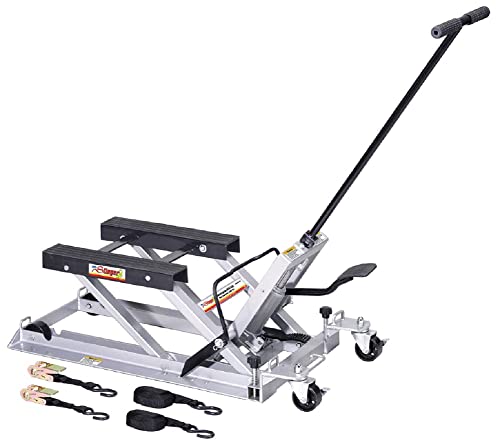



The VEVOR 1500 LBS Hydraulic Motorcycle Lift Jack earns the top spot because it delivers professional-grade lifting in an affordable, portable package. The foot-operated hydraulic pump raises the platform smoothly from 4.7 inches to 15 inches — enough clearance to handle nearly every standard motorcycle, cruiser, touring bike, ATV, and UTV on the market. At a rated capacity of 1,500 lbs, it handles heavy bikes with zero strain.
Stability is where this jack really separates itself. The platform features non-slip rubber stripes that grip the frame firmly, and two ratchet tie-down belts keep the bike from shifting during service. The three-position safety pin locks the platform at the desired height so the hydraulic system isn't bearing the full load alone. Four integrated wheels make positioning effortless — roll it under the bike, pump the pedal, and the machine does the rest. According to motorcycle safety guidelines, a stable lift platform is one of the most critical factors in preventing garage accidents during maintenance.
The long operating handle offers good leverage and keeps hands away from pinch points. Build quality is solid for the price — heavy-gauge steel construction with clean welds throughout. The included wheels are a practical touch that cheaper models skip. For most home-garage mechanics in 2026, this is the jack that does everything without overcomplicating the job.
Pros:
Cons:
Sport bike owners and riders who need wheel-off access should look no further than the VEVOR 850 lbs Front and Rear Combo Stand. This two-stand system lets riders lift both ends of the bike independently — essential when pulling wheels, servicing brakes, or doing a full suspension overhaul. The front stand features an adjustable double-fork head ranging from 6.5 to 9.5 inches, while the rear stand offers a U-shaped fork head adjustable from 8.9 to 13.8 inches. A bonus pair of L-shaped fork heads (9.1–13 inches) accommodates spool-style swingarm ends.
The 850 lb combined rating is more than adequate for sport bikes, naked bikes, and mid-sized cruisers. Construction is heavy-duty steel throughout, with reinforced limit clips and a triangular support geometry that resists wobble even on uneven flooring. The bracket joint positioning is precise — there's no slop in the connections that would cause the stand to shift under load. Both stands have been tested with popular platforms including Yamaha R-series, Honda CBR, Kawasaki Ninja, and Suzuki GSX models without fitment issues.
The learning curve is worth noting. First-time users of a front-rear combo system should practice lifting technique before committing to a full wheel removal. That said, the VEVOR combo delivers excellent value compared to buying two separate stands. For aluminum frame fans, the 6 Best Aluminum Floor Jacks of 2026 covers complementary lifting tools for the garage.
Pros:
Cons:
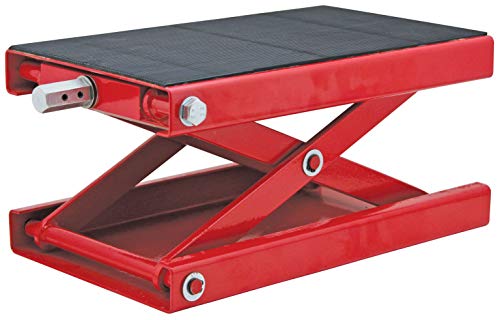
The Black Widow Scissor Jack proves that a center-lift tool doesn't need to be complicated to be effective. This no-frills unit handles up to 1,100 lbs and raises the bike using a standard 7/8-inch socket or wrench — no hydraulics, no foot pedals, just a simple mechanical screw mechanism that never needs fluid maintenance. The rubber platform protects frame rails and underbody components from scratches during contact.
The center-lift design gives access to both wheels simultaneously, which is useful for chain cleaning, sprocket inspection, and brake service. Raising and lowering is deliberate and controlled — the mechanical screw system won't drop suddenly like a faulty hydraulic can. For riders who need something compact to stash in a small garage or workshop corner, the Black Widow's slim profile is a genuine advantage.
Speed is the trade-off. Cranking a scissor jack by hand takes more time than a hydraulic pedal pump. For occasional use, that's a minor inconvenience. For shops doing multiple bikes per day, it gets old fast. But for the weekend rider who needs a reliable, low-maintenance lift at a wallet-friendly price, the Black Widow delivers exactly what it promises.
Pros:
Cons:
The OTC 1545 is built for one specific problem: bikes and ATVs that sit too low for a standard scissor jack to slide underneath. Its ultra-low-profile entry height solves the clearance problem cleanly, and the 1,500 lb capacity means it handles heavy touring bikes and ATVs without breaking a sweat. OTC is a professional-grade tool brand with a long history in the automotive service industry, and the build quality on this unit reflects that pedigree.
The lift table design gives a wide, stable platform that distributes weight evenly across the frame contact points. This reduces the risk of frame flex or localized stress on the motorcycle's undercarriage. The unit is often found in professional service shops precisely because of its reliability and long service life. It's not the cheapest option on this list, but buyers who want a jack that will last a decade of regular use are investing wisely.
Setup is straightforward, and the low entry profile eliminates the awkward positioning required with taller jacks. For riders with custom choppers, low-slung cruisers, or sport bikes with aggressive geometry, the OTC 1545 is often the only jack that fits the job without modification or improvisation.
Pros:
Cons:
The Extreme Max Wide Scissors Jack addresses a common frustration: standard scissor jack platforms are too narrow for cruisers and touring bikes with wide frame rails. The wider platform provides more contact area and better stability under wide-profile bikes like Harley-Davidson Road Kings, Honda Gold Wings, and Indian Chiefs. The 1,100 lb capacity is appropriate for most of these platforms, and the rubber padding on the deck prevents cosmetic damage during contact.
Extending up to 14 inches of lift height, the jack gives plenty of room for undercarriage service, tire changes, and suspension work. Like the Black Widow, this unit uses a hand-operated 7/8-inch socket or wrench mechanism — Extreme Max specifically warns against using an impact wrench or powered drill, which can damage the jack's internal screw threads. That's a real-world caution worth heeding. Mechanical simplicity means there's nothing to leak or fail unexpectedly.
The wide footprint also aids stability on smooth garage floors. The jack doesn't rock or tip when pressure is applied unevenly — a genuine concern with narrow-platform designs under wide bikes. Riders with big-bore cruisers who want a no-fuss mechanical option in 2026 will find the Extreme Max Wide a reliable daily driver for routine maintenance tasks.
Pros:
Cons:
The BIG RED T64017 is one of the most versatile jacks on this list. It handles motorcycles, snowmobiles, ATVs, and UTVs equally well — making it a smart choice for riders who operate multiple powersports vehicles. The hydraulic lifting range spans from 5-1/8 inches to 16-1/8 inches, giving it one of the longest travel ranges in this category. Six locking positions provide precise height control throughout that range.
The included accessories set the BIG RED apart: it ships with two locking swivel casters, a bottle jack, and a pulling bar. The swivel casters make repositioning easy even with a loaded platform. The bottle jack serves as a backup lift source or supplemental support point. Few jacks in this price range include this kind of accessory package out of the box. The 3/4-ton hydraulic operation keeps effort minimal even with heavy snowmobiles or loaded UTVs.
The red powder-coat finish is distinctive and corrosion-resistant. Build quality is consistent with BIG RED's reputation as a reliable mid-range tool brand. The 1,500 lb capacity keeps it competitive with the top-rated VEVOR unit, and the extended height range makes it uniquely suited to taller vehicle types like snowmobiles that need more clearance than a standard motorcycle lift delivers.
Pros:
Cons:
The Goplus Hydraulic Scissor Lift brings 1,500 lbs of lifting power to a price point that undercuts most of the competition. The fully adjustable deck raises vehicles up to 17-3/8 inches — the highest maximum height on this entire list. That extra clearance is useful for taller bikes or mechanics who prefer standing while working rather than crouching. The black powder-coat finish is a nice touch that protects against rust and corrosion in damp garage environments.
High-grade steel construction keeps the frame solid under load, and multiple locking positions ensure the lift stays exactly where it's set. The hydraulic mechanism allows easy, controlled lifting without physical strain — a meaningful advantage for solo mechanics working on heavier bikes. The deck surface grips the frame securely and protects against scratches during contact.
Buyers should note that quality control can vary between units on consumer-grade hydraulic tools. Checking the hydraulic system before first use — and periodically during ownership — is good practice with any pump-style jack. That said, the Goplus earns strong ratings from users across a wide range of motorcycles and ATVs, making it a consistently reliable recommendation for home garage mechanics who want hydraulic convenience without premium pricing in 2026.
Pros:
Cons:

Not every motorcycle jack fits every bike or every garage. Matching the right tool to the situation prevents accidents, protects the bike, and makes maintenance faster. Here are the most important factors to evaluate before buying.
This is the first spec to check — and the one most often misjudged. A motorcycle's wet weight (with fluids) is the relevant number, not the dry weight listed in spec sheets. Most middleweight bikes fall between 400 and 600 lbs, but large-displacement cruisers, touring bikes, and adventure bikes frequently exceed 800 lbs. ATVs and UTVs can top 1,000 lbs loaded.
The safe rule: choose a jack rated at least 25–30% above the vehicle's wet weight. That buffer accounts for dynamic load — the brief spike in force that occurs when a bike settles onto the platform. All six of the hydraulic jacks on this list have 1,500 lb ratings, which provides comfortable headroom for virtually every motorcycle and most ATVs. The 850 lb VEVOR combo stand is the exception — it targets sport bikes and mid-sized naked bikes specifically.
The minimum (entry) height determines whether the jack physically fits under the bike. Low-slung cruisers and customs can have frame clearance as little as 4–5 inches. The OTC 1545's ultra-low profile was designed specifically for these applications. The maximum height determines how much working room mechanics have underneath the bike. Jobs like exhaust system work or brake caliper removal benefit from extra vertical clearance. The Goplus tops this list at 17-3/8 inches max — a genuine advantage for taller tasks.
Motorcycle jacks fall into two primary mechanism categories: hydraulic and mechanical (scissor screw). Each has a clear use case.
A motorcycle jack failure mid-maintenance is dangerous. Key safety features to verify before buying:
Riders who want to understand the full scope of garage safety practices during maintenance can find useful context at the 6 Best Aluminum Floor Jacks of 2026, which covers complementary lifting best practices for four-wheel vehicles.
Garage space is valuable. The best motorcycle jacks balance lifting power with manageable dimensions when stowed. Hydraulic scissor jacks collapse flat for storage. The BIG RED unit includes integrated swivel casters — roll it anywhere in the garage without lifting it. Mechanical scissor jacks are typically the lightest and flattest option. Pedestal fork stands store vertically and take almost no floor space. Buyers with tight garages or shared spaces should factor stored dimensions into the decision, not just working dimensions.
For the majority of motorcycles — including sport bikes, naked bikes, and mid-sized cruisers — a 1,100 to 1,500 lb rated jack provides adequate headroom. Heavy touring bikes like the Honda Gold Wing or Harley-Davidson Ultra Classic can approach 900–1,000 lbs wet, so a 1,500 lb jack is the safer choice. ATVs and UTVs require at least 1,500 lbs as a baseline. Choosing the highest practical rating protects against unexpected load spikes and extends the jack's service life.
It depends on the use case. Hydraulic jacks are faster, easier on the body, and better suited to frequent use or heavy bikes. They do require periodic fluid checks and can develop leaks over time. Mechanical scissor jacks are slower but require zero maintenance and have no hydraulic failure mode. For occasional home use, either type works well. For regular maintenance on multiple bikes, hydraulic operation saves meaningful time and effort.
Yes, most high-capacity motorcycle jacks rated at 1,500 lbs can handle ATVs and lighter UTVs. The key factors are weight capacity and platform dimensions. The VEVOR 1500 lb and BIG RED units both explicitly list ATV and UTV compatibility. The BIG RED also lists snowmobile support. Buyers should verify that the jack's platform width and maximum height suit the specific vehicle before using it for these applications.
A motorcycle lift table (like the VEVOR hydraulic or Goplus units) supports the bike from below via a central platform, raising the entire machine. A motorcycle stand (like the VEVOR combo stand) attaches to the front fork or rear swingarm and holds the bike upright from a single contact point per end. Lift tables are better for full undercarriage access. Stands are better for wheel removal. Many experienced mechanics own both types for different jobs.
The bike should be on a flat, level surface before the jack is positioned. The jack platform should contact the motorcycle's designated frame lift point — typically noted in the owner's manual. For cruisers, that's usually the lower frame rails. For sport bikes, it may be specific subframe mounting points. The bike should not rest on soft components like exhaust pipes, coolant hoses, or plastic fairings. Once positioned, ratchet straps or safety pins should be engaged before anyone works underneath or around the bike.
For home-garage use, checking hydraulic oil level every six months or every 20–30 uses is a reasonable schedule. If the jack seems to drift down slowly under load, or if lifting requires more strokes than usual, low or degraded hydraulic fluid is the most likely cause. Most hydraulic jacks use standard hydraulic jack oil, available at any auto parts retailer. Always refer to the manufacturer's specifications before topping off, as using the wrong fluid can damage seals.
The right motorcycle jack makes every maintenance session safer and more productive — and in 2026, there's no reason to compromise on quality. Whether the job calls for a full-featured hydraulic lift like the VEVOR 1500 LBS, a precision combo stand for wheel-off sport bike work, or a simple mechanical scissor jack for occasional oil changes, this list has a proven option for every situation. Pick the jack that matches the bike's weight, the garage's space, and the frequency of use, and it'll earn its place in the shop for years to come.
 |
 |
 |
 |

About Liam O'Brien
Liam O'Brien has spent over a decade buying, field-testing, and evaluating automotive tools with a focus on what actually performs in a real DIY garage rather than what markets well on a spec sheet. His hands-on experience spans hand tools, diagnostic equipment, floor jacks, socket sets, and specialty automotive gear across a wide range of brands and price points. At CarCareTotal, he covers automotive tool and equipment reviews, garage setup guides, and buying advice for home mechanics.
Get some FREE car parts & gear.. Or check out the latest free automotive manuals and build guides here.
Disable your ad blocker to unlock all the hidden deals. Hit the button below 🚗
| | | |
