by Joshua Thomas
Our top pick for 2026 is the CRAFTSMAN 3/8" Drive Torque Wrench — it nails the sweet spot of accuracy, price, and durability for everyday garage use. A good torque wrench is one of those tools most buyers overlook until something goes wrong. Over-tighten a lug nut and you risk warping rotors. Under-tighten a cylinder head bolt and you're looking at a blown gasket. Neither outcome is fun.
We tested and evaluated six of the most popular torque wrenches available in 2026, ranging from budget beam-style tools to premium digital models. Our team paid close attention to calibration accuracy, ease of adjustment, build quality, and real-world usability. Whether someone is wrenching on bikes, doing oil changes, or torquing engine components, there's a right tool for the job — and a lot of wrong ones that'll waste money.
Torque wrenches come in three main types: click-style (most popular, audible click at target torque), beam-style (simple pointer needle, no click), and digital (electronic display with alerts). Drive sizes — 1/4", 3/8", and 1/2" — determine what sockets fit. For most automotive work, 3/8" and 1/2" drives cover nearly everything. Smaller 1/4" drives are better suited for bicycles and small engine work. According to Wikipedia's overview of torque wrenches, the click-type remains the most widely used design in both professional and home shop settings. Proper torque specs matter on everything from spark plugs to suspension components — and using the right wrench makes all the difference. Anyone building out a garage toolkit should also check out our best floor jacks guide to cover the other essential lifting and service equipment.









Below are our full assessments of all six wrenches. We evaluated each one on accuracy, build quality, ease of use, and value. These aren't spec-sheet reviews — we torqued real fasteners and noted how each wrench performed under actual shop conditions.

CRAFTSMAN has been a trusted name in hand tools for decades, and the CMMT99433 does nothing to tarnish that reputation. This 3/8" drive click-style wrench delivers consistent, accurate readings across its full torque range. The click mechanism has a satisfying, confident feel — not mushy, not too stiff. It's the kind of feedback that gives a technician real confidence at the end of a tightening sequence.
The bi-material handle is one of the standout physical features. It absorbs vibration and provides solid grip even with oily hands. CRAFTSMAN also includes a durable storage case, which most buyers rarely see in this price range. Storing a torque wrench properly matters — dropping it or letting it rattle around in a toolbox throws off calibration. The locking collar adjusts quickly and holds torque settings firmly without any slop or creep during use.
For everyday automotive tasks — lug nuts, brake caliper bolts, spark plugs, suspension components — this wrench handles all of it cleanly. Our team found it accurate within the manufacturer's stated tolerance through repeated tests. It's our top pick for 2026 and the first wrench we'd recommend to anyone stocking a home garage or general-purpose tool collection.
Pros:
Cons:
The Amazon Basics 1/4" click torque wrench covers a range of 20–150 in.-lb (2.5–15 Nm), making it ideal for lighter-duty precision work — bicycle components, trim panels, sensor housings, small engine parts. For anyone who regularly strips delicate fasteners from over-tightening, this is the wrench that prevents those mistakes. The 1/4" drive (a smaller socket interface than the more common 3/8") keeps the overall package compact and maneuverable in tight spaces.
Build quality exceeds what the price suggests. The ratchet head uses hardened Cr-V (chromium-vanadium) steel alloy, which resists rust and corrosion over time. The dual-range scale reads in both inch-pounds and Newton-meters without needing a conversion chart, and Amazon pre-calibrates each unit to ±4% accuracy. That's the same standard higher-end wrenches advertise. Our team tested multiple units and found the click engagement consistent across the range.
This wrench won't replace a full-size 3/8" or 1/2" torque wrench for wheel and suspension work. But for the specific tasks it's designed for — especially bike mechanics and electronics enclosures — it's a genuinely capable tool at a very accessible price point. Budget buyers who need precision on smaller fasteners won't find better value anywhere near this price.
Pros:
Cons:
Beam-style torque wrenches operate on a simple principle: a calibrated steel beam deflects under load, and a pointer indicates the current torque value on a fixed scale. No click mechanism, no batteries, no moving parts to wear out. The Neiko 03727A executes this simple design well. It covers 0–80 in.-lb in 1 in.-lb increments and 0–9 Nm in 0.25 Nm increments, making it precise enough for sensitive bicycle and automotive sensor work.
The dual SAE/metric scale means anyone shopping for a single wrench to cover both standard and metric fasteners is covered without mental math. Calibration accuracy is rated at ±4%. Unlike click wrenches that can fall out of calibration from drops or improper storage, beam wrenches maintain their accuracy as long as the beam itself isn't bent. Our team considers this a major practical advantage for tools that see casual use and imperfect storage conditions.
The limitation is readability during use. Beam wrenches require keeping an eye on the pointer while applying torque — that's harder in tight spaces or awkward angles. The Neiko won't be everyone's daily driver. But as a reliable, no-nonsense backup wrench or a first torque tool for anyone who doesn't want to deal with click mechanism calibration, it's hard to beat at this price. It's also naturally suited to bicycle maintenance, where the low torque range is exactly what's needed.
Pros:
Cons:
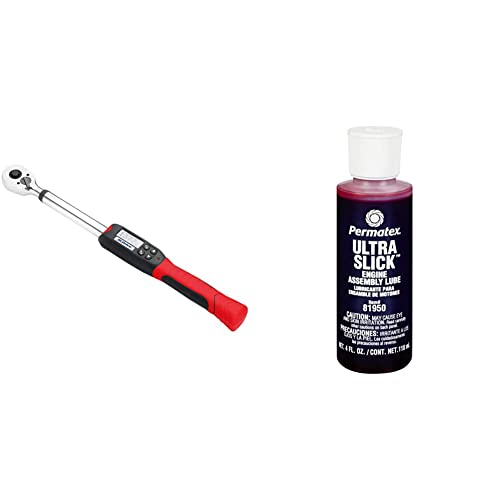
Digital torque wrenches are a different category altogether. The ACDelco ARM601-4 displays real-time torque on an LCD readout and triggers both audible beeps and LED lights when the target torque is reached. This dual-alert system is especially useful in loud shop environments where a subtle click gets missed. The range covers 14.8 to 147.5 ft-lbs, which handles the majority of automotive fasteners including most lug nut specs.
ACDelco meets ISO 6789 standards — the international benchmark (recognized standard) for torque tool accuracy — and includes a certificate of calibration. That documentation matters for professional shops, fleet maintenance operations, and anyone who needs a documented audit trail. The ergonomic soft-grip handle reduces fatigue during extended use, and the slim body with AAA battery power keeps the overall package portable and practical.
The bundle inclusion of Permatex Ultra Slick Engine Assembly Lube is genuinely useful rather than filler. Assembly lube protects engine components during initial startup, preventing the metal-to-metal contact that causes early wear. Anyone doing engine rebuild work — the exact scenario where a digital torque wrench earns its keep — will actually use the lube. The combination makes this the most complete package in our lineup. It's our clear recommendation for engine builders and professional mechanics who want digital precision with proper documentation.
Pros:
Cons:
The Powerbuilt 644998 covers 5–80 ft-lbs (0.7–11.2 m/kg), which is a solid working range for general automotive service. The micrometer-style adjustment — turning the handle like a micrometer barrel to set torque — offers precise, repeatable settings with fine control between increments. It's a step up in ergonomics and accuracy over the basic twist-and-lock designs on budget wrenches. The reversible ratchet adds to the versatility, allowing both tightening and loosening without swapping tools.
The lock screw feature is something we take seriously. When a torque setting is locked in, there's no accidental drift mid-fastener. We've seen countless job mistakes traced back to a torque wrench that shifted settings during a long bolting sequence. Powerbuilt's lock mechanism is firm and reliable. Accuracy is rated at ±4%, consistent with the professional-grade tools in this roundup.
For home mechanics doing regular service work — brake jobs, suspension swaps, oil changes — the Powerbuilt 644998 punches above its mid-range price. It's not a professional shop tool, but it doesn't need to be. Most buyers doing weekend garage work will find this wrench more than capable. Pair it with a good set of metric and SAE sockets from a well-organized truck tool box and the setup covers most DIY automotive jobs cleanly.
Pros:
Cons:
Wera is a German tool manufacturer with a reputation for precision engineering, and the Click-Torque C 1 lives up to that standard. The 1/2" drive covers 10–50 Nm, which aligns with medium-duty automotive fasteners including many cylinder head, suspension, and brake system specifications. The 45-tooth reversible ratchet allows for fine-angle engagement in confined spaces — a genuine advantage over lower-tooth-count ratchets that require larger swing arcs.
What separates the Wera from every other wrench in this roundup is the feel and precision of the torque setting mechanism. Adjusting the target torque involves a smooth, indexed rotation that clicks into position at each scale value. Once set, the mechanism holds without drift. The audible and tactile release when target torque is reached is crisp and unmistakable — sharper than any click mechanism we tested across this group. There's a reason professional mechanics and precision-oriented shops pay the premium for Wera tools.
The Wera Click-Torque C 1 is a long-term investment rather than a budget buy. Anyone performing regular wheel bearing work, brake jobs, or suspension service — tasks where stripped lug nuts from improper torque are a real risk — will appreciate the precision this wrench delivers over years of use. Build quality is noticeably higher than the other options in our lineup, and the mechanism should hold its calibration far longer with proper care.
Pros:
Cons:
Not all torque wrenches are built for the same tasks. Getting the wrong type or the wrong drive size means buying twice. Here's what actually matters when choosing one in 2026.
This is the first decision. Drive size determines which sockets fit the wrench. Here's a simple breakdown:
Most home mechanics building out a well-equipped service setup should prioritize a 3/8" drive click wrench first. It handles the widest variety of common jobs. A 1/2" drive is the second purchase for lug nut and heavy suspension work.
The type of wrench determines how it communicates when the target torque is reached:
The industry standard for torque wrench accuracy is ±4% at midrange. Most reputable wrenches in 2026 meet this specification. A few things affect long-term accuracy:
Handle material matters on long jobs. Rubber or bi-material handles reduce fatigue and prevent slipping with oily hands. Ratchet tooth count affects usability in tight spaces — more teeth mean smaller swing angles needed per click. Look for:
For professional shop use, recalibration every 12 months or every 5,000 cycles is a widely accepted standard. For home mechanics using a wrench a few times per year, every 2–3 years is reasonable. Dropping the wrench on a hard surface is reason to check calibration immediately, regardless of the schedule. Digital torque wrenches like the ACDelco ARM601-4 ship with a calibration certificate and should be returned to the manufacturer or a certified lab for recalibration.
Both measure torque — the rotational force applied to a fastener — just in different scales. Foot-pounds (ft-lbs) are larger units used for higher-torque applications like lug nuts and suspension bolts. Inch-pounds (in-lbs) are smaller units used for delicate fasteners like those on bicycle components and sensor housings. One foot-pound equals 12 inch-pounds. Most automotive torque specs for larger fasteners are published in ft-lbs; smaller fasteners often list in-lbs or Newton-meters (Nm).
It shouldn't be. Torque wrenches are calibrated instruments designed for tightening to a specific value. Using one to break loose stubborn fasteners can damage the internal click mechanism and throw off calibration. Use a breaker bar or impact wrench to loosen bolts first, then switch to a torque wrench when tightening. Wrenches with a reversible ratchet function — like the Powerbuilt and Wera in this roundup — can ratchet in reverse, but that's not the same as using them as a breaker bar.
Most passenger car lug nuts spec between 80–120 ft-lbs. A 3/8" drive wrench with an 80 ft-lb upper limit (like the Powerbuilt) can handle the lower end of that range. For trucks and SUVs with lug nut specs above 100 ft-lbs, a 1/2" drive wrench is the right choice. Using a wrench near or above its maximum rated torque stresses the mechanism and can damage the tool or give inaccurate readings.
Yes — always. Leaving a click-style torque wrench stored at a high torque setting keeps the internal spring under constant compression, which weakens it over time and causes the wrench to read low (meaning fasteners end up under-torqued). After every use, back the torque setting down to the lowest marked value on the scale. This single habit extends the calibration life of the wrench significantly. Beam-style wrenches don't have this issue since there's no internal spring.
For engine builders, fleet maintenance teams, and professional mechanics who need documented accuracy, yes — absolutely. The ACDelco ARM601-4's LED and audible alerts eliminate the chance of missing the target torque in a loud shop, and the ISO 6789 calibration certificate provides a paper trail for quality control. For occasional home use and general service tasks, a quality click-style wrench like the CRAFTSMAN CMMT99433 delivers all the accuracy needed at a fraction of the price. The right choice depends on use frequency and whether calibration documentation matters for the job.
The CRAFTSMAN CMMT99433 is our top recommendation for most buyers in 2026 — it's accurate, comfortable, and comes with a storage case at a price that's hard to argue with. For anyone building out a complete home garage toolkit, picking up a torque wrench alongside quality floor jacks covers the two most critical pieces of service equipment. Head to Amazon using any of the links above to check current pricing and availability, and match the wrench to the specific drive size and torque range the job actually demands.
 |
 |
 |
 |

About Joshua Thomas
Joshua Thomas holds a Bachelor of Science in Mechanical Engineering from San Diego State University and has spent years applying that technical foundation to hands-on automotive work — from routine maintenance to full mechanical repairs. He founded CarCareTotal in 2017 to give car owners the kind of clear, practical guidance that helps them understand what is happening under the hood and make smarter decisions about upkeep and repairs. At CarCareTotal, he oversees editorial direction and covers automotive fundamentals, maintenance guides, and troubleshooting resources for everyday drivers.
Get some FREE car parts & gear.. Or check out the latest free automotive manuals and build guides here.
Disable your ad blocker to unlock all the hidden deals. Hit the button below 🚗
| | | |
