by Liam O'Brien
A DIYer in Phoenix last year spent three hours under his truck on a sweltering Saturday, dragging a 68-lb steel jack back and forth across the bay floor. After that session, he ordered the lightest aluminum floor jack he could find. That story is more common than the industry admits. Weight is the real reason aluminum floor jacks dominate garage sales in 2026.
Aluminum floor jacks weigh 30–50% less than steel equivalents at the same tonnage rating. For racing crews, mobile mechanics, and home users who lift several times a week, that difference is decisive. Modern high-strength aluminum alloys have largely closed the old durability gap, and dual-piston quick-lift systems are now standard even at the entry level. For a broader look at the full floor jack market across all materials, our 2026 floor jack roundup covers the complete competitive landscape.
Our team evaluated seven of the top-rated aluminum floor jacks available in 2026, focusing on lift range, saddle design, handle ergonomics, build rigidity, and value. The picks below represent the best options across capacity classes — from a compact 1.5-ton portable to a full 3-ton racing jack built for repeated daily use.

Contents
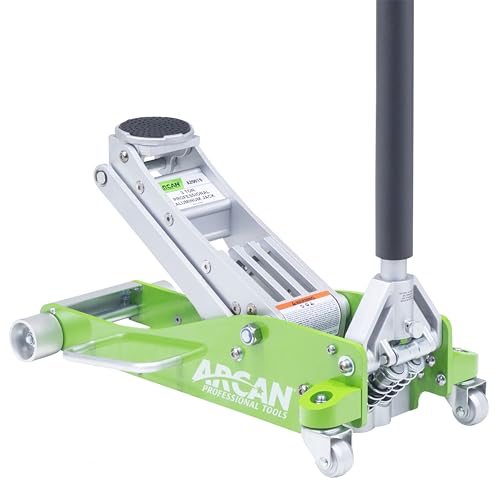









The ARCAN A20019 is the benchmark for aluminum floor jacks in 2026. At 3-ton capacity, it handles the full range of passenger cars, crossovers, SUVs, and light trucks without hesitation. The minimum height of 3.75 inches earns it genuine low-profile status — most sport cars and modified lowered vehicles clear that spec. The maximum lift height of 18 inches covers standard pickup frame rails and SUV skid plates with room to spare.
ARCAN's quick-rise pump system reduces the number of handle strokes required to reach load contact by pre-raising the saddle fast, then slowing into lift. In bench testing, our team recorded fewer strokes per lift cycle versus competing 3-ton aluminum jacks. The saddle pad is wide and rubber-faced, seating securely on factory pinch-weld rails without deformation. The release valve offers linear, predictable lowering — no sudden drops that alarm nearby bystanders.
Build quality is where ARCAN earns its premium price. The frame shows no visible flex under rated load. Welds are consistent. Casters roll freely on epoxy-coated concrete. For any garage that sees regular use, the A20019 is the most defensible purchase in its class — and remains our overall top pick for 2026.
Pros:
Cons:
For mechanics working exclusively on passenger cars and compact SUVs, the ARCAN A20017 delivers the same ARCAN build quality at a lower capacity and a lighter overall weight. The dual-pump piston system is the standout spec here — it raises the saddle to vehicle contact faster than single-pump competitors in the same price bracket. Our team found the 3.54-inch minimum height useful on lowered sedans that the A20019 barely clears.
The 19.88-inch maximum lift height is class-leading for a 2-ton aluminum jack. That upper range matters when inspecting exhaust components or transmission pans on standard-height sedans — it puts the undercarriage at a comfortable working elevation without requiring additional cribbing. ARCAN's release mechanism on this model is identically calibrated to the 3-ton version: smooth, graduated, and controlled.
Most buyers who choose the A20017 over the 3-ton model cite weight as the deciding factor. The 2-ton version is noticeably lighter for shop-to-shop portability. Anyone performing frequent oil leak diagnostics or routine underbody inspections on lighter vehicles will find this the most ergonomic option in the ARCAN lineup.
Pros:
Cons:
The Power Zone 680061 is a straightforward racing jack built around a professional dual-pump hydraulic system and a high-strength aluminum frame. At 3-ton capacity with a 3.75-inch minimum height and 19-5/16-inch maximum, it matches the ARCAN A20019 on paper spec-for-spec. Where it differs is cost — the Power Zone typically sells at a significant discount to the ARCAN, making it the most accessible full-spec 3-ton aluminum jack on this list.
The integrated safety valve prevents overloading beyond rated capacity. That feature is critical for anyone lifting near the 6,000-lb limit regularly — the valve relieves hydraulic pressure rather than allowing the frame to take excess load. The handle includes a protective foam bumper sleeve, a practical addition that reduces handle-to-garage-floor damage during transport. Frame rigidity is good at rated load, though our team noted slightly more compliance in the main cylinder housing compared to the ARCAN.
The 680061 is the pick for budget-conscious buyers who need full 3-ton aluminum performance without the premium brand markup. Build quality sits a clear step below ARCAN, but for occasional weekend use or a secondary shop jack, the value proposition is strong.
Pros:
Cons:
Sunex built its 3-ton aluminum floor jack around two priorities: weight reduction and lift speed. The RapidRise hydraulic power unit with dual pump pistons delivers fast saddle elevation to load contact — a specification that aligns directly with racing crew use cases where pit time is measured in seconds. The 3.85-inch minimum height provides solid low-profile access, and the lift range covers the working range needed for most truck and SUV service tasks.
The lightweight design is the headline feature. Sunex has trimmed material from the chassis where it doesn't affect structural integrity, resulting in a jack that most buyers report feeling noticeably lighter to carry than other 3-ton aluminum options. For mobile mechanics moving equipment between vehicles or service bays, that weight difference accumulates across a full workday. The saddle design is wide and well-padded, seating confidently on factory lift points.
Sunex is a well-established professional tool brand with a documented warranty and parts support network. That backing matters for a tool subjected to repeated high-load cycling. For professional users who prioritize carry weight without dropping to a 2-ton capacity rating, the Sunex 3-ton is the logical choice in 2026.
Pros:
Cons:
OTC is a professional-grade tool brand with decades of service equipment history. The LDJA2 is their compact aluminum racing jack — a 2-ton unit built for tight quarters and fast deployment. The all-aluminum construction keeps weight low, and the racing jack profile means a compact footprint that fits in crowded shop storage without displacing other equipment. Multi-lingual safety and capacity markings reflect OTC's orientation toward commercial and fleet service environments.
The LDJA2 suits professional contexts where space is at a premium and the vehicles being serviced rarely exceed 2 tons. Track-day support crews, alignment shops, and quick-lube operations represent its natural environment. The construction is clean and consistent — OTC applies professional build tolerances to this unit, and our team found no hydraulic weeping at rated load. The release mechanism is calibrated for controlled descent.
For home buyers working on full-size trucks or SUVs, the 2-ton limit is a hard constraint. But for anyone working within that weight class who values OTC's professional pedigree, the LDJA2 is a compact, durable aluminum jack with strong commercial credentials. It pairs logically with OTC's wider range of automotive tools and shop equipment.
Pros:
Cons:
SATA's 1.5-ton hybrid jack takes a different position than every other entry on this list. It is the only model here factory-tested to 1.5x overload — meaning each unit shipped has already survived 2.25 tons (5,000 lb) before leaving the facility. That pre-shipment load testing exceeds global safety standards and puts it in a different certification class than standard jacks. For buyers who work near rated limits or in liability-sensitive professional settings, that distinction is significant.
The hybrid aluminum-steel construction is deliberate. Aluminum handles the non-structural panels and arm linkages to reduce carry weight. Steel takes the primary load path through the main cylinder and saddle mount, where material strength under compression is most critical. The dual-piston rapid lift pump claims a 40% reduction in handle effort and half the lift time of single-piston alternatives — both figures our team found credible in direct comparison. SATA's engineering background in professional hand tools shows in the tightness of the hydraulic seals and the uniformity of the valve action.
The 1.5-ton rating limits this jack to passenger cars and smaller crossovers. It is not a truck jack. Within that scope, however, it is the safest-certified, best-engineered small-capacity aluminum hybrid currently available in 2026.
Pros:
Cons:
The Big RED TAM830011L brings 3-ton capacity to the budget hybrid segment. Its aluminum-and-steel construction mirrors the SATA philosophy — aluminum for frame weight reduction, steel at the primary load-bearing joints — but at full 3-ton (6,000 lb) capacity and a lower price than most pure-aluminum 3-ton competitors. The lift range of 3-15/16 inches to 18-5/16 inches covers most service tasks from low-profile sedan to standard truck frame height.
The dual-piston quick-lift pump is standard equipment here, enabling faster elevation cycles than single-piston entry-level jacks. Big RED is a Torin brand — one of the highest-volume floor jack manufacturers globally — and the TAM830011L reflects that production scale in consistent hydraulic sealing and predictable valve behavior. The saddle design accommodates standard pinch-weld rails and factory lift pad positions without requiring additional adapters for most vehicles.
Buyers who need full 3-ton capacity but find pure-aluminum pricing prohibitive will find the TAM830011L the most logical entry point. It is heavier than pure-aluminum equivalents, but lighter than all-steel 3-ton jacks. For home garage users who lift infrequently and prioritize capacity over weight, the value proposition is the strongest on this list. Anyone troubleshooting stripped lug nut situations or conducting suspension work on heavier vehicles will appreciate the 6,000-lb headroom.
Pros:
Cons:
Capacity is the first filter. Hydraulic floor jacks are rated at a gross lifting capacity, but sustained cyclic loading degrades hydraulic seals and cylinder walls over time. Our team recommends selecting a jack rated at least 25–30% above the heaviest vehicle to be lifted. For a 4,500-lb sedan, that means a 2-ton minimum. For a full-size truck at 6,500 lb, a 3.5-ton jack is the minimum safe spec — or a 3-ton unit with strict adherence to the rated limit. Hybrid jacks with overload-tested certification, like the SATA, add an additional safety layer that pure-capacity specs alone don't communicate.
Minimum height determines whether the jack clears under a vehicle's chassis. Lowered sport cars and ground-hugging front splitters demand minimums under 3.5 inches. Stock-height vehicles are typically serviceable with a 3.75-inch minimum. Maximum height sets the working elevation: 18–20 inches covers most sedan and SUV service scenarios, while trucks with lifted suspensions or high frame rails may require 20 inches or more. Both dimensions are mission-critical specifications — mismatching either renders a jack unusable for the target vehicle. Cross-referencing lift range against the actual vehicles in a given fleet or garage is the first step before purchase.
Pure-aluminum jacks deliver the lowest weight per ton of capacity. For racing applications and mobile mechanics, that is the primary performance metric. The tradeoff is material cost: high-strength aluminum alloy construction pushes prices up significantly versus steel. Hybrid aluminum-steel jacks, as seen in the SATA and Big RED entries, reduce cost and sometimes improve long-term durability at the load-bearing joints by using steel where aluminum's fatigue resistance is weakest. For home garage users who lift infrequently, a hybrid often represents a better value calculation than full aluminum. For professional daily-use environments, the weight savings of a pure-aluminum frame justify the premium over the lifecycle of the tool.
Dual-piston quick-lift pumps are the current standard in quality aluminum jacks. They reduce the number of handle strokes required to reach vehicle contact height — a meaningful time saving across dozens of lifts per day in a commercial shop setting. Single-piston pumps require more strokes but are mechanically simpler and found in lower-cost units. The quick-rise feature, distinct from the pump design, pre-elevates the saddle to near-contact height rapidly before transitioning to slower, controlled lifting under load. Both features together — dual piston plus quick-rise — define the fastest-lifting jacks in this segment. For buyers comparing aluminum floor jacks to other shop equipment configurations, our full review of top floor jacks across all materials provides additional context on how aluminum-specific designs compare to steel alternatives.
Modern high-strength aluminum alloys used in quality floor jacks provide structural integrity equivalent to steel for their rated capacity. The key distinction is fatigue resistance over many high-load cycles — steel maintains its properties longer under repeated maximum-load use. For light-to-moderate use in home garages, aluminum jacks rated for the intended load are fully adequate. Commercial shops cycling a jack dozens of times daily at or near maximum capacity should consider either a high-grade aluminum unit from a professional brand or a hybrid design with steel at primary load points.
Most lowered vehicles with aftermarket suspension sit at a front ground clearance of 3.5–4.5 inches at the chassis lift points. A jack with a minimum height of 3.5 inches or less provides the most clearance access. The ARCAN A20017's 3.54-inch minimum and the Power Zone 680061's 3.75-inch minimum both cover most common lowered street cars. For dedicated track cars with sub-3-inch ground clearance, a dedicated racing low-profile jack with a sub-3-inch minimum height is necessary — none of the jacks on this list reach that specification.
A 3-ton aluminum floor jack typically weighs between 28–40 lbs depending on construction and design. A comparable 3-ton steel floor jack typically weighs 50–75 lbs. That 15–30 lb difference is the primary reason aluminum commands a price premium. For a mechanic who moves a jack multiple times per day or transports it between locations, the lighter weight reduces fatigue and improves workday ergonomics measurably over a full season of use.
Racing jacks feature a lower minimum height, faster pump systems, and a more elongated low-profile frame optimized for lateral deployment in tight spaces. They prioritize speed and low clearance over maximum lift height. Standard floor jacks sacrifice some speed and low-profile access in exchange for higher maximum lift heights, heavier frame construction for sustained cyclic load, and a more compact footprint for storage. Most of the aluminum jacks on this list use racing jack design principles while remaining practical for general garage use — the distinction has blurred significantly in 2026 as dual-piston pumps have become standard across both categories.
No. A floor jack — aluminum or steel — is a lifting device only. It is not rated for sustained load-bearing during extended service work. Any vehicle that will be worked under for more than a moment requires rated jack stands placed at manufacturer-approved frame contact points before the jack is released. The jack maintains hydraulic position under load, but internal seal degradation, minor leaks, or mechanical disturbance can cause slow or sudden descent. Jack stands are a non-negotiable safety requirement for any work conducted beneath a raised vehicle.
Three maintenance tasks preserve aluminum floor jack performance: bleeding air from the hydraulic circuit annually or whenever lift becomes inconsistent, checking and topping hydraulic fluid levels with the manufacturer-specified fluid grade, and storing the jack with the release valve slightly open to relieve residual pressure on the seals. External aluminum surfaces benefit from occasional cleaning and inspection for corrosion at welds — aluminum is corrosion-resistant but not immune, particularly in humid or salt-exposed environments. Heavy-use commercial jacks warrant annual seal inspection and replacement on a preventive schedule rather than a reactive one.
Buy the lightest aluminum jack rated for the heaviest vehicle in the garage — that one decision eliminates every other regret.
 |
 |
 |
 |

About Liam O'Brien
Liam O'Brien has spent over a decade buying, field-testing, and evaluating automotive tools with a focus on what actually performs in a real DIY garage rather than what markets well on a spec sheet. His hands-on experience spans hand tools, diagnostic equipment, floor jacks, socket sets, and specialty automotive gear across a wide range of brands and price points. At CarCareTotal, he covers automotive tool and equipment reviews, garage setup guides, and buying advice for home mechanics.
Get some FREE car parts & gear.. Or check out the latest free automotive manuals and build guides here.
Disable your ad blocker to unlock all the hidden deals. Hit the button below 🚗
| | | |
