by Liam O'Brien
The Camco Rhino 21-Gallon Portable RV Tote Tank tops our 2026 rankings as the best all-around option for most RV owners — it delivers the right balance of capacity, rugged HDPE construction, and a complete accessory kit that gets you operational right out of the box. If you want one tank that handles the widest range of RV situations without overspending, start here.
Managing black water on the road is one of the less glamorous realities of RV life, but a quality portable waste tank makes the job far less unpleasant. Whether your dump station is 200 feet away or you're boondocking without hookups, a tote tank lets you transport waste safely without breaking camp. The challenge is picking the right capacity and build quality for your setup — a 12-gallon tank suits a weekend solo trip, while a 42-gallon unit handles a family of four on a week-long stay.
In 2026, the market is led by three brands that have earned their positions through consistent performance: Thetford (SmartTote2 line), Camco (Rhino series), and Barker (4-Wheeler tanks). This guide covers seven top models with detailed reviews, a buying guide, and answers to the most common buyer questions. For complementary RV gear, our best RV sewer hoses guide covers the hoses that connect your tank to the dump station. If you're outfitting your rig more broadly, our best RV covers guide is worth bookmarking as well.

Contents
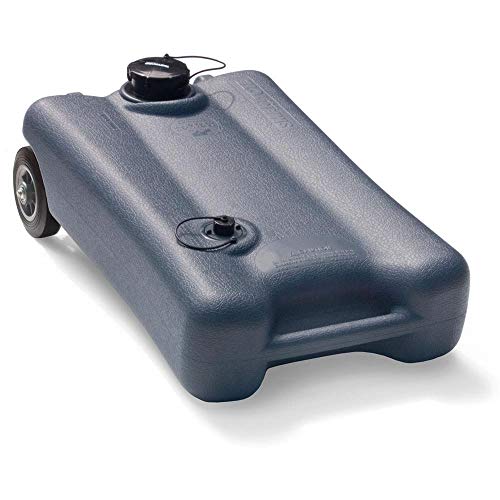






The Thetford SmartTote2 12-Gallon is the tank you reach for when portability is the primary requirement. At 12 gallons, it targets solo travelers, couples, and anyone parked close enough to a dump station that multiple trips per week are a minor inconvenience rather than a hardship. Thetford ships it fully assembled with caps for both the hose opening and vent — you're ready to use it the moment you unbox it, without hunting for additional fittings or hardware.
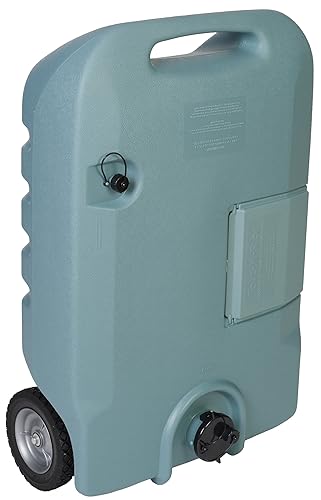
What the SmartTote2 does exceptionally well is stay out of your way. The lightweight, compact design means you can lift and maneuver it without straining, and the two-wheel setup rolls smoothly on paved campground surfaces. It does not include a hose — that's a deliberate choice to keep the unit price accessible — so budget for a compatible sewer hose before your first trip. The 12-gallon capacity is genuinely limiting for anything longer than two or three days with two people, but within its intended use case it performs exactly as advertised. Thetford also offers the SmartTote2 LX in larger capacities, including a 40-gallon AutoStop model for high-volume situations, shown below.

Thetford's build quality on this unit is consistent with the rest of the SmartTote2 line. The polyethylene shell resists cracking and UV degradation through normal outdoor use. The caps form a reliable seal that prevents odor and spillage during transport. For weekend campers and RVers who dump frequently, it's a clean, no-frills solution that doesn't ask much of you in return.
Pros:
Cons:
Camco's Rhino 15-Gallon is the entry point to the Rhino series, and it immediately demonstrates why Camco dominates this product category. Where the SmartTote2 prioritizes minimalism, the Rhino 15 packs substantially more value into a comparable price range: no-flat wheels engineered for any terrain, an oversized handle for one-handed maneuvering, a removable steel tow adapter for attachment behind a truck or golf cart, and a 3-foot sewer hose so you can start draining the moment you arrive at the dump station.
The construction is UV-stabilized blow-molded HDPE, measuring 20⅛" L × 12½" W × 32⅛" H and weighing 31.5 lb empty. That empty weight stays manageable — a full 15-gallon load adds roughly 125 pounds of liquid waste, which the Rhino's no-flat wheels handle without issue on gravel or paved surfaces. The low drain hole design is one of the more practical engineering decisions in this product line: it allows the tank to drain nearly completely without tilting, which saves time and prevents waste residue buildup in the corners of the shell.
At 15 gallons, this tank is well-suited for weekend trips with one or two people, or as a supplemental tank alongside a larger primary unit. The Rhino series uses consistent connection fittings across all capacity tiers — accessories you buy for the 15-gallon transfer to a larger Rhino if you upgrade later, which is a genuine advantage over mixing brands mid-season.
Pros:
Cons:
The Camco Rhino 21-Gallon is the tank that most RV owners should buy in 2026. At 21 gallons, it hits the sweet spot between manageable empty weight and meaningful capacity — enough to handle a full week for a couple, or 3–4 days for a family of four, without running daily dump trips. It carries the complete Rhino feature set: no-flat wheels, removable steel tow adapter, 3-foot sewer hose, and UV-stabilized HDPE construction.

The tank measures 20⅛" L × 12½" W × 40" H and weighs 34.5 lb empty. Six additional gallons over the 15-gallon model costs just 3 lb of empty weight — an excellent tradeoff that adds meaningful dump-run interval without meaningfully changing storage requirements. The tow adapter is steel-constructed and removes cleanly when not in use, keeping the profile compact during storage. The low drain hole design, shared across the Rhino line, allows near-complete drainage on flat campground pavement without tilting or repositioning.
In real-world use, the extra capacity compared to the 15-gallon means fewer trips to the dump station per trip, which translates directly into less camp disruption and more time doing what you came to do. For most RV owners, the 21-gallon Rhino is the last tote tank they'll ever need to buy. If you're building out a complete waste management setup, pair it with a quality hose from our best RV sewer hoses roundup — the right hose connection prevents the single most common frustration at dump stations.
Pros:
Cons:
The Camco Rhino 28-Gallon steps up the engineering significantly from the smaller Rhino models. At 28 gallons, maneuverability under a full load becomes a real operational concern — Camco addresses this with steerable front wheels, a design change that lets you guide the tank around obstacles that would leave a fixed-wheel tank pointed in the wrong direction. The combination of steerable front wheels and large rear wheels gives you genuine directional control on gravel campground paths, slopes, and tight turns around your rig.
The tank measures 24½" L × 13" W × 44" H and weighs 53 lb empty — a notable jump over the 21-gallon's 34.5 lb. That weight reflects the stronger frame and larger wheel assembly required to manage a full load responsibly. Camco includes a removable 24" tow bar (longer than the smaller models' adapters), a 3-foot sewer hose, and a built-in gate valve. The gate valve is a critical addition at this capacity tier — it gives you controlled drainage rather than a sudden uncontrolled rush when you open the valve at the dump station.
A fully loaded 28-gallon tank approaches 235 pounds. You're towing this, not hauling it by hand, and the steerable wheel system justifies its existence at this weight class. For families of four on week-long trips, or couples who prefer longer intervals between dump runs without committing to a 36-gallon footprint, the Rhino 28 fills a practical gap in the lineup. The built-in gate valve alone makes it worth the step up from the 21-gallon if controlled drainage is a priority for you.
Pros:
Cons:
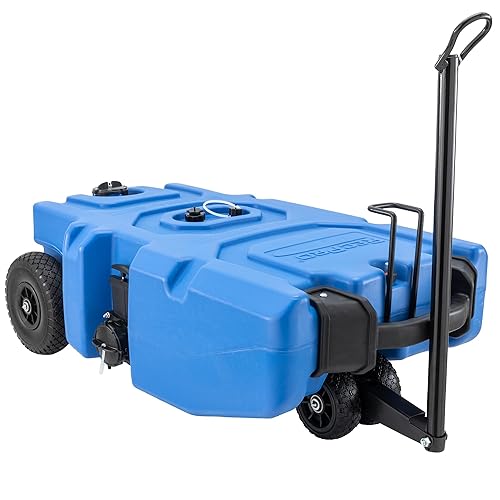
Barker's 4-Wheeler line takes a different engineering approach than Camco's Rhino series, and the 32-gallon is where that philosophy pays off most visibly. The front-mounted double wheel swivel is engineered for true omnidirectional pulling — you steer the tank like a cart rather than fighting a fixed-wheel unit around corners and parked equipment. The swivel mounting plate is heavy-duty and oversized, designed to take repeated stress across multiple seasons without loosening or cracking.
Barker constructed the 32-gallon from blow-molded polyethylene combined with zinc-plated steel and aluminum components — a material mix that balances corrosion resistance with structural rigidity. Barker describes the rolling action as quiet and smooth, which matters more than it might initially seem: if you're navigating past occupied sites at 6 a.m. on your way to the dump station, a noisy tank becomes a social problem. The blue color also differentiates the Barker from other tanks at a dump station — a minor but practically useful detail when multiple RVers share the same facility. Barker also offers a smaller 25-gallon model in the same 4-Wheeler family for those who need the swivel design without the 32-gallon footprint.

Compared directly to the Camco Rhino 28-Gallon, the Barker 32 offers 4 more gallons of capacity at a comparable price point, while trading Camco's no-flat wheel technology for a four-wheel swivel system that delivers better turning radius in tight spaces. If your campground has narrow paths between sites or you regularly maneuver around obstacles, the Barker's swivel system is a genuine advantage. If no-flat reliability is your top priority, the Rhino is the stronger call.
Pros:
Cons:
The Camco Rhino 36-Gallon is the largest tank in Camco's standard Rhino lineup, and it delivers the same proven feature set at a capacity tier that serves full-time RVers and large groups traveling in 2026. At 36 gallons, it handles the black tank output of a family of four for up to 10–12 days under typical camping water usage, or provides a substantial buffer for situations where dump station access is limited or unpredictable during remote travel.
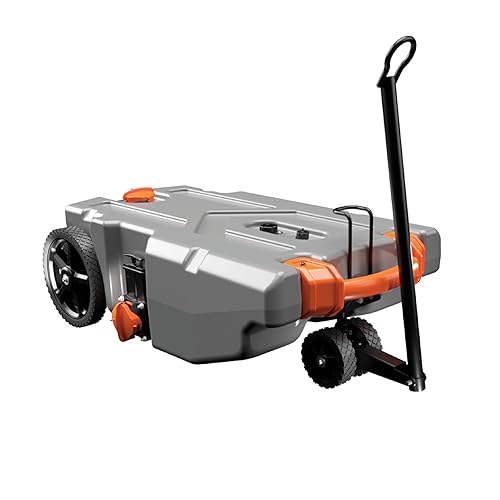
The 36-gallon measures 24⅛" L × 14¾" W × 44⅞" H and weighs 45 lb empty — counterintuitively lighter than the 28-gallon model's 53 lb. That discrepancy reflects Camco's different design choices at each capacity tier. The UV-stabilized HDPE shell, no-flat wheel system, and built-in gate valve are consistent with the larger Rhino format, and the removable steel tow adapter and 3-foot sewer hose cover your dump station essentials.
A fully loaded 36-gallon tank carries approximately 300 pounds. You tow it — full stop. The no-flat wheel construction is especially critical at this weight class: a flat wheel failure with a fully loaded 36-gallon tank at a dump station is a genuine operational emergency. Camco's no-flat design eliminates that failure mode entirely. For RV owners who want maximum dump station interval within Camco's established ecosystem, the 36-gallon is the definitive answer in this lineup.
Pros:
Cons:
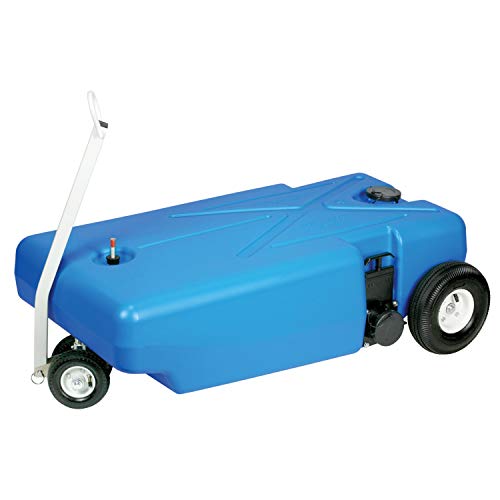
The Barker 4-Wheeler 42-Gallon is the flagship of the Barker lineup and the largest tank in this review. At 42 gallons, it's purpose-built for full-time RV living, extended boondocking, and remote travel where dump station access is genuinely infrequent. The universal fit designation means it connects to standard RV drain valves without custom adapters, and the double-wheel front swivel design — Barker's core differentiator — handles the load when the tank is full and directional control is most critical.
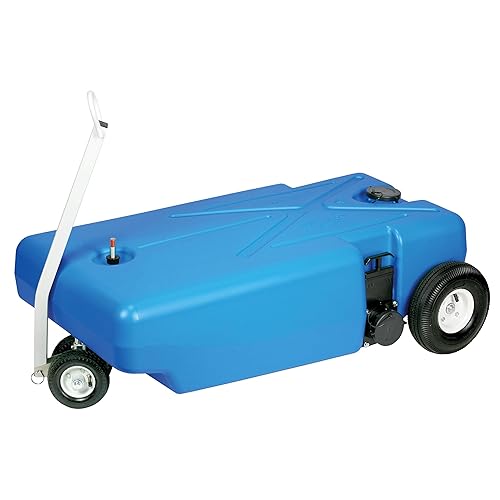
A fully loaded 42-gallon tank carries approximately 350 pounds of liquid waste. Barker engineered the four-wheel swivel design specifically to handle this weight — distributing load across a wider footprint reduces tipping risk and makes direction changes more controlled than any two-wheel design at the same capacity tier. The quiet, smooth-rolling construction is meaningful here because you'll be towing this tank past occupied campsites to reach dump facilities, and vibration-induced noise at that weight is a real consideration if you're running a dump trip at first light.
The Barker 42-gallon is not a casual purchase. It's a commitment to a specific RV lifestyle — one where capacity and convenience over long stretches outweigh portability concerns. Full-time RVers, families on month-long trips, and anyone with reliable vehicle towing access will find it delivers everything they need from a portable waste management solution. If you're building out a full long-term travel setup, it pairs naturally with the other gear covered in our best RV air conditioners guide, where you'll find recommendations for keeping your living space comfortable on extended stays.
Pros:
Cons:

Capacity is the first and most consequential decision you'll make. The EPA's vessel sewage discharge guidelines and campground dump station regulations both emphasize proper waste containment between uses — your tank needs enough capacity to hold waste safely between dump runs without overflow risk.
A working benchmark: a single adult generates approximately 10–15 gallons of combined black water per week under normal RV use. Use that math to estimate your interval needs:
Don't over-buy on capacity without accounting for storage. A 42-gallon tank has physical dimensions that need to live somewhere when you're not at a dump station. Measure your available storage space before committing to the largest option — an oversized tank that won't fit your storage bay is dead weight.
Wheel design determines how the tank behaves under load on real campground terrain. The two main approaches are two-wheel fixed or steerable (Camco Rhino) and four-wheel swivel (Barker 4-Wheeler), and each has genuine field advantages depending on your situation.
Terrain is the tiebreaker. If your campground has smooth, paved access to dump stations, either system handles the job. If you're regularly navigating gravel paths, grass, or uneven ground, the no-flat wheel construction on Camco's Rhino models eliminates failure points that traditional wheels introduce. The Barker swivel system shines when tight-radius turns are the priority.
All tanks in this review use blow-molded polyethylene as the primary shell material. The meaningful differences appear in the specific formulation and how metal components are treated for corrosion resistance.
Both construction approaches produce tanks that perform reliably over multiple seasons with proper maintenance. The more critical durability factor is the drain fittings and caps — these are the stress points that fail first on lower-quality alternatives. All models reviewed here use fittings that form reliable seals, but inspect and replace gaskets at the start of each camping season as preventive maintenance.
What's in the box matters, especially when you're setting up at a campground for the first time and discover you're missing a critical fitting. Factor included accessories into your actual cost comparison:
A tank that costs $20 less but requires a $25 sewer hose and $10 in fittings to operate is not actually cheaper. Calculate total operational cost before comparing sticker prices. For additional RV accessories and maintenance equipment recommendations, browse our full tools and gear section.
Empty your portable RV waste tank when it reaches approximately two-thirds to three-quarters full — don't wait for maximum capacity. At a full load, sloshing during transport significantly increases spillage risk, and the additional weight makes maneuvering on campground terrain harder. For most RV setups, this means dump runs every 3–7 days depending on party size, daily water usage, and which capacity tank you're running.
Yes. Most tote tanks in this review include a removable tow adapter designed for attachment to a standard trailer hitch or ball mount. Camco Rhino models specifically list truck or golf cart towing compatibility. Ensure your tank is securely attached before moving, and follow campground rules about waste transport — many facilities restrict towing speeds near dump station areas to 5 mph or less.
The Barker 4-Wheeler 42-Gallon is the best option for full-time RVers who need maximum capacity between dump station visits. Its four-wheel swivel design handles the load at full capacity, and 42 gallons provides the longest practical interval in this review. For full-timers who prefer Camco's no-flat wheel reliability and complete accessory kit, the Camco Rhino 36-Gallon is the stronger fit within that brand's lineup.
It depends on the model. All Camco Rhino tanks reviewed here (15, 21, 28, and 36-gallon) include a 3-foot sewer hose as part of their accessory kits. The Thetford SmartTote2 12-Gallon does not include a hose and requires a separate purchase. Barker 4-Wheeler tanks typically require separately sourced hoses and fittings. Always verify what's included before buying to avoid arriving at camp without essential connections.
After each use, rinse the tank with clean water through the drain valve before any residue dries. Several RV-specific tank cleaning solutions break down waste residue without degrading polyethylene shells. At the start of each camping season, inspect all gaskets and fittings — replace any that show visible cracking, flattening, or compression set. Store the tank with the drain valve open and caps removed to allow airflow and prevent odor buildup between uses.
A family of four on a week-long trip typically generates 40–60 gallons of combined black water. A 21-gallon tank requires dump runs every 3–4 days, which is manageable but frequent. A 28-gallon or 32-gallon tank extends that interval to 5–7 days, suiting most family camping schedules. If you're planning extended trips or remote stays with limited dump station access, a 36-gallon or 42-gallon unit gives you comfortable operational margin.
 |
 |
 |
 |

About Liam O'Brien
Liam O'Brien has spent over a decade buying, field-testing, and evaluating automotive tools with a focus on what actually performs in a real DIY garage rather than what markets well on a spec sheet. His hands-on experience spans hand tools, diagnostic equipment, floor jacks, socket sets, and specialty automotive gear across a wide range of brands and price points. At CarCareTotal, he covers automotive tool and equipment reviews, garage setup guides, and buying advice for home mechanics.
Get some FREE car parts & gear.. Or check out the latest free automotive manuals and build guides here.
Disable your ad blocker to unlock all the hidden deals. Hit the button below 🚗
| | | |
