Exterior ›
by Rachel Park
Over 11 million households in the United States own a recreational vehicle, according to the RV Industry Association, and every single one of them needs a reliable water hose to connect to campground hookups. Yet a surprising number of RV owners still use standard garden hoses — a choice that can introduce lead, BPA, and other contaminants directly into their drinking water supply. The right RV water hose is not just a convenience item. It is a health and safety essential.
The market for RV-specific water hoses has expanded significantly heading into 2026, with manufacturers offering everything from ultralight fabric-reinforced designs to heated hoses built for sub-zero temperatures. Choosing the right one depends on camping style, climate, and how much storage space is available. A full-timer in Arizona has very different needs than a weekend warrior braving Minnesota winters. Factors like hose length, inner diameter, pressure rating, and material certifications all play a role in making the best decision.

After testing seven of the most popular RV water hoses available in 2026 — evaluating flow rate, kink resistance, taste, flexibility, and long-term durability — this guide breaks down exactly what each hose does well and where it falls short. Whether the priority is a premium drinking water hose for a cross-country road trip or a compact coiled option for quick campsite setups, one of these picks will fit the bill. Those equipping an RV for the first time may also want to check out the best RV toilets and best RV water pressure regulators to round out the plumbing setup.
Contents








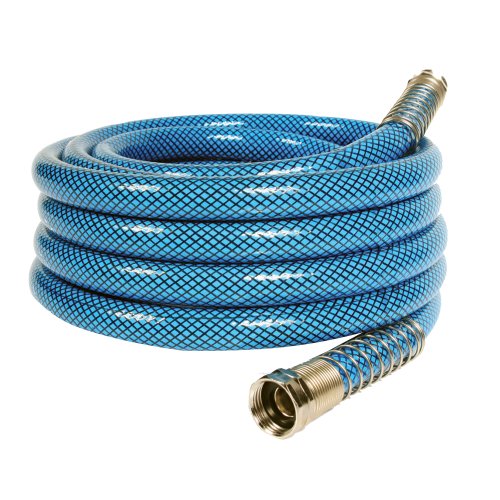

The Camco TastePURE 50-Ft has earned its reputation as the go-to RV water hose for good reason. Constructed with NSF/ANSI 61 certified materials specifically approved for drinking water contact, this hose delivers water that tastes clean right out of the box — no prolonged flushing or break-in period required. The diamond-hatch reinforced PVC design gives it structural rigidity that prevents kinking in most situations, while the 5/8-inch inner diameter provides strong, consistent water flow even at moderate campground pressures.
At 50 feet, this hose reaches hookups at virtually any campsite configuration. The easy-on grip connectors thread onto spigots without tools, and the machined brass fittings feel substantially more durable than the stamped fittings found on budget competitors. Camco manufactures this hose entirely in the United States, and it carries CSA lead-free certification to NSF/ANSI 372, meaning it complies with every federal and state lead-free regulation currently on the books.
The tradeoff for all that reinforcement is weight. A 50-foot hose of this construction weighs noticeably more than fabric-reinforced alternatives, and it can be stiff in cold weather until water flows through it for a minute or two. For buyers who prioritize proven safety certifications and a no-compromise approach to drinking water quality, the TastePURE 50-Ft remains the standard-bearer in 2026.
Pros:
Cons:
Campgrounds with inconsistent or high water pressure can wreak havoc on standard hoses, causing bulging, leaks, or even burst fittings. The Valterra AquaFresh is engineered specifically for this scenario, rated to handle up to 160 psi — well above the 40–60 psi range most campgrounds deliver. That pressure tolerance provides a significant safety margin, making this hose a strong choice for RV owners who travel to a wide variety of parks and never know what pressure awaits at the spigot. Pairing it with one of the best RV water pressure regulators creates a bulletproof water delivery setup.
The 25-foot length and 1/2-inch inner diameter keep weight and storage requirements minimal. The Hi-Flow fittings are universally compatible with standard RV, camper, and trailer connections. Valterra designed this hose for durability over multiple seasons, with reinforced construction that holds up to repeated coiling and uncoiling without developing memory kinks.
The narrower 1/2-inch diameter does produce slightly lower flow volume compared to 5/8-inch hoses, which can be noticeable when filling a fresh water tank. And at 25 feet, the hose may come up short at larger pull-through sites where the hookup pedestal sits far from the RV's water inlet. Still, for buyers who value pressure handling above all else, the AquaFresh delivers.
Pros:
Cons:
Weight is a real concern for RV owners managing cargo limits. The Teknor Apex Zero-G lives up to its name — this 50-foot hose weighs roughly half of what a comparable traditional PVC hose weighs. The secret is a woven fiber jacket that replaces the heavy rubber or PVC outer layer found on conventional hoses. When empty, the Zero-G lays flat and rolls up to a fraction of the bulk, making it a dream for tight RV storage compartments.
Manufactured in the United States using FDA-sanctioned materials, the Zero-G complies with the Consumer Product Safety Improvement Act of 2008 for lead content. The flat-weave construction virtually eliminates kinking, one of the most persistent frustrations RV owners experience with traditional round hoses. Water flows freely even when the hose is bent around sharp corners or draped over obstacles between the hookup and the RV inlet.
There are a few caveats to note. The Zero-G's fabric construction can be more susceptible to abrasion damage when dragged across rough asphalt or gravel pads compared to reinforced PVC. The fittings, while functional, are lighter-duty than the machined brass connections on premium Camco models. Buyers who camp primarily on paved or grass pads will get excellent service from this hose. Those who frequently set up on rough surfaces should take care with routing.
Pros:
Cons:
The Camco EvoFlex2 represents Camco's top-tier engineering for 2026. It takes everything that works about the TastePURE line and upgrades the construction with a fabric-reinforced design that slashes weight while maintaining the same drinking water safety certifications. The result is a hose that handles like a premium garden hose but meets every NSF/ANSI 372 standard for lead-free drinking water contact. It is BPA-free and phthalate-free as well.
The 5/8-inch inner diameter delivers the same strong flow rate as the standard TastePURE, and the 50-foot length covers even the most spread-out campsite hookups. Molded strain-reliefs at both ends prevent the kind of kinking and crimping that typically occurs right at the fitting connection — the most vulnerable point on any water hose. Camco specifically designed the EvoFlex2 to handle the repeated coiling and uncoiling that comes with frequent campsite setup and breakdown.
The premium label comes with a premium price tag. The EvoFlex2 typically costs 40–60% more than the standard TastePURE, which is a significant jump for what is essentially the same water delivery capability in a lighter, more flexible package. Full-time RV dwellers and frequent travelers who set up camp multiple times per month will appreciate the weight and flexibility improvements enough to justify the investment. Weekend campers may find the standard TastePURE delivers equivalent results at a better value.
Pros:
Cons:
Not every camping scenario requires a full 50-foot hose uncoiled across the campsite. The Camco 20-Ft Coiled Hose is designed for fast, low-hassle connections where the hookup pedestal sits close to the RV. Its coiled design works like a telephone cord — it self-retracts and stays tidy without any manual coiling required. Simply disconnect it from the spigot and it springs back into a neat, storable coil.
The brass fittings resist rust and corrosion, a genuine advantage for RV owners who camp near saltwater or in humid coastal environments. Marine use is one of the hose's intended applications, along with general cleaning, car washing, and gardening. The built-in strain relief reduces kinking at connection points, which is especially important for coiled hoses that naturally put rotational stress on fittings. Buyers outfitting a complete exterior setup for their RV will find this hose pairs well with other quick-connect accessories.
The limitations are straightforward. Twenty feet of coiled hose extends to roughly 15–17 feet of usable reach in practice, since the coils consume some effective length. The 1/2-inch inner diameter delivers adequate but not impressive flow. This is not a primary water hose for extended stays — it is a supplemental or short-trip hose that excels in convenience and storage efficiency. Buyers who need more reach and flow should look at the 50-foot options above.
Pros:
Cons:
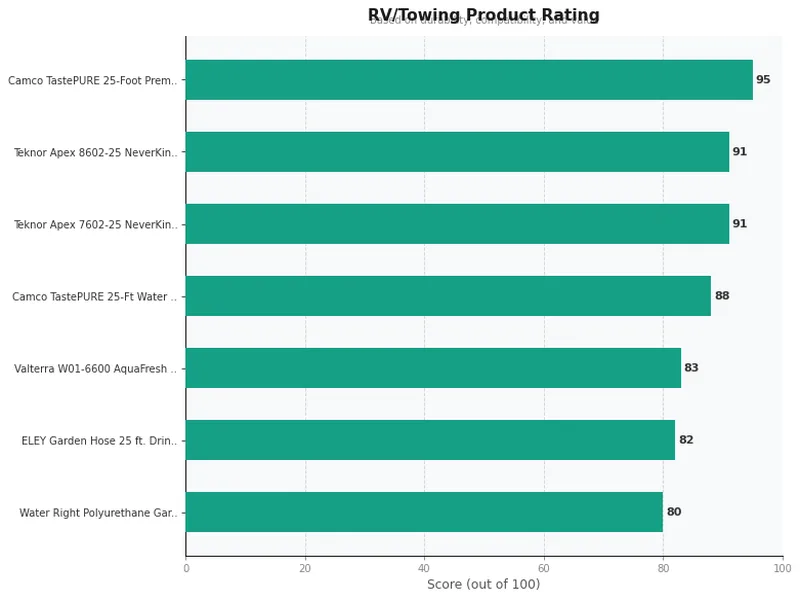
The TastePURE 25-Ft Premium takes the same professional-grade construction as its 50-foot sibling and packages it in a more manageable length. For RV owners who consistently camp at sites with nearby hookup pedestals — or those who carry two hoses and want a shorter option for city water connections — this 25-foot version offers the same NSF/ANSI 61 certified drinking water safety in a lighter, easier-to-handle package.
Camco's heavy-duty no-kink design is the standout feature here. The reinforced PVC construction is noticeably stiffer and more resistant to crimping than standard drinking water hoses, which translates to fewer frustrating flow interruptions during use. The machined fittings — not stamped or cast — provide a precision thread that seats securely on spigots without cross-threading. The smart strain comfort grip at each end makes connecting and disconnecting the hose a tool-free operation even with wet hands.
The 25-foot length is both a strength and a limitation. Buyers save weight and storage space, but there is no margin for error on larger campsites. RV owners who camp exclusively at smaller state park loops or pull-through sites with close pedestals will find 25 feet perfectly adequate. Those who venture to boondocking-adjacent sites with distant water sources need the 50-foot version instead.
Pros:
Cons:
Winter camping presents a unique and potentially expensive problem: frozen water hoses. A single hard freeze can crack fittings, split PVC, and leave an RV without water until temperatures rise. This 25-foot heated water hose eliminates that risk entirely with an integrated heating element rated to keep water flowing at temperatures as low as -47°F. For RV owners who camp through fall and winter — or full-timers in northern climates — this hose is not a luxury. It is a necessity.
The five-layer construction incorporates thickened heating wires sandwiched between insulation and a durable blue rubber exterior. This design distributes heat evenly along the full length of the hose, preventing the cold spots that plague cheaper heated hoses. The heating element draws power from a standard 120V outlet, which is available at virtually all full-hookup RV sites. Setup is simple: plug it in, connect it to the spigot, and the hose maintains its own temperature regardless of outside conditions. Buyers who also need to keep their RV interior warm should consider the best electric heaters for RV to complement this cold-weather hose.
The tradeoffs are inherent to the design. A heated hose is heavier and bulkier than any unheated option on this list due to the insulation layers and wiring. It also requires an electrical connection, which means it cannot be used at dry camping or boondocking sites without a generator. And at 25 feet, reach is limited. For three-season camping, any of the unheated options above will serve better. But for cold-weather use, nothing else on this list comes close to the peace of mind this hose provides.
Pros:
Cons:
The most critical factor when selecting an RV water hose is whether it is certified safe for drinking water. Standard garden hoses often contain lead, BPA, and phthalates that leach into water, especially when the hose sits in direct sunlight. Buyers should look for hoses certified to NSF/ANSI 61 (drinking water system components) and NSF/ANSI 372 (lead-free compliance). These certifications are not marketing language — they represent independent laboratory testing that verifies the hose materials do not introduce harmful contaminants into the water supply. CSA lead-free certification provides an additional layer of assurance for buyers who want the highest standard of safety.
RV water hoses typically come in 25-foot and 50-foot lengths. A 25-foot hose works well for compact campsites with nearby hookup pedestals, and it saves weight and storage space. A 50-foot hose provides the versatility to reach distant spigots at any campsite configuration. Some experienced RV owners carry both — a short hose for routine stays and a longer one for backup. Inner diameter matters for flow rate: a 5/8-inch hose delivers roughly 50% more water volume per minute than a 1/2-inch hose at the same pressure. For filling freshwater tanks, the larger diameter makes a noticeable difference in fill time.
A kinked hose stops water flow and creates pressure buildup that can damage fittings over time. Reinforced PVC hoses with diamond-hatch patterns resist kinking through structural rigidity — the hose holds its shape even when bent. Fabric-reinforced hoses like the Zero-G and EvoFlex2 take the opposite approach, using a flexible woven jacket that bends freely without crimping. Both approaches work, but they suit different preferences. Rigid hoses are more durable on rough surfaces. Flexible hoses are lighter, pack smaller, and handle repeated coiling better. Strain-relief fittings at each end prevent the most common kink point — right where the hose meets the connector.
Hose fittings determine how securely the hose connects to spigots and RV inlets, and how long those connections last. Machined brass fittings are the gold standard — they thread precisely, resist cross-threading, and hold up to years of repeated connection and disconnection without stripping. Stamped or cast fittings are cheaper to manufacture but more prone to rounding and corrosion over time. For RV owners who camp near saltwater or in humid climates, rust-resistant brass fittings are especially important. Comfort grip connectors add ergonomic value for hand-tightening without tools, particularly useful when dealing with wet or cold hands during setup.
Using a standard garden hose for RV drinking water is strongly discouraged. Most garden hoses are manufactured with materials that contain lead, BPA, and phthalates — chemicals that leach into the water, particularly when the hose is exposed to heat and sunlight. RV-specific drinking water hoses carry NSF/ANSI 61 and 372 certifications confirming that their materials are safe for potable water contact. The cost difference between a garden hose and a certified RV water hose is minimal compared to the health risks involved.
A quality RV water hose typically lasts three to five years with proper care, though some premium models can last longer. Signs that a hose needs replacement include visible cracks, persistent kinking that does not straighten out, discoloration of the water, or a noticeable taste or odor. Brass fittings that have become stripped or corroded are another indicator. Storing the hose out of direct sunlight when not in use and draining it completely before storage significantly extends its lifespan.
Most RV plumbing systems are designed to operate at 40–60 psi (pounds per square inch). Campground water pressure can vary widely, sometimes exceeding 100 psi at certain hookups. Pressure above 60 psi risks damaging RV plumbing fixtures, water heaters, and toilet valves. An inline water pressure regulator installed between the campground spigot and the hose protects the entire system. Adjustable regulators allow fine-tuning the pressure to the exact level preferred.
The best length depends on camping habits. A 50-foot hose provides flexibility for any campsite, regardless of hookup pedestal placement. A 25-foot hose is lighter, easier to store, and sufficient for most standard campsites with nearby hookups. Many experienced RV owners keep both lengths on hand. A 25-foot hose handles routine stays, while the 50-foot hose serves as backup for sites with distant water connections. Carrying both adds minimal weight and eliminates reach concerns entirely.
Heated RV water hoses are designed for energy efficiency and typically consume between 90 and 180 watts depending on the model and length. This is comparable to running a standard incandescent light bulb. On a metered campsite, the electricity cost for running a heated hose continuously through a cold night is negligible — usually a few cents. The hose draws power only when its thermostat detects temperatures approaching freezing, so it does not run at full power constantly. The electricity cost is trivial compared to the potential damage from a frozen and burst water hose.
Proper storage starts with completely draining the hose after each use. Standing water left inside promotes mold, mildew, and bacterial growth. After draining, coil the hose loosely — tight coils create kink memory — and store it in a cool, shaded location. UV exposure from sunlight degrades PVC and rubber over time, causing brittleness and cracking. Dedicated hose bags or storage containers keep the hose clean and protected from abrasion during transit. Storing the hose caps-up prevents dirt and insects from entering the fittings.
Every RV water hose on this list delivers safe, clean drinking water — but the best choice depends on individual camping habits, climate conditions, and storage constraints. The Camco TastePURE 50-Ft stands as the most reliable all-around option for the majority of RV owners, while the heated hose opens up year-round camping possibilities that no unheated alternative can match. Pick the hose that fits the way camping actually happens — not the way it looks on paper — and it will serve reliably for seasons to come.
 |
 |
 |
 |

About Rachel Park
Rachel Park specializes in the interior and exterior upgrades that meaningfully change how a car looks, sounds, and feels on a daily basis. She has hands-on experience with head unit installations and audio system builds, LED and HID lighting conversions, interior refresh projects, and cosmetic exterior work — evaluated from both a DIY accessibility and quality-of-result perspective. At CarCareTotal, she covers car audio and electronics, lighting upgrades, and interior and exterior styling accessories.
Get some FREE car parts & gear.. Or check out the latest free automotive manuals and build guides here.
Disable your ad blocker to unlock all the hidden deals. Hit the button below 🚗
| | | |
