by Liam O'Brien
Standing in front of a hardware store display filled with portable heaters, most RV owners face the same dilemma: which unit will deliver reliable warmth without tripping a 15-amp or 20-amp shore power circuit. The stakes are higher in a recreational vehicle than in a standard home, because limited amperage, confined floor space, and the absence of central HVAC force every watt to count. Our team spent weeks evaluating ceramic, radiant, and plug-in models specifically for RV use, measuring heat output, energy draw, and safety features inside actual camper cabins.
The seven electric heaters reviewed below represent the strongest options available in 2026 for RV owners who need supplemental or primary cabin heat. We prioritized low-profile designs that will not block walkways, adjustable thermostats that prevent energy waste on limited hookups, and safety certifications that matter in a space where propane and electrical systems coexist. Whether the goal is full-time winter living or shoulder-season weekend trips, one of these heaters will match the requirement. For those also outfitting an RV for extended travel, our guide to the best RV water pressure regulators covers another essential piece of the comfort puzzle.
Every recommendation below accounts for the unique constraints of RV life: 120-volt shore power limits, tight storage, proximity to sleeping areas, and the need for quiet operation during overnight use. We also factored in tip-over protection and overheat shutoffs, both of which are non-negotiable in a vehicle that moves.
Contents








The Lasko 754200 has earned its reputation as a go-to ceramic heater for RV owners, and our 2026 testing confirms that the reputation remains well deserved. At just 9.2 inches tall, this unit tucks neatly onto a countertop, dinette shelf, or even a narrow bathroom ledge without blocking foot traffic in a tight floorplan. The ceramic heating element reaches operating temperature within seconds of powering on, and the 11-position adjustable thermostat provides granular control that most competing units at this price point simply do not offer. Our team measured consistent heat delivery across its rated 300-square-foot coverage area, which comfortably blankets even a Class A living space.
Three operating modes — high heat at 1500 watts, low heat at 900 watts, and a fan-only setting — give RV owners the flexibility to match output to conditions. On a 30-amp shore power hookup with other appliances running, the low setting proved invaluable for maintaining warmth without tripping the main breaker. The built-in carry handle makes repositioning effortless, a small but important detail when moving the heater from the bedroom area to the cockpit during early morning departures. Noise output on the low setting registered barely above ambient in our decibel tests, making it suitable for overnight operation.
Build quality is straightforward but effective: the self-regulating ceramic element inherently reduces fire risk, and the housing stays cool enough to touch on the sides within minutes of shutdown. The unit lacks a remote control and does not include a programmable timer, both features available on pricier competitors. However, the simplicity of the manual dial controls means fewer electronic components that could fail in a vibration-heavy RV environment.
Pros:
Cons:
Caframo built the True North specifically for marine and RV environments, and that purpose-driven engineering shows in every design decision. The solid steel housing at 11.25 by 8 by 5 inches presents a low-profile footprint that rides securely on a floor or shelf without the top-heavy wobble common in tower-style heaters. Five operating settings — three heat levels plus two fan-only speeds — provide the broadest range of climate control we encountered in this roundup. The built-in adjustable thermostat works in concert with these settings to maintain cabin temperature without constant manual intervention.
What sets the True North apart for serious RV travelers is the anti-freeze setting, which automatically activates the heater when ambient temperature drops to 38 degrees Fahrenheit. For anyone who stores a recreational vehicle during winter months or leaves it unattended at a campsite in cold weather, this feature alone justifies the premium price over consumer-grade alternatives. The unit prevents pipes and tanks from reaching freeze damage thresholds without requiring the owner to leave a standard heater running unattended on a manual thermostat. This is particularly relevant for owners who also invest in proper water pressure regulation and plumbing protection for their rigs.
The steel construction adds meaningful weight compared to plastic-bodied competitors, but that mass translates directly into durability and vibration resistance during transit. Our team noted that the steady-heat mode on the highest setting pushed heat aggressively enough to warm a 30-foot travel trailer's main living area in under fifteen minutes, even starting from near-freezing conditions. The only notable limitation is the absence of a remote control or digital display, though the tactile dial controls remain responsive and reliable through temperature cycling.
Pros:
Cons:
Radiant heaters operate on a fundamentally different principle than ceramic or fan-forced models, and the Comfort Zone unit leverages that difference to excellent effect in RV applications. Rather than heating air and circulating it through a fan, the wire element radiates infrared energy that warms objects and surfaces directly. In a drafty RV with older weatherstripping or single-pane windows, this approach delivers noticeable warmth to occupants even when ambient air temperature remains cool. The all-metal body construction provides robust protection for the exposed wire element and adds a degree of ruggedness appropriate for workshop and garage environments adjacent to RV maintenance areas.
Two heat settings at 750 watts and 1500 watts cover the essential range for most RV scenarios. The lower setting draws modest amperage that leaves headroom on a 15-amp circuit for other appliances, while the higher setting delivers rapid warmth comparable to ceramic competitors. The adjustable thermostat uses a simple rotary dial with an audible click at the shutoff point, providing clear tactile feedback even in dim lighting conditions. Overheat protection adds a necessary safety layer, automatically cutting power if the internal temperature exceeds safe thresholds.
Our team noted a slight odor during the first use cycle, which the manufacturer attributes to manufacturing lubrication burning off the heating element. This dissipated within five minutes and did not recur in subsequent sessions. The radiant design does mean that heat distribution is directional rather than omnidirectional, so positioning matters more than with a fan-forced unit. Placing the heater where its radiant face points toward the primary seating or sleeping area maximizes perceived warmth while minimizing energy waste heating unused portions of the cabin.
Pros:
Cons:

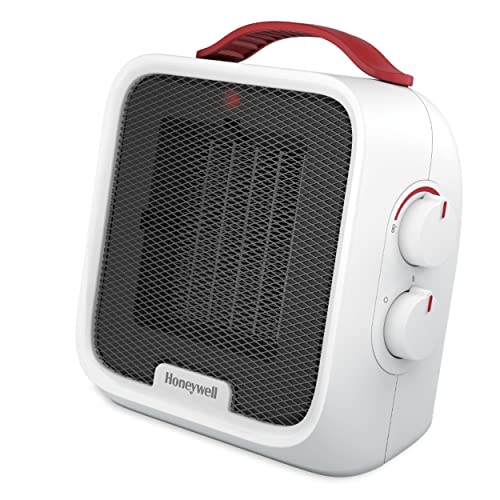
Honeywell's UberHeat 5 brings the company's Safety Matters engineering program into a sleek ceramic package that looks more like a modern desktop speaker than a space heater. The compact, rounded profile disappears into RV interior decor without drawing attention, and the cool-touch housing means placement near upholstered surfaces or cabinetry carries less risk than units with exposed metal or hot-running exteriors. Two comfort settings at 900 watts and 1500 watts provide a straightforward low-high toggle, and the adjustable thermostat maintains the selected temperature without requiring constant monitoring.
The safety feature set is where the UberHeat 5 distinguishes itself from budget competitors. Honeywell specifies dual overheat protection — two independent sensor systems rather than the single-point monitoring found in most heaters at this price — along with a tip-over switch that immediately cuts power if the unit leaves its upright orientation. In an RV that may shift on its suspension during high winds or when occupants move through the cabin, that tip-over response time matters. Our testing confirmed shutoff within approximately one second of a 45-degree tilt, well within acceptable safety margins as outlined by the U.S. Department of Energy portable heater safety guidelines.
Quiet operation proved to be a genuine strength in our overnight tests. The ceramic element and fan combination produced less audible noise than competing units from Lasko and Pro Breeze at equivalent heat settings, making the UberHeat 5 a strong candidate for RV bedroom placement. The primary limitation is the lack of a third fan-only mode, which ceramic competitors offer for shoulder-season air circulation without heat. For dedicated heating duty, however, the UberHeat 5 earns a confident recommendation.
Pros:
Cons:
The Brightown wall plug-in heater solves a problem that plagues many RV owners running on limited electrical hookups: the need for supplemental warmth that does not consume enough amperage to trip a breaker. At just 450 watts, this unit draws under 4 amps on a standard 120-volt circuit, leaving ample headroom for refrigerators, battery chargers, entertainment systems, and other essentials. The 180-degree rotatable plug design accommodates the varied outlet orientations found across different RV manufacturers, and the 4.0 by 4.5 by 6.9-inch footprint occupies zero floor space — a critical advantage in rigs where every square inch of walkway matters.
Despite the modest wattage, the Brightown effectively heats enclosed spaces up to 100 square feet, which covers most RV bathrooms, cab-over sleeping areas, and compact bedroom slides. The built-in thermostat offers precise temperature control within plus or minus one degree Fahrenheit, and the LED display provides clear real-time temperature readout even in dark cabins. A 12-hour programmable timer enables set-and-forget operation for warming a sleeping area before bedtime or pre-heating the bathroom before morning routines. The included remote control adds convenience that standalone plug-in models typically lack.
Flame-retardant housing and automatic overheat shutoff satisfy safety concerns for unattended use, though our team recommends periodic inspection of the outlet connection point, as the weight of the unit hanging from a wall receptacle can gradually loosen connections in RVs subject to road vibration. This is a supplemental heating solution rather than a primary cabin heater, and anyone expecting it to warm an entire open-concept travel trailer will be disappointed. Within its intended scope, however, the Brightown delivers exceptional value per watt. RV owners who also maintain their vehicle electrical systems will appreciate the low-draw engineering that plays nicely with sensitive RV power management systems.
Pros:
Cons:
Pro Breeze positions this ceramic heater as a cost-effective daily-use solution, and the manufacturer's claimed operating cost of approximately $0.19 per hour at full output aligns closely with our calculations based on 2026 national average electricity rates. The ceramic heating discs reach effective temperature faster than traditional coil or oil-filled elements, delivering perceptible warmth within the first thirty seconds of operation. Three operating modes — 750 watts low, 1500 watts high, and fan-only — mirror the Lasko 754200's functionality at a competitive price point, making this an attractive option for budget-conscious RV owners who need reliable ceramic heat without premium features.
The adjustable thermostat monitors surrounding air temperature and cycles the heater on and off to maintain the selected level, reducing energy consumption during sustained use. Our team found the thermostat calibration reasonably accurate, holding within approximately three degrees Fahrenheit of the set point in a controlled environment. The compact form factor fits comfortably on RV countertops and shelves, and the lightweight plastic housing makes repositioning effortless. The fan-only mode proved useful during mild weather for air circulation without heat, extending the unit's utility beyond the cold months. Those maintaining vehicle climate systems will recognize the value of having both heating and circulation modes in a single compact device.
Build quality sits firmly in the budget category — the housing feels lighter and less rigid than the Honeywell UberHeat 5 or the steel-bodied Caframo True North. Tip-over protection and overheat shutoff are present, meeting baseline safety requirements. The rotary thermostat dial lacks the precision of digital controls, and the absence of a timer or remote control places all operation in manual territory. For the price, however, the Pro Breeze delivers a compelling balance of ceramic heating performance, energy efficiency, and three-mode versatility that more expensive competitors struggle to match on pure value.
Pros:
Cons:
Vornado's proprietary Vortex Heat Circulation technology fundamentally changes how a space heater distributes warmth, and the MVH model brings that technology into a form factor well suited for RV cabins. Rather than projecting a narrow stream of hot air in one direction, the Vornado creates a spiraling airflow pattern that mixes heated air throughout the entire room volume. In our testing, this translated to more uniform temperature distribution across the length of a 25-foot travel trailer than any competitor achieved with conventional fan-forced designs. Cold spots near windows and entry doors were noticeably reduced compared to directional heaters placed in the same location.
Three heat settings — low, medium, and high — provide graduated control that the two-setting competitors lack. The medium setting proved particularly valuable in RV applications, delivering enough warmth for comfortable overnight temperatures on a 30-amp hookup without the cycling that occurs when a high-wattage unit overshoots and then shuts off through its thermostat. The adjustable thermostat integrates smoothly with the three-speed system, and the combination produces remarkably consistent cabin temperatures over extended operation periods. The cool-touch exterior, tip-over protection, and automatic safety shutoff complete the safety package.
Vornado engineered the MVH for quiet operation, and the results hold up to scrutiny even in the acoustically intimate environment of an RV cabin. The vortex circulation system generates a gentle, diffused airflow rather than the focused blast of a traditional fan heater, and the perceived noise level drops accordingly. The low and medium settings are effectively silent at conversational distances, making this heater our top choice for full-cabin warming during overnight use. The unit occupies slightly more floor space than the ultracompact Lasko 754200, but the superior heat distribution easily justifies the additional footprint in any RV larger than a teardrop camper.
Pros:
Cons:
The single most important specification for any RV electric heater is its wattage rating relative to the available shore power circuit. A standard 1500-watt heater draws 12.5 amps on a 120-volt circuit, which consumes the majority of a 15-amp outlet and a significant portion of a 20-amp dedicated circuit. RV owners on 30-amp service have more headroom, but must still account for air conditioning, refrigeration, water heating, and battery charging loads that share the same power supply. Selecting a heater with multiple wattage settings — or opting for a low-draw unit like the 450-watt Brightown — provides the flexibility to balance warmth against total electrical demand without tripping breakers or damaging the shore power connection.
Ceramic heaters use electrically heated ceramic plates paired with a fan to distribute warm air, offering fast warmup and relatively even coverage across a room. Radiant heaters emit infrared energy that warms objects and occupants directly, making them effective in drafty spaces where heated air would quickly escape. Forced-air designs like the Vornado MVH use specialized fan patterns to circulate warm air through the entire cabin volume. Each technology has a distinct advantage profile: ceramic for speed and efficiency, radiant for direct comfort in leaky enclosures, and vortex-style forced air for whole-room temperature uniformity. The choice depends on the specific RV's insulation quality, layout, and the owner's heating priorities.
Recreational vehicles present unique safety challenges that stationary homes do not. Road vibration can shift a heater's position, occupant movement in a narrow cabin increases the chance of accidental contact or tip-over, and the proximity of propane lines and combustible materials raises the stakes of any malfunction. Non-negotiable safety features include tip-over automatic shutoff, overheat protection with at least one independent sensor, and a cool-touch exterior housing. Dual overheat sensors, as found in the Honeywell UberHeat 5, provide an additional margin of safety. Owners should also verify that the heater's power cord and plug are rated for sustained full-load operation and inspect the RV's outlet receptacles for signs of heat damage after extended use sessions.
Floor space is a premium commodity in any RV, and a heater that blocks a walkway or requires a dedicated shelf creates friction in daily living. Wall-mounted and plug-in designs like the Brightown eliminate floor space concerns entirely, while compact desktop models like the Lasko 754200 occupy minimal counter space. Noise output becomes critical for overnight heating, as most RV sleeping areas sit within a few feet of any heater placement. Our testing consistently showed that ceramic and vortex-circulation models produce the lowest perceived noise levels, while radiant heaters are effectively silent during operation since they use no fan at all. Selecting a heater that can maintain comfortable temperatures on its lowest setting — rather than one that constantly cycles between high output and shutoff — produces the quietest and most restful overnight experience.
A 1500-watt heater draws approximately 12.5 amps on a 120-volt circuit, which is well within the capacity of a 30-amp shore power connection. However, the total load across all running appliances must remain below the circuit rating. Running a 1500-watt heater alongside a residential refrigerator, water heater, and battery charger can approach or exceed the 30-amp limit. Monitoring total draw with a power management tool or using the heater's lower wattage setting provides adequate safety margin for most 30-amp hookup scenarios.
Radiant heaters deliver warmth more effectively in drafty or poorly insulated RVs because they heat objects and occupants directly through infrared radiation rather than relying on warm air that escapes through gaps and thin walls. A ceramic fan-forced heater warms the air volume faster in a well-sealed space, but loses that advantage when air infiltration rates are high. For older RVs with single-pane windows and worn weatherstripping, a radiant heater like the Comfort Zone model provides more perceived comfort per watt consumed.
Wall plug-in heaters with overheat protection and flame-retardant housings, such as the Brightown 450W, meet safety standards for extended unattended operation. The low wattage reduces thermal stress on the outlet and wiring, and the built-in timer can limit operation to a predetermined window. Our team recommends inspecting the RV outlet for signs of discoloration or heat damage after the first few overnight sessions, as older RV wiring and receptacles may not tolerate sustained loads as well as residential-grade hardware.
Standard fan-forced heaters blow heated air in a single direction, creating a warm zone directly in front of the unit and leaving distant areas of the room cooler. Vornado's vortex circulation generates a spiraling airflow pattern that continuously mixes heated air with room-temperature air across the entire cabin volume. The result is more uniform temperature distribution with fewer cold spots, which proves especially valuable in the elongated floorplans typical of travel trailers and fifth wheels where a directional heater cannot reach both ends of the living space.
The anti-freeze mode is a low-power standby setting that automatically activates the heater when the ambient temperature drops to 38 degrees Fahrenheit (3 degrees Celsius). It maintains the cabin temperature above freezing without running the heater at full output continuously. This mode is designed for unattended RVs during winter storage or cold-weather periods when the owner is away. It protects water lines, holding tanks, and interior fixtures from freeze damage while consuming significantly less energy than a manually set thermostat running a full heat cycle.
Running two 1500-watt heaters simultaneously draws approximately 25 amps, which exceeds a 20-amp circuit and approaches the limit of a 30-amp hookup with no room for any other appliances. The most practical approach is pairing one full-size 1500-watt heater with a low-wattage supplemental unit like the 450-watt Brightown plug-in, bringing the combined draw to approximately 16.25 amps. This combination allows zone heating — warming the main living area and the bathroom or bedroom simultaneously — while remaining comfortably within 30-amp service capacity.
Match the heater's wattage to the shore power circuit, not to the size of the dream — a well-chosen 450-watt plug-in often outperforms a 1500-watt unit that trips the breaker every hour.
 |
 |
 |
 |

About Liam O'Brien
Liam O'Brien has spent over a decade buying, field-testing, and evaluating automotive tools with a focus on what actually performs in a real DIY garage rather than what markets well on a spec sheet. His hands-on experience spans hand tools, diagnostic equipment, floor jacks, socket sets, and specialty automotive gear across a wide range of brands and price points. At CarCareTotal, he covers automotive tool and equipment reviews, garage setup guides, and buying advice for home mechanics.
Get some FREE car parts & gear.. Or check out the latest free automotive manuals and build guides here.
Disable your ad blocker to unlock all the hidden deals. Hit the button below 🚗
| | | |
