by Joshua Thomas
When a car vibrates at highway speeds, the cause is almost always a rotating component — wheel imbalance, tire damage, worn CV joints, bad wheel bearings, or a warped rotor — and diagnosing it correctly starts with noting exactly where the vibration is felt in the cabin. This problem doesn't resolve on its own, and delayed attention accelerates wear on surrounding components.
Speed-dependent vibration that emerges above 55–65 mph is distinct from a shake that occurs at idle, which points to entirely different systems. Vibration felt in the steering wheel suggests a front-end source; vibration through the seat or floor points to rear-end or driveshaft issues; vibration through the entire cabin simultaneously suggests a severe tire problem or major drivetrain fault. That distinction alone cuts the diagnostic list in half before a single bolt is touched.
Contents
The physics behind speed-dependent vibration is straightforward: imbalance forces scale with the square of rotational speed, so a minor defect that's imperceptible at 30 mph becomes a violent shake at 70 mph. This is why vibration that seems to appear suddenly above a specific threshold isn't random — it's a known imbalance crossing the threshold of perception. The steering wheel shake guide covers the same underlying mechanics for front-end vibration specifically, and the same diagnostic logic applies here across all four wheels and the drivetrain.
One detail most drivers overlook: some vibrations appear at one speed range and smooth out at higher speeds. This is a dynamic imbalance phenomenon, where opposing imbalance forces partially cancel at certain RPM bands and reinforce at others. A vibration that appears at 65 mph but smooths out at 80 mph is still a balance or tire issue — it just behaves in a speed-banded way that can mislead an untrained diagnosis.
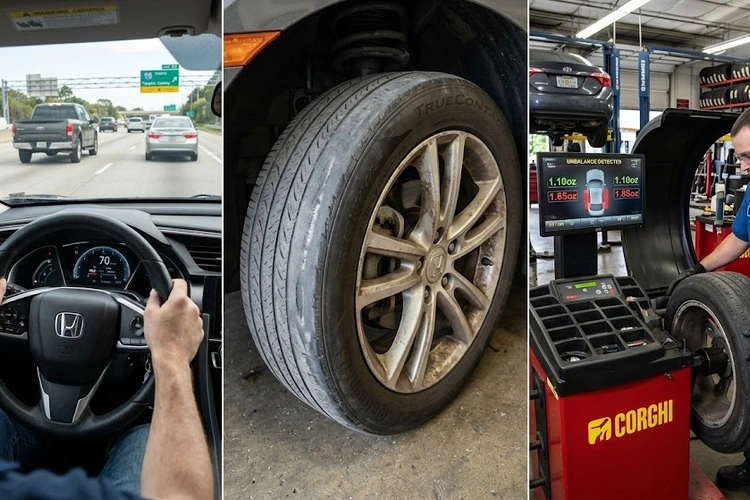
Out-of-balance wheels are the single most common reason a car vibrates at highway speeds, and a standard spin balance service — $60–$100 for all four wheels — is the correct first step before any other diagnosis. Each wheel and tire assembly has manufacturing weight variations, and balance weights compensate for those discrepancies. When weights fall off, even a half-ounce imbalance generates significant force above 55 mph. The vibration typically peaks in a specific speed range and eases slightly above it.
Cupping, flat spots from hard braking, and internal belt separation all create vibration that mimics imbalance but won't resolve with balancing alone. A tire with a broken internal belt produces a rhythmic thump that becomes a harsh shake at speed, and no amount of rebalancing fixes it. NHTSA tire inspection guidelines recommend checking for bulges, irregular tread wear, and sidewall damage regularly — all of these compromise the round profile that smooth high-speed driving requires.
A tire that passes a visual inspection can still have a broken internal belt. Rotate tires and track whether vibration moves to a different axle — if it does, the tire is the problem, not the wheel.
On front-wheel-drive vehicles, deteriorating CV joints produce vibration that intensifies under acceleration at highway speeds, which distinguishes them cleanly from wheel balance issues. On RWD and AWD platforms, a bent or unbalanced driveshaft causes a smooth oscillating vibration that begins in a specific RPM band. The car shaking while driving breakdown covers how to isolate drivetrain-sourced vibration from wheel-sourced vibration using acceleration and deceleration tests.
A worn wheel bearing produces a drone or humming noise while driving that shifts in pitch during lane changes, combined with vibration that steadily worsens over time rather than peaking at a specific speed. Unlike tire imbalance, bearing vibration doesn't smooth out at higher speeds — it intensifies. Bearing replacement requires a hydraulic press to remove and install the new unit, making this a shop job on most vehicles despite being conceptually simple.
Thermally distorted rotors develop high spots from rapid heating and uneven cooling, creating runout that manifests as a pulsation at highway speeds even without touching the brake pedal. The tell is that the vibration worsens noticeably during braking and is felt through the steering wheel specifically. Anyone experiencing rotor warping alongside grinding noise when braking should treat it as urgent — that combination indicates metal-on-metal contact beyond rotor distortion alone.
Worn tie rod ends, ball joints, strut mounts, and control arm bushings introduce play that allows components to move in ways they shouldn't at speed, producing an erratic, looseness-based vibration rather than the clean, speed-proportional shake of wheel imbalance. A deteriorated strut mount allows the strut assembly to wobble under chassis load at speed. This vibration worsens on rough pavement and often comes with imprecise steering feel that makes highway driving fatiguing.
Worn motor mounts allow the engine to rock under load, transferring that movement through the firewall as vibration that's most prominent during sustained highway cruise. Engine misfires create an irregular power pulse that manifests as rhythmic shake — and the key diagnostic clue is that it correlates with tachometer RPM rather than vehicle speed. If the vibration tracks RPM instead of speedometer reading, the issue is drivetrain or engine rather than wheels, and transmission slipping symptoms should also be checked before assuming the engine is the sole culprit.
| Cause | Vibration Location | Speed Behavior | Typical Repair Cost | DIY Friendly? |
|---|---|---|---|---|
| Wheel Imbalance | Steering wheel or seat | Peaks at 60–70 mph | $60–$100 (all 4) | No (needs balancer) |
| Tire Damage | Whole car | Worsens with speed | $120–$250/tire | No |
| CV Joint / Driveshaft | Floor or whole car | Worse under acceleration | $200–$600 | Advanced only |
| Wheel Bearing | Floor, one side | Steadily worsens | $150–$400 | No (needs press) |
| Warped Rotors | Steering wheel (braking) | Worst during braking | $150–$400 (pair) | Yes (moderate) |
| Suspension Wear | Steering, whole car | Erratic, road-dependent | $100–$500+ | Partial |
| Engine / Drivetrain | Whole car | RPM-based, not speed | $200–$1,000+ | Advanced only |
Most highway vibration repairs sit outside the typical home mechanic's toolkit — not because of skill requirements, but because of equipment requirements. Wheel balancing demands a spin balancer. Bearing replacement demands a hydraulic press. Driveshaft balancing requires specialized shop machinery. The honest list of genuinely DIY-friendly repairs is short: rotor replacement, control arm bushing swaps on some platforms, and motor mount replacement on accessible engines.
Always rule out wheel balance and tire condition first — these two causes account for the majority of highway vibration cases and cost the least to address. Jumping to expensive suspension or drivetrain repairs before checking basics is the most common diagnostic mistake.
The threshold for professional diagnosis is clear: vibration that returns shortly after a balance service, vibration accompanied by noise that shifts with steering input, or any vibration that worsens noticeably week over week. These patterns point to structural wear in bearings, joints, or mounts — components where continued driving risks sudden failure rather than just accelerating discomfort.
Tire rotation every 5,000–7,500 miles is the single highest-impact habit for preventing highway vibration long-term, because it equalizes wear before any tire develops the cupping or uneven contact patterns that trigger imbalance. Adding a balance service at every rotation interval catches weight loss early at minimal additional cost. Alignment — distinct from balancing — should be verified annually and after any significant suspension impact, since misalignment drives exactly the tire wear patterns that produce vibration down the road.
Suspension component inspection at each oil change is worth building into a maintenance rhythm. Tie rod ends and ball joints have predictable failure signatures — detectable play with the wheel lifted off the ground — and early replacement prevents the secondary wear they impose on neighboring components. Combining consistent rotation, balancing, alignment, and suspension checks eliminates the vast majority of highway vibration causes before they ever develop into a noticeable problem.
Imbalance forces scale with the square of rotational speed, so a minor defect that's imperceptible at 30 mph generates significant force above 60 mph. This is why vibration that seems to appear suddenly at a certain speed isn't random — wheel imbalance is the most common explanation for this exact pattern.
Yes. Significantly underinflated tires flex more than designed, generating heat and uneven road contact that produces vibration. Inflate to the pressure listed on the driver's door jamb placard — not the maximum pressure molded into the tire sidewall, which is a different number for a different purpose.
It depends entirely on the cause. Wheel imbalance is uncomfortable but not immediately dangerous. A failing wheel bearing can seize without warning, and a tire with a broken internal belt can blow out at speed. Any vibration that worsens noticeably over a short period warrants immediate inspection, not deferred maintenance.
Only if imbalance is the actual cause. Balancing won't address tire structural damage, worn bearings, CV joint wear, or rotor problems. If vibration returns within a few thousand miles after a fresh balance, the root cause lies elsewhere and a more thorough inspection is needed.
Diagnosis at a reputable shop typically runs $50–$100 for a road test and inspection. The fix ranges from $60–$100 for a four-wheel balance to $400–$600 or more for CV joints or wheel bearings. Starting with the cheapest plausible repair — balance and tire inspection — before escalating is the rational approach.
This is a classic dynamic imbalance pattern, where opposing imbalance forces partially cancel at higher RPM bands. The vibration is real and the imbalance is real — it's just speed-banded in a way that makes it seem intermittent. A spin balance service will identify and correct it regardless of the speed-banding behavior.
Yes, and this is underappreciated. Sustained vibration accelerates wear on wheel bearings, CV boots, tie rod ends, and strut mounts by subjecting them to continuous micro-stress they weren't designed to absorb. What starts as a balance issue can evolve into a suspension repair bill if left unaddressed across tens of thousands of miles.
 |
 |
 |
 |

About Joshua Thomas
Joshua Thomas just simply loves cars and willing to work on them whenever there's chance... sometimes for free.
He started CarCareTotal back in 2017 from the advices of total strangers who witnessed his amazing skills in car repairs here and there.
His goal with this creation is to help car owners better learn how to maintain and repair their cars; as such, the site would cover alot of areas: troubleshooting, product recommendations, tips & tricks.
Joshua received Bachelor of Science in Mechanical Engineering at San Diego State University.
Get some FREE car parts & gear.. Or check out the latest free automotive manuals and build guides here.
Disable your ad blocker to unlock all the hidden deals. Hit the button below 🚗
| | | |
