by Sarah Whitfield
You're heading home after work, turning onto your street, when your front tire drops into a familiar pothole. A sharp clunk rings out from somewhere under the hood. You slow down, hit the next bump — same sound. That noise is your suspension telling you something is wrong.
A clunking noise going over bumps ranks among the top complaints at independent repair shops. It can signal a $15 end link or a failing ball joint that puts you at real risk of losing steering control. Seven components account for nearly every case. If you're also noticing vibration or pulling through the wheel, the same suspension issue often drives both — read more about what causes your steering wheel to shake to understand how these symptoms connect.
Contents
Most clunking suspension repairs go wrong before a wrench is ever picked up. The misdiagnosis happens during the conversation at the service desk. Two errors cause the majority of unnecessary spending.
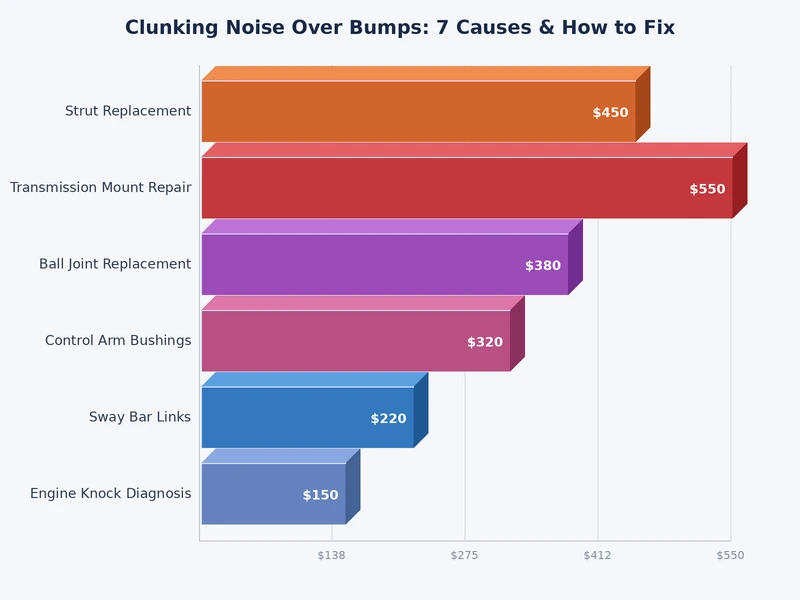
Struts are the most over-replaced suspension component in the independent shop market. Sway bar end links, strut mounts, and control arm bushings fail far more frequently and cost a fraction of what struts cost. A pair of end links runs $30–$80 in parts. A full strut replacement runs $250–$400 per corner installed. Authorizing strut replacement without first ruling out end links is a diagnostic shortcut that costs real money. Any shop that quotes struts without confirming end links, mounts, and bushings first deserves a second opinion.
A clunking noise going over bumps that appears only during left turns points to a different component than a clunk that occurs during straight-line driving. A clunk that triggers over sharp potholes but not smooth speed bumps narrows the field still further. Record the exact conditions before any shop visit: which wheel, what speed, what steering angle, what road surface. That information cuts diagnostic labor time and protects you from paying for exploratory work. If you're also experiencing symptoms of bad wheel alignment, document those too — alignment drift often accompanies failing suspension components and can mask or mimic clunk sources.
The sway bar end link connects the sway bar to the strut or control arm via a ball-and-socket joint encased in rubber. When the rubber tears or the socket wears, the link develops play. Every bump translates to metal-on-metal contact. The clunk is sharp, repetitive, and worsens with vehicle speed. End links are the single most common source of suspension clunk on vehicles with more than 60,000 miles, particularly on cars driven regularly on deteriorated urban roads.
The strut mount sits at the top of the strut assembly between the strut shaft and the chassis. It contains a bearing plate and a rubber isolator. When the isolator collapses or the bearing corrodes, the strut shifts in its perch during suspension compression. The resulting noise is a thud or hollow knock directly over bumps. Failed strut mounts frequently produce a grinding sensation through the steering column as well. If you've noticed shaking or vibration while driving alongside the clunk, a collapsed strut mount bearing is a primary suspect.
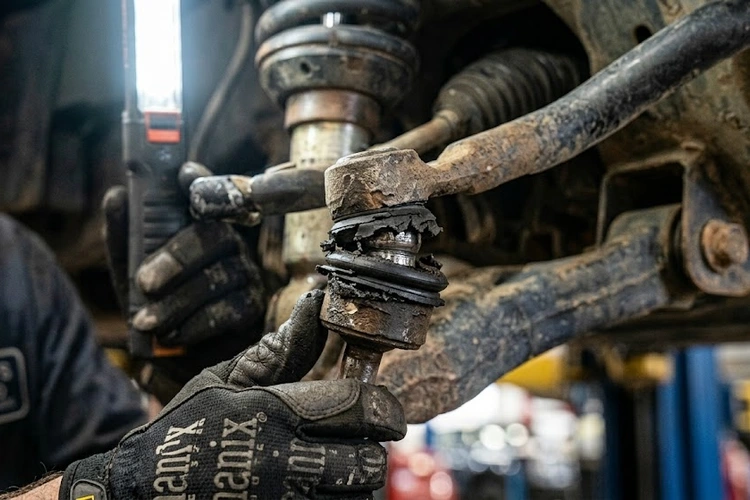
Ball joints connect the control arm to the steering knuckle, forming the pivot point that allows the suspension to travel and the wheel to steer simultaneously. A worn ball joint develops axial or radial play inside its socket. Under compression over a bump, that play becomes a knock. Ball joint failure is a structural emergency. A joint that separates completely causes immediate, unrecoverable loss of steering control. Treat any clunk accompanied by vague or imprecise steering as a ball joint issue until proven otherwise.
Control arm bushings are rubber or polyurethane sleeves pressed into the control arm ears that cushion the arm's pivot point against the subframe. As the rubber degrades from age, oil contamination, or road salt exposure, the bushing develops slop in the bore. The clunk often feels centrally located even when the failing bushing is on one specific side. Braking over a bump amplifies the noise because the control arm loads and unloads rapidly during combined deceleration and suspension compression.
A shock or strut that has lost its damping capacity allows the suspension to travel farther than designed on each compression cycle. At maximum travel, the suspension contacts the internal bump stop — a rubber buffer inside the strut housing. The result is a dull, hollow thud. The noise is most pronounced over sharp, abrupt road imperfections rather than gradual undulations. Worn dampers also degrade progressively, so the clunking worsens over months rather than appearing suddenly. According to Wikipedia's breakdown of shock absorber mechanics, a worn damper increases stopping distance and reduces tire contact patch consistency.
Exhaust heat shields are thin stamped-steel panels fastened over the catalytic converter and exhaust pipes to protect surrounding components from radiant heat. Road debris, corrosion, and vibration fatigue the mounting hardware over time. A loose shield produces a distinctive rattle-clunk over bumps that often changes in character with engine load — louder at low RPM under light acceleration, quieter at cruise. With the engine cold, push firmly on each heat shield panel by hand. Any flex or audible movement confirms the source immediately.
Outer tie rod ends absorb road shock with every suspension cycle, transmitting steering inputs from the rack to the knuckle. When the ball socket wears, the end develops free play. The clunk appears during bump compression and also during slow-speed turns when load transfers through the steering linkage. Worn tie rod ends also cause the steering to feel imprecise and can cause the vehicle to wander at highway speeds. Left unrepaired, they allow toe angle to drift, producing rapid and uneven tire wear on the affected corner.
Ball joint failure is a structural emergency with no warning period. Stop driving and arrange a tow if you observe any of the following alongside the clunk: the steering wheel feels loose or unresponsive, the car pulls sharply to one side without steering input, or the affected wheel appears to lean outward when viewed straight on. These signs indicate the joint is on the verge of separation. A worn tie rod end with severe play also warrants a tow — the consequences of failure at speed are identical.
A loose heat shield, worn end links, or a deteriorated strut mount leave the vehicle structurally stable. Schedule the repair within one to two weeks. A loose heat shield in particular should not be deferred beyond that window — prolonged contact between a vibrating metal panel and exhaust components creates a fire risk over time. Worn end links, if left longer than a few weeks, begin to accelerate wear on the sway bar bushings, converting a $40 repair into a $200 one.
The table below reflects current market averages. Labor figures assume a shop rate of $110 per hour. DIY costs reflect parts only from major online retailers.
| Component | DIY Parts Cost | Shop Total (Parts + Labor) | Risk If Ignored |
|---|---|---|---|
| Sway bar end link | $15–$40 per side | $80–$180 per side | Accelerated bushing wear |
| Strut mount (top mount) | $40–$80 each | $200–$380 per corner | Bearing failure, increased noise |
| Ball joint | $30–$80 each | $150–$400 per joint | Structural: wheel separation risk |
| Control arm bushing | $20–$60 per arm | $150–$300 per side | Alignment drift, tire wear |
| Shock or strut | $50–$150 each | $250–$500 per corner | Increased braking distance |
| Heat shield | $20–$60 | $80–$150 | Fire risk from exhaust contact |
| Tie rod end (outer) | $25–$60 each | $100–$250 per side | Steering imprecision, tire wear |
End links and heat shields are straightforward DIY repairs for anyone with basic hand tools and jackstands. Ball joints and control arm bushings require a hydraulic press for proper installation. Attempting a press-fit joint without the correct tooling produces an unsafe result that will not hold under load. Strut mounts require spring compression — a coil spring under load stores enough energy to cause serious injury if the compressor slips. Reserve those jobs for a shop with the right equipment.
Push firmly down on each corner of the vehicle and release sharply. Normal suspension rebounds once with no oscillation. Two or more oscillations indicate a worn shock or strut at that corner. A clunk during the push or rebound points directly to a worn strut mount or failed end link at the same corner. This test takes under three minutes and narrows the diagnosis before you've spent a dollar.
Raise the vehicle on properly rated jackstands — never use a floor jack as the only support. Grip the wheel at the 12 and 6 o'clock positions and push and pull with force. Any movement indicates ball joint play. Repeat with your grip at 9 and 3 o'clock — play here indicates tie rod wear. Walk along the sway bar and inspect each end link: bent hardware, torn rubber boots, or loose nuts all require replacement. Grab the control arm and attempt to move it vertically. Movement with a clunk confirms bushing failure.
Drive over the same bump multiple times at three different speeds. A clunk that intensifies with speed typically indicates worn shocks reaching full suspension travel. Steer left and right slowly while at low speed — if the clunk appears in one direction only, load is transferring through the sway bar, implicating the end link or bushing on the loaded side. Provide this information to your technician upfront. It eliminates exploratory diagnostic time and protects you from paying for work the data already ruled out.
A clunk over every bump is your suspension asking for ten minutes of your time — ignore it long enough and it will demand ten times the money and a tow truck.
 |
 |
 |
 |

About Sarah Whitfield
Sarah Whitfield is a diagnostics and troubleshooting specialist who spent ten years as an ASE-certified technician before joining the editorial team. She specializes in OBD-II analysis, electrical gremlins, and the kind of intermittent problems that make most owners give up.
Get some FREE car parts & gear.. Or check out the latest free automotive manuals and build guides here.
Disable your ad blocker to unlock all the hidden deals. Hit the button below 🚗
| | | |
