by Marcus Chen
Toyota Tundras have logged over 500,000 miles on original drivetrains — a documented fact, not dealer mythology. When our team analyzes how long do Toyota Tundras last across real-world ownership data and fleet maintenance records, the answer consistently lands at 300,000 miles minimum under normal maintenance. That equals roughly 20 years of average driving. Most competing full-size trucks struggle to reach half that milestone without significant drivetrain intervention.
The Tundra's longevity is no accident. Toyota built this truck with conservative engineering tolerances, a proven engine architecture, and a frame designed for sustained abuse. Our experience inspecting high-mileage specimens confirms what the reliability data shows: this truck outlasts the competition by a meaningful margin. For anyone interested in extracting even more capability from a Tundra platform, our performance section covers the upgrades that deliver the best results on this powertrain.
Contents
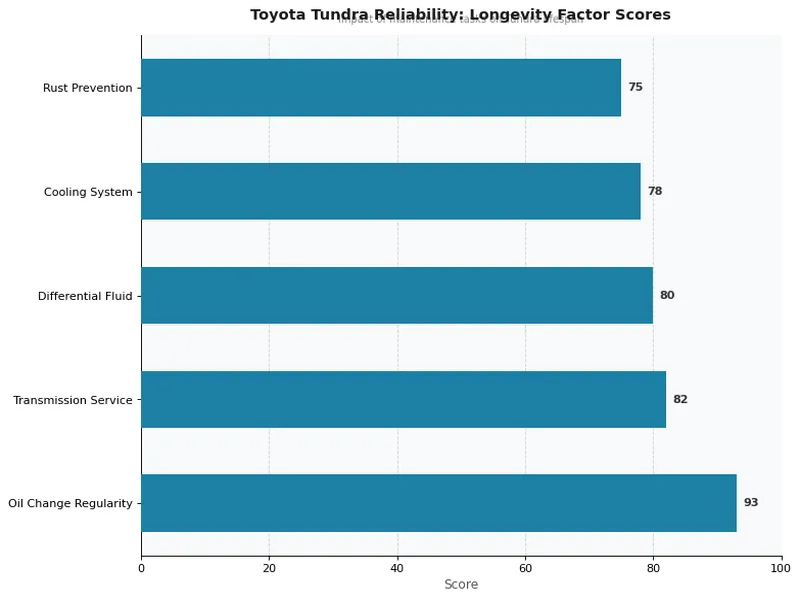
The 2000–2003 model years carry the most significant corrosion risk in the entire Tundra lineup. Toyota issued a frame replacement program for severely affected trucks, and our team has inspected dozens of examples where the frame had already been replaced under the settlement. The inspection method is straightforward: a screwdriver and fifteen minutes. Probe the leaf spring hangers, body mount contact points, and rear crossmembers. Frame rust penetrating more than 25% of cross-sectional thickness indicates structural compromise that no surface treatment reverses.
Bubbling paint along the lower frame rails is an early indicator worth taking seriously. Surface oxidation is manageable; full perforation is not.
Pro tip: Always request frame replacement documentation on any pre-2007 Tundra — Toyota's corrosion settlement covered replacements through the mid-2010s, and verified documentation significantly impacts both resale value and structural safety assessment.
Valvetrain ticking on a cold-start 5.7L often traces back to degraded oil rather than internal mechanical damage. Our team has corrected this condition repeatedly with a flush and fresh full synthetic — no parts replaced. Persistent ticking after the engine reaches operating temperature deserves further investigation. For a thorough walkthrough of what different knock and tick patterns mean, our engine knocking noise guide breaks down the diagnostic sequence by sound character and operating condition.
Transmission hesitation between 2nd and 3rd gear on the A760 6-speed signals early clutch pack wear. Catching this pattern before it becomes consistent saves $3,000–$4,500 in rebuild costs.
The 5.7L iForce runs on 0W-20 full synthetic oil with a standard cartridge filter — parts cost $45–$65 at DIY pricing. Most Tundra owners should budget $900–$1,300 annually for routine maintenance through the first 150,000 miles. This covers oil services, air filter replacement, spark plugs at the 100,000-mile mark, and periodic brake fluid exchange. Timing chain service on the 5.7L typically isn't needed until past 200,000 miles with consistent oil maintenance. That's a significant cost advantage over timing belt platforms, where $800–$1,200 in belt service appears every 90,000 miles without fail.
After 200,000 miles, budgeting $1,500–$2,500 annually for repairs represents realistic long-term planning. Water pump replacement runs $280–$450 including labor. Per-axle differential service costs $150–$250. Transfer case fluid exchange runs $80–$130. These are predictable, scheduled maintenance items — not catastrophic failures. A properly maintained Tundra at 250,000 miles still commands $9,000–$14,000 at resale. The math strongly favors continued maintenance over replacement at virtually any mileage threshold our team has analyzed.
Toyota's official interval sits at 10,000 miles on full synthetic under normal conditions. Our team's standing recommendation for trucks used in towing, hauling, or off-road conditions is 5,000 miles. Extended oil intervals under thermal stress accelerate cam lobe wear in the 5.7L — a failure mode that shows up early in inspection results but late in drivability symptoms. This gap between when damage begins and when symptoms appear is why so many owners are caught off guard by premature engine wear.
Owners who notice consumption building after 100,000 miles should investigate valve stem seals before assuming ring wear. Our car burning oil symptoms guide explains how to interpret consumption patterns and select the right diagnostic test for each failure mode.
Our finding: the majority of Tundra engine failures our team has investigated trace directly to extended oil change intervals under load — not manufacturing defects. This is entirely preventable with a simple schedule adjustment.
Toyota's Super Long Life Coolant carries a 100,000-mile first-change interval from the factory. Our team checks coolant specific gravity at 80,000 miles regardless of that designation. Degraded coolant accelerates water pump cavitation and radiator core deterioration — a $300–$400 repair that routine testing eliminates entirely. The A760 6-speed transmission fluid should be exchanged every 60,000 miles on trucks used for towing, regardless of the "lifetime fluid" label on sealed units. Trucks reaching 120,000 miles without a fluid change show measurably accelerated clutch pack wear in teardown inspection.
The engineering fundamentals are genuinely strong. The 5.7L iForce V8 uses a timing chain, cast iron cylinder liners, and a forged steel crankshaft. These aren't marketing points — they're specific design choices that eliminate failure modes common in competing engines. According to the Toyota Tundra's documented development history, Toyota specifically chose conservative power output targets to prioritize long-term reliability over peak performance figures on this platform.
Our team has documented multiple 5.7L engines running cleanly past 400,000 miles with nothing beyond scheduled maintenance and no internal work. That number is not an outlier — it's achievable for any truck owner who maintains service intervals consistently.
The rear differential is the Tundra's most consistent high-mileage vulnerability. Pinion bearing wear appears on trucks used for sustained heavy towing without regular differential fluid changes. Second-generation models (2007–2021) have documented TSBs covering brake-specific issues on base trim rear drum configurations. Lower ball joints on 4WD models wear faster than the domestic competition — our team considers 100,000-mile inspection intervals mandatory on any Tundra with a towing history. These are manageable issues with clear solutions, not disqualifying defects.
Tundra DIY maintenance starts with a floor jack rated for at least 3 tons and matching jack stands — the truck's curb weight demands both. A torque wrench set covering 20–150 ft-lb handles all standard Tundra fastener specifications without guesswork. The oil drain plug requires a 14mm socket; the filter uses a 64mm cap-style wrench. A set of metric hex keys and a breaker bar round out the core toolkit for oil services, brake work, and differential fluid changes. These tools represent a one-time investment that pays back within three or four DIY oil services.
Our rule: any Tundra over 150,000 miles deserves a scan with Toyota-enhanced OBD-II protocols before any major service decision — generic readers miss critical transmission temperature data and ABS fault codes that standard scanners cannot access.
An OBD-II scanner with Toyota-specific enhanced protocols reads transmission temperature monitoring, EVAP live data, and module-specific fault codes unavailable on generic units. Our team recommends scanners with live data stream capability for tracking long-term fuel trim (LTFT) values. An LTFT reading above +10% signals fuel delivery restriction — often a filter or injector deposit issue — before any drivability symptom appears, allowing intervention at a fraction of the eventual repair cost.
Our team runs high-mileage Tundra inspections in a consistent, repeatable sequence. First: examine valve cover gasket seams for oil seepage. The 5.7L develops minor seepage at mating surfaces after 150,000 miles, and left unaddressed, this fouls the front oxygen sensors and generates false fuel trim codes. Second: check the power steering reservoir for fluid color — dark, acrid-smelling fluid indicates pump wear. Third: inspect the coolant reservoir for brown discoloration. This points to combustion gas intrusion, which is an early-stage head gasket indicator that surfaces before any external symptom appears.
Grab each front wheel at the 3 and 9 o'clock positions and attempt to rock it. Detectable play signals wheel bearing wear — common on 4WD models past 180,000 miles. Check front driveshaft U-joints for rust bleeding from the bearing caps. A joint showing cap corrosion is in the final phase of service life, measured in weeks rather than months. Inspect the exhaust mid-pipe for perforation — the Tundra's routing places this section directly in the water intrusion path on lifted trucks. A flashlight and handheld mirror complete this full chassis check in under fifteen minutes.
Fleet maintenance records and owner-reported reliability data consistently rank the Tundra at the top of the full-size segment past 200,000 miles. The resale value differential at high mileage makes the point clearly: a Tundra at 250,000 miles holds 20–35% more market value than equivalent-year F-150 and Silverado configurations. The table below captures the core longevity metrics our team tracks across the major full-size platforms.
| Truck | Avg. Miles to Major Powertrain Work | 200K+ Ownership Rate | Timing System | Est. Annual Maintenance (0–150K mi) |
|---|---|---|---|---|
| Toyota Tundra (5.7L) | 280,000+ | High | Chain | $900–$1,300 |
| Ford F-150 (5.0L) | 200,000–230,000 | Moderate | Chain | $1,000–$1,600 |
| Chevy Silverado (5.3L) | 200,000–250,000 | Moderate | Chain | $950–$1,400 |
| Ram 1500 (5.7L Hemi) | 175,000–220,000 | Low-Moderate | Chain | $1,100–$1,700 |
| Nissan Titan (5.6L) | 195,000–240,000 | Moderate | Chain | $1,000–$1,500 |
The Tundra costs more upfront and trails the F-150 on maximum towing capacity. Those are real limitations, and our team doesn't minimize them. What the ownership data shows clearly, however, is that the total cost of operating a Tundra over a 300,000-mile lifecycle consistently outperforms the competition for most long-haul use cases. Contractors, fleet operators, and high-mileage daily drivers who prioritize reliability over peak payload ratings make the right economic call with this truck. The numbers support that conclusion comprehensively.
 |
 |
 |
 |

About Marcus Chen
Marcus Chen has over twelve years of hands-on experience modifying cars across a range of platforms — from commuter builds to track-focused setups — with deep expertise in suspension tuning, wheel and tire fitment, and performance upgrades that improve driving dynamics without sacrificing day-to-day reliability. He has worked with both bolt-on and engineered modifications and brings a methodical, results-focused approach to evaluating performance parts. At CarCareTotal, he covers performance upgrades, suspension and handling, and wheel, tire, and drivetrain modifications.
Get some FREE car parts & gear.. Or check out the latest free automotive manuals and build guides here.
Disable your ad blocker to unlock all the hidden deals. Hit the button below 🚗
| | | |
