by Diego Ramirez
A strange smell from your car is almost always a warning sign, and getting your strange car smells diagnosis right can mean the difference between a quick fix and a repair bill that runs into the hundreds. Your nose picks up problems that your dashboard warning lights often miss entirely, which makes it one of the most reliable diagnostic tools you already own.
Most drivers smell something odd and hope it disappears on its own — but that is almost never how car problems work. Smells like burning rubber, rotten eggs, or sweet coolant are your car's way of flagging a problem before it gets out of hand, and every mile you drive while ignoring one can push a manageable issue into expensive territory. This guide covers every major car smell you are likely to encounter, what each one means, and exactly how to track down the source yourself.

Contents
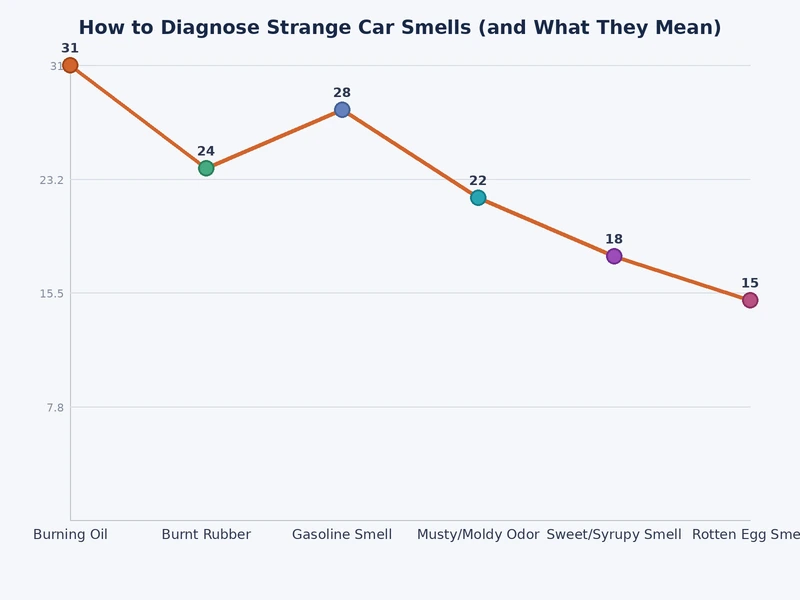
Cars are full of fluids, rubber, plastics, and metals that all behave differently under heat and pressure, and when something starts to fail, those materials almost always produce a distinctive smell before anything else goes wrong. A burning oil smell, for example, nearly always means oil is dripping onto the exhaust and cooking off — a problem that is easy to fix early but can foul your oxygen sensors and destroy your catalytic converter if you keep driving and ignore it.
The reason smells are so useful is that they are specific. Each fluid in your car has its own chemical signature, and your nose can distinguish between a coolant leak, a brake fluid leak, and a power steering fluid leak even when they produce similar physical symptoms. Learning those signatures is practical knowledge that pays off every time you get behind the wheel and catch something early enough to handle it cheaply.
Not every smell you notice in your car signals a crisis. Some smells are completely normal in specific situations — a faint burning smell when you first use the brakes after a long highway descent, for example, is usually just the pads heating up under heavy use, not a sign of brake failure. But a smell that shows up every time you drive, or one that gets noticeably stronger over time, demands your immediate attention.
Here is a rule you can actually use: if you smell something unusual twice in the same week, treat it as a real problem and investigate it right away. A one-time smell might be a fluke, but a recurring one almost never is. The sooner you start your strange car smells diagnosis, the more clues you have to work with — fluids leave stains, odors point to specific zones of the car, and problems that haven't escalated yet are far easier to identify and fix.
The moment you notice a strange smell, pay attention to exactly when it happens — at startup, while accelerating, when you brake, or only after you park and shut the engine off. That timing tells you a great deal about where to look. A smell that only appears while braking almost certainly comes from the braking system, while a smell that shows up under hard acceleration points toward fuel delivery, the exhaust system, or the engine itself.
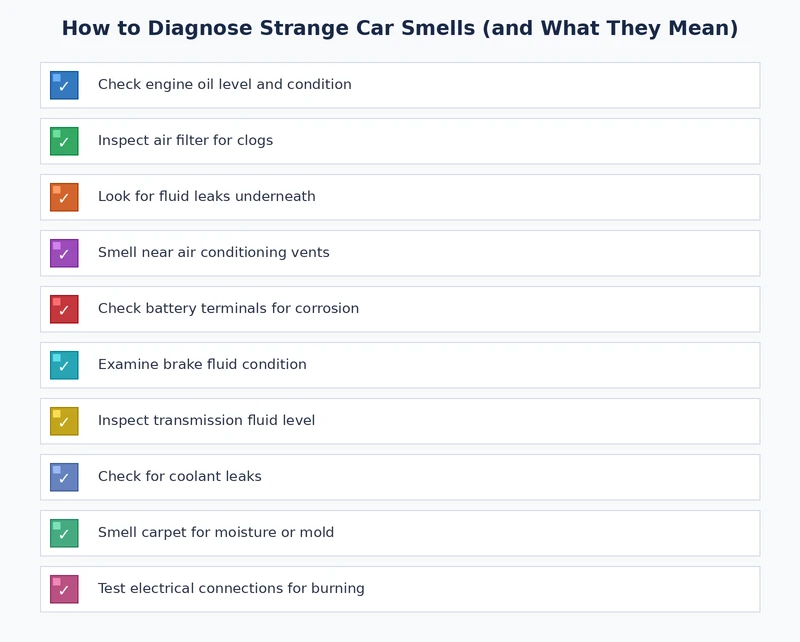
Your first physical check should always be under the hood, with the car parked on a flat surface after a short drive so things are warm enough to produce the smell but not dangerously hot. Look for these things immediately:
If the smell is strongest from inside the cabin, shift your investigation to the HVAC (heating, ventilation, and air conditioning) system — musty, chemical, or burning smells from the vents are often HVAC-related rather than engine-related, and they need a completely different set of fixes.
Once you have a general zone — engine bay, brakes, interior, or exhaust — you can narrow things down with targeted checks. If you suspect a fluid leak, put a clean piece of white cardboard under the car overnight and check it in the morning. The color and location of the drip tells you which fluid is leaking and roughly where the problem is originating from the underside of the vehicle.
Pro tip: A UV leak detection dye kit — available at any auto parts store for under $20 — lets you find coolant and oil leaks that are too small to see with the naked eye by shining a UV flashlight on engine surfaces.
For brake smells specifically, carefully touch the wheel rim with the back of your hand after a short drive — it will be warm to hot, so use the back of your hand rather than your palm to test safely. A wheel that is significantly hotter than the others points to a stuck caliper (the clamp that presses the brake pad against the rotor) on that corner. Stuck calipers create constant friction, produce a sharp burning smell, and cause dangerous brake fade. Our guide on how to break in new brake pads properly also covers how heat cycles affect pad performance and what normal brake smells during break-in actually feel like.
For exhaust smells that enter the cabin, the most serious possibility is a carbon monoxide leak from a cracked exhaust manifold or a failed gasket. Carbon monoxide itself is odorless, so what you are actually smelling is the accompanying exhaust gases — but the CO comes along for the ride. If you ever feel dizzy, lightheaded, or develop a sudden headache while driving, pull over immediately and get fresh air. This is a safety emergency that requires immediate action, not a routine maintenance issue you can schedule for next week.
Burning smells are the most common category and also the most varied, which is why narrowing down the type of burning smell matters so much. A burning rubber smell almost always means a rubber component — a hose, a belt, or a seal — is contacting a hot surface it shouldn't be touching at all. A loose or worn serpentine belt rubbing against the engine block is a classic cause, and it is worth reading through our guide on how to fix a squeaky belt on your car if you also notice a high-pitched squeal from under the hood. If the heat shield over your catalytic converter has come loose, it can also produce a sharp burning smell from the floor of the car during highway driving — our guide on how to fix a rattling heat shield covers that scenario in full detail.
A burning oil smell almost always means oil is dripping onto a hot exhaust surface and cooking off. Check your valve cover gaskets and the area around the oil drain plug first, as those are the most common leak points on higher-mileage engines. A burning plastic smell is a different matter entirely — it frequently points to an electrical short or an overheating component, and it warrants a mechanic visit the same day you smell it, not a few days later when you have more time.
A smell of raw gasoline — especially after you park — can indicate a fuel injector is leaking, a fuel line has developed a crack, or the evaporative emissions system (the sealed system that prevents fuel vapors from escaping into the atmosphere) has failed. Gasoline leaks are a genuine fire hazard and should be diagnosed the same day you notice them. Problems with fuel delivery, including a failing fuel pressure regulator, can also produce a strong fuel smell because the engine runs with too much fuel relative to air, and unburned gasoline exits through the exhaust system.
A rotten egg or sulfur smell is almost always a sign of a failing catalytic converter or a fuel system problem sending excessive sulfur through the exhaust. The catalytic converter converts hydrogen sulfide in exhaust gases into odorless sulfur dioxide — when it stops working correctly, the unprocessed hydrogen sulfide gets through and produces that distinctive egg smell. According to the EPA's vehicle emissions program, properly functioning catalytic converters are required on all modern vehicles precisely because of these harmful byproducts. If you drive a diesel vehicle, the smell profile is different and warrants its own investigation — our guide on how to remove diesel fuel smell from your car covers those scenarios in detail, including when the smell originates inside the cabin.
A musty or mildew smell from your vents usually means moisture has built up on the evaporator core (the component behind your dashboard that cools cabin air before it reaches you through the vents). It is a very common problem after the AC runs for extended periods in humid weather. Running your fan on high with the AC switched off for the last few minutes of your drive can help dry out the evaporator and dramatically reduce mildew growth over time.
A sweet, syrupy smell that seems to come from the engine bay or from under the car after you park almost always means coolant is leaking and burning off on a hot surface. Coolant is highly toxic to animals and has a strong, recognizable sweet smell that you will not forget once you know it. Never ignore this smell — a coolant leak can cause engine overheating and serious damage much faster than most people expect, and the repair cost scales quickly with how long you wait.
If your car has been sitting unused for a while, you might notice a stale or musty smell from the interior that is simply mold and mildew growth in the carpet or upholstery due to trapped moisture — not a mechanical issue at all. Our guide on how to maintain a car that sits unused for months covers this and the other smell-related problems that develop when cars aren't driven regularly and how to address them.
| Smell | Likely Source | Urgency Level | DIY or Shop? |
|---|---|---|---|
| Burning rubber | Belt, hose, or seal touching a hot surface | High | DIY inspect, shop if you find the source |
| Burning oil | Oil dripping on exhaust, valve cover leak | High | DIY inspect, shop for seal replacement |
| Burning plastic | Electrical short, overheating component | Very High — same day | Shop immediately |
| Rotten eggs / sulfur | Failing catalytic converter, rich fuel mix | High | Shop |
| Raw gasoline | Fuel injector, fuel line, or EVAP system leak | Very High — fire risk | Shop immediately |
| Sweet / syrupy | Coolant leak burning off on exhaust or engine | Very High | Shop immediately |
| Musty from vents | Mold on evaporator core or dirty cabin air filter | Medium | Replace cabin filter DIY, shop for evaporator |
| Exhaust smell in cabin | Cracked manifold, failed gasket, exhaust leak | Very High — CO risk | Stop driving, shop immediately |
| Burning brakes | Stuck caliper, worn pads, glazed rotors | High | DIY inspection, shop for caliper or pad work |
Most of the smells covered in this guide are caused by fluids leaking onto hot surfaces, and most fluid leaks start small and get worse over time as seals and gaskets continue to degrade. Checking your oil, coolant, brake fluid, and power steering fluid once a month takes less than five minutes and gives you a reliable baseline for what is normal in your car. When a level drops suddenly between checks, that tells you something is leaking — even before you have smelled anything unusual from the engine.
Flushing your fluids on schedule matters for smell prevention too, because old and degraded fluids smell different from fresh ones when they do leak or burn off. Burnt power steering fluid has a sharp, acrid odor that is easy to confuse with other problems if you don't know what fresh fluid smells like. Our guide on how to flush power steering fluid covers when and how to do that job properly so you are always working with clean, identifiable fluid in that system.
You can handle a lot of diagnostic work yourself with nothing but a flashlight, some white cardboard, and the smell reference table above. But some smells require professional equipment to trace accurately, and some require professional repair regardless of where the problem is. Anything involving the fuel system, catalytic converter, or electrical components falls into the shop-immediately category — not because the diagnosis is always complicated, but because the risks of getting it wrong are genuinely high.
Warning: If you smell burning plastic alongside visible smoke from under the hood or dashboard, do not continue driving — pull over safely, shut the engine off, and call for a tow, as this combination can indicate an active electrical fire.
The best thing you can do before handing a car to a mechanic is document the smell thoroughly so you can give a specific description: "I smell burning rubber near the front-left wheel after driving for 20 minutes, and it goes away when I stop." That kind of detail cuts diagnostic time significantly and often reduces your bill, because the mechanic spends less time hunting and more time fixing the actual problem you already identified.
This is the most dangerous car smell myth, and it causes a lot of unnecessary engine damage and high repair bills every year. Smells disappear for two reasons: the condition that created them changed temporarily, or the fluid that was burning off ran low enough to stop reaching the hot surface. Neither of those things means the underlying problem is resolved in any way. An oil leak that stops smelling after two weeks may have stopped because the oil level dropped below the leak point — your engine is now running low on oil, which is a far bigger problem than the original small leak was.
If you notice a smell and it goes away before you investigate it, treat that as a reason to look harder, not a reason to move on. Check your fluid levels, inspect under the car for staining, and trust your memory of what you smelled. Strange car smells diagnosis is an ongoing process, not a single event, and intermittent problems are often the hardest to catch before they escalate into something serious and expensive.
That distinctive new car smell — the one that some people actively seek out and others replicate with air fresheners — is actually off-gassing from the plastics, adhesives, and treated fabrics inside the cabin. Volatile organic compounds (VOCs), which are chemicals that evaporate at room temperature and enter the air you breathe, are responsible for most of what you smell in a brand-new vehicle, and prolonged exposure to high VOC concentrations has been linked to headaches, respiratory irritation, and other health effects in sensitive individuals.
The practical fix is straightforward: ventilate your new car aggressively during the first few weeks of ownership. Drive with the windows down when traffic and weather allow it, and avoid parking in direct sun with all windows closed — heat dramatically accelerates VOC off-gassing, which is exactly why the smell hits you hardest when you open the door after the car has been sitting in a hot parking lot for several hours.
The fact that your car starts and drives normally tells you almost nothing about whether a particular smell is serious. Most of the problems that produce smells — slow fluid leaks, degrading gaskets and seals, a partially blocked catalytic converter — simply do not affect drivability until they are well advanced. By the time your car actually runs rough, misfires, or refuses to start, the damage has already been compounding for weeks or months and the repair bill has grown accordingly.
Treat every recurring smell as a diagnostic task worth completing, even when the car feels completely normal to drive. Write down when you first smelled it, what conditions trigger it (cold start, hot engine, highway speed, sitting at idle), and whether it comes from inside or outside the cabin. That documentation is genuinely useful whether you end up diagnosing the problem yourself or describing it to a mechanic who needs to find it fast.
Air fresheners and odor eliminators belong in your car for routine freshness, not as a response to a mechanical smell you haven't identified yet. Hanging a pine tree air freshener to cover a burning rubber smell does not make the burning rubber stop — it makes it harder for you to tell whether the problem is getting worse over time, and it prevents passengers from noticing that something is wrong. The same mistake applies to spraying deodorizer into your vents when you have a musty smell: you are covering the symptom while the mold on your evaporator core continues to grow undisturbed.
When you have an active mechanical smell, the correct sequence is to identify the source, fix the problem or have it fixed, and then clean and freshen the interior afterward. Doing those steps in the wrong order wastes money and extends the time the underlying problem goes unaddressed — which is the one thing that makes every car repair more expensive in the end.
A burning smell from your car's vents is most often caused by mold or debris on the evaporator core, dust burning off the heater on its first use after a long idle period, or — in more serious cases — a leaking heater core allowing coolant to burn off inside the HVAC system. If the smell is sweet and syrupy rather than dry and dusty, suspect the heater core and get it checked by a mechanic as soon as possible, since a leaking heater core also fogs your windshield from the inside.
A rotten egg smell coming from your car's exhaust is a sign that your catalytic converter is not converting hydrogen sulfide into odorless sulfur dioxide properly, which almost always means the converter needs to be replaced. It is not immediately dangerous in the same way a carbon monoxide leak is, but driving with a failing catalytic converter is illegal in most states, will cause your car to fail an emissions test, and can eventually damage other exhaust components. Address it as soon as you can schedule the repair.
A brief gasoline smell right after filling up is completely normal — a small amount of vapor escapes when you remove the nozzle, and it dissipates within a few minutes of driving. If the smell persists longer than five or ten minutes, or if it appears when you have not recently fueled up, that points to a real problem: a loose or cracked gas cap, a fuel line with a pinhole crack, or a failed component in the evaporative emissions system. Start by tightening the gas cap and checking whether the smell continues over the next day or two before pursuing further diagnosis.
A burning smell that appears specifically and consistently when you brake almost always comes from the braking system. The most common causes are new brake pads going through normal initial heat cycles, a stuck brake caliper creating constant friction against the rotor on one wheel, or pads that have worn down to bare metal and are grinding directly against the rotor surface. If you also feel a pulsing sensation in the brake pedal or notice that one wheel is noticeably hotter than the others after a short drive, treat it as an urgent safety issue and get the brakes inspected right away.
Yes, it can. A persistent musty smell from your car's vents indicates active mold or mildew growth on the evaporator core or inside the ductwork, and prolonged exposure to mold spores can cause respiratory irritation, allergic reactions, and headaches — particularly in people with asthma or existing mold sensitivities. Replacing the cabin air filter is always a good first step and sometimes fixes the problem entirely. If the smell returns after a fresh filter, the evaporator core itself needs to be cleaned or treated with an antimicrobial product, which typically requires removing part of the dashboard and is best handled by a shop.
Your car tells you when something is wrong well before it stops running — you just have to know how to listen. Start your strange car smells diagnosis the moment something catches your attention, use the smell type, timing, and location to narrow down the source, and act on what you find rather than hoping the problem resolves itself on the next drive. Check your fluid levels today if you haven't done it recently, and if there is a smell you have been putting off investigating, make it your first task this weekend — catching a small problem early is almost always faster, cheaper, and safer than dealing with the same problem after it has had weeks to get worse.
 |
 |
 |
 |

About Diego Ramirez
Diego Ramirez is a maintenance and care specialist who has been wrenching on cars since he was sixteen. He focuses on fluid changes, preventive care routines, paint protection, and the small habits that turn a five-year-old car into a fifteen-year-old car.
Get some FREE car parts & gear.. Or check out the latest free automotive manuals and build guides here.
Disable your ad blocker to unlock all the hidden deals. Hit the button below 🚗
| | | |
