by Diego Ramirez
How to maintain a car sitting long term correctly starts with a solid pre-storage checklist and routine check-ins every three to four weeks. Most people skip both steps and discover flat-spotted tires, dead batteries, and corroded brake rotors when the vehicle finally needs to move again.
Our team has documented these failure patterns across many real-world storage situations, and the damage is almost always preventable. Two hours of preparation work and a modest investment in the right supplies is all it takes for most vehicles stored up to a year. Our detailed walkthrough on how to store a car for winter covers climate-specific preparation strategies that complement the broader approach outlined throughout this guide.
Contents
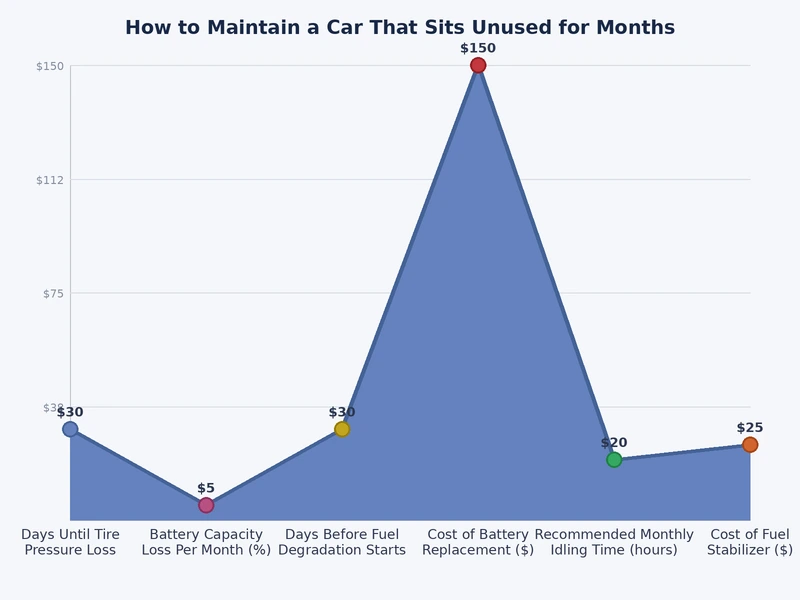
Misinformation about car storage is widespread, and our team encounters the same damaging assumptions repeatedly when inspecting vehicles returned from extended storage. Getting the fundamentals right is the foundation for everything else in this guide.
The most persistent myth is that a modern car can be parked, left completely alone, and started reliably months later without any preparation. Modern vehicles with sophisticated electronics, ethanol-blended fuel systems, and complex rubber seals are particularly vulnerable to prolonged inactivity, and this assumption consistently leads to expensive repairs.
According to Wikipedia's overview of automotive batteries, a standard lead-acid battery loses roughly 1% of its charge per day at room temperature. Left untended for three months, that battery can drop to a level that causes irreversible sulfation damage and permanent capacity loss.
Our team's position is clear: fill the tank with fresh fuel and add a quality stabilizer — never store a vehicle with an empty tank. An empty tank allows condensation to form on interior metal surfaces, promoting rust from the inside, while a full tank with stabilizer protects the fuel system throughout the storage period.
Most people who store vehicles on an empty tank discover this problem firsthand when the tank develops pinhole corrosion that is expensive to repair or replace.
Pro Tip: Add fuel stabilizer to a full tank and run the engine for five minutes to circulate treated fuel through the entire injection system before parking the vehicle.
Real cases make the argument for proper preparation more clearly than any theoretical list, so our team has documented two representative storage outcomes that reflect what most people encounter.
A late-model sedan stored for six months in a covered carport without any preparation arrived at our team's review with a dead battery, seized rear brake pads, and degraded fuel throughout the system. The repair list included a battery replacement, brake rotor resurface on all four corners, and a full fuel system cleaning. Two cracked coolant hoses that had dried and split during the storage period added further cost, bringing the total past $800 — all preventable with roughly two hours of preparation work and a $40 investment before the car was parked.
Our most dramatic documented case involved a pickup stored outdoors for two years under a basic tarp with no preparation. Beyond the expected dead battery and flat-spotted tires, the truck needed a complete brake system overhaul and fuel tank replacement. Significant wiring damage from rodent activity added thousands more to the repair total. The vehicle also required a full coolant flush, as the old coolant had degraded to the point of actively corroding internal metal surfaces. Applying the seasonal maintenance principles from our guide on how to maintain a car in winter to any extended dormancy period would have prevented most of that damage — the principles translate directly to long-term storage.
Before committing to long-term storage, our team recommends honestly evaluating whether storage is actually the right choice, because it carries genuine costs and responsibilities alongside its benefits.
Warning: Comprehensive-only insurance during storage typically does not cover mechanical failures from neglect — only physical damage events like theft, fire, or flooding.
Understanding the real costs prevents the unpleasant surprise of discovering that "free" storage has generated hundreds of dollars in avoidable repair bills when the vehicle eventually returns to service.
The initial preparation investment is the most significant single expense, and our team considers it non-negotiable for any vehicle stored more than 60 days. Getting this right costs $80–$250 depending on whether an oil change and quality cover are also required. This investment reliably prevents failures that cost five to ten times more when the vehicle returns to service.
Any vehicle stored for more than six months should budget for fluid replacement and a mechanical inspection on return — these are expected maintenance items for properly returned stored vehicles, not signs that something went wrong.
| Item | Estimated Cost | Required For | Notes |
|---|---|---|---|
| Battery maintainer / tender | $25–$60 | All stored vehicles | One-time purchase; prevents sulfation damage during storage |
| Fuel stabilizer (16 oz) | $8–$15 | All stored vehicles | Treats up to 40 gallons; essential for ethanol-blended fuel |
| Quality breathable car cover | $40–$150 | Outdoor or dusty storage | Breathable fabric prevents moisture trapping beneath cover |
| Tire pressure gauge and inflator | $10–$30 | All stored vehicles | Inflate to max sidewall pressure before storage begins |
| Rodent deterrent (ultrasonic or cedar) | $15–$40 | Garage and outdoor storage | Peppermint-soaked cotton or electronic deterrents are effective |
| Oil change (fresh oil before storage) | $35–$80 | Storage beyond 3 months | Acidic byproducts in used oil attack bearings during extended storage |
| Brake fluid flush (on return) | $80–$150 | Storage beyond 6 months | Brake fluid absorbs moisture over time; flush before driving again |
| Fuel system cleaning (on return) | $60–$120 | Unprepared storage over 60 days | Clears varnish deposits from injectors and fuel lines after stale fuel |
The right equipment makes maintaining a stored vehicle straightforward rather than guesswork, and our team's essential list is shorter than most people expect.
The battery is the single most failure-prone component in any stored vehicle, and it deserves dedicated equipment rather than a hopeful disconnection. Our team recommends a quality automatic battery maintainer over a basic trickle charger, because maintainers regulate their output intelligently and prevent overcharging damage during extended connection periods. Our roundup of the best car battery chargers covers maintainer-mode units well-suited for long-term storage use. Keeping a quality jump starter at the storage location also provides a reliable backup if the maintainer is ever disconnected or fails.
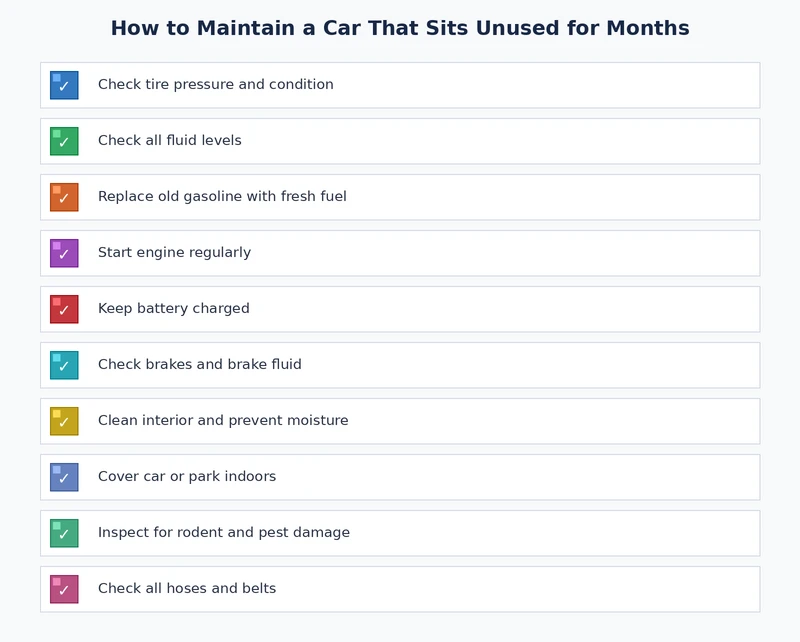
Our team's pre-storage checklist is built around maximum impact for minimum effort, targeting the tasks that prevent the most common and costly storage failures rather than exhaustive low-priority preparation steps.
Every three to four weeks, a brief inspection of fewer than 15 minutes prevents problems from developing undetected over the storage period. Our team treats this schedule as non-negotiable for any vehicle stored beyond 60 days.
Not every situation justifies the effort and cost of proper long-term storage, and our team has a clear framework for evaluating which direction makes more sense for a given vehicle and circumstance.
Most modern vehicles begin developing noticeable issues within 30 to 60 days of complete inactivity, with battery discharge and fuel degradation appearing first. With a battery maintainer and fuel stabilizer properly applied, a prepared vehicle can sit for six to twelve months without significant mechanical consequences, though our team recommends brief check-ins every three to four weeks regardless of preparation level.
Our team's clear recommendation is to leave the parking brake fully released for any storage period exceeding a few weeks. Rear brake pads or shoes can fuse to the rotor or drum surface under sustained clamping pressure over months, creating a situation where the vehicle cannot move without professional intervention or significant force that can damage the braking components permanently.
Our team recommends a fresh oil change before any storage period exceeding three months. Used engine oil contains acidic combustion byproducts that actively attack bearing surfaces and internal metal components when the engine sits without the diluting and flushing effect of normal operation — and the cost of one oil change is far less than the bearing damage that results from months of storage with degraded oil left in place.
Inflating tires to their maximum sidewall pressure before storage reduces the contact patch area and makes flat-spotting significantly less likely over periods of one to six months. For storage beyond six months, our team recommends either moving the vehicle every few weeks to shift the contact patch to a fresh area, or placing the vehicle on jack stands to remove weight from the tires entirely throughout the dormancy period.
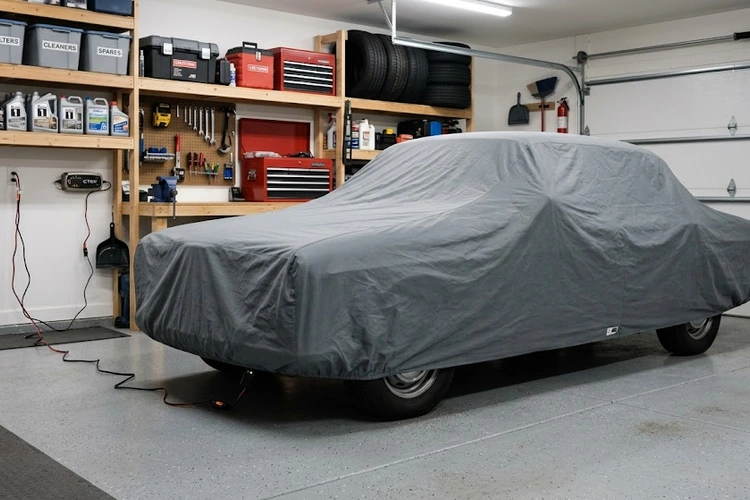
Garage storage is the clear preference for maintaining a car sitting long term, because it eliminates UV exposure, minimizes temperature cycling stress on rubber and plastic components, and dramatically reduces rodent access risk. When garage storage isn't available, a quality breathable cover combined with rodent deterrents and a battery maintainer on a heavy-duty outdoor extension cord represents the best practical alternative most people can realistically arrange.
The difference between a stored vehicle that restarts cleanly and one that needs $800 in repairs almost always comes down to the preparation work done in the two hours before the car was parked. Our team recommends starting with the day-one checklist above, picking up a battery maintainer and fuel stabilizer on the same errand, and setting a calendar reminder for a quick check-in every three to four weeks — those three actions alone prevent the vast majority of storage-related failures our team has documented across years of real-world cases.
 |
 |
 |
 |

About Diego Ramirez
Diego Ramirez is a maintenance and care specialist who has been wrenching on cars since he was sixteen. He focuses on fluid changes, preventive care routines, paint protection, and the small habits that turn a five-year-old car into a fifteen-year-old car.
Get some FREE car parts & gear.. Or check out the latest free automotive manuals and build guides here.
Disable your ad blocker to unlock all the hidden deals. Hit the button below 🚗
| | | |
