by Diego Ramirez
Chrome trim loses up to 60% of its corrosion resistance within the first two years on a vehicle when left completely unprotected — a figure that puts the cost of neglect in sharp perspective for anyone who cares about long-term vehicle aesthetics. Chrome trim appears across a wide range of components: door handles, grille surrounds, window moldings, mirror caps, roof rails, and bumper accents, making it one of the most consistently exposed materials on a modern vehicle. Knowing how to protect chrome trim on your car is a fundamentally different discipline than protecting painted surfaces, because chrome demands pH-neutral cleaners, non-abrasive polishes, and sealants formulated for metallic platings rather than clear coat systems.
The underlying structure of automotive chrome plating — a thin chromium deposit over a nickel sublayer, which itself sits over steel or a polymer substrate — means that any breach in the surface layer can allow moisture and oxygen to reach the base metal, triggering corrosion from the inside out. That's why a proactive protection strategy, rather than a reactive one, is the only sensible approach for keeping chrome trim pristine across multiple seasons. Those looking for product-specific guidance should start with the best chrome polishes available, which covers dedicated formulations that clean, polish, and protect in a single application step.
Contents
Chrome trim on a daily driver contends with an unusually hostile set of environmental conditions, each attacking the plating through a different mechanism and at a different rate. UV radiation degrades any organic coating applied over the surface, leaving it increasingly porous and receptive to contamination as months pass. Road salt during winter months penetrates microscopic surface irregularities in the chromium layer and reaches the nickel sublayer, where it initiates corrosion that expands outward over time in the characteristic pitting and bubbling pattern that makes chrome restoration so labor-intensive. Airborne iron fallout from brake dust and rail dust deposits on chrome surfaces in a way that slowly undermines the adhesion between plating layers, and acidic contamination from bug splatter, tree sap, and bird droppings can etch into unprotected chrome far faster than it damages clear coat.
Galvanic corrosion is a subtler but equally damaging threat. When chrome trim sits adjacent to steel fasteners or mounting hardware and moisture bridges the two dissimilar metals, a small electrochemical cell forms that accelerates corrosion at the interface — which is why chrome trim near door jambs and window channels tends to show early pitting and rust staining before trim in better-drained positions.
Not all chrome trim weathers at the same rate, and understanding which pieces are highest-priority for protection helps allocate time and product budget more effectively. Horizontal surfaces like roof rails and trunk lid accents collect standing water and airborne contamination, accelerating oxidation compared to vertical pieces. Lower body accents and rocker panel trim face the most intense road spray, abrasive grit, and de-icing chemical exposure during winter driving. Door handles and grab bars experience repeated mechanical contact alongside chemical exposure, meaning any wax or sealant layer wears away faster there than on a passive trim piece like a grille surround or window molding. Rear bumper chrome trim is particularly vulnerable on tow vehicles because exhaust heat cycling accelerates coating breakdown over time.
The single most impactful quick win for chrome trim protection is switching to a pH-neutral wash shampoo and applying it with a dedicated microfiber wash mitt rather than a sponge or brush. Most automotive shampoos fall in a safe pH range, but wheel cleaners, low-pH fallout removers, and alkaline-heavy degreasers should never be applied directly to chrome without checking compatibility first, as they strip wax and sealant coatings aggressively and can leave the plating surface temporarily more vulnerable to contamination uptake. Rinsing chrome trim with clean water immediately after washing — before the shampoo has a chance to dry — prevents concentration rings from forming in tight trim gaps and along embossed edges.
Drying chrome trim with a dedicated plush microfiber towel rather than allowing air drying prevents calcium and magnesium deposits from forming in hard-water areas, where water spots on chrome surfaces leave a hazy film that requires polishing rather than simple wiping to remove cleanly.
Iron fallout accumulates on chrome trim as aggressively as on painted panels, and a pH-neutral iron remover applied every three to six months dissolves embedded metallic contamination before it has a chance to oxidize into the surface. The purple color-change reaction that signals iron dissolution works identically on chrome as it does on paint, making it easy to assess contamination levels visually. Understanding the difference between clay bar vs iron remover helps in deciding which decontamination method — or which sequence combining both — belongs in the routine before applying a fresh protective coating to chrome trim. Clay barring chrome trim should be done with extra caution and a generous amount of lubricant spray, as clay dragged on a dry chrome surface can leave light marring that shows on the high-gloss finish.
Proper preparation separates a chrome protection job that lasts six months from one that fades in six weeks, and there are no shortcuts in the prep phase that don't eventually show up in the results. Starting with a thorough pH-neutral wash removes surface grime and road film, followed by an iron decontamination step to dissolve any ferrous particles embedded in the porous chromium surface. If light oxidation, water spot etching, or surface hazing is present, a chrome-specific metal polish — or a fine-cut automotive polish used with a soft foam applicator pad — addresses those defects before any sealant or wax goes on. Applying sealant over contamination or micro-oxidation traps the defects permanently under the coating and makes subsequent correction more difficult, which is why cutting the sequence short produces consistently unsatisfying long-term results.
Once the surface has been polished and wiped clean with isopropyl alcohol on a microfiber towel — removing any polish oils that would interfere with sealant bonding — the chrome is ready for protection. For those who also want to address paint condition during the same session, reviewing the best car polishes available provides a useful framework for selecting the right abrasive level for different surface conditions.
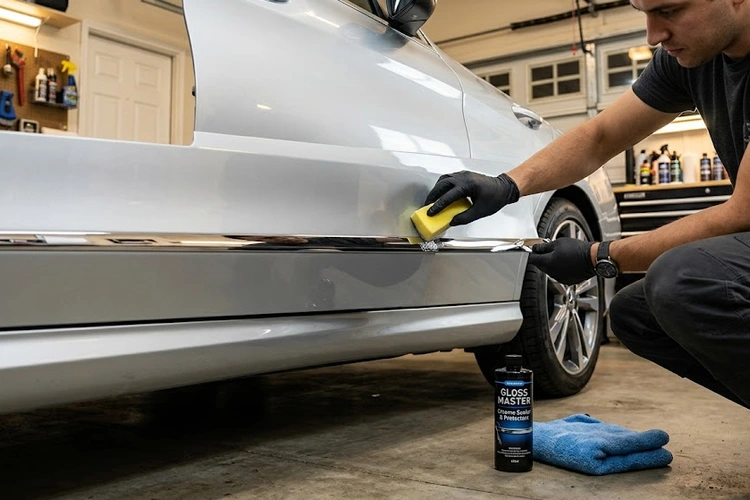
Carnauba wax applied in a thin, even layer by hand or foam applicator, allowed to haze, then buffed with a clean microfiber towel provides a warm reflective finish that typically holds for two to three months before reapplication. Synthetic polymer sealants, applied the same way, generally extend protection to four to six months and perform better in climates with harsh winters or intense UV exposure. Spray sealants with SiO2 content work well as maintenance coats applied between full polishing sessions — they add a fresh sacrificial layer over existing protection without requiring complete surface prep each time, which makes them practical for high-wear areas like door handles where the base sealant erodes faster. For maximum durability on high-value vehicles, paint protection film applied to chrome trim by a professional installer provides a physical barrier against stone chips, abrasion, and chemical contamination that chemical coatings alone cannot replicate.
The market for chrome trim protection spans several distinct product categories, each suited to a different role in a well-structured protection routine. Many experienced detailers combine two or more formats — a periodic metal polish to maintain surface clarity, a durable polymer sealant as a base protective layer, and a spray detailer for between-wash maintenance. The table below outlines the main categories, their practical performance characteristics, and where each fits best.
| Product Type | Protection Duration | Application Difficulty | Best Use Case | Approx. Cost |
|---|---|---|---|---|
| Carnauba Paste Wax | 2–3 months | Moderate | Show cars, warm climates | $10–$30 |
| Synthetic Polymer Sealant | 4–6 months | Easy | Daily drivers, winter climates | $15–$40 |
| Spray SiO2 Detailer | 4–8 weeks | Very Easy | Maintenance between full coatings | $10–$25 |
| Chrome Polish + Wax Combo | 2–3 months | Moderate | Trim with light oxidation or hazing | $10–$35 |
| Paint Protection Film (PPF) | 5–10 years | Professional Install | High-value or show vehicles | $200–$800+ |
Road salt is arguably the greatest sustained threat to chrome trim in cold climates, and a pre-winter sealant application — ideally a polymer sealant rather than carnauba, for its superior chloride resistance and longer durability — provides the most practical barrier against penetration into the plating surface. Applying a second coat of sealant twenty-four hours after the first significantly increases protective layer thickness without adding meaningful complexity to the workflow, and the incremental durability gain through a full winter season is well worth the extra time. For a broader approach to vehicle protection during cold months, a comprehensive guide on how to maintain your car in winter covers paint, rubber trim, undercarriage, and fluid management alongside chrome care in a single organized framework.
During winter, rinsing the underside and lower trim pieces with fresh water after driving on salted roads — even just a garden hose rinse without shampoo — removes chloride deposits before they have time to penetrate the sealant and reach the plating. Chrome trim on lower body panels and bumper accents benefits most from this practice, as those pieces see the highest concentration of road spray during normal driving.
After winter, chrome trim typically carries a residue of road salt, iron fallout, and oxidation byproducts that standard washing alone doesn't remove, and skipping the spring decontamination step allows that residue to continue attacking the plating surface through the warmer months. A full decontamination sequence — iron remover, followed by clay bar on any remaining bonded contamination, followed by light polishing to restore surface clarity — brings chrome back to a clean baseline condition before warm-season sealant application. Inspecting chrome trim closely in spring also reveals early-stage pitting, edge lifting, or delamination on chrome-appearance plated plastics while the damage is still minor enough to address with a targeted polish and reseal rather than professional refinishing or trim replacement.
Regular carnauba paste wax or synthetic polymer sealant can be applied to chrome trim without issues — the key is ensuring the surface is clean and free of oxidation before application. Products containing strong abrasives or those formulated specifically for clear coat should be avoided, as they may be too aggressive for the thin chromium plating layer and can introduce fine scratches that show clearly on a high-gloss chrome finish.
A full polish-and-seal cycle every three to four months works well for most daily drivers, with a spray SiO2 detailer or maintenance wax applied between those sessions to top up the protective layer. In regions with harsh winters or heavy road salt use, adding a dedicated pre-winter sealant application and a spring decontamination-and-reseal session brings the total to four to six protection cycles per year, which keeps the plating surface in consistently good condition.
Chrome plated over a polymer substrate — common on modern vehicles for weight reduction — requires the same cleaning and protection routine as metal-base chrome but is more sensitive to heat and solvent-based products that can warp or craze the substrate. The protective coatings that work on metal chrome work equally well on plastic chrome, but avoid applying products near heat sources like exhaust outlets, and never use steam cleaning directly on plastic-base chrome trim at close range.
Light rust spotting on chrome trim — typically appearing as small brown or orange pits — can often be addressed with a dedicated chrome cleaner or fine metal polish applied with light pressure on a soft cotton or foam applicator. If the pitting has penetrated through the chromium and nickel layers into the base metal, however, polishing alone won't stop the progression, and the piece will need professional replating or replacement to prevent the corrosion from spreading further across the surface.
Chrome trim protection rewards consistency far more than any single heroic cleaning session, and the drivers who get the best long-term results are the ones who build iron decontamination, regular sealant application, and pH-neutral washing into their standard maintenance rotation. Starting with the right chrome polish and sealant pairing makes that routine dramatically more effective — take a few minutes to read through the dedicated product roundup at the best chrome polishes to find a formulation that matches the vehicle's specific exposure conditions, then commit to the seasonal schedule outlined above and let the results speak for themselves.
 |
 |
 |
 |

About Diego Ramirez
Diego Ramirez is a maintenance and care specialist who has been wrenching on cars since he was sixteen. He focuses on fluid changes, preventive care routines, paint protection, and the small habits that turn a five-year-old car into a fifteen-year-old car.
Get some FREE car parts & gear.. Or check out the latest free automotive manuals and build guides here.
Disable your ad blocker to unlock all the hidden deals. Hit the button below 🚗
| | | |
