by Sarah Whitfield
A failing mass air flow sensor produces a recognizable cluster of symptoms — rough idle, poor acceleration, black exhaust smoke, and an illuminated check engine light — that worsen progressively if left unaddressed. The MAF sensor is one of the most consequential components in a modern engine's fuel management system, measuring intake air volume and density and relaying that data to the ECU in real time. When contamination or electrical failure corrupts those readings, the engine control unit miscalculates fuel injection quantities and drives the air-fuel ratio off target, cascading into drivability problems across nearly every operating condition. Drivers noticing these patterns should compare engine misfire symptoms against MAF-related conditions before committing to a repair path, since the two share considerable symptom overlap.
The encouraging reality is that many MAF sensor failures stem from contamination alone — a problem that responds well to a $10 can of specialized cleaner and thirty minutes of careful work. Understanding the full symptom picture, the cleaning procedure, and when replacement is unavoidable eliminates unnecessary parts swaps and diagnostic loops.
Contents
The challenge with mass air flow sensor diagnostics is that the symptom profile overlaps significantly with other fuel and ignition faults, making systematic diagnosis more valuable than a parts-swap approach. A MAF sensor reading low air mass causes the ECU to over-fuel the engine; one reading high causes under-fueling. Both failure modes share symptoms with a dozen other faults, and the overlap demands deliberate testing before any parts are ordered.
The most reliably reported mass air flow sensor symptoms form a predictable set of drivability and performance complaints:
A rough idle and stalling pattern also points to a failing idle air control valve, which regulates airflow at closed-throttle positions and produces nearly identical behavior when it sticks or fails. A bad O2 sensor adds another layer of diagnostic confusion — a downstream oxygen sensor reading rich can trigger fuel trim corrections and a check engine light that mirrors MAF behavior so closely that a code reader alone cannot separate the two; live data comparison through a scan tool is the only reliable differentiator.
Real-world MAF failures follow predictable patterns shaped by vehicle age, mileage, air filter maintenance history, and intake configuration. Symptom onset typically spans weeks to months rather than appearing suddenly, which is why many owners attribute early MAF degradation to normal vehicle aging until the drivability decline becomes undeniable.
Vehicles in the 100,000–150,000-mile range see MAF failures at disproportionately high rates because the hot wire sensing elements accumulate years of airborne oil vapor, dust, and fuel residue from positive crankcase ventilation routing. Symptom onset is almost always gradual — mild throttle hesitation first, then deteriorating idle quality, then a stored code. Owners of reliable long-running platforms like the Ford Escape report that a single MAF cleaning at 80,000 miles frequently restores throttle response to near-factory behavior and corrects marginally elevated long-term fuel trim values within a single service interval.
Oiled gauze-style air filters — standard equipment on most aftermarket cold air intake kits — are a well-documented MAF contaminator. The oil coating migrates onto the sensing element over time, particularly when the filter is over-oiled during service, producing a lean-then-rich swing that resembles a partially clogged injector in its symptom profile. This failure mode recurs within 15,000–20,000 miles of a cleaning if the root cause — excess filter oil — goes uncorrected. Switching to a dry-media aftermarket filter eliminates this contamination pathway entirely.
The decision between cleaning and replacing a MAF sensor hinges on the contamination type and whether any electrical damage has occurred. Contamination from oil vapor or dust responds well to cleaning; a burnt sensing element, broken circuit trace, or corroded connector does not. The table below summarizes the key decision factors.
| Factor | Cleaning | Replacement |
|---|---|---|
| Typical cost | $8–$80 (DIY to shop) | $60–$300+ |
| Time required | 1–2 hours including dry time | 30–60 minutes |
| Best suited for | Physical contamination only | Electrical or physical sensor damage |
| Success rate | High when contamination is the sole cause | Near 100% for verified sensor failure |
| Risk level | Low with correct cleaner product | Low; compatibility must be confirmed by part number |
| Preventive use | Every 40,000–50,000 miles proactively | Once; typically lasts the vehicle's remaining life |
Cleaning is appropriate when the sensor produces plausible but slightly off readings, the contamination is purely physical with visible residue on the hot wire element, and diagnostic codes fall within the P0100–P0104 range without companion codes suggesting broader electrical faults. It works best on vehicles under 130,000 miles where the sensor has never been serviced and the drivability problem developed gradually rather than appearing overnight.
Replacement is the correct call when cleaning produces no measurable improvement after two attempts, when codes return within 500 miles of a thorough cleaning, when live data shows erratic voltage swings at steady throttle positions, or when physical inspection reveals a broken sensing wire, corroded terminals, or a cracked housing. At that stage, further cleaning is diagnostic time wasted.
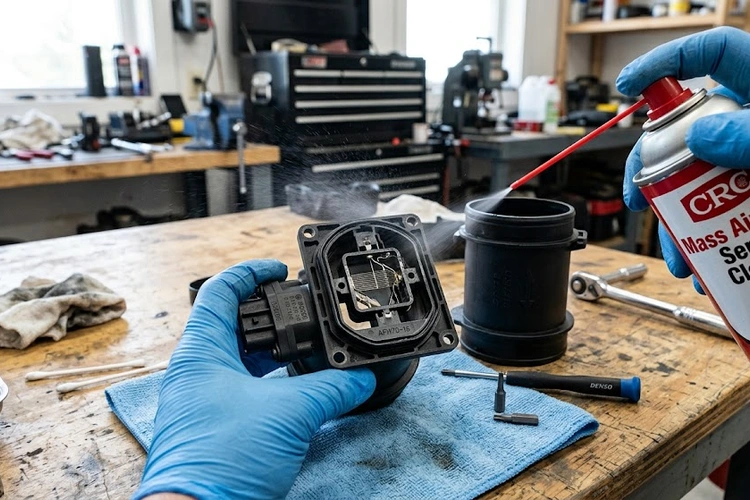
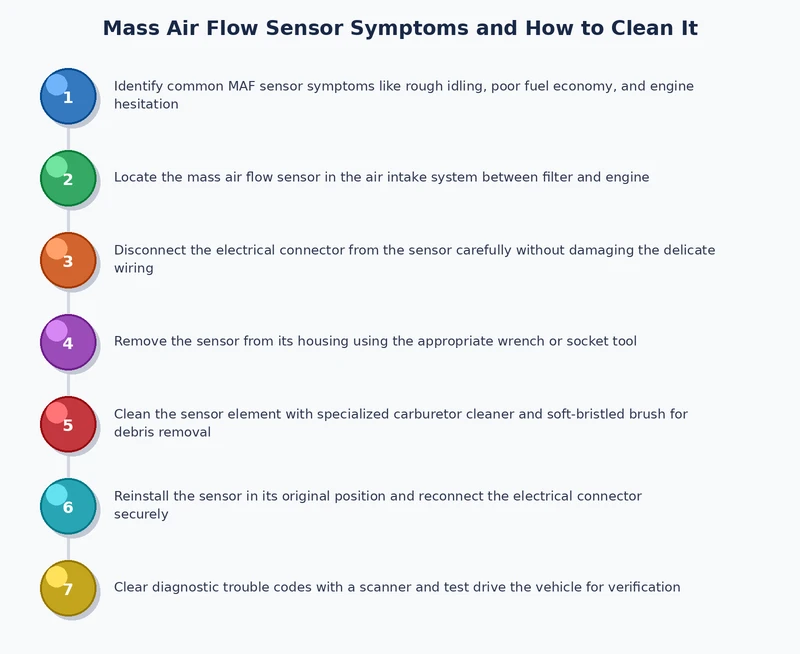
Cleaning a MAF sensor is beginner-accessible, but it demands precision — the hot wire sensing element is fragile, cannot tolerate mechanical contact, and suffers permanent damage from solvents not specifically formulated for MAF use. Carburetor cleaner, brake cleaner, and throttle body cleaner leave residue or attack sensor coatings and are not substitutes regardless of what any forum thread suggests.
Understanding the full cost spread between a DIY cleaning, a shop cleaning, and a complete replacement helps owners make rational repair decisions before the first part is purchased.
| Repair Option | DIY Cost | Shop Cost (Parts + Labor) |
|---|---|---|
| MAF sensor cleaning | $8–$15 | $50–$90 |
| Aftermarket replacement (Bosch, Denso, Standard) | $60–$120 | $120–$200 |
| OEM replacement (factory-branded) | $80–$200 | $200–$350 |
| Dealer-sourced OEM replacement | N/A | $250–$420+ |
For contamination-related failures, the DIY cleaning path represents the highest value by a wide margin. Aftermarket sensors from Bosch, Denso, or Standard Motor Products perform comparably to OEM units on the vast majority of applications and cost roughly half the price of dealer-sourced parts. Budget-conscious owners should exhaust the cleaning option first, especially on vehicles showing gradual symptom progression rather than sudden, total sensor failure.
Prevention eliminates the majority of MAF sensor failures before they develop. A few disciplined maintenance habits — most taking under five minutes — protect the sensor across the vehicle's entire service life and avoid the diagnostic loops that contamination-related failures generate.
Replace the air filter on schedule — every 15,000–30,000 miles depending on driving conditions — and inspect it visually at every oil change. A saturated or torn filter allows particulates to bypass the media entirely, coating the MAF wire within a few thousand miles of exposure. Vehicles operating in dusty or unpaved environments should halve that service interval without exception. The broader connection between consistent maintenance habits and long-term component health is covered in depth in this guide to maintaining your vehicle.
Any crack or loose clamp between the MAF sensor and the throttle body creates an unmetered air path — air the sensor never measures — producing persistent lean codes and rough idle despite a perfectly functional sensor. Inspecting the intake tube, couplers, and clamps at every oil change takes under two minutes and catches vacuum leaks before they generate costly misdiagnosis cycles and unnecessary parts replacements.
When running aftermarket gauze-style filters, apply filter oil sparingly and allow at least 24 hours of cure time before reinstalling the filter. Excess oil migrates onto the MAF wire within a few thousand miles and produces the same contamination pattern as a neglected paper filter — but on a much shorter cycle and with a different visual signature that can confuse diagnosis when the technician is unaware of the intake configuration.
The MAF sensor does not operate in isolation. Its readings directly influence fuel trim values, ignition timing, and catalytic converter efficiency simultaneously, making a degraded sensor a systemic problem rather than an isolated component fault with a single consequence.
A MAF sensor stuck in a low-reading condition forces the ECU to add fuel through closed-loop correction, pushing long-term fuel trim values progressively higher over weeks of operation. This chronic rich condition accelerates catalyst degradation and stresses downstream oxygen sensors, generating symptoms that appear long before a technician traces the root cause back to the MAF problem. Overlapping diagnostic pathways worth reviewing include camshaft position sensor failure symptoms and fuel pressure regulator failure symptoms, both of which produce drivability codes that co-occur with MAF faults on high-mileage engines and require live data comparison to untangle.
Cleaning the MAF sensor preventively every 40,000–50,000 miles on vehicles past 80,000 miles is a sound strategy regardless of whether symptoms have appeared. The cost is under $15 in materials, the procedure fits within an hour, and the alternative is a slow accumulation of marginal fuel trim corrections that gradually shorten injector and catalytic converter service life. Pairing the MAF cleaning with scheduled air filter replacement creates a natural combined service interval that addresses both the contamination source and its primary victim in a single session.
The most common mass air flow sensor symptoms are rough idle, hesitation during acceleration, reduced fuel economy, black exhaust smoke from a rich fuel mixture, stalling at idle, and a check engine light with codes P0100 through P0104. These symptoms typically develop gradually as contamination accumulates on the sensor's hot wire element rather than appearing suddenly.
Yes — in most cases a contaminated MAF sensor responds well to cleaning with a purpose-formulated MAF cleaner aerosol. Cleaning is appropriate when the contamination is physical, such as oil vapor residue or dust buildup, rather than electrical damage. If symptoms return within 500 miles of a thorough cleaning, replacement is the correct next step.
Only a cleaner specifically formulated for mass air flow sensors — such as CRC MAF Sensor Cleaner — should be used. Carburetor cleaner, brake cleaner, and throttle body cleaner leave residue or attack the sensor's delicate wire coating and can cause permanent damage. The sensing element should never be touched or scrubbed mechanically during the cleaning process.
A cleaned MAF sensor requires 20–30 minutes of air drying at room temperature before reinstallation. Rushing the drying step and installing the sensor while solvent traces remain can damage the sensing element when it heats up during operation, defeating the entire purpose of the cleaning procedure.
Yes, a malfunctioning MAF sensor often causes emissions test failure. The rich fuel mixture produced by a low-reading sensor generates elevated hydrocarbon and CO emissions, and stored OBD-II codes in the P0100–P0104 range flag the vehicle as a readiness monitor failure in most state testing programs, resulting in automatic disqualification regardless of tailpipe output.
Cleaning the MAF sensor every 40,000–50,000 miles is a sound preventive practice on vehicles past 80,000 miles. Pairing the cleaning with scheduled air filter replacement creates a natural combined service interval, addresses both the contamination source and the sensor in one session, and keeps long-term fuel trims within factory specifications without additional labor time.
Mass air flow sensor symptoms are among the more manageable engine problems a driver can face — predictable in their progression, straightforward to diagnose with a scan tool, and often fully correctable with a purpose-formulated aerosol and less than an hour of careful work. The most effective next step for any vehicle showing these symptoms is a code read followed immediately by a thorough cleaning; skipping that step and ordering a replacement sensor without cleaning first is the most common and most avoidable mistake in MAF diagnosis. Owners who establish a 40,000-mile preventive cleaning interval aligned with air filter replacement will eliminate most MAF-related failures before they ever reach the symptom stage.
 |
 |
 |
 |

About Sarah Whitfield
Sarah Whitfield is a diagnostics and troubleshooting specialist who spent ten years as an ASE-certified technician before joining the editorial team. She specializes in OBD-II analysis, electrical gremlins, and the kind of intermittent problems that make most owners give up.
Get some FREE car parts & gear.. Or check out the latest free automotive manuals and build guides here.
Disable your ad blocker to unlock all the hidden deals. Hit the button below 🚗
| | | |
