by Sarah Whitfield
Approximately 30 percent of rear-axle failures reaching independent repair shops trace directly back to differential noise that drivers tolerated for three months or longer without investigation, a pattern our team has documented consistently across drivetrain service histories. Rear differential noise symptoms rarely announce themselves as emergencies — they begin as faint whines, low rumbles, or intermittent clunks that blend convincingly into road noise until the internal damage has compounded significantly. Catching these signals early is the single most reliable way to avoid the difference between a $120 fluid service and a $2,500 gear set replacement.
The rear differential is the mechanical unit that distributes driveshaft torque to both rear wheels while allowing each wheel to rotate at different speeds through corners — a function detailed on Wikipedia's differential reference page. When the gears, bearings, or seals inside begin to fail, the noise they produce follows predictable patterns our team has learned to read with precision. This guide covers the six primary symptoms, their root causes, and the realistic repair costs most drivers face at each severity level.
Contents
Rear differential noise symptoms fall into recognizable categories, and each category points toward a different internal component. Drivers who can describe the sound accurately — its pitch, when it appears, and how it changes with speed or load — cut diagnostic time in half, which directly reduces labor costs.
A persistent whine that changes pitch with vehicle speed — but not with engine RPM — is the signature of worn ring-and-pinion gears or incorrect gear backlash. The noise typically peaks between 30 and 70 mph before fading slightly at higher velocities. This pattern is closely related to the humming noise while driving that originates from drivetrain components rather than tires, and the two are frequently confused during initial diagnosis.
A sharp clunk when power is first applied — or during the transition between acceleration and deceleration — typically indicates worn U-joints, excessive carrier bearing play, or badly worn spider gears. Our experience with drivetrain clunking noise shows that this symptom escalates quickly once wear passes a threshold, making early intervention critical to avoiding complete axle failure.
A deep, cyclic rumble that builds with vehicle speed and produces subtle vibrations through the floor points toward failing wheel bearings in the rear axle housing. Unlike tire-related vibration at highway speeds, differential bearing noise remains consistent regardless of steering wheel position, which helps narrow the diagnosis efficiently before any disassembly begins.
Clicking or snapping sounds that appear exclusively during slow, tight maneuvers — parking lot turns, three-point turns — indicate worn or broken spider gears inside the differential case. The load shift during turning forces the spider gears to rotate, and worn teeth produce a rhythmic clicking distinctly different from constant-velocity joint noise. Our team recommends reviewing CV joint replacement costs alongside differential repair quotes when this symptom appears, since both components share similar failure modes in high-mileage vehicles.
Grinding that diminishes after differential fluid warms up is a strong indicator of metal contamination from previous bearing or gear damage. Gear chatter — a rapid, irregular stuttering — often points to limited-slip differential (LSD) clutch pack wear, particularly when the LSD friction modifier has been depleted. Drivers sometimes confuse this with transmission slipping symptoms, since both produce irregular sounds during initial engagement.
Vibration that amplifies when the vehicle is loaded with passengers, towing a trailer, or climbing grades suggests pinion bearing failure or insufficient preload on the pinion nut — a condition that allows the pinion gear to shift slightly under load. This movement also accelerates differential oil leaks, as the shifting shaft wears the pinion seal contact surface unevenly over time.
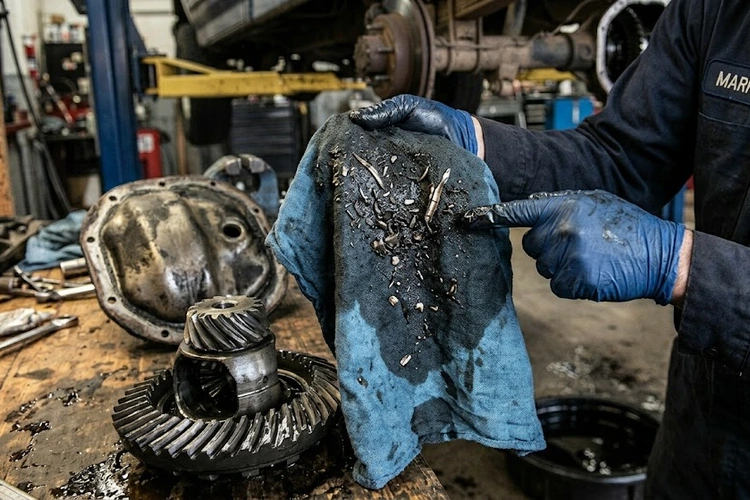
A fluid inspection takes ten minutes and costs nothing — metallic particles suspended in the differential fluid confirm internal damage before the noise reaches a catastrophic stage.
Our team approaches every differential noise complaint with a structured basic inspection before reaching for specialized tools. The essential checklist:
When basic inspection is inconclusive, these tools produce definitive results:
Several differential maintenance tasks fall within the capability of anyone with basic mechanical experience and a torque wrench:
Ring-and-pinion replacement and full differential rebuilds require a bearing press, inch-pound torque wrench, and gear-marking compound, along with the experience to set bearing preload and backlash correctly. Incorrect preload destroys new bearings within 10,000 miles. The table below covers realistic cost ranges by repair type:
| Repair Type | DIY Parts Cost | Shop Total Cost | Difficulty |
|---|---|---|---|
| Differential Fluid Change | $30–$60 | $80–$150 | Easy |
| Cover Gasket / Axle Seal | $15–$50 | $120–$280 | Easy–Moderate |
| Pinion Seal Replacement | $20–$60 | $150–$320 | Moderate |
| Wheel Bearing Replacement | $60–$150 | $250–$500 | Moderate |
| Ring and Pinion Replacement | $200–$500 | $900–$1,800 | Advanced |
| Full Differential Rebuild | $300–$700 | $1,400–$3,200 | Advanced |
A structured road test eliminates guesswork and narrows the suspect components before any disassembly begins. Our team follows this sequence on every differential noise diagnosis:
Bearing noise is cyclic and tied to wheel rotation speed, producing a rhythmic pattern that changes smoothly with velocity. Gear noise is load-dependent — it appears under throttle, softens during coasting, and disappears in neutral coast. Gentle lane-change weave maneuvers at highway speed reliably distinguish axle bearing noise from differential gear noise, since bearing load shifts with lateral weight transfer while gear noise remains constant. Our team also verifies wheel alignment during every differential diagnosis, since alignment-related vibration patterns mimic differential bearing failures closely enough to cause misdiagnosis.
Not every differential noise requires same-day shop attention. Our team considers the following conditions manageable for one to two weeks before repair, provided the vehicle avoids towing and aggressive driving:
Any noise that changes character suddenly — louder, rougher, or accompanied by new vibration — moves the repair from "schedule soon" to "stop driving today."
The following symptoms indicate active mechanical failure where continued driving risks complete rear axle separation:
Rear differential noise symptoms most commonly present as a whining or howling sound that changes with vehicle speed, a clunking noise during acceleration-to-deceleration transitions, or a rhythmic rumbling that intensifies as speed increases. Clicking during tight, slow-speed turns is also a reliable indicator of internal spider gear wear specifically.
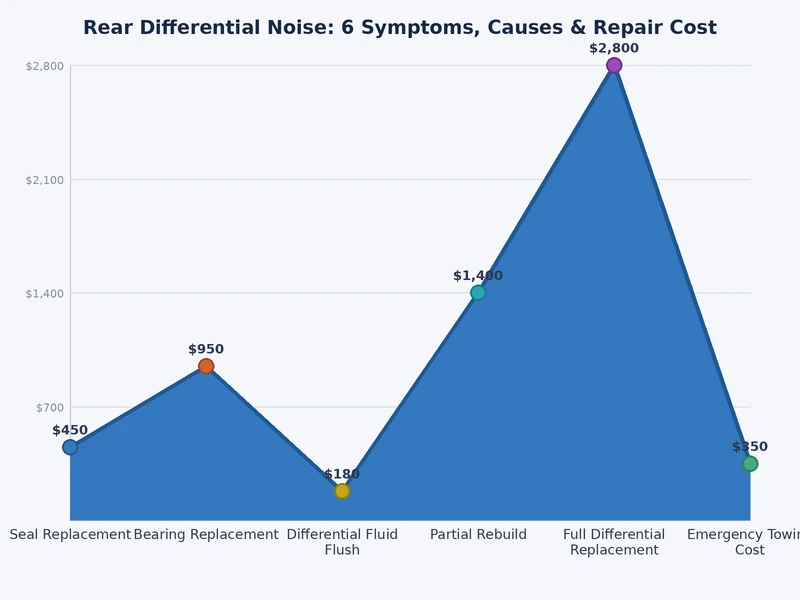
Repair costs span a wide range depending on the root cause. A fluid service runs $80–$150 at a shop, while a seal replacement costs $120–$320. Wheel bearing replacement typically ranges from $250–$500 per side, and a full rebuild or ring-and-pinion replacement runs $1,400 to over $3,000 depending on the vehicle model and local labor rates.
Minor, stable noise may allow brief continued driving with careful monitoring, but ignoring differential noise consistently leads to compounding internal damage. What begins as a $150 fluid-related problem can escalate to a $2,500 gear replacement within weeks of continued heavy use, making early attention almost always the more economical choice.
Most rear differentials last between 100,000 and 150,000 miles when fluid changes are performed every 30,000 to 50,000 miles per the manufacturer's schedule. Towing heavy loads frequently, aggressive driving habits, or neglected fluid maintenance significantly shortens service life and accelerates the onset of the noise-producing wear patterns described above.
Not always. Rear axle noise encompasses both the differential unit itself and the wheel bearings mounted in the axle housing. Differential gear or carrier bearing noise originates at the center of the rear axle, while wheel bearing noise originates at each individual wheel end. The neutral coast-down road test is the most reliable method for distinguishing between these two sources without disassembly.
If noise appears or worsens after a fluid service, the most common causes are using the incorrect gear oil viscosity specification, omitting the required friction modifier in limited-slip differentials, or overfilling the housing. LSD clutch pack chatter is especially sensitive to fluid type — conventional gear oil used in an LSD produces immediate noise that only resolves when friction-modified fluid is installed correctly.
Advanced differential failure — particularly collapsed carrier bearings or severely worn spider gears — affects rear axle stability and produces unpredictable behavior during cornering under load. Our team treats any differential noise complaint that coincides with handling changes as an urgent situation, and always verifies wheel alignment alongside the differential diagnosis since both systems produce overlapping symptoms in early failure stages.
The differential that gets fresh fluid on schedule almost never makes news — the one that gets ignored always does.
 |
 |
 |
 |

About Sarah Whitfield
Sarah Whitfield is a diagnostics and troubleshooting specialist who spent ten years as an ASE-certified technician before joining the editorial team. She specializes in OBD-II analysis, electrical gremlins, and the kind of intermittent problems that make most owners give up.
Get some FREE car parts & gear.. Or check out the latest free automotive manuals and build guides here.
Disable your ad blocker to unlock all the hidden deals. Hit the button below 🚗
| | | |
