by Joshua Thomas
Approximately one in four drivers will experience a trunk failure at some point during their vehicle ownership, according to data from automotive repair industry analysts. When a trunk won't open, the consequences are immediate: luggage, tools, and emergency gear become inaccessible without warning. The problem is rarely catastrophic, but identifying the correct cause is essential before any repair attempt.
A stuck trunk shares its failure patterns with other vehicle access problems. Drivers who have encountered a car door that won't open from inside or outside will recognize the same underlying mechanisms: failed cables, corroded latches, and electrical faults appear across all vehicle entry and storage points. The trunk is one component in that broader system. This guide examines six specific causes, clarifies when professional repair is appropriate, corrects persistent misconceptions, and provides realistic cost expectations.
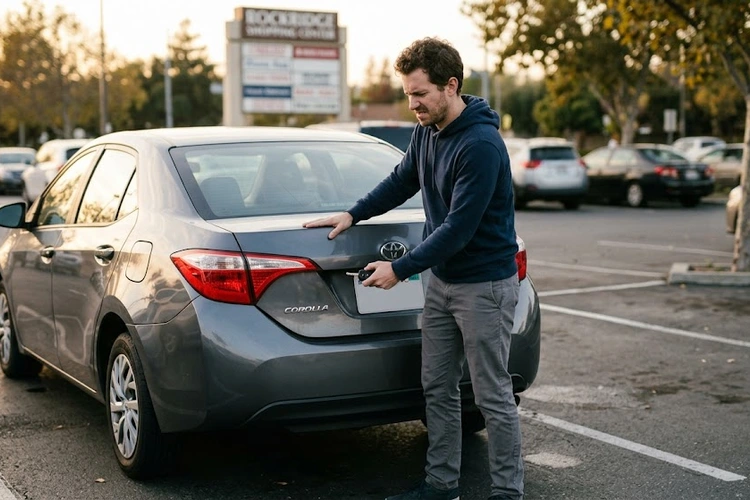
Contents
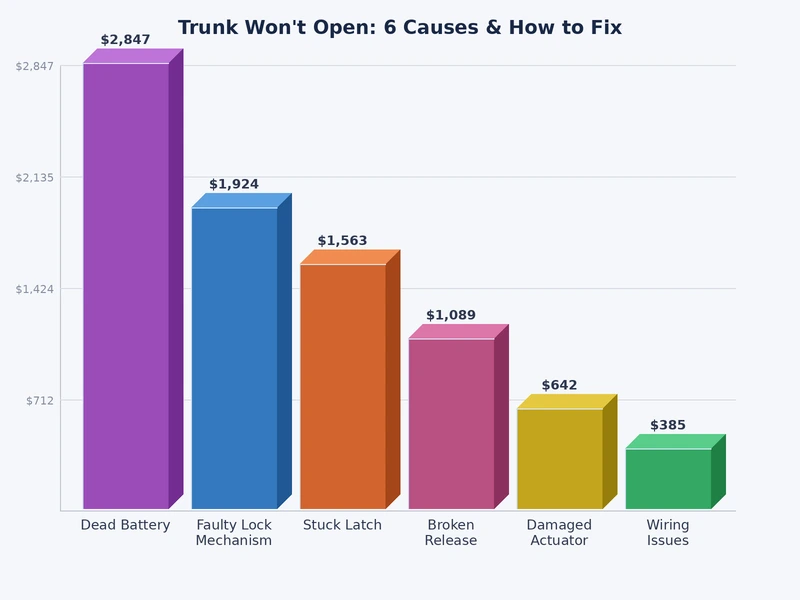
Trunk failures follow predictable patterns. In most cases, one of six underlying issues is responsible. Identifying the correct cause before purchasing parts or scheduling service saves both time and money. The diagnostic approach for each cause is described below.
The key fob transmits a radio signal to the vehicle's body control module (BCM), which activates the trunk release. When the fob battery is depleted, that signal never reaches the module. The trunk appears completely unresponsive, yet nothing inside the mechanism has failed.
Diagnosis is direct: attempt to open the trunk using the physical key or the interior release lever. If either method works, the fob battery is the culprit. Most fobs use a CR2032 or CR2025 coin battery, available for under two dollars at any hardware or convenience store. Replacement takes under a minute and requires no tools.
Vehicles equipped with an electric trunk release route power through a dedicated fuse — a small protective device that interrupts electrical current to prevent circuit damage. When that fuse fails, the electric release stops functioning entirely. The physical key and interior lever typically still work, which helps isolate the problem from other potential causes.
The fuse box location varies by manufacturer. Most vehicles place it under the dashboard on the driver's side or inside the engine bay. Consulting the owner's manual identifies the correct fuse and its amperage rating. A visual inspection under bright light reveals a broken wire inside the fuse housing. Replacement fuses cost under two dollars each. When multiple electrical accessories fail simultaneously, an undercharged or failing battery may be contributing — maintaining battery health with a reliable car battery charger reduces voltage instability that causes nuisance fuse failures.
The trunk latch is the mechanical catch that holds the lid closed and disengages when commanded by the release mechanism. Over time, the latch can crack, corrode internally, or lose spring tension. A failing latch may partially release but fail to fully disengage, or may not respond at all despite the release mechanism functioning correctly elsewhere in the system.
Inspection requires access through the cargo area. On most vehicles, folding the rear seat flat reveals the latch assembly through an interior trim panel. Visible corrosion, housing cracks, or a spring that fails to return to its resting position confirm latch failure. Replacement latches typically cost fifteen to eighty dollars and install with basic hand tools — usually a screwdriver and a small wrench set.
Most vehicles route a flexible steel cable from an interior release lever — typically positioned near the driver's seat or inside the cargo area — to the latch mechanism. This cable transmits the mechanical force needed to disengage the latch. Over time, cables stretch at anchor points, fray at end fittings, or snap entirely, particularly on higher-mileage vehicles.
The clearest diagnostic indicator is an interior release lever that pulls with almost no resistance. A healthy cable creates slight tension throughout its travel. When the cable breaks or separates from its end fitting, that resistance disappears entirely. Accessing the cable typically requires removing interior trim panels in the cargo area or behind the rear seat.
The lock cylinder — the physical keyhole built into the trunk lid — can seize when corrosion, dirt accumulation, or internal wear prevents the key from turning. This failure mode is especially common in vehicles exposed to road salt or coastal salt air over extended periods. Drivers familiar with the challenge of protecting car paint in coastal salt air will recognize how aggressively salt penetrates metal surfaces. Lock cylinders face identical exposure with every winter or seaside drive.
Penetrating oil applied directly into the keyhole sometimes frees a seized cylinder — allow several minutes before attempting to turn the key. If the cylinder remains immovable, or if the key turns without actuating the latch, cylinder replacement is the appropriate course of action.
In sub-freezing temperatures, moisture trapped inside the latch mechanism can freeze solid, physically preventing any movement. This is a temporary environmental failure rather than a mechanical defect. The latch components are structurally intact — they simply cannot move until the ice melts.
A commercial lock de-icer spray resolves most frozen latch situations within minutes. Alternatively, a heat gun held six to eight inches from the latch area — kept continuously moving to prevent localized heat buildup — warms the mechanism without damaging surrounding paint or plastic trim. Open flames should never be used near vehicle surfaces under any circumstances.
Applying a thin coat of silicone-based lubricant to the trunk latch each autumn is the single most effective preventive measure against frozen latches in cold climates.
Not every trunk failure belongs in a home garage. Some repairs require only patience and basic tools. Others demand diagnostic equipment and structural knowledge beyond the reach of most home mechanics. Matching the repair to the appropriate setting prevents costly secondary mistakes.
Key fob battery replacement, fuse swaps, and latch lubrication require no specialized tools and carry essentially no risk of causing further damage when performed correctly. Trunk latch replacement on most mainstream vehicles involves removing three to five bolts and disconnecting a single wiring harness — work that typically takes under ninety minutes for a careful home mechanic.
Release cable replacement is more involved but remains achievable on vehicles where fold-down rear seats allow cable access from inside the cabin without removing exterior bodywork. Following the manufacturer's specified routing path is important: an improperly routed cable binds against interior panels and fails prematurely, creating a second repair where there should have been none.
Electrical faults beyond a blown fuse — including a failing BCM, a damaged wiring harness, or a corroded connector — require a scan tool and electrical training to diagnose correctly. Attempting these repairs without proper equipment typically produces misdiagnosis and unnecessary parts spending.
Structural damage to the trunk lid or latch mounting points, often resulting from a rear-end collision, requires alignment assessment before any latch replacement. Installing a new latch on a warped or misaligned lid perpetuates the original failure at the cost of new parts.
Vehicles that have been sitting unused for extended periods present a compounding risk. A guide on maintaining a car that sits unused for months details how dormancy simultaneously causes corrosion, cable degradation, and seized mechanisms across multiple systems. When several trunk components are affected at once, a professional inspection is the more practical starting point than piecemeal DIY repair.
A significant portion of trunk failures resolve without any replacement parts. Corrosion-seized latches frequently free up after penetrating oil and careful manipulation. Stiff mechanisms often respond to silicone lubricant alone. A fob that appears dead may need only a two-dollar battery. Diagnosis must precede purchasing — not follow it. Skipping this step generates parts expense for problems that cleaning or lubrication would have fully resolved.
Electric trunk release systems carry an unearned reputation for fragility. Complaint data compiled by the National Highway Traffic Safety Administration (NHTSA) indicates that latch-related failures occur across both mechanical and electric systems at broadly comparable rates. Manual cable systems fail through fraying and corrosion. Electric systems fail through fuse issues, BCM faults, and corroded connectors. Neither design is inherently superior across all conditions and climates. Regular maintenance — not system type — is the stronger predictor of long-term reliability.
Applying a pry bar or sustained force to a resistant trunk lid damages the lid itself, cracks the latch housing, and misaligns the hinges. These secondary failures often cost more than addressing the original problem through proper diagnosis would have. A trunk that won't open deserves a methodical approach — not a forceful shortcut that compounds the damage.
When a trunk resists opening, the first tool to reach for is a flashlight — not a pry bar.
Most trunk failures are preventable. A consistent annual maintenance routine keeps latches, cables, and lock cylinders in reliable working order without significant time or cost investment.
The trunk latch mechanism, hinges, and lock cylinder benefit from a light application of silicone-based lubricant once per year — more frequently in environments with salt exposure or high humidity. Silicone spray is preferred over petroleum-based products such as WD-40, which attract dust and grime that accelerate wear inside precision latch mechanisms over time.
The rubber weatherstripping (the compressible seal around the trunk opening) also requires periodic treatment with a silicone protectant. Cracked or hardened weatherstripping allows water into the latch area, directly promoting the corrosion that leads to seized cylinders and stiff cables. The same maintenance discipline that governs cleaning car door handles inside and out — where salt and grime accumulate on similar hardware — applies equally to the trunk latch and surrounding metalwork.
A brief annual inspection catches developing problems before they become roadside failures. Keeping the cargo area itself clean removes abrasive debris that can work into latch edges over time — the same reasoning behind regularly addressing adhesive accumulation covered in guides such as removing sticker residue from car interiors. The following checks take under fifteen minutes:
Persistent dampness or musty odors in the cargo area deserve prompt attention. A resource covering diagnosing strange car smells notes that musty odors originating from the rear of the vehicle frequently trace to a failed trunk seal — a finding that simultaneously signals developing latch and cable corrosion in the same area.
Repair costs vary widely depending on the cause, the vehicle make and model, and whether work is performed at home or at a professional shop. Realistic expectations help drivers make informed decisions before committing to a repair path.
For home mechanics, parts costs remain modest across all six failure types. Key fob batteries run one to five dollars. Replacement fuses cost under two dollars each. Silicone lubricant and penetrating oil together cost roughly ten to fifteen dollars. Trunk latch assemblies range from fifteen to eighty dollars depending on the vehicle. Release cables fall between twenty and sixty dollars. Lock cylinders cost twenty to seventy dollars for most mainstream vehicles.
Shop labor rates typically range from eighty to one hundred fifty dollars per hour. Most trunk repairs require one to three hours of labor. The table below summarizes typical cost ranges for common trunk repair scenarios.
| Repair Type | DIY Cost | Professional Cost | Typical Labor Time |
|---|---|---|---|
| Key fob battery replacement | $1–$5 | $10–$25 | Under 15 minutes |
| Blown fuse replacement | $1–$3 | $35–$90 | 30–60 minutes (includes diagnosis) |
| Latch lubrication | $5–$15 | $30–$65 | 15–30 minutes |
| Trunk latch replacement | $15–$80 (parts only) | $110–$320 | 1–2 hours |
| Release cable replacement | $20–$60 (parts only) | $150–$360 | 1.5–3 hours |
| Lock cylinder replacement | $20–$70 (parts only) | $100–$260 | 1–2 hours |
| Frozen latch (de-icer treatment) | $5–$10 | $30–$75 | 15–30 minutes |
Electrical diagnostics involving the BCM or wiring harness add a diagnostic fee of fifty to one hundred fifty dollars on top of any repair labor. Complex electrical repairs on modern vehicles can push total costs beyond five hundred dollars. Addressing trunk problems at the first sign of trouble consistently delivers better value than deferred maintenance. The same principle applies across vehicle upkeep: as a guide on fixing cracked leather car seats illustrates, early intervention costs a fraction of full replacement. Trunk mechanisms follow the same economic curve.
Most vehicles include an interior trunk release mechanism — a lever near the driver's seat, a dashboard button, or an emergency pull cord located inside the trunk itself. Federal safety regulations have required an internal emergency release in all passenger car trunks sold in the United States since model year 2002. If none of these pathways function, the release cable or an electrical fault is the likely cause.
Disconnecting and reconnecting a vehicle battery can reset the body control module (BCM), causing the electric trunk release to behave erratically until the system re-calibrates. Some BCMs require professional reprogramming after battery replacement. If the trunk release was fully functional before the battery swap and failed immediately afterward, the BCM and associated fuses are the first areas to investigate.
A trunk latch on a well-maintained vehicle should last the full service life of the vehicle under normal conditions, often exceeding two hundred thousand miles. Premature failure is most common in vehicles regularly exposed to road salt, coastal humidity, or extended periods of inactivity. Annual lubrication and periodic inspection significantly extend the service life of latch components.
A standard new-vehicle bumper-to-bumper warranty typically covers trunk latch failure for the warranty period, commonly three years or thirty-six thousand miles. Failures attributed to corrosion, accident damage, or owner neglect are generally excluded from coverage. Reviewing the specific warranty terms with the selling dealership before incurring repair costs clarifies what is and is not covered.
All passenger cars sold in the United States since model year 2002 are required by federal law to include an interior emergency trunk release — typically a glow-in-the-dark pull cord or lever positioned near the latch mechanism. Pulling it disengages the latch from inside without any tool or key. On older vehicles without this safety feature, folding down the rear seat provides access to the passenger cabin.
Repeated freeze-thaw cycles do accelerate corrosion and can gradually weaken latch springs over many seasons, though a single freezing event rarely causes permanent structural damage. Applying silicone lubricant after each de-icing treatment prevents residual moisture from settling and refreezing within the mechanism. Persistent freezing problems across multiple winters typically indicate that the trunk weatherstripping seal has failed and requires replacement.
A trunk that won't open is rarely a crisis — it is an invitation to diagnose carefully, act methodically, and address the underlying cause before the next failure arrives at a less convenient moment.
 |
 |
 |
 |

About Joshua Thomas
Joshua Thomas just simply loves cars and willing to work on them whenever there's chance... sometimes for free.
He started CarCareTotal back in 2017 from the advices of total strangers who witnessed his amazing skills in car repairs here and there.
His goal with this creation is to help car owners better learn how to maintain and repair their cars; as such, the site would cover alot of areas: troubleshooting, product recommendations, tips & tricks.
Joshua received Bachelor of Science in Mechanical Engineering at San Diego State University.
Get some FREE car parts & gear.. Or check out the latest free automotive manuals and build guides here.
Disable your ad blocker to unlock all the hidden deals. Hit the button below 🚗
| | | |
