Audio ›
by Joshua Thomas
You've just scored a new amplifier and you're staring at a pile of components wondering whether the wiring kit you grabbed off the shelf is actually going to handle the current draw your system demands. It's a situation every car audio enthusiast knows well, and getting the wrong kit means blown fuses, voltage drop, and a system that never performs to its full potential. Choosing the right amp wiring kit in 2026 is one of the most consequential decisions you'll make when building out your car audio system, and the market has never offered more options at wildly different quality tiers.
Amp wiring kits bundle together every conductor and hardware component you need to connect your amplifier to your vehicle's electrical system — power wire, ground wire, remote turn-on wire, RCA interconnects, speaker wire, fuse holders, and ring terminals. The gauge rating, conductor material (OFC versus CCA), strand count, and jacket flexibility all determine whether your install runs clean and quiet or introduces resistance, heat, and signal noise. After testing kits across budget, mid-range, and premium categories, we've narrowed the field to the seven best options available right now, with picks that cover every wattage class from a modest 200-watt single-channel setup up to a dual-amplifier system pulling serious current from your battery.
Understanding American Wire Gauge ratings is foundational before you commit to a kit. Lower AWG numbers mean thicker wire, higher current capacity, and lower resistance over a given run length. Most single-amp installs running under 500 watts live comfortably on 4-gauge wire, while high-powered mono subwoofer amplifiers and dual-amp configurations demand 1/0 or even 2/0 gauge to avoid the voltage sag that kills bass punch. Pairing your amplifier with a capable car audio battery is equally important — even the best wiring kit can't compensate for an undersized power source.
Contents









When you demand the absolute best conductor material available in a kit format, the KnuKonceptz Kolossus Flex stands alone at the top of the category. The defining feature here is the 5,145-strand count of tinned oxygen-free copper — a specification that eliminates the resistance penalty of copper-clad aluminum while the tinning process protects each individual strand against oxidation over years of exposure to under-hood heat cycles and moisture. OFC wire at this strand density is noticeably more flexible than competing products, which makes routing through tight firewall grommets, along A-pillar trim, and around seat brackets dramatically less frustrating during your install.
The ultra-flex PVC jacket is rated for automotive, truck, and marine applications, giving you confidence in harsh environments where cheaper PVC becomes brittle and cracks. At 0 gauge, this kit is engineered for amplifiers pulling 1,000 watts and above, and the low DC resistance you get from true OFC construction means your amplifier's power supply rails stay closer to their rated voltage even during aggressive bass transients. If you're building a serious competition-level system or simply refuse to compromise on conductor quality for a high-powered daily driver, this is the kit you spec first and never second-guess.
The price premium over CCA alternatives is real, but when you factor in the longevity advantage and the measurable performance difference at high current loads, it represents genuine value for any install that's meant to last. Installers who've worked with both materials consistently note that OFC runs cooler at comparable current levels, and that's a detail that matters when your power wire runs adjacent to heat sources in the engine bay.
Pros:
Cons:
Rockford Fosgate has been synonymous with car audio quality since the early 1980s, and the RFK4X carries that reputation into every component it includes. The kit runs full true AWG sizing on both the battery power and ground conductors at 4 gauge, a specification that matters because wire labeled "4 gauge" by bargain brands frequently measures closer to 8 gauge when you strip back the oversized PVC jacket that compensates visually. Rockford's all-brass hardware components are manufactured to standards that eliminate the corrosion risk inherent in cheap tin or zinc-alloy connectors, and the MAXI fuse at 100 amps provides appropriate overcurrent protection for amplifiers in the 300–500 watt RMS range.
The 16-gauge speaker wire included in the kit is a thoughtful inclusion for installers who want a single-source solution without sourcing speaker cable separately. Pairing this kit with a quality Apple CarPlay stereo or a dedicated head unit gives you a clean signal path from source to amplifier to speakers. The MAXI fuse format is a smart engineering choice over AGU glass fuses — MAXI fuses are more robust against vibration-induced failure, easier to inspect visually, and nearly impossible to counterfeit compared to the fuse formats used in cheaper kits.
For the installer who wants a brand-name kit with traceable quality standards and hardware that won't oxidize and fail after two summers, the RFK4X delivers exactly what Rockford's reputation promises. The price sits in the mid-range of the category, making it one of the best value propositions in the 4-gauge segment when you account for the all-brass hardware quality and true-gauge conductor sizing.
Pros:
Cons:
Running two amplifiers from a single battery connection requires careful attention to your power distribution architecture, and the InstallGear Dual 1/0 Gauge kit is designed specifically to handle that challenge without forcing you to cobble together components from multiple sources. The package includes 17 feet of 1/0-gauge CCA power wire, 3 feet of 1/0-gauge ground wire, 6 feet of 4-gauge power wire, and 6 feet of 4-gauge ground wire — giving you the main trunk run in 1/0 and the secondary branches in 4 gauge, which mirrors how professional installers spec dual-amp systems. The ANL fuse holder and two distribution blocks that convert from 1/0 down to 4 gauge are included in the box, which is a significant convenience compared to sourcing those components separately.
The CCA (copper-clad aluminum) construction is the honest trade-off that keeps this kit affordable relative to full-OFC alternatives. CCA wire has approximately 61% of the conductivity of pure copper by cross-sectional area, which means you compensate with the larger 1/0 gauge sizing to achieve comparable current-carrying capacity at the trunk level. For dual-amp builds where the combined power draw sits between 800 and 1,500 watts, this kit handles the load effectively when the wiring runs are kept within the included lengths. The soft-touch jacket is genuinely more flexible than competitor products at this gauge, which matters considerably when you're pushing 1/0 wire through a firewall grommet at an awkward angle on a cold day.
The four 1/0-gauge crimp ring terminals and four 4-gauge crimp ring terminals included in the package represent good hardware coverage for a dual-amp install. You'll want a proper ratcheting crimper rather than a generic squeeze-type tool to seat the 1/0 terminals correctly — the kit doesn't include the crimper, but that's standard practice across the category.
Pros:
Cons:
Stinger's 6000 Series sits at the top of the brand's amplifier wiring lineup, and the SK6641 reflects that positioning through conductor quality and hardware construction that measurably surpass the mid-tier competition. Designed specifically for car audio systems operating up to 400 watts, the premium power and ground wire in this kit provides optimal power transfer through engineering choices that Stinger doesn't shortcut on — the wire is sized correctly at true 4 AWG, the jacket is rated for the temperature and chemical exposure found in vehicle engine compartments, and the fuse holder components are built to the tolerances that prevent the arcing and resistance that develop in cheap hardware after a few years of heat cycling.
Stinger's reputation in the professional install community is built on consistency — when a technician at a shop specs a Stinger 6000 kit, they know exactly what they're getting in terms of gauge accuracy, current capacity, and connector quality, without needing to verify each component individually against a caliper and multimeter. That predictability has real value in a market segment where the labeling frequently overstates the actual conductor size. If you're pairing this kit with a quality head unit — and we'd recommend checking our guide to the best single din head units for 2026 — the Stinger 6000 delivers the clean, stable power supply that lets your head unit's preamp outputs perform without the noise floor artifacts introduced by resistive wiring.
The 400-watt ceiling for this kit aligns it correctly with single-channel Class D subwoofer amplifiers in the 300-400 watt RMS range or two-channel amplifiers running a pair of component speakers. For most enthusiast daily-driver installations, this wattage bracket covers the majority of real-world builds, making the SK6641 one of the more appropriately specified kits in the 4-gauge category.
Pros:
Cons:
Not every car audio upgrade demands the current-carrying capacity of 4 or 1/0 gauge wire, and the SK6681 exists for exactly the scenario where you're running a modest amplifier — a 2-channel amp powering a pair of component speakers, a small subwoofer amplifier in the 150-200 watt range, or a powered subwoofer that integrates its own plate amplifier — where 8-gauge wiring provides more than adequate capacity without the bulk and cost overhead of larger conductors. Stinger's 6000 Series quality engineering carries through to this 8-gauge configuration, so you're getting the same true-gauge conductor sizing and premium wire jacket construction that distinguishes the 6000 line from the crowded budget segment.
The practical advantage of 8-gauge wire over its larger counterparts is how much easier it routes through tight interior spaces. Pulling wire along the A-pillar, under carpet, and through door hinges is significantly less physical effort when you're working with 8-gauge versus 4-gauge, and the flexibility advantage becomes even more pronounced in vehicle builds where interior access is limited — think compact sedans, sports cars, and hatchbacks where every inch of routing space is at a premium. The SK6681 is rated for systems up to 400 watts, and while that ceiling is technically shared with the 4-gauge SK6641, the 8-gauge conductor will run warmer under sustained high-power loads and is better suited for systems operating comfortably below the maximum rather than pushing the limit.
For the enthusiast who wants Stinger's quality standards in a more manageable format — or who is adding a modest amplifier to an existing system without needing to run new large-gauge wire from the battery — this kit solves the problem cleanly, with components that will outlast the vehicle in most cases.
Pros:
Cons:
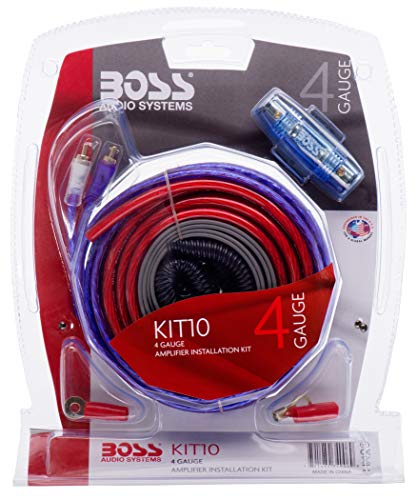
When your budget is the primary constraint and you need to get an amplifier wired up without spending significantly on the installation hardware, the BOSS KIT10 delivers a functional complete package at a price that leaves room for better speakers or a stronger amplifier. The kit includes a 20-foot 4-gauge red power cable, a 3-foot 4-gauge black ground cable, 16-foot 18-gauge blue remote turn-on wire, and 30 feet of 16-gauge speaker wire — which is a generous allotment of speaker wire that covers most routing scenarios without needing supplemental rolls. The gold-plated AGU in-line fuse holder is a hardware quality highlight in what is otherwise a value-tier kit, providing a degree of corrosion resistance at the fuse holder contact points that you don't always find at this price level.
The honest caveat with the KIT10 is that the wire labeling should be treated with appropriate skepticism — budget-tier 4-gauge wire frequently measures closer to 6 or even 8 AWG at the actual copper conductor, with the oversized PVC jacket creating a visual impression of larger conductor cross-section than is actually present. For moderate-power amplifiers in the 200–300 watt range with power wire runs under 15 feet, the KIT10 will function adequately. For amplifiers pushing 400 watts or above, or for builds where the power wire run exceeds 15 feet with multiple bends increasing effective resistance, step up to one of the Stinger or Rockford kits covered elsewhere in this guide.
As an entry point for a first-time installer adding a modest subwoofer amplifier to a factory-radio system, the KIT10 earns its place on this list. Combine it with a reliable vehicle battery and keep your expectations aligned with the price tier — this kit exists to provide a functional solution, not an audiophile-grade installation foundation. The gold-plated fuse holder is a small but genuine quality touch that helps at the price point.
Pros:
Cons:
Sky High Car Audio has cultivated a loyal following in the high-power car audio community by offering products that compete with established premium brands on specification while maintaining pricing that doesn't require a second mortgage. The 1/0-gauge CCA construction in this kit provides the current-carrying capacity your high-powered amplifier demands, and the complete package covers every component you need for a single high-powered amp installation — power wire, ground wire, RCA cables, speaker wire, remote wire, and an ANL fuse holder — so you're not sourcing individual components from different suppliers and hoping the connectors are compatible.
The RCA cables included in this kit represent a meaningful differentiator from kits that treat signal cable as an afterthought. Clean RCA interconnects are essential for maintaining a low noise floor through your signal chain — signal noise picked up at the head unit-to-amp RCA connection manifests as hiss or alternator whine through your speakers regardless of how clean your power wiring is. The green and black color scheme is visually distinctive and will resonate with builders who want their engine bay or trunk install to carry a cohesive aesthetic. For high-powered subwoofer builds in 2026 where budget matters but quality cannot be entirely sacrificed, the Sky High kit delivers the 1/0 gauge sizing your amplifier needs with a genuinely complete component package.
The copper-clad aluminum construction is the correct trade-off at this gauge and this price point — at 1/0 gauge, the resistance difference between CCA and OFC wire is meaningful in absolute terms but becomes less significant relative to the other resistance sources in your installation (connections, fuses, and the battery's internal resistance). For most enthusiast builds that aren't chasing competition-level specifications, the Sky High 1/0 CCA kit hits the sweet spot of cost-effectiveness and genuine capability.
Pros:
Cons:
The single most important specification you evaluate before purchasing an amp wiring kit is the wire gauge relative to your amplifier's power draw. The rule of thumb used by professional installers works like this: calculate your amplifier's total RMS power output divided by your vehicle's charging system voltage (approximately 13.8 volts while running), and the result is your current draw in amps. A 500-watt RMS amplifier at 75% efficiency draws roughly 48 amps continuously, which demands at minimum a 4-gauge power conductor for runs under 15 feet. Systems pushing 800 watts and above require 2/0 or 1/0 gauge wire to avoid the voltage drop that compresses bass dynamics and triggers thermal protection shutdowns during extended listening sessions. Matching the kit gauge to your actual power draw — not a speculative future upgrade — is the correct engineering approach for 2026 installations.
Oxygen-free copper (OFC) and copper-clad aluminum (CCA) represent the two conductor material choices you'll encounter across every kit at every price point. OFC is drawn from electrolytic tough-pitch copper and refined to eliminate dissolved oxygen that would otherwise reduce conductivity — the result is wire that carries more current per unit cross-section, runs cooler at equivalent loads, and resists oxidation at the stranded conductor level. CCA wire uses an aluminum core with a thin copper cladding, which reduces weight and material cost but introduces approximately 39% higher resistance per unit cross-section compared to pure copper. For builds where budget matters and the wiring run lengths are short, CCA at the correct gauge performs acceptably — the InstallGear and Sky High kits on this list demonstrate that principle. For high-performance or competition builds where every millivolt of voltage drop at the amplifier's power rail matters, OFC is the non-negotiable specification.
The connectors, ring terminals, fuse holders, and distribution blocks in a wiring kit are where budget products fail catastrophically over time. Cheap tin-plated or zinc alloy hardware oxidizes at the contact surfaces, and that oxidation layer creates resistance that generates heat — a feedback loop that accelerates corrosion and can eventually result in burned connectors or blown fuses from overcurrent conditions. Brass hardware, whether bare or gold-plated, provides substantially better long-term resistance to the electrochemical corrosion that develops in the heat and humidity cycles typical of a vehicle engine compartment. The fuse holder type matters equally: ANL fuse holders used in 1/0-gauge applications handle sustained high current more reliably than the AGU glass fuse format common in 4-gauge kits, and MAXI blade fuses offer better vibration resistance than AGU glass at the 4-gauge level.
A wiring kit that arrives missing critical components forces you to make a second purchase run before your amplifier goes live, and the cost of that inconvenience — both time and money — often closes the gap between a complete premium kit and the budget option you chose to save money. Verify before purchasing that your kit includes everything required for your specific installation configuration: power wire in sufficient length for your vehicle, ground wire long enough to reach a chassis ground point (short ground wires are the most common missing-component complaint in user reviews), remote turn-on wire, RCA interconnects if your kit targets single-amp installs, ring terminals appropriate for your wire gauge, and a fuse holder with fuse installed or included. Dual-amp kits should additionally include distribution blocks for both power and ground. Review the included lengths against your vehicle's actual routing path — a coupe with a compact trunk requires much shorter runs than a full-size SUV or pickup truck.
A 1,000-watt RMS amplifier requires 1/0-gauge (also written as 0 AWG) wiring for power and ground conductors, particularly for wire runs exceeding 10 feet. At 1,000 watts and typical vehicle charging voltage of 13.8 volts, your amplifier draws approximately 90 amps continuously at 80% efficiency — a current level that will cause dangerous heating in 4-gauge wire over sustained high-volume listening sessions. Use 1/0 OFC or large-diameter CCA wire to keep voltage drop below 0.5 volts across the full power run.
For high-powered amplifiers above 600 watts RMS or competition builds where maximum efficiency matters, OFC wire is worth the price premium. OFC carries approximately 64% more current per unit cross-section compared to CCA of the same diameter, runs cooler at equivalent loads, and resists internal oxidation over the life of the installation. For budget builds with modest power draws under 400 watts and short wire runs, quality CCA at the correct gauge performs adequately — the resistance difference becomes less significant at moderate current levels relative to the cost differential between the two materials.
A single standard kit designed for one amplifier will not safely power two amplifiers in parallel — the combined current draw of two amplifiers exceeds the fuse rating and current-carrying capacity of single-amp kit components. For dual-amplifier installations, you need either a dedicated dual-amp kit like the InstallGear Dual 1/0 that includes power distribution blocks, or you source a large-gauge primary run kit and add separate distribution hardware. The standard approach is a 1/0-gauge primary run fused at the battery, with distribution blocks that branch to 4-gauge secondary runs feeding each individual amplifier's own fuse holder.
The ideal ground point for your amplifier is a bare metal chassis location within 18 inches of the amplifier mounting position. Remove any paint, primer, or surface coating from the grounding point with sandpaper before crimping your ring terminal to the bolt, and use a self-tapping screw or existing factory ground bolt for the connection. A long ground wire run introduces resistance just as a long power wire run does — the ground circuit is half of your amplifier's DC power loop, and high-resistance grounding causes alternator noise, reduced power output, and thermal protection engagement under load. Never ground to carpet brackets, seat rails, or any painted surface.
The main fuse at the battery end of your power wire should be sized to protect the wire, not the amplifier — the amplifier has its own fuse. Select a fuse rating that equals approximately 80-90% of the wire's maximum current-carrying capacity for your gauge at the run length installed. For 4-gauge OFC wire at runs under 15 feet, a 100-amp main fuse is appropriate. For 1/0-gauge wire, a 250-amp ANL fuse is the standard specification. Fusing the wire close to the battery — within 18 inches — is required practice because that section of wire runs unprotected through the engine compartment where a short circuit would be most catastrophic.
If you have quality existing RCA cables with adequate shielding, you can absolutely reuse them with a new wiring kit — RCA cables aren't consumed or worn out by use under normal circumstances. However, if your existing RCAs are budget-tier cables with thin shielding, replacing them as part of a new installation is worthwhile because poor RCA shielding is the most common source of alternator whine and radio frequency interference in car audio systems. For new builds starting from scratch, select a kit that includes RCA cables so you have a matched installation solution, then evaluate whether an upgrade is warranted after the system is running.
 |
 |
 |
 |

About Joshua Thomas
Joshua Thomas holds a Bachelor of Science in Mechanical Engineering from San Diego State University and has spent years applying that technical foundation to hands-on automotive work — from routine maintenance to full mechanical repairs. He founded CarCareTotal in 2017 to give car owners the kind of clear, practical guidance that helps them understand what is happening under the hood and make smarter decisions about upkeep and repairs. At CarCareTotal, he oversees editorial direction and covers automotive fundamentals, maintenance guides, and troubleshooting resources for everyday drivers.
Get some FREE car parts & gear.. Or check out the latest free automotive manuals and build guides here.
Disable your ad blocker to unlock all the hidden deals. Hit the button below 🚗
| | | |
