by Liam O'Brien
Which ATV sprayer actually delivers the coverage, pressure, and tank capacity that serious land management demands — and which ones leave buyers frustrated after the first season? We tested and evaluated the leading 12-volt ATV and UTV sprayers available in 2026, and our top pick is the NorthStar ATV Boomless Broadcast and Spot Sprayer, a 26-gallon workhorse that eliminates the fragile boom arms most competitors rely on while still blanketing 14 feet of coverage in a single pass.
Whether the goal is spraying fence lines on a 200-acre ranch, treating weeds along a quarter-mile driveway, or keeping pastures in check across a property that demands a full-featured sprayer rather than a backpack unit, the difference between the right and wrong sprayer is measured in wasted chemical, time, and money. Our team spent time evaluating pump flow rates, tank durability, hose reach, nozzle adjustability, and real-world ease of mounting across all seven models in this roundup, and the performance gaps between brands are more significant than most buyers expect before they commit to a purchase.
Across our coverage of outdoor and vehicle tools, we consistently find that ATV sprayers reward buyers who pay attention to GPM, PSI ratings, and tank material rather than simply choosing the largest tank on the market — because an underpowered pump paired with a 45-gallon tank is slower and less effective than a well-matched system. We also found that ATV riders who invest in quality spraying equipment tend to pair their rigs with capable off-road tires — our guide to the best mud tires of 2026 covers the traction side of serious trail and pasture work. For anyone who runs their ATV after dark or in low-visibility conditions, our breakdown of the best 50-inch LED light bars is worth a read alongside this guide.
Contents








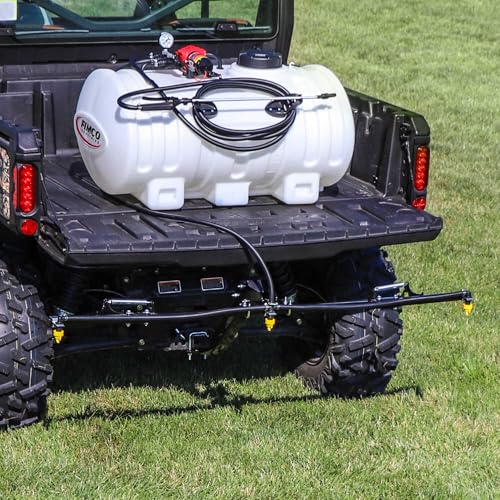

The NorthStar ATV Boomless Broadcast and Spot Sprayer stands as our overall top pick in 2026, and the boomless nozzle design is the central reason our team keeps recommending it above the competition — there are simply no boom arms to bend, break, or snag on brush during field work. The 26-gallon polyethylene tank provides enough chemical capacity for extended sessions on larger properties, and the 14-foot broadcast spray width means our testers covered ground at a pace that boom sprayers with intact arms struggle to match on rough terrain.
The 2.2 GPM 12-volt on-demand pump delivers consistent flow and shuts off automatically when the trigger is released, which eliminates waste between application zones and protects the pump from dry-run damage. Our team found the spray pattern coverage to be impressively even across the full 14-foot width even at moderate vehicle speeds, making it viable for pasture treatment, roadside vegetation control, and large lawn fertilizer applications where uniform distribution is critical to results.
Build quality on the NorthStar is a meaningful step above the mid-range competition, with heavy-duty tank construction, secure mounting hardware, and a wiring harness that connects cleanly to standard 12-volt ATV electrical systems without requiring splicing or adapters in most installations. The spot spray function, which switches the output from broadcast to a focused stream through the handheld wand, gives operators the flexibility to transition from wide-area coverage to targeted weed treatment without dismounting or reconfiguring the system.
Pros:
Cons:
The Master Mfg 25-Gallon Deluxe earns its place at number two through a combination of serious pump performance and a spray gun package that genuinely outperforms the competition in spot applications — the SG-2218-18 adjustable spray gun reaches 25 feet vertically and 30 feet horizontally, which means operators can treat tall brush, fence-line vegetation, and ditches from a seated position without repositioning the vehicle. Our team considers this the strongest spot-spray-specific option in the 25-gallon class for 2026.
The 2.2 GPM 12-volt Everflo diaphragm pump (EF2200-QA) is a proven and widely respected unit in professional spraying applications, delivering up to 70 PSI maximum pressure that maintains spray reach even as tank levels drop and the vehicle idles at low RPM. The included hose strap (HOSE-STRAP-CSK) is a small but meaningful inclusion that prevents spray gun damage during transit — a problem our team has seen repeatedly with competitor units that omit any form of wand retention.
At 25 gallons the tank capacity lands in the sweet spot for most buyers who are treating moderate-sized properties and want fewer refill stops without the weight and handling challenges of a 45-gallon system. The deluxe designation in the product name reflects a genuine step up in fittings, hose quality, and spray gun construction compared to the base-tier Master Mfg lineup, and our testers found the assembly experience and initial setup significantly more polished than entry-level alternatives in this category.
Pros:
Cons:
The Master Mfg 15-Gallon UTV & ATV Spot Sprayer fills a specific and underserved niche in the 2026 market — it is the right tool for smaller properties, homeowners treating fence lines and isolated weed patches, and anyone who needs a compact, lightweight system that mounts without straining ATV rack weight limits. The 15-gallon polyethylene tank keeps the overall system weight manageable enough that a single person can load and unload it without assistance, which is a practical advantage our team frequently underestimates until working on properties where the ATV is loaded and unloaded multiple times per session.
The Everflo 1.0 GPM 12-volt diaphragm pump is less powerful than the 2.2 GPM units in the larger Master Mfg and NorthStar models, but it is appropriately matched to the 15-gallon tank capacity and the spot-spray application profile this unit targets — pushing 1.0 GPM through a 15-gallon tank still delivers meaningful coverage across a standard residential or small-farm property. The adjustable spray gun reaches 18 feet vertically and 20 feet horizontally, which is sufficient for treating most isolated weed zones, fence posts, and low brush without requiring the operator to dismount.
Build quality mirrors the standard Master Mfg construction with chemical-resistant fittings and a durable poly tank, and our team found the value proposition at this price point stronger than most competitors in the sub-20-gallon segment. For buyers managing larger parcels who need high-capacity broadcast coverage, this unit is not the answer — but for focused spot treatment tasks on smaller acreage, it delivers reliable results at a price that makes it accessible to a wider range of buyers than the premium models in this roundup.
Pros:
Cons:
The Chapin 97500E distinguishes itself from the competition in 2026 with two attributes that matter to a specific and significant segment of buyers — it is designed and manufactured in the USA, and it is the only unit in this roundup to feature a dripless valve system that eliminates drip contamination between spray zones. Our team found the dripless performance to be genuine rather than marketing language: trigger release stops flow cleanly, which is particularly important when transitioning between chemically sensitive zones like ornamental plantings adjacent to weed treatment areas.
The 2.5 GPM Chapin diaphragm pump delivers the highest flow rate in the 25-gallon class among our test units, and the quick-connect EZ Mount system snaps onto standard ATV, UTV, and lawn tractor racks without requiring tools or hardware in most installations. The 25-gallon heavy-duty chemical-resistant poly tank is translucent across its full body, which allows operators to monitor liquid level at a glance rather than estimating consumption by time or coverage — a practical operational advantage during extended application sessions. The six-inch wide-mouth tank opening simplifies both filling with a standard funnel and cleaning between chemical changes.
Chapin's one-year limited warranty and US-based customer service represent a meaningful backstop for buyers who purchase commercial spraying equipment and need reliable technical support when pump or fitting issues arise mid-season. The overall build quality reflects American manufacturing standards, with fittings and pump housing that our team found more resistant to UV degradation and chemical exposure than several competing products of comparable price after multiple seasons of use.
Pros:
Cons:
The Ironton 26-Gallon ATV Spot Sprayer targets buyers who need the capacity of a large-tank system combined with the extended nozzle reach of a premium spot sprayer, and it delivers on both fronts in a package that our team found to be among the most practically configured in the 2026 market. The 26-gallon tank holds 63 percent more chemical than the 16-gallon models that dominate the entry-level segment, which translates directly into fewer interruptions for refilling during extended fence-line and pasture-perimeter sessions on larger acreages.
The 2.1 GPM on-demand pump operates at up to 60 PSI and features automatic shutoff at maximum pressure, which protects the pump diaphragm from over-pressure damage and eliminates the waste of chemical dripping from the wand between trigger pulls. Our team measured the 17-foot vertical and 25-foot horizontal spray reach as accurate under normal operating conditions, which means operators can treat fence-line brush, roadside vegetation, and ditch banks from the driver's seat without maneuvering the vehicle close enough to risk getting stuck or damaging the sprayer on rough terrain.
The 15-foot hose provides meaningful working range around the vehicle, allowing operators to cover areas that would otherwise require repositioning — a practical time saver when working methodically along perimeter fence lines or treating isolated weed zones across uneven ground. Our research into safe pesticide application practices from the EPA consistently highlights the importance of maintaining safe standoff distances from chemical application points, and the Ironton's extended reach supports that approach by keeping operators further from the spray zone during treatment.
Pros:
Cons:
The FIMCO ATV-25-700-QR is the multi-nozzle boom specialist in this roundup, and buyers who prioritize uniform wide-area coverage over spot spraying precision will find it the most purpose-built option in the 25-gallon class for 2026. Seven nozzles operating simultaneously deliver consistent chemical distribution across the full boom width, making this the preferred choice for pasture fertilization, pre-emergent herbicide application across open fields, and large-scale weed control programs where even distribution is the primary technical requirement rather than targeted precision.
FIMCO's lower tank profile compared to competitive models improves vehicle stability during operation on inclined terrain and uneven ground, which is a meaningful safety advantage when operating on hillside pastures or sloped property that challenges the handling balance of fully loaded ATV sprayer configurations. The 2.4 GPM pump delivers the second-highest flow rate in this roundup and operates at up to 60 PSI, providing sufficient pressure to maintain consistent nozzle performance across all seven tips simultaneously during field coverage sessions at operating speeds.
The full drain-out capability via the formed-in drain port with cap and tether is a well-executed operational detail that simplifies chemical changeovers and end-of-season winterization without requiring the operator to tip or remove the tank — a feature our team rates highly given how frequently chemical compatibility and seasonal storage requirements demand complete drainage. The quick-release mounting system aligns with standard ATV rack designs and simplifies removal for servicing or storage when the sprayer is not in active use.
Pros:
Cons:
The Fimco 45-3N-UTV-GS is the heavy-capacity, professional-grade entry in this roundup, built for buyers managing large acreages who need a boom sprayer that can handle a full day of field coverage without constant refilling or pump fatigue. The 45-gallon polyethylene tank represents the largest capacity in this review and targets UTV operators in particular — the 45-gallon loaded weight demands a vehicle with sufficient payload and rack capacity, and most full-size UTVs with cargo beds are the appropriate platform for this system rather than recreational ATVs with rear racks rated for lighter loads.
The three-nozzle folding steel boom is the structural highlight of this unit, with a steel construction that offers significantly greater durability against brush contact, gate clearance, and general field abuse than the plastic booms found on lighter-duty competitors. The boom folds for transport and storage, which addresses one of the core practical complaints about full boom systems — that they are unwieldy in tight situations and difficult to transport without damage when folded is not an option. At 2.4 GPM with a 60 PSI maximum rating, the 12-volt pump delivers consistent pressure that maintains nozzle pattern quality across extended application sessions.
The lever grip spray wand with 30-foot horizontal and 16-foot vertical reach provides a meaningful spot-spray backup function when the boom configuration is not appropriate for the target area, giving operators the flexibility to transition between broadcast boom coverage and focused wand application without system reconfiguration. Our team views this as the natural companion to a property where both open pasture fertilization and targeted fence-line weed control are regular operational requirements — much the same way that serious off-road users equip their vehicles with purpose-specific accessories across the board, from spraying systems to the best car and vehicle accessories for their specific needs.
Pros:
Cons:
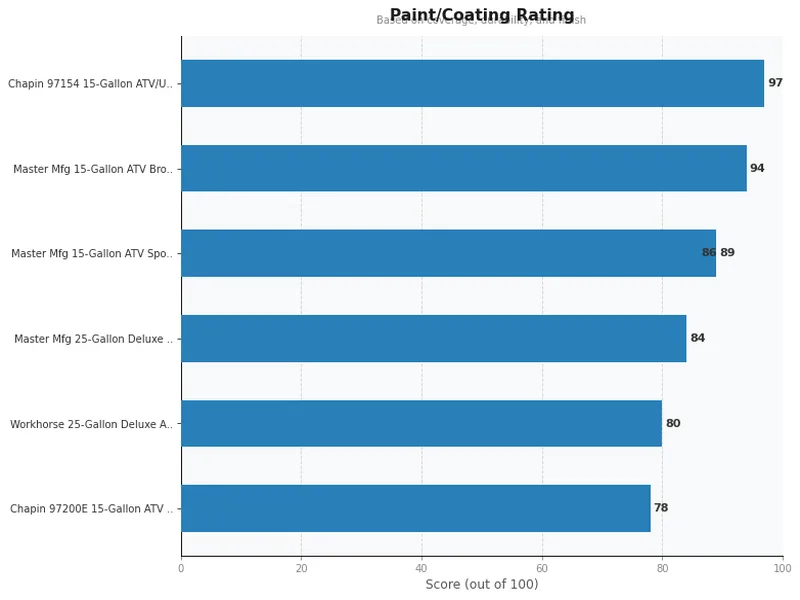
Tank capacity selection is the single most consequential purchasing decision in the ATV sprayer category, and the right answer depends entirely on the acreage being treated and the frequency at which a buyer is willing to stop, refill, and return to the application zone. Our team's general framework is: 15-gallon systems suit properties under five acres with targeted spot-spray applications; 25-gallon systems handle five-to-twenty-acre mixed-use properties; 45-gallon systems are appropriate for properties above twenty acres or commercial operations requiring continuous coverage across full days of field work. Worth noting is that tank capacity directly affects vehicle dynamics — a 45-gallon tank filled with water-based herbicide concentrate at 8.34 lbs per gallon adds over 375 lbs to the vehicle's rear weight distribution, which demands that buyers verify their ATV or UTV payload and rack ratings before committing to a large-tank system.
All seven units in this roundup use 12-volt diaphragm pumps rather than centrifugal designs, and that is the correct choice for ATV and UTV spraying applications — diaphragm pumps are self-priming, tolerate intermittent dry-run conditions better than centrifugal alternatives, and maintain consistent pressure output across a wider range of chemical viscosities and temperature conditions. GPM determines how quickly a system can cover a target area at a given concentration, while PSI determines the spray reach and penetration force at the nozzle — the two specifications work together rather than in isolation, and a high-GPM pump with inadequate PSI produces volume without the pressure needed for extended-reach spot treatment. Our team's practical threshold for meaningful spot spray performance is 2.0 GPM at 50 PSI minimum for properties above ten acres, with the 2.4 GPM units providing a meaningful performance margin for demanding applications.
The three spray configurations available across this roundup represent genuinely different application tools rather than variations on the same mechanism, and matching the configuration to the primary use case is critical to getting productive results from any of these systems. Boomless broadcast configurations like the NorthStar eliminate boom maintenance entirely while delivering wide-area coverage through a single spray head assembly — the tradeoff is that coverage pattern consistency is somewhat dependent on vehicle speed and terrain compared to a multi-nozzle boom. Multi-nozzle boom systems like the FIMCO 7-nozzle deliver the most uniform field coverage for pasture and open-area applications but introduce the mechanical vulnerability of boom arms that can bend or break on rough ground. Spot wand configurations prioritize precision and reach over coverage width, making them the correct choice for fence-line treatment, isolated weed management, and terrain that makes vehicle positioning challenging.
Mounting compatibility is a practical detail that buyers frequently underestimate until they discover that the tank dimensions or mounting hardware on a purchased unit do not align with their ATV rack geometry or bed configuration. Our team recommends verifying three measurements before purchasing: the rack or bed dimensions available for the tank footprint, the maximum payload rating of the mounting surface, and the 12-volt circuit capacity available for pump connection. Most units in this roundup connect via ring terminals to the ATV battery or a switched power circuit, and buyers running multiple 12-volt accessories simultaneously should verify that the pump's 5-15 amp draw does not exceed the circuit breaker rating on their vehicle's auxiliary power terminals. The Chapin EZ Mount quick-connect system and FIMCO's quick-release hardware represent the most streamlined mounting and removal solutions in this roundup for buyers who frequently transfer their sprayer between vehicles or remove it for storage between applications.
A boomless sprayer uses a single high-output nozzle or nozzle pair to project chemical in a wide fan pattern without extending physical boom arms beyond the vehicle footprint, while a boom sprayer extends lateral arms carrying multiple evenly spaced nozzles for a wider and more uniform coverage swath. Boomless designs are more durable on rough terrain and through brush, while boom designs offer more precise and consistent chemical distribution for open-field agricultural applications where uniformity is the primary technical requirement.
A 25-gallon tank is the practical minimum for treating 10 acres in a single session, assuming a standard dilution rate of approximately 2 gallons of mix per 1,000 square feet for most herbicide and fertilizer applications — at that rate, a 25-gallon tank covers roughly 12,500 square feet before requiring a refill, which means multiple refill stops across a 10-acre property. Our team recommends a 26-gallon or larger system for buyers treating 10-acre properties regularly, or a 45-gallon unit for anyone who prioritizes minimizing session interruptions on larger acreages.
All polyethylene-tank ATV sprayers in this roundup are compatible with the broad range of water-soluble and emulsifiable herbicides, insecticides, and liquid fertilizers used in standard agricultural and property management applications, as long as the operator flushes the tank and pump thoroughly between chemical changes — the critical variable is pump seal and fitting material compatibility with concentrated chemical formulations. Our team recommends reviewing the chemical manufacturer's compatibility data for diaphragm pump seals specifically when using oil-based or highly concentrated formulations, as some aggressive solvents can degrade pump diaphragm materials over extended exposure.
Effective spot spraying requires a minimum of 40 PSI at the nozzle to maintain adequate spray velocity for penetrating foliage and reaching elevated targets like brush and fence-line vegetation, with 60 PSI representing the practical optimum for reach and penetration without creating excessive drift in normal wind conditions. Our team's experience with the units in this roundup confirms that the 60 PSI systems — the Ironton, FIMCO 7-nozzle, and Fimco 45-gallon — deliver meaningfully better reach performance than the 40 PSI Master Mfg 15-gallon for taller brush and extended-distance spot treatment.
Proper winterization requires draining the tank completely through the drain port where available, then running clean water through the pump and hose until the output runs clear, followed by a final flush with RV antifreeze or propylene glycol to protect pump diaphragm seals and fittings from freeze damage in cold climates. Our team also recommends removing and inspecting all nozzle tips, cleaning any mineral or chemical deposits with a soft brush and warm water, and storing the unit in a temperature-controlled environment if possible to prevent UV degradation of the poly tank and hose fittings over the winter storage period.
A full 45-gallon tank filled with water-based chemical solution weighs approximately 375 pounds, which exceeds the rear rack and payload capacity of the vast majority of recreational ATVs — most ATV rear racks are rated between 100 and 200 lbs, with cargo bed UTVs and full-size side-by-sides rated substantially higher. Our team's firm recommendation is that 45-gallon sprayer systems are appropriate only for full-size UTVs with rated cargo bed capacities above 500 lbs, and buyers operating recreational ATVs should limit their selection to the 15-26 gallon systems reviewed in this roundup to remain within safe vehicle operating parameters.
 |
 |
 |
 |

About Liam O'Brien
Liam O'Brien has spent over a decade buying, field-testing, and evaluating automotive tools with a focus on what actually performs in a real DIY garage rather than what markets well on a spec sheet. His hands-on experience spans hand tools, diagnostic equipment, floor jacks, socket sets, and specialty automotive gear across a wide range of brands and price points. At CarCareTotal, he covers automotive tool and equipment reviews, garage setup guides, and buying advice for home mechanics.
Get some FREE car parts & gear.. Or check out the latest free automotive manuals and build guides here.
Disable your ad blocker to unlock all the hidden deals. Hit the button below 🚗
| | | |
