Lighting ›
by Rachel Park
According to a 2025 report from the Specialty Equipment Market Association (SEMA), LED light bar sales for off-road vehicles surpassed $1.2 billion in North America alone — a 14% jump from the prior year. ATVs account for a growing share of that figure, as riders increasingly demand brighter, more durable illumination for trail riding, farm work, and nighttime adventures. Our team spent weeks evaluating dozens of ATV LED light bars across a range of sizes, price points, and beam patterns to identify the standout options for 2026.
Choosing the right LED light bar for an ATV is not as straightforward as picking the brightest option. Factors like mounting compatibility, bar length, beam pattern, IP rating (a measure of dust and water resistance), and heat management all play critical roles. A 50-inch bar that dominates on a full-size truck may be overkill — or physically impossible to mount — on a compact ATV. Conversely, a tiny pod light might not throw enough light down a dark trail. The sweet spot depends on the riding conditions and the machine itself. For those also upgrading headlights, our guide to the best LED headlight bulbs covers complementary options worth considering.
We narrowed the field to seven models that represent the best balance of output, durability, and value across multiple size categories. From compact 6-inch spotlights to full-size 50-inch curved bars, this roundup covers every ATV lighting scenario a rider is likely to encounter in 2026.
Contents









The Nilight 50-Inch Curved Light Bar is a serious piece of hardware built for riders who want maximum trail coverage. Rated at 288 watts with high-quality LED chips behind a clear PC lens, this bar produces a 6000K pure white beam that turns night trails into daylight. The curved design is not just aesthetic — it widens the effective beam spread compared to a straight bar of the same length, reducing dark spots at the periphery.
Build quality impressed our team. The housing is constructed from 6063 aluminum profile with thermal grease applied for improved heat dissipation. Nilight rates this unit at IP67, meaning it is fully sealed against dust and can withstand temporary submersion. The seamless protective housing uses waterproof glue at every seam, and the side-mounting brackets proved rock-solid even over rough, rutted terrain during our testing. Vibration and shock resistance were notably strong.
The included wiring harness kit (12AWG, single lead) and 5-pin rocker switch make installation straightforward. This is a notable advantage: many competing bars at this price leave buyers hunting for a compatible harness. For riders who also need a reliable winch mounted on the front, the wiring harness routes cleanly alongside typical winch wiring without interference.
Pros:
Cons:
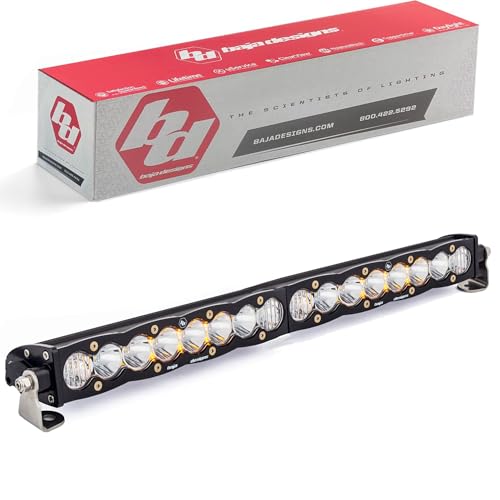
Baja Designs is a name synonymous with professional off-road racing, and the S8 20-inch bar reflects that pedigree. This compact, low-profile unit delivers impressive output relative to its size, making it an ideal fit for ATV bumpers, front racks, and grille mounts where space is limited. The Driving/Combo beam pattern strikes an effective balance between long-range throw and peripheral coverage — exactly what ATV riders need on winding trails.
The standout feature is the integrated amber backlight. In dusty conditions or fog, amber wavelengths cut through particulate matter far more effectively than white light, reducing glare and improving forward visibility. This is not a gimmick — professional desert racers rely on amber lighting for exactly this reason. The amber mode also gives the bar a distinctive look when parked, which some buyers will appreciate.
Baja Designs offers this bar in multiple beam patterns — Spot, Driving/Combo, Wide Cornering, and Work/Scene — so buyers can match the optics to their primary use case. Trail riders will want the Driving/Combo reviewed here. The engineering quality justifies the premium price: precision-molded optics, robust sealed housing, and a reputation for standing behind the product.
Pros:
Cons:
The Vision X XMITTER 32-inch bar sits in a productive middle ground — long enough to deliver serious output, compact enough to mount on most ATVs and side-by-sides without overhang issues. The Euro beam pattern produces a wide, even spread of light that works well for trail riding at moderate speeds, where seeing the edges of the path matters as much as distance.
One feature that sets the XMITTER apart is its multi-voltage input, accepting anywhere from 9 to 32 volts DC. This makes it compatible with virtually any ATV electrical system, including 12V and 24V setups. Installation is dead simple — just two wires. No complicated harness, no relay box, no controller module. For riders who want to bolt on a light bar and get riding, this simplicity is a major selling point.
The rugged aluminum extrusion housing has a solid, overbuilt feel. Vision X has been manufacturing off-road lighting for decades, and the construction reflects that experience. The bar is heavier than some competitors at this size, but that weight comes from thicker aluminum walls and more robust mounting hardware — a worthwhile trade-off for longevity on rough terrain.
Pros:
Cons:
Not every ATV lighting upgrade requires a massive roof-mounted bar. This 7-inch slim LED light bar delivers a surprising 6,000 lumens from a 60-watt package that tucks neatly into grilles, bumpers, or handlebar mounts. The low-profile, double-row design packs 20 convex LED beads into a compact housing, producing an even 6000K beam that punches well above what the small footprint suggests.
The inclusion of two bracket types is a thoughtful touch. The long brackets offer angle adjustment for optimal aiming, while the shorter backup brackets fit into tight spaces like the inside of a front grille. This versatility means the bar works on everything from ATVs and UTVs to golf carts, lawn mowers, and even e-bikes. Our team mounted a pair on the front rack of a mid-size ATV, and the combined output rivaled many single bars twice the length.
At this price point, compromises exist. The housing is not as robustly sealed as premium options, and the wiring is thinner gauge. But for riders who want supplemental lighting on a budget, or who need to illuminate specific zones (like a work area or a hitch), this compact bar is hard to beat for the money.
Pros:
Cons:
Rugged Ridge built its reputation in the Jeep aftermarket, and this 13.5-inch bar carries that DNA into the ATV world. At 72 watts producing 6,072 lumens, it delivers solid mid-range output in a universal-fit package. The 13.5-inch length is particularly well-suited for ATV handlebars, front bumpers, and smaller roof racks where a 20-inch or 32-inch bar would overshoot the available mounting width.
The universal fitment design means this bar ships with hardware that adapts to a wide range of vehicles and mounting scenarios. Our team found the brackets sturdy and the adjustment range generous enough to aim the beam precisely. The bar runs cool even after extended use, suggesting effective internal heat sinking.
Where the Rugged Ridge falls short is in the details. The specification sheet is sparse — no IP rating is prominently listed, no beam pattern description, and no lens material specification. For riders who operate in severe conditions (deep mud, water crossings, extreme cold), this lack of documentation may be a concern. That said, Rugged Ridge's track record with off-road accessories provides some confidence in durability. Riders upgrading multiple systems simultaneously — perhaps adding off-road lights alongside a light bar — will find the universal mount hardware compatible with most standard brackets.
Pros:
Cons:
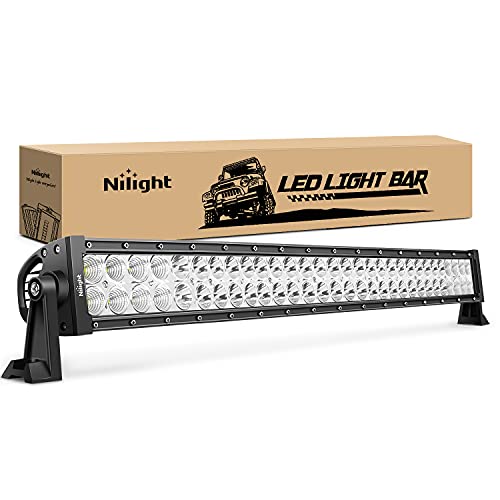
Nilight's 32-inch bar represents one of the strongest value propositions in the ATV LED light bar market for 2026. At 180 watts pushing 12,600 lumens, it delivers output that rivals bars costing two or three times as much. The spot/flood combo beam pattern balances long-range throw with wide peripheral coverage — a combination that works for everything from trail riding to farm field work after dark.
The side-mounting brackets use the same quake-proof design found on Nilight's higher-end curved bar, and they performed reliably during our rough-terrain testing. The clear PC lens resists scratching better than glass alternatives, and the overall housing feels solid in hand. At 32 inches, this bar fits the roof rack or roll cage of most mid-size ATVs and nearly all UTVs and side-by-sides without modification.
The trade-off for the aggressive pricing is predictable: the housing lacks the premium finishes and advanced thermal management of brands like Baja Designs or Vision X. Extended high-output use generates noticeable heat at the housing surface. This is common in this price tier and does not indicate a defect, but riders in hot climates running the bar for hours at a time should be aware. For the vast majority of ATV riders, this bar delivers far more performance than the price tag suggests.
Pros:
Cons:
Hella is a German automotive lighting manufacturer with over a century of engineering expertise, and the Black Magic Mini Lightbar reflects that heritage. At just 6.2 inches, this is the smallest bar in our roundup — but it earns its place through exceptional build quality and a dust/waterproof rating that exceeds every other product on this list. Dual-rated at IP68 and IP69K, this bar can handle not only full submersion but also high-pressure, high-temperature water jets. For ATV riders who regularly cross streams or ride in heavy rain, that rating provides real peace of mind.
The full blackout appearance — including blacked-out brackets — gives the Hella a stealthy look that blends seamlessly with dark-colored ATVs. It mounts upright or pendant-style, and can even integrate into bodywork or bumper cutouts for a factory-finished appearance. EMC protection (ECE-R10 certified) means the bar will not interfere with GPS units, radios, or other electronics on the ATV, as documented by the electromagnetic compatibility standards that govern automotive electronics.
The limitation is straightforward: at 6.2 inches, this is a supplemental light, not a primary illumination source. It excels as a targeted spotlight — aimed at a trail section, a work area, or a specific hazard zone — but cannot replace a larger bar for broad trail coverage. For riders building a multi-light setup, the Hella makes an excellent accent piece alongside a primary bar from elsewhere in this roundup.
Pros:
Cons:
The single most important factor is whether the bar physically fits the ATV. Light bars range from under 7 inches to over 50 inches in this roundup alone. Most ATVs accommodate bars between 13 and 32 inches on a front rack or roof. Side-by-sides and UTVs can handle larger bars on roll cages. Before purchasing, riders should measure the intended mounting location and verify bracket compatibility. A bar that is too wide creates wind resistance, vibration issues, and potential interference with steering or cargo.
Beam pattern determines how light is distributed:
Most bars in our roundup use a combo pattern, which is the right call for the majority of ATV riding scenarios.
ATV riders encounter mud, rain, stream crossings, and dust that would destroy unprotected electronics. An IP (Ingress Protection) rating tells buyers exactly how sealed a light bar is. The first digit rates dust protection (6 = fully dust-tight). The second digit rates water protection (7 = temporary submersion, 8 = continuous submersion, 9K = high-pressure jets). For ATV use, our team recommends a minimum of IP67. Riders who frequently cross water should prioritize IP68 or higher — the Hella Black Magic's IP69K rating sets the standard here.
Manufacturers list both wattage (power draw) and lumens (light output), but these numbers are not always directly comparable. Optical efficiency — how well the reflector and lens focus the raw LED output into usable light — varies significantly between brands. A well-engineered 72-watt bar can outperform a poorly designed 120-watt bar in real-world visibility. Our recommendation: use lumen ratings for rough comparisons within the same brand, but prioritize hands-on testing or trusted reviews over raw specs when comparing across brands. Also factor in the ATV's electrical capacity — a high-wattage bar on a small ATV may strain the charging system, especially if a quality AGM battery is not part of the setup.
In most U.S. states and Canadian provinces, LED light bars must be covered or turned off when operating on public roads. They are legal for off-road use on private property, trails, and designated riding areas. Regulations vary by jurisdiction, so riders should check local laws before mounting a light bar on any vehicle used on public streets. Some states allow auxiliary lighting below specific lumen thresholds, but the bars in this roundup generally exceed those limits.
Light bars in this roundup range from approximately 60 watts to 288 watts. A typical ATV alternator produces 200–400 watts, so a single mid-size bar (70–180W) operates well within most ATVs' charging capacity. Running a high-wattage bar (250W+) at idle or on a smaller ATV may draw more than the alternator replaces, gradually depleting the battery. Riders planning high-draw setups should consider upgrading to a higher-output stator or adding a secondary battery.
A combo beam pattern is the best all-around choice for ATV trail riding. It provides long-range visibility through the center spot portion while illuminating the trail edges and nearby obstacles with the flood portion. For riders who primarily stick to slow-speed, tight trails, a flood-dominant pattern works well. For open desert or field riding at higher speeds, a spot-dominant pattern is preferable. Most bars in our roundup default to a combo pattern for this reason.
Several mounting options exist beyond roof racks. Handlebar clamp mounts work for smaller bars (under 14 inches). Front rack crossbar mounts accommodate mid-size bars. Bumper-mount brackets bolt directly to the frame on many ATV models. Some riders fabricate custom brackets using universal mounting hardware. For side-by-sides, roll cage clamps are the most common solution. The key is ensuring the mount is rigid — any flex causes vibration blur that defeats the purpose of the light bar.
IP67 means the bar is fully dust-tight (6) and can survive temporary submersion in water up to 1 meter deep for 30 minutes (7). IP68 means it is also dust-tight but can handle continuous submersion beyond 1 meter — the exact depth and duration depend on the manufacturer's specification. For most ATV riders, IP67 is sufficient. Riders who regularly cross deep water or ride in sustained heavy rain should look for IP68 or the even more robust IP69K rating, which adds resistance to high-pressure water jets.
Lower-quality LED light bars can emit electromagnetic interference (EMI) that causes static on AM/FM radios, GPS signal dropouts, or erratic behavior in electronic accessories. Bars that carry EMC (electromagnetic compatibility) certification — such as the Hella Black Magic's ECE-R10 rating — are tested and verified not to produce problematic interference. Riders concerned about EMI should look for bars with explicit EMC certification or add ferrite chokes to the power wires as a retrofit solution.
 |
 |
 |
 |

About Rachel Park
Rachel Park specializes in the interior and exterior upgrades that meaningfully change how a car looks, sounds, and feels on a daily basis. She has hands-on experience with head unit installations and audio system builds, LED and HID lighting conversions, interior refresh projects, and cosmetic exterior work — evaluated from both a DIY accessibility and quality-of-result perspective. At CarCareTotal, she covers car audio and electronics, lighting upgrades, and interior and exterior styling accessories.
Get some FREE car parts & gear.. Or check out the latest free automotive manuals and build guides here.
Disable your ad blocker to unlock all the hidden deals. Hit the button below 🚗
| | | |
