Interior ›
by Rachel Park
Research from the U.S. Environmental Protection Agency shows that indoor air — including the air inside your car cabin — can be two to five times more polluted than outdoor air, which makes freshness harder to maintain than most people assume. If you're looking for the best long lasting car air freshener, you've probably already discovered that most hanging trees and basic sprays fade within days, not weeks. Your car's interior surfaces — fabric seats, carpet fibers, headliners — absorb and re-release odors continuously, which means masking smells at the surface level rarely solves the underlying problem.
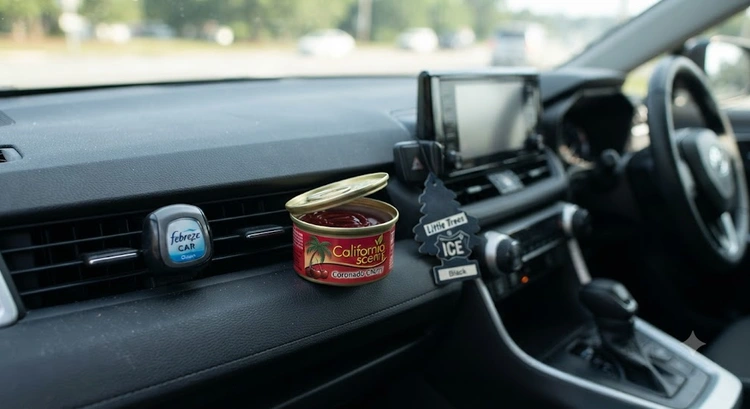
This guide compares the three dominant formats — sprays, vent clips, and gel containers — across lifespan, cost, scent intensity, and practical application. You'll find a format-by-format breakdown, a realistic price comparison table, installation steps, and troubleshooting advice for when your freshener fades faster than the label promises. The goal is to help you make a single purchase decision that actually holds up across weeks of daily driving.
Whether you commute thirty minutes each way, haul gear regularly, or drive with pets, the format you choose matters as much as the scent you pick. Understanding what makes one type outlast another gives you a clear advantage before you spend anything.
Contents
Your car cabin is a sealed, thermally unstable environment — temperatures regularly exceed 130°F (54°C) on a hot day, which forces odor molecules out of fabric, plastic, and vinyl surfaces continuously. Standard air fresheners work by releasing fragrance molecules that override your nose's perception of bad odors, but those fragrance molecules evaporate faster under heat than the odor-causing molecules do. The result is that most fresheners smell strongest on day one and become nearly undetectable by day ten.
If you're dealing with a persistent smell that fresheners can't seem to address, read our guide on how to get rid of bad car odors for good — because masking and eliminating are two entirely different processes, and only one of them actually works long-term.
Each of these sources regenerates odor continuously, which is why a single-use spray rarely solves the problem. The format you choose needs to outlast the source — or you need to remove the source first.
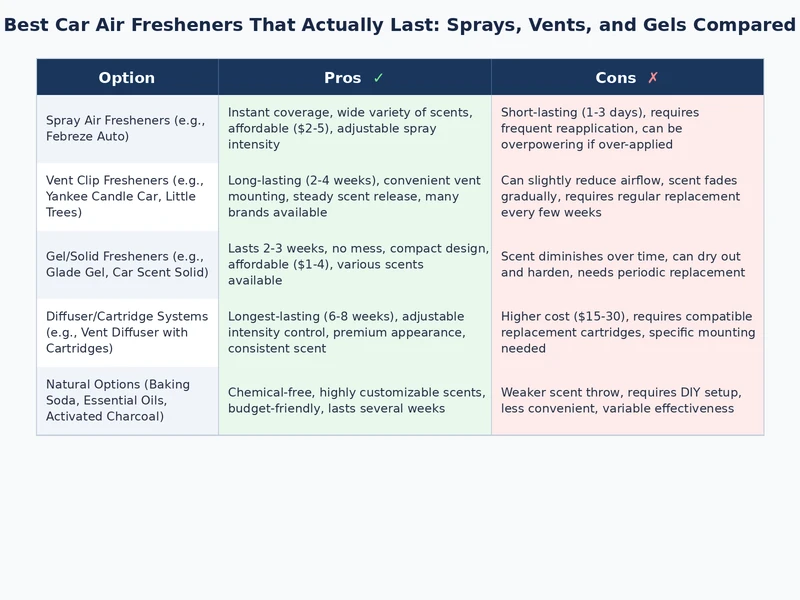
Aerosol and pump sprays deliver an immediate burst of fragrance that disperses throughout the cabin within seconds. They are the fastest format for acute odor situations — arriving at a destination with a client, picking up a date, or clearing out a food smell after lunch. However, sprays are not a long-term solution: most formulas are fully undetectable within three to seven days, and many drivers find themselves re-applying daily.
Vent clips attach directly to your dashboard air vents and use airflow to distribute fragrance throughout the cabin whenever the fan is running. They tend to offer a moderate, consistent scent rather than a strong initial burst. Because evaporation depends partly on air movement rather than heat alone, vent clips often outlast sprays significantly — most manufacturers claim 30 to 60 days under normal use.
Gel-based fresheners use a solid or semi-solid fragrance medium that releases scent through slow evaporation without requiring airflow. Because the evaporation rate is lower and more consistent, gel containers routinely last 45 to 90 days — making them the most cost-effective option on a per-day basis. Many gel formats include an adjustable dial or lid that lets you control the intensity and extend the total lifespan further.
| Format | Average Lifespan | Scent Intensity | Price Range | Best For |
|---|---|---|---|---|
| Spray | 3–7 days per use | High (initial burst) | $4–$12 per bottle | Quick odor events |
| Vent Clip | 30–60 days | Moderate, steady | $5–$15 per clip | Daily commuters |
| Gel Container | 45–90 days | Mild to moderate | $6–$18 per unit | Long-term, low-maintenance |
| Hanging Card/Tree | 7–14 days | High (initial), fades fast | $1–$5 per unit | Short trips, budget use |
Choosing the right format before you shop saves money and avoids the frustration of a product that doesn't fit your situation. Work through these steps in order:
At the shelf level, all three formats appear similarly priced, but the actual cost per day of freshness varies significantly once you calculate replacement frequency.
When you break down the numbers by cost per day, the picture shifts considerably from what the shelf price suggests:
The gel container format delivers the best long lasting car air freshener value on a per-day basis by a wide margin, even though its upfront price is similar to other formats. If you're buying sprays weekly, switching to gels or clips can cut your annual freshener cost by 80 percent or more.
Pro tip: Storing a gel freshener with its dial turned to the lowest setting when the car sits unused for several days — like over a weekend — can add two to three weeks to its total lifespan without any noticeable drop in effectiveness during driving hours.
If your freshener is underperforming relative to its stated lifespan, one of several factors is likely at work:
Before replacing your freshener or switching brands, work through these fixes in order:
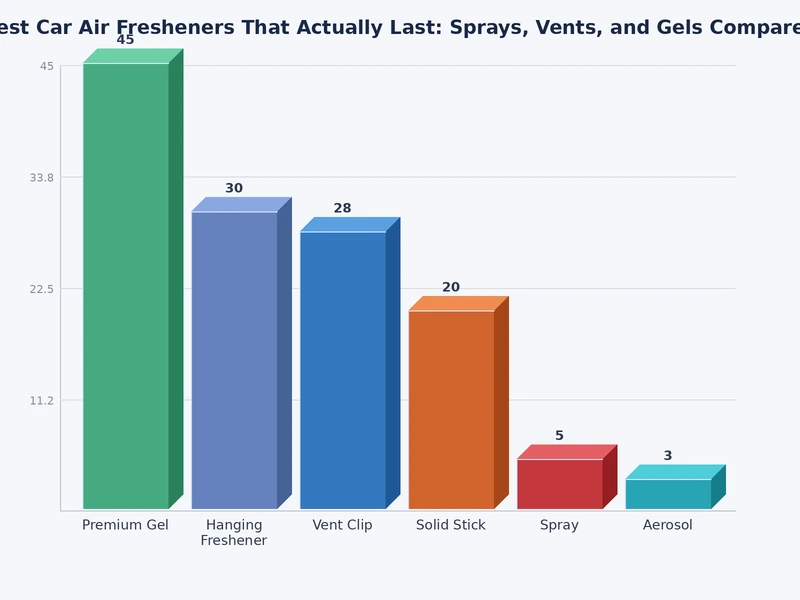
Gel containers consistently offer the longest lifespan among mainstream formats, typically lasting 45 to 90 days depending on heat exposure and how open the adjustment dial is set. Vent clips are a close second at 30 to 60 days. Sprays and hanging cards are the shortest-lived formats, rarely lasting more than one week of daily driving before the scent becomes undetectable.
The most common reason is olfactory fatigue — your nose adapts to a constant background scent and stops registering it as strongly, even though the freshener is still releasing fragrance. High cabin temperatures accelerate evaporation and can also shorten lifespan significantly. If the underlying odor source (spill, pet dander, mildew) is still present, the freshener has to compete harder and may seem to disappear faster than it otherwise would.
Most consumer-grade car air fresheners are formulated at concentrations considered safe for enclosed vehicle use, but prolonged exposure to very strong scents in a sealed cabin can cause headaches or nausea for some people, particularly children and those with respiratory sensitivities. Using an adjustable gel or clip at a lower intensity setting reduces this risk while still providing effective freshness. When applying a spray, briefly open the windows to let the initial burst disperse before closing the cabin.
You can, but layering multiple formats works best when you keep the scent families compatible — such as pairing two citrus-based products rather than mixing citrus with a heavy floral or woodsy scent. Placing one unit at the front of the cabin and one at the rear distributes coverage more evenly without concentrating fragrance in one area. For most standard-size vehicles, one gel container or vent clip is sufficient; larger vehicles like SUVs and full-size trucks often benefit from two units for consistent whole-cabin coverage.
Finding the best long lasting car air freshener comes down to matching the format to your actual driving conditions — your climate, your cabin size, your odor sources, and how much time you want to spend on maintenance. Start by addressing any underlying smell at the source, then choose a gel container or vent clip for day-to-day coverage and keep a spray on hand for acute situations. Browse the full range of interior car care options to find the combination that works for your specific vehicle and routine.
 |
 |
 |
 |

About Rachel Park
Rachel Park specializes in the interior and exterior upgrades that meaningfully change how a car looks, sounds, and feels on a daily basis. She has hands-on experience with head unit installations and audio system builds, LED and HID lighting conversions, interior refresh projects, and cosmetic exterior work — evaluated from both a DIY accessibility and quality-of-result perspective. At CarCareTotal, she covers car audio and electronics, lighting upgrades, and interior and exterior styling accessories.
Get some FREE car parts & gear.. Or check out the latest free automotive manuals and build guides here.
Disable your ad blocker to unlock all the hidden deals. Hit the button below 🚗
| | | |
