by Liam O'Brien
The B&W Companion OEM 25K stands out as the top fifth wheel hitch for 2026, combining a fully articulating head with effortless puck-system installation that most competing units still struggle to match. Towing a fifth wheel trailer demands a hitch that can handle enormous pin weights, articulate smoothly through uneven terrain, and install without turning a truck bed into a permanent construction project.

Fifth wheel hitches have evolved significantly over the past few years, with OEM puck systems becoming standard on most heavy-duty pickups from GM, Ford, and Ram. The shift toward factory-integrated mounting points has driven manufacturers like B&W, CURT, and PullRite to develop hitch platforms that leverage these pucks for tool-free installation and removal. Whether the priority is raw towing capacity for a heavy toy hauler, automatic sliding functionality for short-bed trucks, or a budget-friendly fixed hitch for occasional weekend trips, the 2026 market offers strong options at every price tier. Those also preparing their tow rig should consider pairing a quality hitch with a reliable trailer brake controller for safe stopping power on mountain grades and highway merges.
This roundup covers seven fifth wheel hitches tested and evaluated across weight capacity, articulation range, installation complexity, slide functionality, and long-term durability, drawing on real-world towing feedback and specification analysis to help buyers match the right hitch to their trailer and truck combination.
Contents
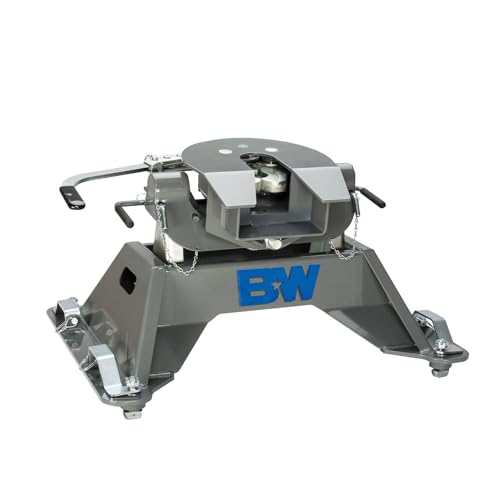






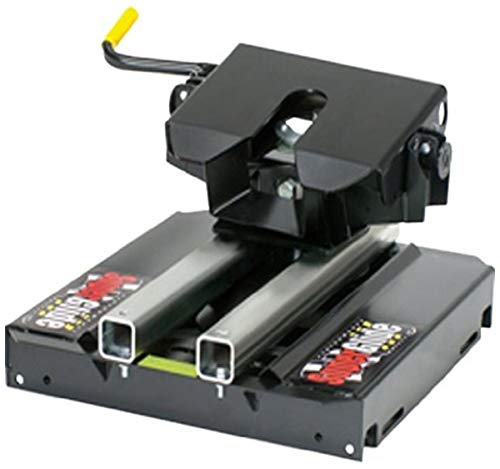


The B&W Companion OEM 25K is purpose-built for 2020–2026 Chevrolet and GMC trucks equipped with the factory puck system, which means installation involves dropping the hitch into the bed-mounted receivers without drilling a single hole. The fully articulating head pivots both front-to-back and side-to-side, allowing the kingpin to move freely during turns and over uneven road surfaces, which reduces stress on both the trailer frame and the truck bed.
Build quality on the RVK3715 is immediately apparent from the heavy-gauge steel construction and the powder-coat finish that resists corrosion from road salt and moisture exposure over multiple towing seasons. The cam-action latching handle deserves particular attention because it allows single-handed release even when the trailer is parked on a slope or uneven campsite, a scenario where many competing hitches bind and require pry bars or hammers to disengage. At 25,000 pounds gross trailer weight capacity, this hitch handles everything from mid-size travel trailers to heavy toy haulers without approaching its structural limits.
The OEM puck compatibility does limit this model to GM trucks from 2020 onward, so buyers with older trucks or Ford and Ram platforms will need the universal-rail version or a different brand entirely. The price point sits at the premium end of the market, though the convenience of true tool-free install and removal arguably justifies the investment for anyone who uses their truck bed for non-towing purposes regularly.
Pros:
Cons:
The Reese 30047 occupies the value end of the fifth wheel hitch market with a 16,000-pound gross trailer weight capacity and 4,000-pound pin weight rating that handles lighter fifth wheel trailers and moderate-sized RVs without issue. The 6-inch side-to-side pivot accommodates hookups on uneven ground and provides enough articulation for comfortable towing on crowned roads and moderate curves, though it does not match the full multi-axis articulation found on higher-end units like the B&W Companion series.
Installation follows the standard universal rail system, requiring a set of crossmembers and mounting brackets matched to the specific truck application. The mounting hardware is sold separately, which is standard practice at this price tier but worth factoring into the total cost of ownership. Build quality is solid for the price point, with adequate corrosion resistance for seasonal towing in temperate climates, though buyers in heavy road-salt regions may want to apply additional undercoating to the mounting hardware. The item may ship in multiple boxes, so confirming all components have arrived before starting the install is advisable.
For buyers towing lighter fifth wheels under 14,000 pounds on occasional weekend trips and seasonal vacations, the Reese 30047 delivers reliable performance at a fraction of what premium puck-system hitches cost, making it one of the most accessible entry points into fifth wheel towing for 2026.
Pros:
Cons:
The Demco 21K Autoslide combines a generous 21,000-pound towing capacity with a fully automatic sliding mechanism that activates during turns and recenters itself when the truck straightens out. This automatic slide is the primary selling point for short-bed truck owners who need cab clearance during tight maneuvers at fuel stations, campground pull-throughs, and backing into narrow sites. Unlike manual sliders that require the driver to stop and physically reposition the hitch before making sharp turns, the Autoslide handles the entire process mechanically through a cam-and-roller system engaged by trailer movement.
At roughly 250 pounds shipping weight, this is a substantial piece of hardware that requires two people for installation and ideally a truck with a strong enough suspension to handle the added bed weight without noticeable sag. The package dimensions of 34.5 x 32 x 19.5 inches give a sense of the footprint in the truck bed, and buyers should verify clearance with their specific bed configuration, especially if running a toolbox or bed-mounted accessories. The 21K capacity positions this hitch squarely in the mid-to-heavy range, suitable for larger travel trailers and moderate toy haulers.
The Autoslide mechanism adds mechanical complexity compared to fixed-mount hitches, and some owners report that periodic lubrication of the slide rails is essential to maintaining smooth operation over time. Buyers who rarely make tight turns or who have long-bed trucks may find the automatic slide unnecessary, but for short-bed applications, the Demco Autoslide remains one of the most effective solutions available for 2026.
Pros:
Cons:
The PullRite SuperGlide 4100 brings automatic sliding technology to the 16,000-pound weight class, offering 14 inches of fully automatic slide travel that exceeds the range of most manually adjusted slider designs by roughly 50 percent. The SuperGlide mechanism activates through trailer articulation during turns, sliding the hitch rearward to create cab clearance and then automatically returning to the forward-locked position when the truck straightens, all without the driver needing to exit the vehicle or engage any manual locks.
That 14-inch slide range is a meaningful advantage over the 8–10 inches offered by typical manual sliders, as it provides substantially more cab clearance during sharp turns into tight campsites or narrow fuel station approaches. The automatic operation eliminates the risk of forgetting to unlock a manual slider before turning, which can result in costly cab-to-trailer contact on short-bed trucks. Installation follows standard rail mounting, and the hitch interfaces with most major rail systems through adapter kits.
The 16K capacity limits the PullRite 4100 to lighter and mid-range fifth wheels, so buyers pulling heavy toy haulers or large luxury fifth wheels above 14,000 pounds should look at the Demco 21K Autoslide or the PullRite 24K variant instead. For short-bed truck owners towing in the sub-16K range, the SuperGlide's combination of automatic operation and extended slide travel makes it one of the smartest slider investments available, pairing well with standard trailer hitches for multi-purpose towing setups where the fifth wheel hitch gets swapped out seasonally.
Pros:
Cons:

The CURT A25 combines 25,000-pound towing capacity with an integrated sliding mechanism and OEM puck system compatibility, making it one of the few hitches on the market that delivers both high capacity and slider functionality without requiring a traditional rail-mounted base. The quarter-turn anchoring system locks into factory puck receivers quickly, enabling installation and removal in minutes rather than the hour-plus process that rail-mounted sliders typically require.
Adjustable anchors address one of the most common complaints about puck-system hitches: chucking and rattling between the hitch legs and the puck receivers during towing. By dialing in the anchor tension, owners can eliminate the play that causes noise and vibration at highway speeds, resulting in a noticeably quieter towing experience compared to non-adjustable puck hitches. The sliding mechanism provides cab clearance for short-bed trucks, though it operates manually rather than automatically like the PullRite or Demco units, so drivers need to remember to unlock the slide before making tight turns.
CURT's A25 platform has earned a solid reputation for its combination of price, capacity, and puck-system convenience, positioning it as a strong mid-range option for buyers who want 25K capacity without the full premium of the B&W Companion. The year-range specificity of puck system compatibility means buyers should verify their exact truck model and year before purchasing, as fitment varies between manufacturers and production years. For those outfitting a tow rig with quality blind spot mirrors and proper brake controllers, the CURT A25 rounds out a capable and well-integrated towing package.
Pros:
Cons:
The PullRite 4500 represents the top tier of automatic sliding fifth wheel hitches for 2026, merging OE puck system compatibility for 2020 and newer GM trucks with a 24,000-pound gross trailer weight capacity and 6,000-pound pin weight rating. The 14 inches of fully automatic slide travel operates identically to the smaller SuperGlide 4100 — engaging through trailer articulation during turns and self-centering on straightaways — but at a capacity that handles heavy luxury fifth wheels and loaded toy haulers that the 16K model simply cannot accommodate.
The 6,000-pound pin weight capacity is particularly noteworthy because pin weight is often the limiting factor with heavier trailers, especially when loaded with water, fuel, and cargo for extended trips. Many competing 20K+ hitches top out at 4,500–5,000 pounds of pin weight, which can leave inadequate margin on a fully loaded trailer. The OE puck mounting keeps the truck bed functional when the hitch is removed, and the installation process leverages the factory mounting points without requiring custom brackets or welded crossmembers.
This is unambiguously the premium option in this roundup, with pricing that reflects the combination of automatic sliding, high capacity, and OE integration. Buyers pulling lighter trailers under 18,000 pounds may find equal satisfaction with the CURT A25 or the standard B&W Companion at a lower investment, but for heavy fifth wheel owners who demand automatic slide and refuse to compromise on capacity, the PullRite 4500 stands alone in the GM puck-system category.
Pros:
Cons:
The B&W Companion RVK3500 delivers the same fully articulating head and cam-action latching handle found on the OEM puck version but pairs them with B&W's Turnoverball gooseneck mounting system, which means this hitch works with a wider range of truck applications beyond just GM puck-equipped models. The Turnoverball platform uses a single ball hole in the truck bed that accepts both the fifth wheel hitch and a gooseneck ball, offering genuine dual-purpose functionality from one permanent mounting point.
Polyurethane bushings throughout the pivot assembly are a distinguishing feature that directly addresses the rattling and clanking that plague many fifth wheel hitches during towing, especially on rough roads and gravel campground approaches. The result is noticeably quieter operation compared to metal-on-metal pivot designs, and the bushings are replaceable if they wear over extended use. The fully articulating head provides the same smooth front-to-back and side-to-side pivoting as the puck-system model, maintaining consistent kingpin engagement through varying terrain and turn angles.
For buyers who need B&W build quality and articulation performance but do not have a puck-equipped truck — or who want the versatility of switching between fifth wheel and gooseneck configurations — the RVK3500 is the logical choice in the Companion lineup. The Turnoverball installation does require drilling through the truck bed, which is a more permanent commitment than puck-system mounting, but the result is a clean, flush-mounted system that reclaims full bed use when the hitch is stored. Combining this hitch with a well-maintained tow vehicle, including keeping up with proper tools and maintenance schedules, ensures safe and reliable fifth wheel towing season after season.
Pros:
Cons:
Every fifth wheel hitch carries two critical ratings: gross trailer weight (GTW) and vertical pin weight capacity. The GTW rating indicates the maximum loaded weight of the trailer the hitch can safely tow, while the pin weight rating specifies how much downward force the kingpin connection can handle at the coupling point. Most fifth wheel trailers place 15–25 percent of their total loaded weight on the pin, so a 20,000-pound trailer might exert 3,000–5,000 pounds of pin weight depending on cargo distribution and tank levels. Always select a hitch with ratings that exceed the trailer's fully loaded weights by a meaningful margin, accounting for water, fuel, and cargo that add up quickly on extended trips. The fifth-wheel coupling system has been the standard for heavy towing applications across commercial and recreational vehicles for decades, and proper weight matching remains the foundation of safe operation.
Fixed-mount hitches work well for long-bed trucks (8-foot beds) where the cab-to-trailer clearance is sufficient during turns without repositioning the hitch. Short-bed trucks (6.5-foot beds) almost always require a sliding hitch to prevent the trailer from contacting the cab during sharp turns, and buyers should choose between manual and automatic sliding mechanisms based on how frequently tight-turn situations arise in their typical towing routine.
OEM puck systems have become the dominant mounting platform on late-model heavy-duty pickups, with factory-installed receivers in the truck bed that accept compatible hitches via quarter-turn or drop-in anchoring. Puck-system hitches install and remove in minutes without tools, and they leave the truck bed fully functional when the hitch is stored. Universal rail systems use aftermarket crossmembers bolted or welded to the truck frame, providing mounting compatibility across virtually any truck but requiring more involved installation and offering less convenient removal. Buyers with newer trucks that include factory puck receivers should strongly consider a puck-compatible hitch for the significant convenience advantage, while those with older trucks or multiple truck platforms may benefit from the flexibility of universal rail mounting.
Fifth wheel hitches endure enormous mechanical loads during towing — not just static weight but also dynamic forces from braking, acceleration, road irregularities, and crosswinds. Key indicators of durable construction include heavy-gauge steel framework, quality powder-coat or e-coat finishes for corrosion resistance, polyurethane or composite bushings at pivot points for noise reduction, and replaceable wear components for long-term serviceability. Buyers in northern climates with heavy road salt exposure should pay particular attention to corrosion protection, as rust on pivot points and slide mechanisms can compromise both performance and safety over time. Budget hitches may deliver adequate performance for occasional seasonal towing, but frequent towers covering thousands of miles annually will benefit from investing in premium construction that maintains smooth operation across many towing seasons.
A fifth wheel hitch uses a large horseshoe-shaped coupling mechanism mounted in the truck bed that engages a kingpin on the trailer, distributing weight across a broad contact area and providing controlled articulation. A gooseneck hitch uses a ball-and-coupler connection through a single hole in the truck bed, which is simpler and less expensive but generally offers less stability at higher weights. Fifth wheel hitches are preferred for larger RV trailers because the wider coupling platform provides better lateral stability and smoother weight transfer during towing.
Short-bed trucks can tow fifth wheel trailers safely when equipped with a sliding hitch that moves the kingpin rearward during tight turns to prevent cab-to-trailer contact. Automatic sliders like the PullRite SuperGlide and Demco Autoslide handle this repositioning without driver intervention, while manual sliders require stopping to unlock and relock the slide mechanism. Without a slider, short-bed trucks risk damaging the cab, trailer front cap, or both during turns exceeding approximately 60 degrees.
Most half-ton trucks are not designed for fifth wheel towing and lack the payload capacity to safely handle the pin weights associated with fifth wheel trailers, which typically range from 2,500 to 6,000 pounds. Three-quarter-ton and one-ton trucks are the standard platforms for fifth wheel towing, with payload capacities ranging from 3,000 to over 7,000 pounds depending on the configuration, leaving adequate margin for pin weight plus passengers and in-bed cargo. Always check the truck's specific payload rating on the driver's door jamb sticker rather than relying on general model specifications.
OEM puck system hitches install directly into factory-placed receivers in the truck bed without any drilling, cutting, or permanent modification. The puck receivers are installed by the manufacturer during assembly, and compatible hitches lock into these receivers using quarter-turn anchors or drop-in leg mechanisms. This allows the hitch to be installed and removed in minutes, restoring full truck bed functionality when fifth wheel towing is not needed, which is a significant advantage over rail-mounted or Turnoverball systems that require permanent bed modifications.
The kingpin contact plate should be greased before every towing trip using a quality fifth wheel lubricant or white lithium grease to prevent metal-on-metal wear and ensure smooth pivot operation. Slide mechanisms on slider hitches should be cleaned and lubricated every 3–6 months or every 5,000 towing miles, whichever comes first, using the manufacturer's recommended lubricant. Pivot bushings, latch mechanisms, and mounting hardware should be inspected at least annually for wear, corrosion, and proper torque, with particular attention to polyurethane bushings that can deteriorate from UV exposure and extreme temperature cycling.
A fully articulating head pivots both front-to-back and side-to-side independently, allowing the trailer kingpin to maintain optimal engagement with the hitch coupling through uneven terrain, crowned roads, and varying campsite grades. Fixed or semi-articulating heads can bind under angular loads, increasing stress on the kingpin, hitch structure, and truck bed while creating noise and handling issues during towing. Full articulation also simplifies hookup by allowing the trailer to approach the hitch from slightly off-center angles without requiring perfect alignment, which experienced fifth wheel owners appreciate after dealing with the frustration of precision-alignment hitches.
Match the hitch to the truck bed and the trailer weight, not to the biggest number on the spec sheet — the right fifth wheel hitch is the one that fits the rig and disappears from mind once the wheels are rolling.
 |
 |
 |
 |

About Liam O'Brien
Liam O'Brien has spent over a decade buying, field-testing, and evaluating automotive tools with a focus on what actually performs in a real DIY garage rather than what markets well on a spec sheet. His hands-on experience spans hand tools, diagnostic equipment, floor jacks, socket sets, and specialty automotive gear across a wide range of brands and price points. At CarCareTotal, he covers automotive tool and equipment reviews, garage setup guides, and buying advice for home mechanics.
Get some FREE car parts & gear.. Or check out the latest free automotive manuals and build guides here.
Disable your ad blocker to unlock all the hidden deals. Hit the button below 🚗
| | | |
