by Joshua Thomas
If you own a garage, protecting the floor with the right coating is one of the smartest upgrades you can make. A quality garage floor coating guards against oil stains, tire marks, moisture intrusion, and the daily wear and tear of vehicle traffic — all while dramatically improving the appearance of your space.
Modern garage floor coatings range from single-part acrylic paints that go on in an afternoon to professional-grade polyaspartic systems that cure in hours and last for decades. The right choice depends on your garage size, traffic level, climate, and how much prep work you are willing to do.
We researched the most popular products available in 2026 and put together this guide covering the top 7 options, with detailed reviews, a buying guide, and a complete FAQ to help you make the best decision for your garage.






Contents
The MPC-275 Polyaspartic Floor Coating Kit is the top choice for garage owners who want a professional-grade, long-lasting finish without hiring a contractor. Unlike traditional epoxies, polyaspartic coatings cure significantly faster and resist hot-tire pickup, UV yellowing, and chemical staining all at once.
The 2-gallon kit covers up to 500 square feet and delivers a crystal-clear, high-gloss finish that enhances the natural look of decorative flake floors or acts as a standalone protective topcoat. The formula bonds tightly to properly prepared concrete, forming a hard, abrasion-resistant layer that stands up to daily vehicle traffic.
Application is straightforward: mix the two-part formula, roll it out in thin passes, and allow 4-6 hours before foot traffic. Because polyaspartic coatings have a high build rate per coat, one application delivers significantly more protection than multiple layers of water-based epoxy paint.
The main limitation is the shorter working time compared to standard epoxy — you need to work in sections and avoid pausing too long once the product is mixed. However, most reviewers consider this a reasonable trade-off for the superior final result.
Pros
Cons
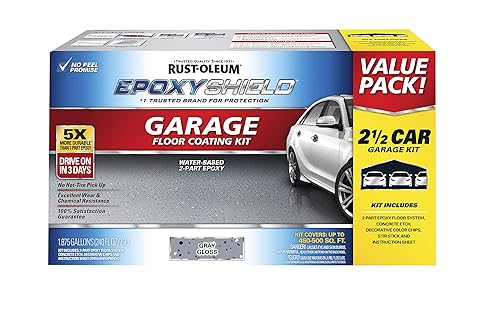
The Rust-Oleum 261845 EpoxyShield 2.5 Car Kit is the go-to solution for homeowners with a standard or larger two-car garage who want a reliable, trusted brand at a reasonable price. Rust-Oleum has been manufacturing coatings for decades, and EpoxyShield consistently ranks among the most reviewed and highest-rated garage floor products on the market.
The kit includes a 2-part water-based epoxy base coat, decorative color chips, and everything needed to complete the job. The gloss gray finish hides oil stains and tire marks effectively, while the epoxy chemistry creates a hard surface that resists peeling and cracking when applied over properly prepared concrete.
Coverage is rated at up to 500 square feet, which comfortably covers most two-car garages in a single application. The water-based formula means low odor during application and easy soap-and-water cleanup of tools.
On the downside, standard epoxy can be susceptible to hot-tire pickup if the surface gets very hot in summer, and full cure takes about 3 days before you should drive on it. Proper concrete etching before application is essential for adhesion.
Pros
Cons
The KILZ 1-Part Epoxy Acrylic Garage Floor Paint is the most accessible option on this list — it requires no mixing, no etching, and no special skills, making it ideal for DIYers who want a quick refresh rather than a complete floor system. At under $40 per gallon, it is also the most budget-friendly choice.
One gallon covers up to 400 square feet in a single coat, and the satin finish provides a clean, uniform appearance that brightens up dark garage interiors. The acrylic formula bonds to concrete, masonry, and even wood, making it versatile for garages, basements, porches, and pool decks.
The quick dry time is a real advantage — surfaces are dry to the touch in about an hour and can be recoated in 4 hours. This means you can complete the full project in a single day without planning around a multi-day cure schedule.
The trade-off is durability. As a 1-part acrylic product, it does not provide the same hard-shell protection as 2-part epoxies. It is best suited for garages with light vehicle traffic and will require reapplication more frequently than true 2-part epoxy systems.
Pros
Cons
RUST BULLET DuraGrade Concrete stands out from the competition with its unique moisture-cured urethane chemistry that eliminates the need for acid etching before application. This makes it a genuine time-saver for homeowners who dread the prep work associated with traditional 2-part epoxies.
The formula penetrates deeply into the concrete surface, bonding from within rather than just sitting on top. This results in excellent adhesion on bare, aged, or even slightly damp concrete — a significant advantage over moisture-sensitive epoxy systems. The flat concrete gray finish gives garages a clean, professional appearance without the high-gloss look that shows every scuff and tire mark.
RUST BULLET products are known for their corrosion-inhibiting properties and long-term durability. The coating is resistant to oil, grease, and most household chemicals, and it handles thermal expansion and contraction well — important for garages in climates with significant temperature swings.
Coverage is lower than some competitors at around 200 sq ft per gallon for a proper two-coat application, which increases the cost for larger garages. The flat finish also shows surface imperfections more than glossy alternatives.
Pros
Cons
The Rust-Oleum RockSolid Polycuramine 2.5 Car Kit in Dark Gray is built around Rust-Oleum's proprietary Polycuramine technology — a blend of epoxy, polyurea, and urethane chemistry that is claimed to be 20 times stronger than standard epoxy. The result is a coating that resists abrasion, chemicals, and temperature extremes significantly better than single-chemistry products.
The kit comes in easy-to-mix burst pouches that eliminate the guesswork of measuring ratios. Coverage extends to 500 square feet — appropriate for a two-car or 2.5-car garage. The self-leveling formula fills minor surface imperfections and creates a consistently smooth surface across the entire floor.
One of the most useful features is the relatively fast return-to-service time. You can walk on the coating in 8-10 hours and drive on it within 24 hours, which is much faster than standard two-part epoxy systems. This significantly reduces garage downtime during the project.
Some users report that the dark gray color can show dust and light debris more than lighter options. The kit price is also higher than standard EpoxyShield products, though the improved chemistry justifies the premium for high-use garages.
Pros
Cons
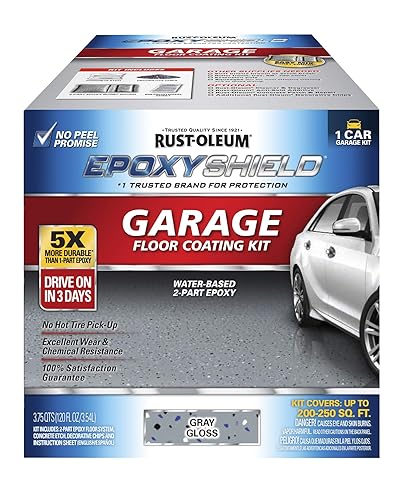
The Rust-Oleum 251965 EpoxyShield 1-Car Kit is the right-sized option for single-car garages, smaller workshops, or utility rooms where the larger 2.5-car kit would result in excess product. It delivers the same proven EpoxyShield 2-part epoxy technology in a more economical, appropriately sized package.
Coverage is rated at up to 250 square feet — the standard size for a one-car garage. The kit includes the two-part epoxy base coat, decorative color chips, and application instructions. The gloss gray finish provides a clean, finished look that hides most minor staining.
As with other EpoxyShield products, the water-based formula keeps odors manageable during application, and cleanup requires only soap and water. The surface can handle light foot traffic in 24 hours, though you should wait the full 72 hours before parking a vehicle on the finished floor.
The product is best suited for garages with light to moderate vehicle traffic. In very hot climates, hot tires can cause peeling if the garage floor reaches extreme temperatures — adding a clear polyurethane topcoat resolves this if it is a concern in your area.
Pros
Cons
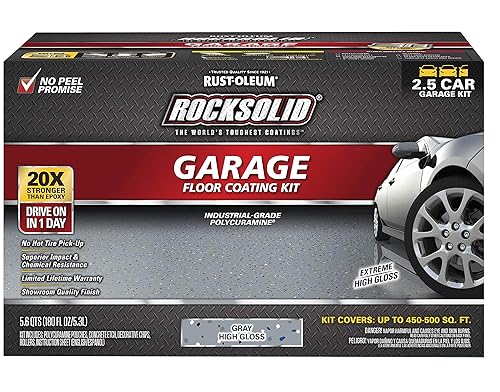
The Rust-Oleum 293513 RockSolid Polycuramine 2.5 Car Kit in High Gloss Gray is the original color option in the RockSolid lineup, offering the same durable Polycuramine technology as the dark gray variant but with a lighter gray finish that brightens the garage interior and makes it easier to spot dropped tools and small parts.
The 2.5-car kit covers up to 500 square feet and includes burst-pouch mixing for consistent results. The high-gloss finish creates a reflective surface that enhances garage lighting — a practical benefit for anyone who works on vehicles or equipment in the space.
Polycuramine's resistance to oil, fuel, antifreeze, and brake fluid makes this coating a strong performer in working garages. The 24-hour drive-on cure time is one of the fastest among multi-component coatings of this type, minimizing the disruption of coating your garage floor.
Some reviewers note that the lighter gray shows tire marks and scuffs more readily than darker alternatives, and that proper surface preparation — including acid etching or mechanical grinding — is critical for long-term adhesion. The kit does not include a topcoat, which some users recommend adding for maximum scratch resistance.
Pros
Cons
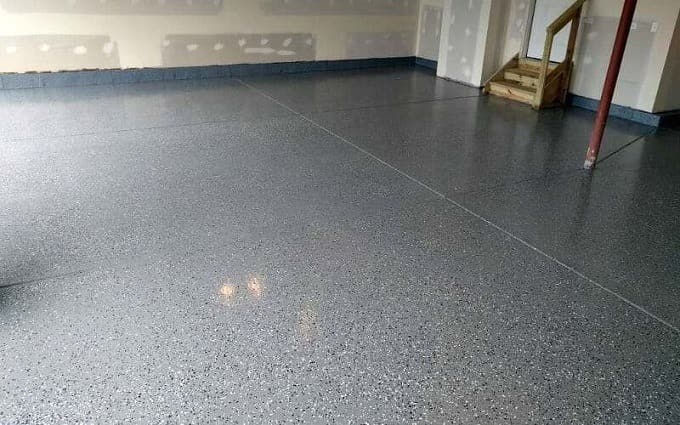
Choosing the right garage floor coating comes down to understanding a few key factors: the chemistry of the product, the conditions in your garage, and how much preparation you are willing to invest. Getting this right the first time saves you from peeling, delamination, and costly reapplication within a few years. For a deeper look at coating chemistry, This Old House has an excellent overview of the major coating types and their trade-offs.
The most important buying decision is the coating chemistry. Standard 2-part epoxy is the most widely available and affordable option — it bonds well to prepared concrete, resists oil and chemicals, and delivers a durable finish. However, epoxy is sensitive to moisture during application, takes 3-7 days for full cure, and can yellow under UV exposure over time.
Polyaspartic and polyurea coatings (like the MPC-275 at the top of our list) cure much faster — often walk-on ready in 4-6 hours — and resist UV yellowing completely. They also tolerate a wider temperature range during application. The trade-off is a higher price and a shorter pot life once mixed, which demands efficient, no-mistakes application.
Single-part acrylic paints like KILZ require no mixing and go on in an afternoon. They are the most budget-friendly option but deliver less hardness and durability than 2-part systems. They are best for lightly used garages or as a temporary solution before committing to a full epoxy or polyaspartic system.
No coating — regardless of price — will bond permanently to improperly prepared concrete. For 2-part epoxy systems, the concrete must be mechanically abraded (diamond grinding or shot blasting) or chemically etched with muriatic or phosphoric acid to open the surface pores. The surface must then be thoroughly cleaned and dried before coating.
RUST BULLET DuraGrade is one of the few products that skips the acid-etch step — its moisture-cured urethane chemistry allows application to bare or slightly damp concrete. For most other products, plan to spend as much time on prep as on the application itself.
Calculate your garage floor area carefully before buying. A single-car garage is typically 200-250 square feet; a two-car garage runs 400-500 square feet. Always add 10-15% to your measurement to account for walls, floor texture, and a second thin coat in high-traffic areas. Most 2.5-car kits are rated for up to 500 square feet, which works for most two-car garages with a comfortable margin.
There is a critical difference between dry time and cure time. A coating may be dry enough for foot traffic in 24 hours but still not fully cured — meaning it is still developing its final hardness and chemical resistance. Driving on an incompletely cured floor is one of the most common causes of premature peeling and tire-mark staining.
Polyaspartic coatings cure fastest (24 hours drive-on). Standard 2-part epoxies typically require 72 hours before vehicle traffic and may take up to 7 days for full chemical cure. Plan your project for a period when you can leave the garage unoccupied for the required cure time.
A garage floor encounters motor oil, brake fluid, gasoline, antifreeze, and de-icing salts — often all in the same winter. True 2-part epoxy and polyaspartic coatings resist all of these chemicals well when fully cured. Single-part acrylic paints offer significantly less chemical resistance and will stain and degrade faster in working garages where spills are frequent.
If your garage doubles as a workshop or you perform regular vehicle maintenance, choose a 2-part epoxy or polyaspartic coating for its superior chemical resistance. Rust-Oleum Polycuramine and MPC-275 both perform well in this regard.
MPC-275 Polyaspartic Floor Coating Kit – 2 Gallon Clear Gloss Polyurea Garage Floor Coating – Thin - Walmart Link
Rust-Oleum 261845 EPOXYSHIELD Garage Floor Coating Kit - Walmart Link
KILZ 1-Part Epoxy Acrylic Concrete & Garage Floor Paint - Walmart Link
RUST BULLET DuraGrade Concrete - ConcreteGrey - 1 Gallon - High-Performance - Walmart Link
Rust-Oleum 317284 RockSolid Polycuramine Garage Floor Coating - Walmart Link
Rust-Oleum 251965 EPOXYSHIELD Garage Floor Coating Kit - Walmart Link
Rust-Oleum 293513 RockSolid Polycuramine Garage Floor Coating - Walmart Link
MPC-275 Polyaspartic Floor Coating Kit – 2 Gallon Clear Gloss Polyurea Garage Floor Coating – Thin - eBay Link
Rust-Oleum 261845 EPOXYSHIELD Garage Floor Coating Kit - eBay Link
KILZ 1-Part Epoxy Acrylic Concrete & Garage Floor Paint - eBay Link
RUST BULLET DuraGrade Concrete - ConcreteGrey - 1 Gallon - High-Performance - eBay Link
Rust-Oleum 317284 RockSolid Polycuramine Garage Floor Coating - eBay Link
Rust-Oleum 251965 EPOXYSHIELD Garage Floor Coating Kit - eBay Link
Rust-Oleum 293513 RockSolid Polycuramine Garage Floor Coating - eBay Link
Applying a quality garage floor coating is one of the most practical improvements you can make to your garage. It protects the concrete from oil, chemicals, and abrasion; it looks clean and professional; and it makes the floor far easier to sweep and mop. A properly applied coating can last 10-20 years with minimal maintenance.
For most homeowners, the Rust-Oleum EpoxyShield 2.5-Car Kit offers the best balance of cost, coverage, and reliability. If you want faster cure times and better long-term UV resistance, the MPC-275 Polyaspartic system is worth the premium. And if you want the absolute minimum in prep work, the RUST BULLET DuraGrade Concrete eliminates the acid-etch step entirely.
Whatever product you choose, invest time in proper surface preparation. A clean, etched, and dried concrete surface is the single most important factor in how long your coating will last. Take your time with the prep, follow the mixing and application instructions carefully, and you will end up with a garage floor that looks and performs like a professional installation.
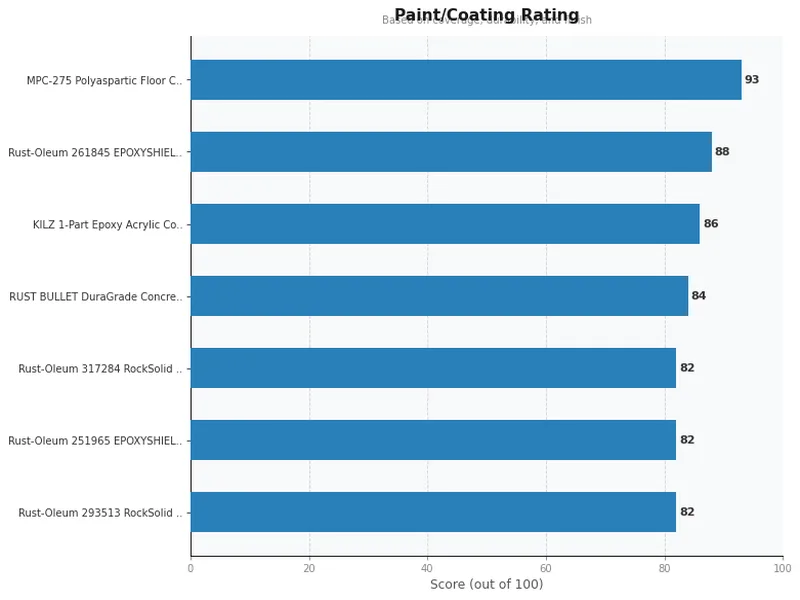
The MPC-275 Polyaspartic Floor Coating Kit is the top performer in 2026 for its fast cure time, UV resistance, and superior durability. For a more budget-friendly option, the Rust-Oleum EpoxyShield 2.5-Car Kit offers excellent value and covers most two-car garages in a single application.
A properly applied 2-part epoxy or polyaspartic coating typically lasts 10-20 years on a residential garage floor. Lifespan depends on traffic volume, the quality of surface preparation, and whether a clear topcoat is applied over the color coat. Single-part acrylic paints last 3-5 years before requiring reapplication.
For most 2-part epoxy systems, yes — acid etching or mechanical grinding is required to open the concrete pores and ensure proper adhesion. Some products, like RUST BULLET DuraGrade Concrete, use moisture-cured urethane chemistry that eliminates the etching requirement and can be applied to bare or lightly damp concrete.
Epoxy coatings are the traditional choice — widely available, affordable, and very durable, but they require 3-7 days for full cure and can yellow under UV light over time. Polyaspartic coatings cure much faster (walk-on in 4-6 hours, drive-on in 24 hours), resist UV yellowing completely, and tolerate a wider application temperature range. Polyaspartic products cost more and have a shorter working window once mixed.
Most 2-part epoxy systems require a minimum of two coats: a base coat and a finish coat. Some installers add a clear polyurethane or polyaspartic topcoat for additional scratch and UV resistance. Single-part acrylic paints typically need two coats for good coverage. Always follow the manufacturer instructions for the specific product you choose.
Most epoxy coatings require a minimum application temperature of 50 degrees F. Below this threshold, the epoxy cures too slowly and may not reach full hardness. Polyaspartic coatings generally have a wider acceptable temperature range — some can be applied in temperatures as low as 0 degrees F. Check the product specifications before planning your project in colder months.
 |
 |
 |
 |

About Joshua Thomas
Joshua Thomas just simply loves cars and willing to work on them whenever there's chance... sometimes for free.
He started CarCareTotal back in 2017 from the advices of total strangers who witnessed his amazing skills in car repairs here and there.
His goal with this creation is to help car owners better learn how to maintain and repair their cars; as such, the site would cover alot of areas: troubleshooting, product recommendations, tips & tricks.
Joshua received Bachelor of Science in Mechanical Engineering at San Diego State University.


Get some FREE car parts & gear.. Or check out the latest free automotive manuals and build guides here.
Disable your ad blocker to unlock all the hidden deals. Hit the button below 🚗
| | | |
