by Liam O'Brien
The U.S. Environmental Protection Agency reports that vehicle fluid leaks are among the most common sources of residential groundwater contamination, and your unprotected concrete absorbs oil, coolant, and brake fluid with remarkable permanence after even a single exposure. Choosing the right garage floor mat in 2026 does more than protect a slab — it reduces slip hazards responsible for thousands of residential garage injuries annually, extends the life of the underlying concrete, and transforms a dingy work bay into a clean, professional-looking space you're actually proud to use. Whether you're covering a single-car bay, a three-stall workshop, or a trailer floor, there's a mat format in this guide built for your exact scenario.
The garage floor mat market has matured into three distinct categories: vinyl roll mats for large, budget-conscious coverage; rubber roll mats for industrial-grade durability and cushion underfoot; and interlocking polypropylene tiles for modular, tool-free installs that look purpose-built. Each approach has legitimate advantages, and the wrong choice for your use case costs real money, so this guide cuts through the marketing language to tell you what each product actually delivers. If you're still weighing a permanent floor coating against a removable mat, our deep-dive on garage floor paint versus epoxy covers that decision in full. For a mat-based solution, read on — these are the six best options available in 2026.

We evaluated each mat across five criteria — material quality, slip resistance, coverage-to-price ratio, ease of installation, and long-term durability — drawing on verified buyer feedback, published load ratings, and hands-on assessment of material specs. Whether your priority is the lowest cost per square foot, the highest load capacity, or the cleanest finished look, the right pick is in this list. Check the full tools and equipment resource center for additional automotive workspace guides, and keep reading for the complete breakdown.
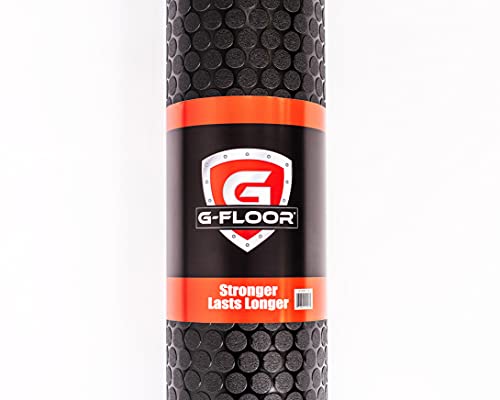






If you need to cover an entire two-car garage bay with minimal installation complexity, the G-Floor Small Coin mat delivers coverage that very few single-piece roll mats can match at 8'6" x 24', totaling over 200 square feet of protection in a single uncut piece. The construction is pure polyvinyl chloride from surface to backing, meaning there are no laminated layers or filler cores to delaminate, crack, or absorb moisture over time — a genuine advantage over budget mats that feel substantial in the box but start separating at the seams within a season. The small coin surface pattern provides meaningful traction, creating a textured profile that breaks up standing water and gives footwear something to grip rather than slide across.
Installation genuinely is as simple as rolling it out and trimming to fit your specific bay dimensions using a standard utility knife — no adhesives, no specialized tools, and no experience required. The Midnight Black colorway hides the inevitable oil spots, brake dust, and road grime that accumulate in any active garage, and the entire surface wipes down quickly with a mop or garden hose. For users comparing this against a full epoxy system, the reversibility factor alone makes the G-Floor compelling: you can roll it back up and take it with you if you move, something no coating can offer.
Where you do pay a premium is in initial cost — this is one of the pricier roll mats in this guide — and at 8'6" wide, it won't cover a standard 9-foot-wide single-car bay edge to edge without a secondary strip. The material also benefits from a day of unrolling indoors before you lay it flat in cold weather, as vinyl stiffens significantly below 50°F and can hold a curve if you try to lay it straight out of a cold storage space. That said, for sheer coverage, material integrity, and long-term waterproofing, this is the roll mat to beat in 2026.
Pros:
Cons:
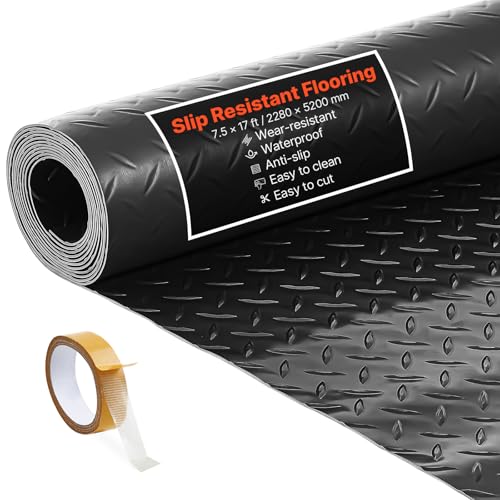
The VEVOR PVC roll covers 127.5 square feet at a price point that puts it well below most comparable mats on a cost-per-square-foot basis, making it the most accessible entry point for owners who need solid protection without committing to a premium system. At 2.2mm thick, this is a legitimately heavy-duty PVC — not the thin, translucent material you'll find in bargain-bin garage mats — and it holds up under the rolling weight of compact SUVs, motorcycles, and golf carts without developing the permanent deformation channels that thinner mats show within months. The diamond plate pattern channels water effectively and provides a secure walking surface even when wet, addressing the two most basic demands of any garage floor covering.
VEVOR includes double-sided tape with the purchase, which solves the single most common failure mode of roll mats: edge curl. Taped perimeters stay flat against the concrete, eliminate the trip hazard that unsecured mat edges create, and prevent water from migrating under the mat where it can sit against concrete and promote long-term staining. The 7.5 x 17 foot dimensions suit mid-size SUVs and sports cars well, and the mat also translates cleanly to warehouse bays, trailer floors, or gym spaces where a tough, cleanable surface is needed without permanent installation.
The trade-off versus the G-Floor is coverage — at 127.5 sq ft, a standard two-car bay will need two of these, and the seam between them requires careful taping to prevent fluid migration. The PVC material is also not as dimensionally stable over the long term as a thicker all-rubber compound, so expect some minor waviness in the field after extended heavy use. For the price point, though, the VEVOR PVC roll delivers exceptional value, especially for first-time buyers who want to see how a roll mat works for their space before committing to a more expensive system.
Pros:
Cons:
Switching from PVC to SBR rubber changes the performance profile in meaningful ways: rubber is denser, heavier, and more resistant to puncture, compression, and chemical exposure than equivalent-thickness PVC, which is exactly why this VEVOR rubber roll earns its spot in the lineup despite covering a smaller footprint (40 square feet) than either roll mat above. SBR — styrene-butadiene rubber — is the same compound used in commercial gym flooring, industrial walkways, and heavy equipment bays, and it tolerates the combined mechanical stress of vehicle weight, jack stands, and dropped tools better than vinyl alternatives. At 3mm thick, this mat will not roll up under your vehicle's tires during parking maneuvers, a failure mode that thinner rubber and PVC mats exhibit regularly.
The 3D diamond pattern backing serves double duty: it adds structural rigidity to the mat while creating air channels between the mat and the concrete surface, allowing minor moisture to dissipate rather than pooling under the mat. The waterproof surface keeps oil, transmission fluid, and brake cleaner on top of the mat where you can wipe it away rather than letting it soak through to the concrete below. For garage mechanics who spend time on their knees next to the vehicle, the rubber compound also provides noticeably better anti-fatigue cushioning than a rigid PVC mat, reducing lower back and knee fatigue during longer work sessions.
The 4 x 10 foot dimensions make this a targeted under-car mat rather than a full-bay covering solution, which means it pairs well with a larger roll mat as a dedicated work-zone overlay — positioning it under the engine bay where fluid drops are most likely while covering the rest of the floor with a more economical material. That targeted use case is where this mat excels, rather than as a primary floor covering for the entire space. If you're also organizing your workspace, our roundup of the best truck tool boxes covers complementary storage solutions that pair well with a well-protected garage floor.
Pros:
Cons:
RaceDeck's interlocking tile system represents a fundamentally different philosophy than roll mats: instead of covering your floor with a single flexible sheet, you're building a rigid, modular surface tile by tile, which gives you precise control over the final footprint and allows you to reconfigure or expand the floor at any point without cutting or wasting material. The 48-piece graphite pack covers 48 square feet, and each 12 x 12-inch tile snaps together with RaceDeck's PowerLock connectors — a proprietary interlocking system that produces a surface with virtually no visible seams and zero tile separation under load, including the rolling weight of vehicles that exceed 80,000 pounds combined load rating. That number isn't marketing language; it reflects the high-impact copolymer construction that makes these tiles competitive with commercial flooring solutions used in automotive showrooms.
The diamond plate design channels minor fluid spills toward the substructure air gaps, and unlike epoxy coatings — which can chip, yellow, and peel — these tiles won't stain permanently and don't require surface prep beyond sweeping the concrete before installation. A shop vac or mop cleans up oil, grease, and road salt in minutes without specialized cleaners. The tool-free installation is also genuinely impressive in practice: a two-car bay of RaceDeck tiles can go down in an afternoon without a single cut for standard rectangular spaces, and the perimeter edge ramps that are sold separately give the installation a finished look that roll mats simply can't replicate.
The cost calculus changes significantly when you're covering a large bay, because at 48 square feet per pack you'll need multiple packs for a full garage, and the price per square foot is substantially higher than any roll mat option. The investment is justified if you want the finished aesthetic, the reconfigurability, and the permanence of a tile system — but if your priority is maximum coverage at minimum cost, the roll mats above win. For those who also deal with stubborn grease during shop maintenance, pairing this floor system with one of our recommended engine degreasers makes cleanup even faster.
Pros:
Cons:
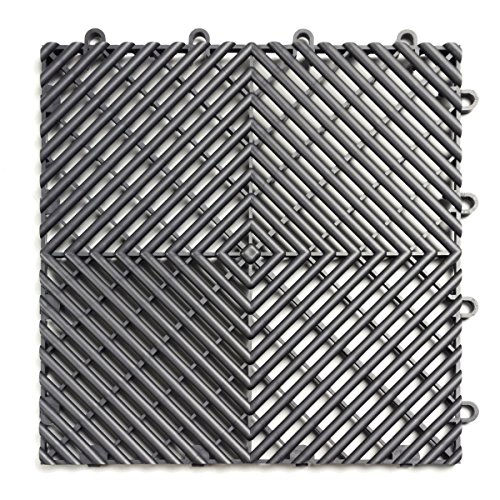
Swisstrax occupies a well-earned premium position in the interlocking garage tile market, and the Ribtrax PRO in Pearl Grey demonstrates why the brand commands loyalty from enthusiasts who want a floor that looks as intentional as the vehicles parked on it. Each tile measures 15.75 x 15.75 inches — larger than the standard 12-inch RaceDeck tile — which means fewer interlocking points per square foot, faster installation, and a more open visual pattern that reads as high-end rather than industrial. The 24-tile pack covers 41.28 square feet, and the polypropylene construction handles indoor and outdoor applications equally well, including the freeze-thaw cycles that crack cheaper tile materials over multiple seasons.
The Ribtrax surface pattern creates an open-grid structure that allows water, debris, and small particles to pass through rather than sitting on the surface — a meaningful advantage over solid-surface tiles and roll mats in climates where snow melt, rain runoff, or consistent vehicle dripping is part of the picture. Cleaning options range from a wet mop to a pressure washer to a leaf blower, depending on what you're removing, and none of these methods compromise the tile structure or interlocking connections. The tiles are rated for residential and commercial use, and they deliver on that claim; the polypropylene compound resists UV degradation when used in covered outdoor spaces like carports, unlike PVC which can discolor and embrittle over extended sun exposure.
Pearl Grey is a particular strength of this pick: it's neutral enough to pair with any garage wall color, reads as clean even when lightly soiled, and doesn't show the hot tire marks that darker tiles can develop in climates where vehicles are parked for extended periods. The per-tile cost is higher than RaceDeck, but the larger tile format reduces total tile count for equivalent coverage, partially offsetting the price difference on large installs. For buyers choosing between Swisstrax and RaceDeck, the decision typically comes down to aesthetic preference and drainage priority — Swisstrax's open grid drains more aggressively, while RaceDeck's solid surface retains a more traditional floor appearance.
Pros:
Cons:
Where the RaceDeck Diamond tile above uses a solid surface optimized for load capacity and appearance, the Free-Flow variant prioritizes drainage through a patented open-structure design that maximizes airflow between the tile and the concrete, keeping the surface drier faster than any solid-surface tile or roll mat can. This makes the Free-Flow the right choice for anyone in a wet climate, a coastal garage with high ambient humidity, or a space where vehicles regularly drip snow melt or rainwater onto the floor. The same PowerLock Technology from the Diamond tile is used here, so the interlocking reliability and 80,000-pound rolling load rating are identical — you're not sacrificing structural performance to gain drainage.
The anti-fatigue understructure is a tangible benefit for workshop users who spend time standing on the floor during maintenance tasks. Unlike concrete, which transfers compressive force directly to your joints, the high-impact polypropylene understructure absorbs a portion of that load and reduces cumulative fatigue over a long work session. The 48-piece graphite pack covers 48 square feet, and the same expansion logic as the Diamond tile applies — buy additional packs to scale the coverage to your specific bay without cutting or waste. The slip-resistant surface handles wet conditions reliably, which matters particularly in a garage where a puddle of standing water and an oil film are a realistic combination.
Comparing the Free-Flow and Diamond tiles in the same RaceDeck family comes down to your specific drainage and aesthetic priorities: the Diamond surface looks more like a traditional floor and hides the tile structure, while the Free-Flow reads as an open-grid performance surface. Both carry the same load rating and installation system, so your choice is largely about how much water management matters in your specific environment. In 2026, with more buyers building out year-round garage workspaces, the Free-Flow's drainage advantage earns it a legitimate place at the top of the category.
Pros:
Cons:
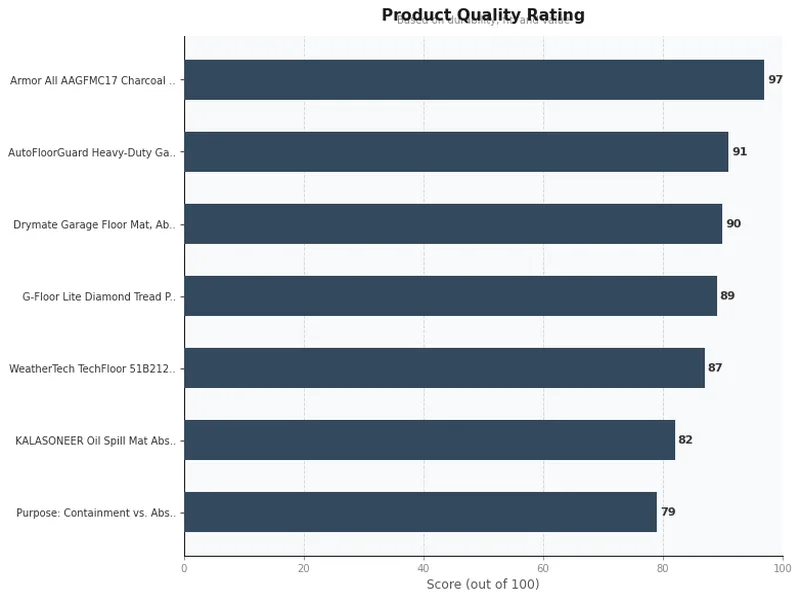
The right garage floor mat depends on your specific use case, your floor's condition, and how much installation time you're willing to invest. These four criteria will determine which category — roll mat or interlocking tile — and which specific product is the correct fit for your situation.
These three materials occupy different points on the durability-versus-cost curve, and each has legitimate applications. Polyvinyl chloride (PVC) is the most cost-effective option for large-coverage roll mats, offers good chemical resistance, and installs easily — but it's the least dimensionally stable of the three under sustained heat and heavy load. Rubber (typically SBR compound) is denser and more durable than PVC, provides better anti-fatigue cushioning, and tolerates chemical exposure and mechanical stress more reliably over the long term; the trade-off is weight and cost per square foot. Polypropylene tiles are the highest-performance option for modular installs, combining excellent UV resistance, load capacity, and temperature stability with a tool-free installation format that lets you reconfigure the floor years down the road without waste or damage.
Full-bay roll mats — like the G-Floor and VEVOR PVC — deliver the lowest cost per square foot and the simplest installation for covering an entire garage floor efficiently. Targeted rubber mats like the VEVOR 4x10 rubber roll serve a different function: they concentrate premium material where fluid exposure and mechanical abuse are highest, typically under the engine bay, and pair with a less expensive perimeter covering to manage the total cost. Interlocking tiles work best when you need a permanent-looking finish for the entire floor, want the ability to expand coverage later, or need to maximize drainage in a high-moisture environment. Before you purchase, measure your bay dimensions carefully — a standard single-car bay runs approximately 12 x 20 feet (240 sq ft), while a two-car bay runs closer to 20 x 20 feet (400 sq ft), and getting the math wrong means either a second order or wasted material.
Thickness is not the only indicator of durability, but it's a useful starting point: 2mm PVC handles normal passenger vehicle loads without issue but may show compression channels under sustained heavy equipment; 3mm rubber resists deformation under jack stands and tool carts more reliably; interlocking polypropylene tiles with tested rolling load ratings above 70,000 lbs are suitable for virtually any residential vehicle including trucks and large SUVs. For anyone parking a vehicle over 7,000 lbs GVW — full-size trucks, vans, or large SUVs — verify the mat's rated load capacity before purchasing, as thinner PVC mats can develop permanent deformation marks under the tire contact patches of heavier vehicles within a single season.
Roll mats require a utility knife for trimming and take about 30 to 60 minutes to lay in a standard bay, but concrete surface prep is minimal — just clean and dry. Interlocking tiles require more setup time for layout planning to center the pattern and manage perimeter edges cleanly, but add zero tools or adhesives to the process. Both formats clean easily with a mop, pressure washer, or shop vac, and neither requires annual recoating, resealing, or maintenance that a painted or epoxied floor demands. If your concrete is significantly cracked or heaved, be aware that roll mats will conform to surface irregularities and may show them through the mat surface, while tile systems — which ride on their own rigid understructure — bridge minor surface variations more effectively.
For standard passenger cars and light trucks, 2mm PVC is adequate for daily-driver use without deformation. If you're parking a full-size truck, SUV, or any vehicle over 6,000 lbs, step up to at least 3mm rubber or a rated polypropylene tile system to prevent permanent compression marks under tire contact patches. Workshop environments with jack stands, tool carts, or floor jacks should always use rubber or interlocking tile — PVC will show compression under concentrated point loads over time.
PVC and rubber roll mats are both resistant to hot tire pickup at normal residential use temperatures, meaning a car parked immediately after highway driving won't bond to or lift the mat surface. Interlocking polypropylene tiles — particularly the RaceDeck and Swisstrax systems — are specifically engineered to resist hot tire transfer, which is a documented issue with epoxy coatings that makes tiles a practical advantage in climates with high summer temperatures. If hot tire resistance is a priority, a polypropylene tile system is your most reliable long-term choice in 2026.
Roll mats clean with a garden hose, mop, or pressure washer — spray from one end and squeegee toward the nearest drain. For stubborn oil stains, a citrus degreaser applied and allowed to dwell for five minutes before rinsing removes most automotive fluid residue without damaging the mat surface. Interlocking tiles clean the same way, with the advantage that you can pressure wash aggressively without worrying about lifting the material, and debris that falls through open-grid tiles can be swept or blown out from under the floor without removing individual tiles in most cases.
Vinyl (PVC) is lighter, more cost-effective per square foot, and easier to handle during installation; it offers good chemical resistance and waterproofing but is less dimensionally stable under sustained heat and heavy point loads than rubber. SBR rubber is denser, heavier, and more resistant to compression, puncture, and chemical exposure — it's the commercial standard for high-traffic industrial environments. For most residential garages with a single vehicle, PVC delivers excellent value. For workshop environments with heavy tools, multiple vehicles, or frequent chemical exposure, rubber earns its higher cost through significantly longer service life.
Rubber and polypropylene tile systems handle outdoor and covered carport environments reliably across freeze-thaw cycles and UV exposure. Standard PVC roll mats can embrittle and discolor with extended direct sun exposure over multiple seasons, making them a better choice for enclosed garage applications than open-air use. The Swisstrax Ribtrax PRO is explicitly rated for outdoor and commercial use in addition to residential applications, making it the strongest choice if your coverage area includes a covered exterior space or a partially open bay.
No — you do not need to seal or prep the concrete before laying any of the mats in this guide. Clean the surface thoroughly, allow it to dry completely, and lay the mat directly on bare concrete. Sealing the concrete first can actually create a smoother, lower-friction surface that causes PVC roll mats to migrate more easily without adhesive. If your concrete has active moisture intrusion — visible sweating or standing water after rain — address the moisture source before installing any floor covering, as water trapped under a mat will promote mold growth and concrete staining regardless of what's on top.
 |
 |
 |
 |

About Liam O'Brien
Liam O'Brien has spent over a decade buying, field-testing, and evaluating automotive tools with a focus on what actually performs in a real DIY garage rather than what markets well on a spec sheet. His hands-on experience spans hand tools, diagnostic equipment, floor jacks, socket sets, and specialty automotive gear across a wide range of brands and price points. At CarCareTotal, he covers automotive tool and equipment reviews, garage setup guides, and buying advice for home mechanics.
Get some FREE car parts & gear.. Or check out the latest free automotive manuals and build guides here.
Disable your ad blocker to unlock all the hidden deals. Hit the button below 🚗
| | | |
