by Liam O'Brien
According to a 2025 survey by the Woodworking Industry Association, nearly 68% of DIY enthusiasts say their garage workbench is the single most-used piece of equipment in their shop — yet more than half admit they settled for whatever was cheapest. That's a mistake you don't want to make. A solid workbench is the foundation of every project you'll tackle, from quick oil changes to full-blown furniture builds.
Whether you need a heavy-duty rolling cabinet with a dozen drawers or a lightweight folding table you can stow in minutes, the 2026 market has more options than ever. We spent weeks comparing weight capacities, drawer quality, work surface materials, and real-world usability across seven of the top-rated garage workbenches available right now. If you're the kind of person who also keeps your garage tools organized and your workspace dialed in, this guide is for you.

We looked at everything from budget-friendly options under $150 to professional-grade rolling cabinets that cost several times more. Each pick below includes an honest breakdown of what it does well and where it falls short. Your ideal workbench depends on your specific projects, available space, and how much storage you need — so we've organized this guide to help you zero in on the right match quickly.




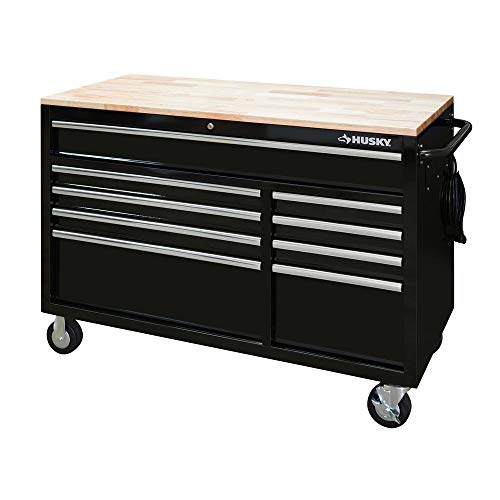




If you want one workbench that handles just about everything, the Husky 61-inch is the one to beat in 2026. It gives you a massive 61-inch-wide solid wood work surface, ten full drawers, plus a cabinet door for storing bulkier items like power tools and paint cans. The real standout feature is the flip-up pegboard that folds out from the back. When you need it, you've got instant vertical tool storage. When you don't, it tucks away so the bench keeps a low profile.
All ten drawers ride on soft-close ball-bearing slides rated at 120 pounds each. That's enough to handle a full set of socket wrenches, impact drivers, or whatever heavy hand tools you throw in there. The casters come pre-installed, which cuts your assembly time significantly — you're basically bolting drawers into a frame and you're done. Roll it to whichever bay of the garage you're working in, lock the casters, and you've got a rock-solid work surface.
The textured black finish holds up well against scratches and grease. One thing to keep in mind is the overall footprint. At 61 inches wide and 23 inches deep, this bench needs a decent amount of floor space. If your garage is on the tighter side, measure first. But for anyone with room, this is the Swiss Army knife of garage workbenches — storage, surface area, and mobility all in one package.
Pros:
Cons:
The Seville Classics UltraHD is the widest bench in our roundup at a full 77 inches across, giving you over six feet of work surface. If you're the type who spreads out — engine parts on one side, reference manual in the middle, tools on the other — this gives you room to breathe. The solid wood top is coated in polyurethane and measures 1.5 inches thick, so it can take a beating from hammers, clamps, and heavy automotive parts without denting easily.
Eleven drawers means you can dedicate separate drawers to different tool categories. Wrenches in one, electrical supplies in another, fasteners in a third. The bold red finish isn't just cosmetic — it makes the bench easy to spot in a crowded workshop, and the powder-coat finish resists chipping and rust over time. Push bars on each side make repositioning the bench straightforward, though at 77 inches wide, you'll want to make sure doorways and aisles can accommodate it.
The main trade-off with the Seville is its depth. At 20 inches, the work surface is shallower than the Husky options. For most tasks that's fine, but if you frequently work on large flat materials like plywood sheets, you might wish for a few more inches front to back. The build quality, however, is undeniably solid. This bench is built for people who want a professional-grade tool station in their home garage. It's similar in spirit to how serious gearheads invest in quality trailer hitches for their towing setup — you pay more upfront, but the reliability pays off over years of heavy use.
Pros:
Cons:
Think of this as the Husky 61's slightly more compact sibling. At 52 inches wide and 24.5 inches deep, it splits the difference between full-size rolling cabinets and smaller standalone benches. You still get nine drawers — with the top and bottom drawers riding on double-slide supports rated at 100 pounds each. That extra slide support means the heaviest drawers won't sag or wobble when you load them up with socket sets, drill bits, or hand tools.
The heavy-duty 21-gauge steel frame is rated to support up to 1,200 pounds. That's not a typo. You could stack an engine block on this thing and still have capacity to spare. The one-inch solid wood top has a protective polyurethane coating, so spilled oil, brake fluid, or solvent wipes clean without staining. Five-inch casters with swivel brakes and rigid wheels give you good mobility, and the steel tubular side handle provides a solid grip when you need to push the whole unit across the garage floor.
Where the 52-inch model really shines is for two-car garages where you want a capable workbench that doesn't dominate one entire wall. You get nearly the same drawer quality and build strength as the larger Husky, just in a tighter package. The only real downside is losing about nine inches of surface width compared to the 61-inch model, which can matter when you're working on bigger projects. But for everyday garage maintenance — the kind of work where you're also reaching for your oil filters and wrenches — the 52-inch hits a sweet spot.
Pros:
Cons:
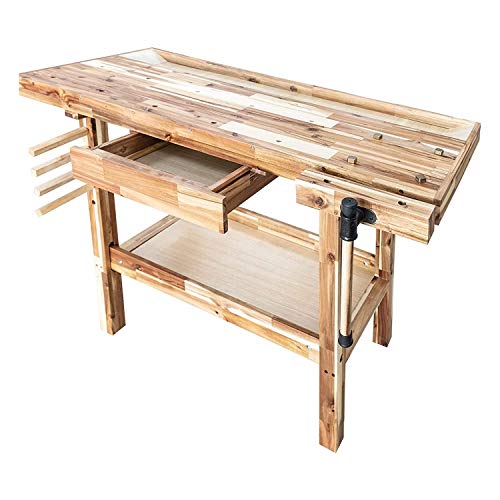
Not everyone needs a rolling cabinet with ten drawers. If you're looking for a straightforward, good-looking workbench at a reasonable price, the Olympia Tools acacia hardwood bench delivers. The 48-inch work surface is made from genuine acacia wood — a hardwood known for its natural resistance to moisture and decay. That makes it a surprisingly good choice for garages where humidity can be an issue, especially in warmer climates.
This bench supports up to 330 pounds, which is modest compared to the steel-framed options on this list. It's perfectly fine for hand tool work, light assembly, small engine repair, and craft projects. The included drawer and lower shelf give you basic storage, and the open-frame design means you can slide bins or toolboxes underneath for extra organization. It also works well as a secondary bench — set it up along a side wall as a dedicated station for detail work while your main bench handles the heavy stuff.
The acacia wood top is attractive enough that some people use these in workshops that double as creative studios. It has a warm, natural grain that looks good without any additional finishing. Just keep in mind the 330-pound limit. This isn't the bench for rebuilding a transmission or pressing bearings. But for the price, the build quality punches above its weight. If you're someone who also values keeping your vehicle's exterior looking sharp — maybe you've already found your go-to from our list of tire shine products — then you appreciate when a product does its job well without overcomplicating things.
Pros:
Cons:
Here's a number that matters: the WORKPRO adjusts from 31.5 inches to 39.375 inches in height. That's nearly an eight-inch range, which means whether you're 5'4" or 6'3", you can dial in a working height that doesn't wreck your back during long sessions. If you've ever spent three hours hunched over a bench that's two inches too low, you know why adjustable height is worth paying for.
But this isn't just about comfort. The WORKPRO is built like a tank. The 1.3mm steel frame was tested at 2,000 pounds for six months during development, and the official load capacity sits at that same 2,000-pound mark. The rubber wood tabletop is FSC-certified (meaning the wood was harvested from responsibly managed forests), measures just over an inch thick, and is finished with a transparent protective coating. It's a 48-by-20-inch surface, which gives you plenty of room for most projects.
The built-in power outlets are a nice bonus that you don't see on many workbenches in this price range. Plug in your charger, grinder, or work light without running extension cords across the garage floor. The only thing missing is storage — there are no drawers or shelves. You'll need to pair this with a separate tool chest or wall-mounted organizer. But if your priority list starts with "won't destroy my lower back" and "can handle serious weight," the WORKPRO deserves a hard look.
Pros:
Cons:
The Keter folds out and locks into position in about 30 seconds. No assembly, no tools needed. Just flip it open and start working. When you're done, it collapses flat enough to lean against a wall or slide behind a shelf. For people who share their garage with two cars and can't dedicate permanent floor space to a workbench, the Keter solves that problem completely.
Don't let the folding design fool you into thinking it's flimsy. This bench holds up to 1,000 pounds, which puts it in the same weight class as many permanent stationary benches. The included 12-inch clamps can be mounted horizontally or vertically, so you can secure boards, pipes, or irregular materials for cutting or drilling. It's an especially good match for miter saw work — set the saw on the bench, clamp your material, and you've got a stable cutting station anywhere you need it.
The resin construction means it's weather-resistant, lightweight, and easy to wipe clean. You could realistically set this up in your driveway, on a job site, or even on a deck for outdoor furniture projects. The trade-off is the plastic work surface. It won't absorb impacts the way a solid wood top does, and it can get scratched up over time. You also won't find any drawers or storage — this is purely a work surface with clamps. But for sheer convenience and portability, nothing else on this list comes close.
Pros:
Cons:
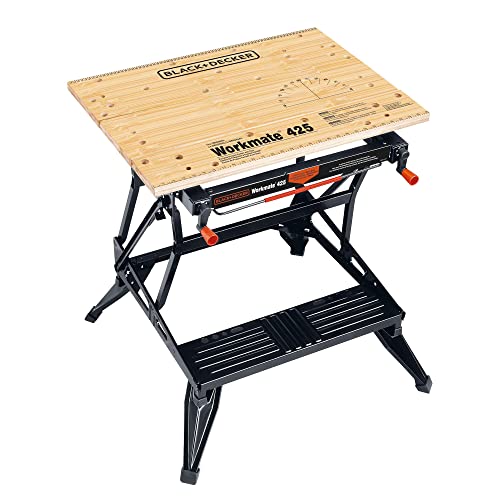
The BLACK+DECKER Workmate has been around for decades, and there's a reason it keeps selling. It combines a portable workbench with a built-in vise (a clamping mechanism that holds materials in place while you work on them). The adjustable jaws open wide enough to grip boards, doors, pipes, and oddly shaped objects using the four swivel pegs. It's the kind of tool that earns its spot by being useful in situations where a full-size bench isn't practical.
At 550 pounds of capacity, the Workmate sits at the lower end of our lineup for weight support. But its purpose isn't to hold an engine block — it's to give you a stable, clamped work surface wherever you need one. The heavy-gauge steel frame and laminated bamboo stalk worktop are surprisingly sturdy for something you can fold up and carry with one hand. It's great for apartment dwellers, renters, or anyone who does most of their work in a space that needs to serve multiple purposes.
The vertical clamping feature is worth highlighting. Flip the Workmate on its side and you can clamp doors, cabinet panels, or shelving for edge work like planing or sanding. That's a capability none of the other benches on this list offer. The main limitation is the small work surface. You won't be spreading out a complex project across this bench. Think of it as a precision tool rather than a general-purpose station. For quick cuts, clamping jobs, and portable repairs, it's been a proven performer for a very long time.
Pros:
Cons:
The single most important spec on any workbench is how much weight it can support. The range in our lineup goes from 330 pounds (Olympia Tools) to 2,000 pounds (WORKPRO), so you need to be realistic about what you'll be putting on it. If you work on engines, transmissions, or heavy machinery, aim for at least 1,000 pounds of capacity. For lighter tasks like electronics repair, hobby work, or basic hand-tool projects, 300 to 500 pounds is usually plenty.
Frame material matters just as much as the number on the spec sheet. Steel-framed benches (like the Husky and WORKPRO models) handle sustained heavy loads better than resin or wood-framed options. For the work surface, solid wood tops — especially hardwoods like acacia and rubber wood — absorb impacts better than steel or plastic. They're also easier on your tools and parts. A polyurethane coating on the wood surface adds protection against moisture, oil stains, and chemical spills.
Drawers make or break a workbench for most garage users. If your tools are currently scattered across five different toolboxes and two milk crates, a bench with nine to eleven drawers will change your life. Look for ball-bearing drawer slides — they open and close smoothly even when loaded with heavy tools. Soft-close slides are a bonus that prevents drawers from slamming shut and damaging contents.
Pay attention to drawer depth and width, not just the number of drawers. Some benches offer many shallow drawers that are great for small hand tools but useless for power tools. Others give you a mix of shallow and deep drawers, which is usually more practical. If the bench you like doesn't have drawers, plan to pair it with a separate tool storage solution like a rolling chest or wall-mounted pegboard system.
Rolling workbenches give you flexibility. Need to work near the garage door for better lighting? Roll it over. Need to clear space for parking? Push it against the wall. The trade-off is that casters add height and can introduce a small amount of wobble under heavy lateral force. Good-quality locking casters minimize this, but a bench bolted to the floor will always be more rigid.
Folding workbenches take mobility a step further — you can transport them in your car or store them when not in use. They're ideal if your garage also needs to function as a parking space, gym, or workshop on different days. Stationary benches offer the most stability per dollar, but you're committed to wherever you place them. Think about how you actually use your garage day to day before deciding which type fits best.
Width determines how much you can spread out. A 48-inch bench handles most individual projects, but if you frequently work on multiple things at once or deal with long materials, 60 inches or wider gives you breathing room. Depth is often overlooked — 20 inches is workable but tight for larger assemblies, while 24 inches or more lets you comfortably stage materials behind whatever you're actively working on.
Height matters more than most people realize. The standard workbench height is around 34 to 36 inches, which works for average-height adults. If you're taller or shorter, an adjustable-height bench like the WORKPRO prevents chronic back strain. The ergonomic rule of thumb is that your work surface should sit at roughly wrist height when your arms hang naturally at your sides. Spending an extra minute getting this right saves you hours of discomfort down the line.
For most adults, a workbench height between 34 and 38 inches works well for standing tasks. The best way to find your ideal height is to stand with your arms relaxed at your sides and measure from the floor to your wrist. That measurement is your target work surface height. If multiple people will use the bench, an adjustable-height model like the WORKPRO eliminates the guesswork entirely.
Folding resin benches like the Keter are designed to handle outdoor conditions, including moisture and temperature changes. Steel-framed and wood-topped benches can be used outdoors temporarily, but prolonged exposure to rain, humidity, and UV will cause rust and wood damage. If you plan to work outside regularly, choose a bench with weather-resistant materials or bring your bench back indoors after each session.
For general hobby work, woodworking, and light repairs, 300 to 500 pounds is sufficient. For automotive work involving engine parts, heavy tools, and machinery, aim for 1,000 pounds or more. The 2,000-pound capacity benches are designed for professional and industrial use where heavy equipment sits on the surface regularly. Always leave a safety margin — if your typical load is 200 pounds, don't buy a bench rated at exactly 200 pounds.
It depends on your garage layout. Rolling benches are better if you need to move the bench around frequently, share space with vehicles, or want to work in different areas. Stationary benches provide more stability for heavy pounding and pressing tasks. Many people find the best setup is one of each — a rolling cabinet for tools and everyday work, plus a smaller stationary bench for tasks that need a completely solid surface.
Solid wood tops (acacia, rubber wood, maple) offer the best combination of durability, impact absorption, and tool-friendliness. They won't scratch metal parts the way steel tops can, and they absorb vibration better than plastic. Steel tops are easier to clean and resist chemical damage, making them better for welding or heavy industrial use. Plastic/resin tops are lightest and most weather-resistant but scratch easily and don't absorb impacts well.
For stationary benches, concrete anchor bolts are the most secure option. Drill into the concrete floor, insert expansion anchors, and bolt the bench legs down. For renters or anyone who doesn't want permanent holes in the floor, heavy-duty anti-slip pads under each leg combined with the bench's own weight usually provide enough stability for most tasks. Rolling benches don't need floor mounting — just lock the casters when working.
 |
 |
 |
 |

About Liam O'Brien
Liam O'Brien has spent over a decade buying, field-testing, and evaluating automotive tools with a focus on what actually performs in a real DIY garage rather than what markets well on a spec sheet. His hands-on experience spans hand tools, diagnostic equipment, floor jacks, socket sets, and specialty automotive gear across a wide range of brands and price points. At CarCareTotal, he covers automotive tool and equipment reviews, garage setup guides, and buying advice for home mechanics.
Get some FREE car parts & gear.. Or check out the latest free automotive manuals and build guides here.
Disable your ad blocker to unlock all the hidden deals. Hit the button below 🚗
| | | |
