Interior ›
by Rachel Park
Back pain affects 31 million Americans at any given time, according to the National Institute of Neurological Disorders and Stroke, and prolonged driving ranks among the most consistent aggravating factors — the sustained vibration, fixed posture, and flattened seat foam combine to compress lumbar discs in ways that standing and walking do not. If you commute daily, haul cargo, or simply spend extended hours behind the wheel, the right lumbar support cushion is not a luxury accessory — it is a functional tool that directly influences your spinal alignment, fatigue levels, and long-term musculoskeletal health. The 2026 market offers more sophisticated options than ever before, from extended full-back panels to breathable wood-bead constructions, and sorting through them requires more than reading a product title.

Our editorial team evaluated six leading lumbar support cushions across multiple criteria: foam density and rebound characteristics, strap security on a range of seat geometries, breathability during summer heat, and compatibility with sedans, SUVs, and trucks. We paid particular attention to how each product performs after the first hour in the seat — the point at which inferior foam begins to collapse and inadequate straps begin to migrate. For drivers who already invest in quality seat protection products or interior upgrades like LED light strips, pairing them with a well-chosen lumbar support completes a cabin environment that is both comfortable and purposeful. The products reviewed here represent the strongest options across distinct use cases, price tiers, and vehicle types available in 2026.
Whether you are managing a diagnosed disc condition, recovering from a long road trip, or simply trying to arrive at your destination without that familiar ache at the base of your spine, each recommendation below is matched to a specific driver profile. Read the full reviews to find your fit, then use the buying guide to sharpen your decision before checking current pricing on Amazon.
Contents



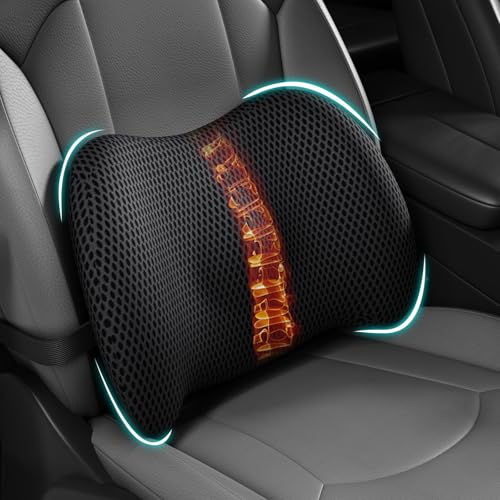




Measuring 20.9 inches in length, this extended back support is the widest-profile cushion in our test group, and that extra surface area translates directly into observable results for drivers who have previously cycled through standard-size lumbar pillows without satisfaction. The slow-rebound memory foam construction cradles the upper, middle, and lower back simultaneously — a design approach that addresses the reality of lumbar anatomy: spinal compression during driving rarely isolates neatly to one zone, and a support panel that spans the full lumbar and thoracic region distributes that load more effectively than a compact disc-style pillow positioned at a single vertebral segment. The foam is firm enough to resist flattening under sustained body weight while remaining compliant enough to absorb road vibrations before they reach your tailbone.
One of the more practical engineering decisions embedded in this product is its explicit targeting of aging vehicle seats. Car seat foam loses structural integrity over time — industry estimates suggest that foam cushioning in high-use seats can lose up to 40 percent of its original thickness within five years of regular use, leaving a pronounced gap between your lumbar curve and the seat back. This cushion fills that void precisely, restoring the support geometry that the original seat was designed to provide. For drivers of older sedans, SUVs, or trucks where the factory seat foam has long since compressed into a hard shell, this single intervention can meaningfully change the comfort profile of a daily commute or a multi-state road trip.
Installation is straightforward — the cushion attaches to the seat back with elastic straps that accommodate both bucket seats and flat-back configurations. The cover material is durable and easy to spot-clean, though it does not come with a removable washable sleeve, which is a minor inconvenience for drivers who eat in their vehicles. That said, for anyone dealing with chronic back discomfort on long drives, this is the most comprehensive single-panel solution currently on the market in 2026, and its broad compatibility across vehicle classes makes it a low-risk investment for most buyers.
Pros:
Cons:
The BYMECOST lumbar cushion enters 2026 as one of the more precisely engineered options for drivers dealing specifically with sciatic nerve compression — a condition where the way a cushion interfaces with the gap between the tailbone and the seat base is as important as how it supports the lumbar curve. The raised center area of this pillow is shaped to follow the natural inward curve of the lower spine rather than pushing against it with a uniform flat surface, and this contoured geometry produces a noticeably different pressure distribution pattern compared to simpler cylindrical or rectangular lumbar rolls. Drivers with diagnosed sciatica or piriformis syndrome will find this design philosophy aligns with clinical recommendations for seating modifications.
The high-density memory foam selected for this cushion is rated for sustained use without sagging — a claim that holds up in practice, as the cushion retains its original profile after extended daily use rather than gradually compressing into a flat panel. The moderate dimensions are a deliberate choice: the product is sized to sit correctly within the lumbar curve without encroaching on the seat's shoulder width or restricting upper body movement, which matters for drivers who need to shoulder-check frequently. The adjustable strap system secures the cushion to the seat back reliably, and the cushion remains anchored even during sudden braking or sharp lane changes — a detail that separates it from cheaper alternatives whose straps loosen within weeks of regular use.
Multi-environment usability is a genuine feature here, not marketing language — the cushion transitions cleanly between car seats, office chairs, and wheelchairs without requiring any adjustment to the strap configuration. For commuters who spend hours in both a vehicle and a desk chair, the ability to carry one cushion between environments reduces the per-dollar cost substantially and ensures consistent spinal support throughout the full workday. If you are exploring interior comfort upgrades for your vehicle more broadly, this cushion addresses one of the highest-impact pain points for daily drivers.
Pros:
Cons:
Lofty Aim has built a reputation for producing accessible, well-engineered lumbar cushions that deliver consistent performance across a broad range of seating environments, and this 2026 offering continues that trajectory. The high-density memory foam core provides firm, responsive support that does not immediately bottom out under body weight — a critical distinction from budget alternatives that feel supportive during the first five minutes of a drive but gradually collapse into a thin, ineffective panel by the time you reach highway speed. The ergonomic profile fills the natural gap between your lower back and the seat back without forcing your spine into an overcorrected anterior tilt, which is a common failure mode of overly rigid lumbar supports that push the lumbar curve forward beyond its natural position.
The adjustable elastic strap system is one of this cushion's most practically valuable features — it is wide enough to anchor the cushion securely on both high-backed bucket seats and lower-profile seats, and the non-slip bottom surface adds a second layer of position retention that prevents the cushion from drifting downward during long drives. This dual-retention system means the cushion stays positioned at your actual lumbar vertebrae rather than migrating to mid-back or seat-crease level after thirty minutes, which is the failure mode that renders many competing products essentially useless after the first hour. The cushion ships ready for immediate use in cars, trucks, office chairs, wheelchairs, and airplane seats without requiring any modification.
The build quality reflects the price-to-performance positioning accurately — the cover fabric is durable and maintains its structural integrity through regular use, though it is not as premium in hand-feel as the covers on higher-priced options. For drivers who want a reliable, no-nonsense lumbar solution that works consistently across multiple seating environments without demanding careful positioning or frequent adjustment, the Lofty Aim pillow is the most straightforward recommendation in this roundup.
Pros:
Cons:
The spinal column does not compress in isolation during driving — the neck and lumbar spine are mechanically linked, and a cushion system that addresses only one zone while leaving the other unsupported creates a partial solution at best. This matched headrest-and-lumbar set from a specialist in orthopedic support accessories recognizes that biomechanical reality and delivers coordinated support across both the cervical and lumbar regions simultaneously, using space memory foam in both components to ensure that the feel and resistance profile remain consistent between the neck rest and the back cushion. The concave headrest cradles the cervical spine in a neutral position while the slope-design lumbar support gently fills the lower back curve without forcing an aggressive anterior tilt.
The engineering attention to the gap between the seat headrest and the seat back is where this product earns its recommendation — many drivers experience neck fatigue specifically because their head is thrust forward by a headrest that does not extend far enough to make contact at the correct cervical vertebral level, and this cushion's concave geometry solves that problem by bridging the headrest-to-neck gap precisely. Simultaneously, the lumbar component's slope design positions the point of maximum support at the L3-L5 vertebral region, which is where most driving-related lumbar compression originates. Both components attach with adjustable straps that work on most standard seat geometries without tools.
For office workers who also drive significant distances, this set offers a seamless transition: both cushions work equally well on office chairs, making the per-piece investment more defensible. The memory foam in both components requires a brief break-in period of approximately three to five days of regular use before it fully conforms to your individual spinal geometry — a normal characteristic of high-density space foam — and users who give it that acclimation period consistently report substantially higher satisfaction than those who form a first-use impression. This is the most complete spinal support solution in the 2026 roundup for drivers who want to address the full neck-to-lower-back chain in a single purchase.
Pros:
Cons:
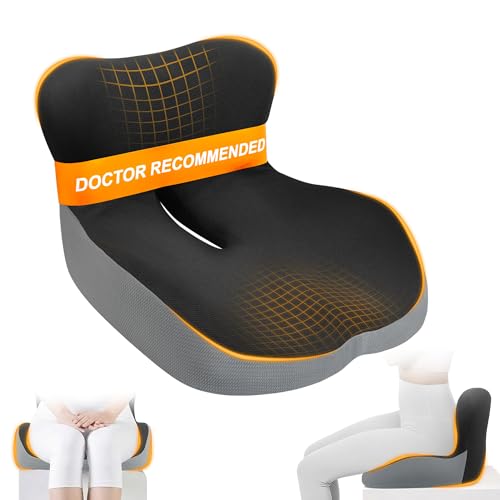
The Allaboutsla L-shaped cushion is the most structurally distinct product in this roundup, combining a lumbar back panel with an integrated seat cushion in a single one-piece unit — a configuration that fundamentally changes the support equation for long-distance drivers and semi-truck operators. Where standalone lumbar pillows address only the back-to-seat interface, this L-shaped system simultaneously redistributes seated pressure across the sit bones while supporting the lumbar curve, creating a more comprehensive pressure-relief profile that becomes especially relevant after the three-hour mark on extended drives, when the cumulative effect of point loading on the ischial tuberosities becomes a significant fatigue factor in its own right. The seat portion uses a W-shaped foam profile that provides additional lateral stability and coverage compared to a flat pad.
The slow-rebound, high-density foam specification used throughout is selected for its ability to balance surface compliance with structural resistance to compression — the foam is soft enough to relieve surface pressure immediately upon sitting but maintains enough internal resistance to prevent the complete collapse that makes thin or low-density alternatives feel like cardboard after extended use. The anti-slip base on the seat component keeps the entire unit anchored to the seat without requiring any strap attachment at the base, while a high-grip fabric on the back panel presses firmly against the seat back to prevent rearward migration. The removable, machine-washable cover is a genuine differentiator in this group — for commercial drivers or anyone who spends significant daily time in the vehicle, the ability to launder the cover on a weekly schedule matters for both hygiene and material longevity.
The breathable fabric construction reduces heat buildup compared to solid memory foam panels, which is a real comfort factor during summer months when most foam-backed cushions become uncomfortably warm within thirty minutes in a sun-heated cabin. For drivers of semi-trucks, delivery vehicles, or anyone completing four-plus hour drives on a regular basis, the Allaboutsla L-shaped cushion represents the most complete fatigue-reduction investment in the 2026 category — it addresses seated pressure, lumbar alignment, and lateral stability simultaneously in a way that no standalone pillow can match.
Pros:
Cons:
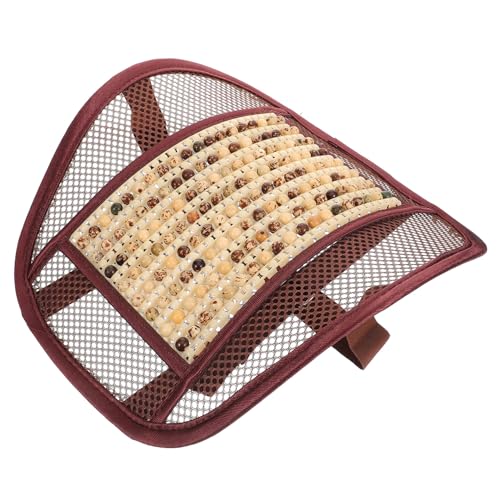
The FRCOLOR wood-bead lumbar support occupies a distinctly different design philosophy from every other product in this roundup — where the other five rely on foam-based compression response, this cushion uses hand-woven wooden beads to create a rigid-but-ventilated support surface that maintains airflow across the contact area throughout the drive. This construction approach has a long history in commercial vehicle use across Southeast Asian and South Asian markets, where drivers discovered empirically that bead surfaces reduce the sweat accumulation and skin-to-fabric adhesion that foam cushions inevitably create during warm-weather long-haul driving. The ergonomic form factor shapes the bead panel to follow the natural lumbar curve, providing firm positional support without the heat-trapping characteristics that make foam alternatives uncomfortable in warm climates or unventilated cabins.
The practical advantages of wood-bead construction are primarily thermal: the bead surface allows continuous air circulation across the driver's back, and the gap between individual beads prevents the sustained surface contact that causes foam cushions to become warm and sticky. For drivers in hot climates, or those whose vehicles lack rear seat climate control, this thermal advantage is substantial and measurable from the first drive. The cushion is also universal in application — it attaches to car seats, office chairs, and home furniture without the specific sizing constraints that affect some memory foam alternatives, and its rigid structure means it does not require a break-in period or initial compression phase.
The primary trade-off of bead construction is precisely the characteristic that makes foam attractive: foam conforms to the body's surface geometry, while beads provide a fixed-geometry surface that the body conforms to over time. Drivers with significant lumbar lordosis or irregular spinal curves may find the accommodation period longer than with compliant foam options. That said, for hot-weather driving, indoor-outdoor commuters who move between a vehicle and an air-conditioned office, or anyone who has experienced the sweaty-back phenomenon with foam cushions and abandoned them as a result, the FRCOLOR bead support solves a real problem that no foam alternative can adequately address. Just as choosing the right garage floor mat depends on your specific environment, the right lumbar support depends on your climate and driving conditions.
Pros:
Cons:
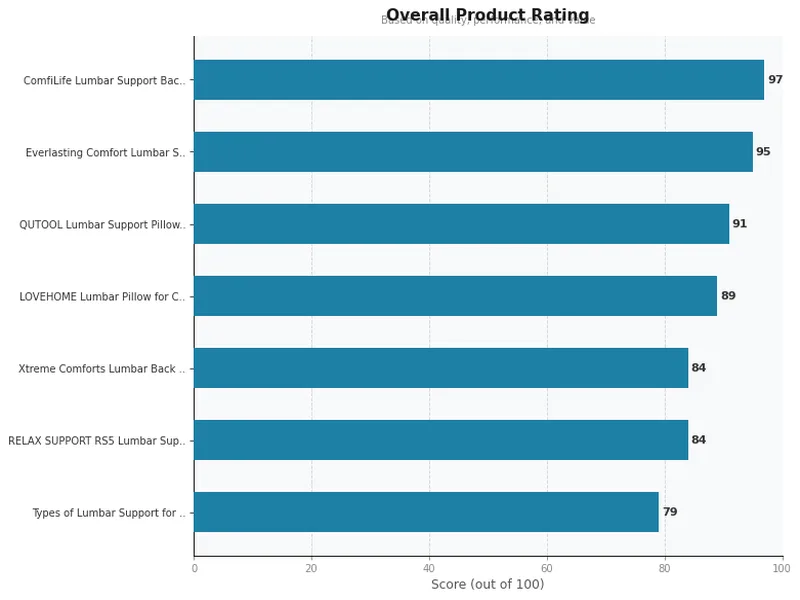
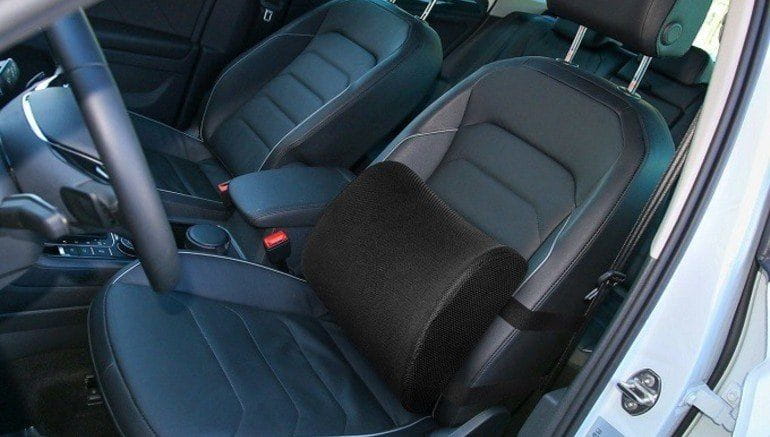
The 2026 market for lumbar car supports has matured to a point where distinguishing between a genuinely effective product and a well-photographed foam rectangle requires attention to several specific technical and practical factors. Understanding what you are actually buying — foam density ratings, strap construction, size compatibility, and ventilation characteristics — allows you to match a product to your vehicle geometry and driving profile rather than relying on marketing claims that are rarely quantified. The four criteria below are the most predictive of real-world satisfaction based on our evaluation process.
Not all memory foam is equivalent — the term describes a broad class of viscoelastic polyurethane foam that varies enormously in density, firmness, and recovery speed. High-density foam (typically 3.5 to 5.5 pounds per cubic foot) resists compression under sustained body weight and recovers its original shape between uses, while low-density foam compresses rapidly and eventually fails to return to full thickness, rendering the support ineffective within weeks of daily use. When evaluating a lumbar cushion, look for explicit density specifications in the product listing — products that describe foam as "premium" or "high-quality" without citing density figures are not providing the information you need to make a confident purchase. Slow-rebound foam (with a recovery time of two to five seconds) is generally preferred for lumbar support because it distributes pressure gradually rather than pushing back against your spine with immediate resistance, which can create uncomfortable point-pressure sensations during extended driving.
A lumbar support cushion that migrates from the correct vertebral position within thirty minutes of driving is functionally worthless regardless of how effective the foam is at the correct height. Evaluate strap systems by looking at two factors: adjustability range and secondary retention. Adjustable elastic straps with a range of at least 12 to 24 inches accommodate the vertical variation in seat back height across different vehicle classes — a strap sized for a compact sedan will not reach the correct position on a full-size truck seat. Secondary retention, in the form of non-slip base materials or friction-grip back panels, prevents the cushion from riding upward or laterally during driving. Products with both adjustable straps and a non-slip back surface maintain their position reliably across a full driving session without requiring manual repositioning at stops.
Lumbar support cushions are rarely sized for the specific vehicle you drive, which makes it essential to check the cushion's width and depth against your seat's available surface area before purchasing. Standard lumbar pillows run approximately 13 to 16 inches wide and 4 to 7 inches deep — measurements that fit within most bucket seat geometries without overlapping the seat bolsters. Extended-format cushions like the first product in this roundup measure up to 20.9 inches wide, which is appropriate for flat-back SUV and truck seats but may overlap the structural bolsters of tightly contoured sport seats, reducing effective contact and potentially causing the cushion to tilt. Additionally, drivers of larger vehicles — full-size SUVs, pickup trucks, and semi-trucks — should prioritize cushions with dimensions and strap ranges designed for their seat geometry rather than assuming a standard-size product will perform equivalently.
Foam-core cushions generate and retain heat at the contact surface — a physical consequence of the material's insulating properties that becomes a meaningful comfort factor during summer driving or in vehicles with limited climate control. Breathable mesh covers, perforated foam panels, and ventilation channels can reduce heat accumulation, but none of these approaches matches the thermal performance of bead-surface constructions, which allow continuous airflow through gaps between individual beads. If your primary driving environment includes high-temperature conditions, an open-cabin vehicle, or a vehicle with rear climate control restrictions, weighting breathability as your top selection criterion and considering bead-surface options is a defensible and evidence-supported decision. For climate-controlled daily commute vehicles, breathability becomes a secondary consideration, and foam compliance and support quality take priority.
Research supports the effectiveness of ergonomic lumbar supports for reducing driving-related lower back pain, particularly for drivers who spend more than two hours per day in a vehicle. The mechanism is straightforward: vehicle seats are designed to an average lumbar curve that does not match most individual drivers, and a properly sized lumbar support fills the gap between the seat and your actual spinal geometry, reducing the muscular compensation that generates fatigue and pain. The key qualifier is "properly sized" — a lumbar support positioned at the wrong vertebral level or with incorrect depth adds pressure rather than relieving it.
The correct position places the thickest or highest point of the lumbar support at the L3-L5 vertebral region — approximately at the level of your belt line when seated. The cushion should contact your lower back when you are sitting upright with your hips pushed fully into the seat, not when you are slouching forward. If the support feels like it is pushing your mid-back forward or creating pressure at your upper lumbar, it is positioned too high. Most adjustment errors involve placing the cushion too high on the seat back, which addresses the thoracic spine rather than the lumbar region.
Yes — most lumbar support cushions sold for automotive use work equally well on office chairs, and several products in this roundup are explicitly rated for both environments. The key compatibility factor is strap reach: office chairs with low-back frames or no vertical adjustment require straps with a broader adjustment range, and cushions with non-slip base materials perform well on fabric office chair surfaces without any strap attachment at all. Dual-environment use increases the per-dollar value of the purchase substantially for commuters who spend the bulk of their day sitting in both a vehicle and a desk chair.
High-density memory foam lumbar cushions from reputable manufacturers maintain effective support for approximately two to four years of daily use before the foam's structural resistance declines below functional threshold. Lower-density alternatives may begin to show measurable compression loss within three to six months of heavy use. The clearest indicator of foam degradation is that the cushion no longer returns to its original thickness after being removed from pressure — if you press the cushion and it recovers slowly or incompletely after several seconds, the internal foam structure has begun to fail and the support it provides has declined proportionally. Bead-surface cushions have essentially unlimited structural life under normal use conditions since wood does not fatigue in the way foam does.
A lumbar support pillow attaches to the seat back and provides targeted support to the lower spine without modifying the seated height or pressure distribution across the seat pan. A full seat cushion sits on the seat base and addresses seated bone pressure and hip angle without necessarily providing any back support. The L-shaped combination designs, like the Allaboutsla unit reviewed above, integrate both functions in a single connected piece, addressing lumbar alignment and seated pressure distribution simultaneously — a design approach that produces better fatigue outcomes on extended drives than either component alone, at the cost of greater bulk and higher price.
Standard lumbar support pillows that attach to the seat back with straps do not interfere with side-curtain or roof-mounted airbag systems, which deploy from the headliner or door frame rather than the seat back. However, vehicles with seat-mounted side airbags — which deploy from the outer edge of the seat back — require careful positioning to ensure the lumbar cushion does not block or redirect the airbag deployment path. Consult your vehicle's owner manual to identify airbag deployment locations before attaching any aftermarket cushion to the seat back, and keep the cushion positioned at the center of the seat back rather than extending to the outer edge where seat-mounted airbags are typically located.
 |
 |
 |
 |

About Rachel Park
Rachel Park specializes in the interior and exterior upgrades that meaningfully change how a car looks, sounds, and feels on a daily basis. She has hands-on experience with head unit installations and audio system builds, LED and HID lighting conversions, interior refresh projects, and cosmetic exterior work — evaluated from both a DIY accessibility and quality-of-result perspective. At CarCareTotal, she covers car audio and electronics, lighting upgrades, and interior and exterior styling accessories.
Get some FREE car parts & gear.. Or check out the latest free automotive manuals and build guides here.
Disable your ad blocker to unlock all the hidden deals. Hit the button below 🚗
| | | |
