Lighting ›
by Rachel Park
According to independent aftermarket research, the global automotive LED interior lighting segment surpassed $2.8 billion in retail sales in 2025, with demand accelerating as RGBIC technology and smartphone-integrated controls bring unprecedented customization to everyday drivers. Car interior LED light strips have evolved far beyond simple underdash glow tubes; modern kits offer 16 million color outputs, microphone-driven music synchronization, and per-segment color control that rivals professional-grade stage lighting systems. Selecting the correct kit requires careful evaluation of chip architecture, control ecosystem compatibility, mounting adhesive quality, and wiring harness design — factors that separate a lasting upgrade from a frustrating weekend project.
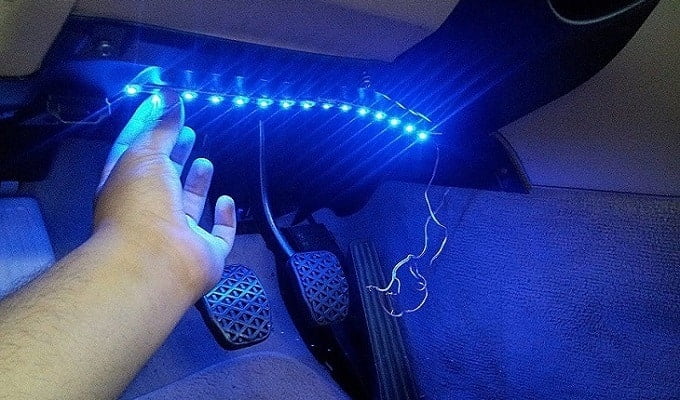
The 2026 market spans a wide spectrum of price points and capability tiers, from plug-and-play cigarette-lighter kits aimed at first-time installers to sophisticated Bluetooth-mesh systems with dedicated iOS and Android applications featuring custom scene scheduling and firmware over-the-air updates. Buyers who invest thirty minutes in understanding lumens output, IP water-resistance ratings, and adhesive backing quality consistently report significantly higher long-term satisfaction than those who prioritize price alone. This guide evaluates seven of the most technically capable and consumer-validated interior LED strip kits currently available, delivering detailed specifications, verified performance assessments, and a structured buying framework drawn from extensive product analysis. For those also considering exterior illumination upgrades, the editorial team's review of the best 30-inch LED light bars of 2026 provides a complementary perspective on high-output vehicular lighting systems.
The seven products reviewed below represent distinct approaches to the interior LED strip category, ranging from RGBIC segmented color control to fiber-optic ambient diffusion. Each review covers chip technology, control interface depth, build durability, and real-world installation considerations. The subsequent buying guide distills the critical specification categories buyers must evaluate before committing to a purchase, ensuring that the selected kit delivers consistent performance across multi-year daily driving conditions. Drivers who also invest in complementary interior upgrades — such as those featured in the best shift knobs guide of 2026 — will find that quality LED ambiance lighting further elevates the overall cockpit aesthetic. Additional context on the broader automotive lighting accessory landscape is available throughout this site.
Contents
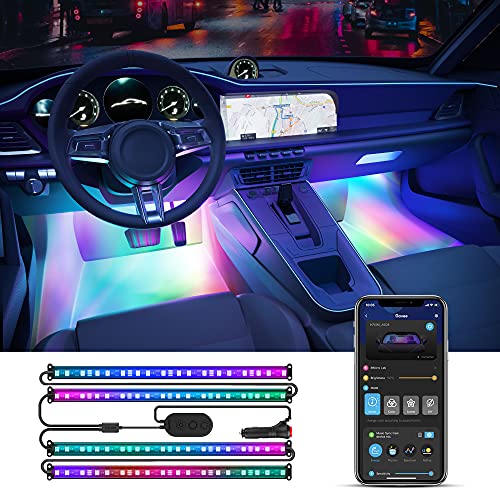







The Govee Car LED Strip Lights (ASIN: B093Q9SFLL) represent the most technologically advanced entry in this roundup, deploying RGBIC — RGB with Independent Control — chip architecture that enables simultaneous multi-color segment display across a dual-strip two-line design. Unlike conventional RGB strips that display a single color across the entire strip length, the RGBIC configuration partitions each strip into independently addressable zones, allowing gradient transitions, chase effects, and spatially dynamic patterns that are simply impossible with standard LED arrangements. The Govee Home application, compatible with iOS and Android platforms, provides access to an extensive library of preset scene modes organized by theme categories including nature, holiday, and emotion, alongside a comprehensive custom color picker delivering access to 16 million color combinations.
The four dedicated music modes leverage a built-in microphone to perform real-time audio frequency analysis, translating bass, mid-range, and treble signals into distinct lighting behaviors that respond to dynamic changes in rhythm and amplitude. DC 12V operation through the vehicle's power system ensures consistent illumination without voltage fluctuation artifacts. The 3M adhesive backing integrated into the dual-strip design facilitates clean routed installation along door sills, under-dash rails, and seat track channels. Govee's firmware update infrastructure ensures that new scene modes and control features become available over time without hardware replacement, delivering a genuinely future-proof investment for buyers who prioritize long-term feature depth over immediate simplicity.
The Govee ecosystem's depth does introduce a dependency on the companion application for accessing the full feature set; buyers without consistent smartphone access will find the standalone operation modes more limited than those of remote-controlled competitors. The dual-strip two-line orientation, while aesthetically distinctive and coverage-maximizing, requires additional planning during installation to route both strips cleanly and symmetrically within the cabin footwell geometry.
Pros:
Cons:
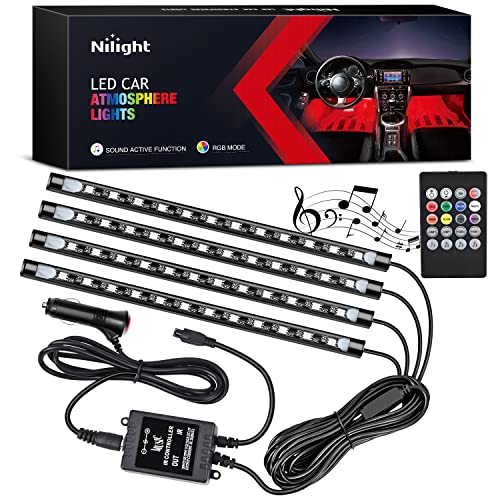
The Nilight TR-06 delivers a four-piece 48-LED under-dash lighting kit at a price point that consistently positions it among the highest-volume sellers in the interior ambient lighting category, validating Nilight's reputation for engineering accessible products without sacrificing core functional performance. The kit operates on DC 12V power and is constructed from ABS material with a documented ultra-thin profile that accommodates mounting in constrained footwell recesses and under-seat channels where bulkier strip systems cannot physically fit. The sound activation function uses an integrated microphone to interpret vocal and music inputs as color-change triggers, allowing the illumination pattern to track the rhythm and amplitude of car stereo audio output in real time.
The wireless remote control system provides manual override capability for color selection and brightness adjustment, operating through a dedicated receiver box that requires clear line-of-sight positioning for reliable signal transmission — a practical installation consideration buyers should address during mounting. Nilight backs the TR-06 with a two-year manufacturer's warranty, a coverage period that exceeds the typical one-year policy offered by competing budget-tier kits and reflects the brand's confidence in the product's long-term operational durability. The water-resistant and anti-corrosion construction extends the product's viable installation range beyond pure interior applications to include boat cabin environments and convertible vehicles with exposed footwell areas.
The TR-06's control ecosystem remains hardware-bound; there is no Bluetooth application integration, which limits dynamic color customization to the remote's fixed preset palette rather than the 16-million-color freedom offered by app-controlled competitors. Buyers seeking granular color tuning beyond the preset selection will find the remote's palette restrictive for advanced personalization demands.
Pros:
Cons:
OPT7 has maintained a position as one of the most recognized names in the automotive LED accessory segment for over fifteen years, and the Aura Interior Car Lights kit reflects that institutional knowledge through refined engineering choices that prioritize ease of installation, physical durability, and long-term adhesion reliability. The four-piece single LED strip configuration delivers coverage across under-dash, door panel, seat divider, and console channel mounting positions, with the flexible and bendable strip construction enabling conformity to curved surfaces that rigid or semi-rigid competitors cannot accommodate without creating visible straight-line gaps.
The wireless remote control system manages access to nine vibrant preset colors, six distinct light show patterns, variable speed controls, and a Soundsync music-reactive mode that interprets audio amplitude signals as brightness and speed modulation inputs. The Cycle, Strobe, Color Fade, and Dimmer functions on the included remote provide sufficient control depth for the majority of buyers who prefer hardware-bound operation over application-dependent customization. OPT7's waterproof and low-profile construction has been validated across hundreds of thousands of real-world installations spanning show cars, daily commuters, and fleet vehicles — a breadth of deployment that provides meaningful durability assurance beyond laboratory specification sheets.
The Aura kit's control architecture does not include Bluetooth or Wi-Fi connectivity, positioning it as a deliberately hardware-centric product that trades application-layer feature depth for installation simplicity and operational independence from smartphone pairing requirements. Buyers who have experienced connectivity reliability issues with app-controlled competitors will find this hardware-only approach practically advantageous, though those seeking 16-million-color granularity will need to look toward app-integrated alternatives.
Pros:
Cons:
The Xprite RGB LED Car Interior kit distinguishes itself within the app-controlled segment through its USB power delivery architecture combined with Bluetooth application integration, delivering a dual-control pathway that provides both granular smartphone-based customization and hardware remote fallback without requiring direct wiring into the vehicle's 12V electrical system for power. The four-strip configuration deploys a total of 72 LEDs across four 18-LED strips, with each strip utilizing high-intensity 3-in-1 RGB chip technology that produces a demonstrably brighter output per LED than single-chip competitors — a specification advantage that becomes particularly visible in vehicles with dark interior color schemes where ambient light diffusion is critical for achieving the intended atmospheric effect.
The Bluetooth control application, compatible with iOS 7 and above and Android 4.3 and above, provides access to a 16-million-color RGB wheel, a downloaded music playback feature, active microphone-responsive modes, and a library of over 30 strobe patterns. The active microphone synchronization performs real-time audio frequency translation, modulating color and speed parameters in response to dynamic changes in the ambient sound environment. The USB plug input configuration extends the product's installation range beyond automotive applications to include motorcycle cockpits, ATV dashboards, boat cabins, and off-road UTV interiors where 12V hardwire access is less consistent than a standard USB port.
The USB power delivery architecture, while broadening compatibility scope, introduces a dependency on available USB port capacity in vehicles that may already have port-limited charging demands from navigation devices, phone chargers, and dashcam power supplies. The cable routing solution — designed to conceal wiring beneath floor mats — requires careful installation planning to avoid creating trip hazards or interference with pedal travel clearance in tightly configured driver footwells.
Pros:
Cons:
The DEHERANE Interior Car LED Strip Lights kit occupies a technically distinct category within this roundup by integrating 315 inches of fiber optic cable into a six-in-one ambient lighting system, creating an illumination character that is qualitatively different from conventional LED strip glow. Fiber optic distribution produces a diffuse, even luminous quality across the cable's full length without discrete LED hotspots, generating the soft ambient wash that automotive OEM designers replicate in luxury cabin lighting systems at price points many multiples higher than the DEHERANE kit. The six-piece configuration provides comprehensive coverage of dashboard edges, door grab rails, footwell perimeters, and seat base channels simultaneously — a spatial ambiance depth that four-strip competitors cannot match without supplemental kit additions.
The control ecosystem combines RF wireless remote with a dedicated smartphone application, providing access to 16 million RGB colors and 29 distinct glow modes spanning cozy, romantic, and dynamic rhythm-driven patterns. The built-in sensitive microphone performs sound-active synchronization, translating music rhythm and amplitude changes into jumping, flashing, and fading light behaviors that integrate with the fiber optic medium's characteristic diffuse glow quality. DIY mode within the application enables buyers to construct fully custom color sequences and timing patterns beyond the 29 preset library entries, extending the creative ceiling well above what fixed-mode remote competitors offer.
The fiber optic installation process is inherently more involved than conventional LED strip mounting; the cable bundles require careful routing through existing body cavities and trim channels to achieve the seamless integrated appearance that justifies the system's technical complexity. Buyers without experience in automotive trim disassembly should allocate additional installation time and consider consulting a professional installer to achieve OEM-quality results from the fiber optic routing process.
Pros:
Cons:
The SUNPIE Car LED Lights Interior RGB kit combines a documented waterproof construction standard with Bluetooth smartphone control integration, creating a product positioned for buyers who operate vehicles in environments where moisture intrusion into the cabin footwell area represents a realistic operational concern — a category that includes off-road 4x4 drivers, boat owners running the strips in marine cabin environments, and convertible vehicle operators in high-humidity climates. The 8.8-foot total strip length provides sufficient coverage for most passenger car and compact SUV interiors, and the DC 12V car charger included in the kit enables clean installation without USB port dependency or complex hardwire routing for buyers lacking electrical modification experience.
Bluetooth control via smartphone delivers access to 16 million color combinations with intuitive brightness scaling and mode switching from a single application interface. The music sync function performs real-time audio analysis through the device microphone, translating beat and rhythm signals into synchronized lighting behavior that adapts dynamically to genre transitions and tempo changes during playback. SUNPIE's emphasis on waterproofing as a primary engineering specification distinguishes this product from competitors that document water-resistance — a materially different and lower protection standard — as their moisture-mitigation claim.
The 8.8-foot strip length, while appropriate for standard passenger vehicles, may prove insufficient for full-coverage installation in extended-wheelbase SUVs, full-size pickup truck cabins, or van conversions where footwell, seat track, and pillar ambiance coverage simultaneously demands more total strip length than the kit provides. Buyers with large vehicle interiors should verify coverage calculations against the 8.8-foot specification before purchase.
Pros:
Cons:
The LEDGlow 4pc Multi-Color LED Interior Kit represents the most installation-accessible product in this roundup, delivering a fully operational four-tube 96-SMD-LED under-dash lighting system through a standard 12V cigarette lighter adapter that eliminates the need for any direct electrical wiring, fuse tap, or control box hardwire connection. Each of the four 9-inch interior tubes houses 24 SMD LEDs with 5 feet of pre-terminated wire, providing sufficient reach for routing from a centrally positioned control box to all four quadrants of a standard passenger vehicle footwell without extension wiring. The cigarette lighter adapter power solution means installation requires no tools, no electrical knowledge, and no modification to the vehicle's existing wiring harness — a meaningful practical advantage for buyers who prioritize reversibility and rental or lease vehicle compatibility.
The control box manages access to seven solid colors — Blue, Red, Green, Purple, Teal, White, and Yellow — along with four fading modes, three strobing modes, one sound activation mode that responds to music playing within the cabin, and an Auto Illumination Bypass Mode that links the kit's power state to the vehicle's ignition source for automatic on-and-off behavior without manual remote interaction. LEDGlow's long-standing market presence and extensive review history across multiple vehicle platforms provides buyers with a depth of real-world installation and longevity data that more recently introduced competitors lack, supporting confident purchase decisions where proven track record carries material weight alongside specification comparisons.
The seven-color solid preset architecture is definitively more limited than the 16-million-color outputs offered by Bluetooth application-integrated competitors, and the SMD tube form factor produces a more point-source light character than the diffuse ambient wash generated by fiber optic or RGBIC strip competitors. Buyers who prioritize installation simplicity and operational independence from smartphone pairing will find the LEDGlow's trade-offs entirely acceptable; buyers who prioritize color depth and dynamic scene programming should evaluate the Govee or DEHERANE alternatives instead.
Pros:
Cons:
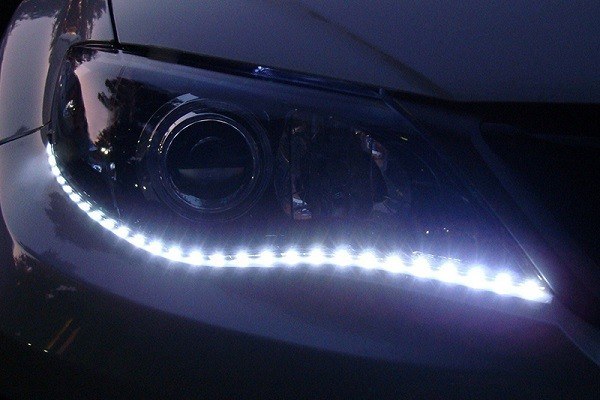
The interior LED strip category spans a wide range of technical specifications and control ecosystem architectures that produce meaningfully different real-world experiences despite superficially similar marketing language. Buyers who evaluate the following criteria systematically before purchase consistently achieve better long-term outcomes than those who base decisions on price or color count alone. According to the LED technology entry on Wikipedia, chip architecture and forward voltage specifications have a direct relationship to longevity and color rendering accuracy — factors that carry significant weight in automotive environments where thermal cycling and vibration accelerate component degradation.
The most fundamental specification distinction in the 2026 interior LED strip market separates RGB chips — which display a single blended color across the entire strip simultaneously — from RGBIC chips that enable independent control of discrete strip segments for gradient and multi-color effects. Buyers who have experienced standard RGB strips and found the single-color limitation visually flat should prioritize RGBIC systems such as the Govee kit reviewed above. Additional chip quality indicators include:
The control interface architecture determines the practical ceiling of color customization, mode depth, and operational convenience over the product's lifespan. Three distinct control tiers exist in the current market, each with specific advantages for defined buyer profiles:
The installation method has direct implications for both installation complexity and long-term operational reliability in the automotive environment. Power delivery options span three categories with distinct trade-off profiles:
Adhesive backing quality is a frequently overlooked installation specification; 3M-backed strips demonstrate significantly superior long-term adhesion in automotive thermal environments compared to generic double-sided tape alternatives, particularly in footwell channels where summer interior temperatures routinely exceed 140°F. Buyers installing strips in pickup trucks or SUVs should also review the lighting considerations addressed in the best halo lights for Jeep Wrangler guide of 2026 for complementary exterior lighting upgrade context.
Automotive interior environments subject LED strips to a demanding combination of thermal cycling, vibration, UV exposure from window intrusion, and occasional moisture from footwell condensation, tracked-in rain, and car wash water entry. Evaluating the following specifications before purchase reduces premature failure risk:
Interior LED light strips are legal in most United States jurisdictions when the illumination is directed downward toward the footwell and does not project light forward through the windshield or toward other drivers. Regulations vary by state; several states restrict visible interior colored lighting visible from outside the vehicle. Buyers should verify local vehicle modification codes before installation, as enforcement practices differ significantly between municipalities and states.
Under the Magnuson-Moss Warranty Act, automotive manufacturers cannot void a vehicle warranty solely because an aftermarket accessory was installed, unless the manufacturer can demonstrate that the accessory directly caused the failure in question. LED light strips drawing power from the cigarette lighter or USB ports present no credible warranty risk. Hardwire installations tapping fuse box circuits fall into a grayer interpretive zone and should be documented carefully.
RGB strips contain red, green, and blue diodes in each LED chip that blend to produce a single color displayed uniformly across the entire strip length. RGBIC strips partition the strip into independently addressable segments, allowing different colors to display simultaneously across different strip zones. The RGBIC architecture enables gradient transitions, chase patterns, and multi-color scene modes that RGB strips physically cannot produce, making RGBIC the preferred choice for buyers who prioritize visual sophistication over budget economy.
Music sync modes use a built-in microphone on the LED controller to sample ambient audio in real time, performing basic frequency or amplitude analysis to trigger color changes, speed variations, and pattern transitions that correlate with the detected sound level and rhythm. More sophisticated implementations — such as those in the Govee and DEHERANE kits — distinguish between bass, mid-range, and treble frequency bands to create more musically nuanced lighting responses than simple amplitude-triggered systems.
Quality LED strips using binned SMD 5050 or equivalent chips in automotive thermal environments typically deliver between 30,000 and 50,000 operational hours under normal cycling conditions, which translates to many years of daily use at typical commute durations. Lifespan is primarily determined by thermal management quality, adhesive degradation leading to strip detachment and subsequent vibration stress, and the durability of solder connections at strip cut points and power input junctions.
The products reviewed in this guide are universally compatible with any DC 12V vehicle, including passenger cars, SUVs, pickup trucks, vans, RVs, and boats. USB-powered options such as the Xprite kit extend compatibility to any platform with a standard USB port regardless of 12V system accessibility. Buyers installing strips in RV interiors should also consult the editorial team's best budget car speakers guide of 2026 for complementary cabin audio upgrade recommendations that pair well with music-synchronized LED ambiance systems.
 |
 |
 |
 |

About Rachel Park
Rachel Park specializes in the interior and exterior upgrades that meaningfully change how a car looks, sounds, and feels on a daily basis. She has hands-on experience with head unit installations and audio system builds, LED and HID lighting conversions, interior refresh projects, and cosmetic exterior work — evaluated from both a DIY accessibility and quality-of-result perspective. At CarCareTotal, she covers car audio and electronics, lighting upgrades, and interior and exterior styling accessories.
Get some FREE car parts & gear.. Or check out the latest free automotive manuals and build guides here.
Disable your ad blocker to unlock all the hidden deals. Hit the button below 🚗
| | | |
