by Liam O'Brien
You're standing in the garage, key in hand, and the starter motor turns over once — slowly — before giving up entirely. Maybe it's a cold morning, maybe the bike sat for a few weeks, or maybe you just knew that three-year-old battery was living on borrowed time. Whatever brought you here, choosing the right replacement motorcycle battery in 2026 is more consequential than most riders realize, because the wrong decision means replaying that exact scenario somewhere less convenient than your own driveway.
Motorcycle batteries have split into two distinct families over the past decade, and both families have a legitimate case in 2026. AGM (Absorbed Glass Mat) lead-acid batteries offer proven compatibility with every charging system, sealed maintenance-free operation, and accessible pricing — they're the standard for a reason, and quality brands like Yuasa have earned decades of trust from OEM engineers and riders alike. Lithium iron phosphate (LiFePO4) batteries weigh 60-70% less than comparable AGM units, hold a charge through longer storage periods without self-discharging, and never sulfate or corrode from the inside out. Picking between them — and picking the right model within each category — is exactly what this guide is designed to help you do.
We've analyzed specifications, dug into construction details, and evaluated real-world use cases across the full range of motorcycle applications to bring you the best motorcycle batteries of 2026, covering everything from high-performance AGM options for sport bikes to heavy-duty lithium packs for loaded touring rigs. If you're upgrading multiple aspects of your ride at the same time, our guide to the best motorcycle tires of 2026 is a natural companion read. Here's everything you need to make the right call the first time.

Contents











Yuasa is the brand that motorcycle OEM engineers specify when they need a battery to live inside the frame of a performance machine and start reliably for years without complaint, and the YTZ14S is a prime example of why that reputation holds in 2026. This battery arrives factory activated and fully charged, which means you install it and ride — no acid filling, no activation wait time, no initial conditioning cycle standing between you and the road. The radial grid design increases the internal plate surface area, which Yuasa credits directly for a 30% cranking amp increase over standard maintenance-free batteries, giving your starter motor the authority it needs to spin a high-compression engine decisively on the first key turn.
The construction centers on VRLA (Valve Regulated Lead Acid) technology with advanced lead-calcium alloy grids, which hold their charge state more than three times longer than conventional lead antimony battery designs. In practical terms, your battery won't self-discharge nearly as fast during a two-week storage gap, and you'll get consistent starts even after a cold winter month if you've maintained the battery on a tender between rides. The spill-proof sealed case eliminates any leakage risk regardless of installation angle, making the YTZ14S fully safe for sport bikes where the battery compartment isn't always perfectly upright and vibration is a constant factor.
If you ride a Honda, Yamaha, Kawasaki, or Suzuki sport bike or naked motorcycle that specifies the YTZ14 group size, this battery delivers factory-grade reliability with measurable performance advantages over budget alternatives. It's not the least expensive AGM you'll find, but for a bike you depend on daily, the Yuasa YTZ14S earns its price by starting reliably across seasons and carrying the warranty backing of a brand that supplies motorcycle manufacturers as a tier-one OEM partner.
Pros:
Cons:
When you're running a fully loaded touring bike with heated grips, GPS navigation, an intercom system, and extra lighting all drawing current simultaneously, you need a battery that can handle that electrical demand without the voltage sag that compromises accessory performance and starter reliability. The Antigravity ATX30-HD delivers 970 cranking amps and 24Ah of true lithium capacity — equivalent to 48Ah in lead-acid terms — which represents serious power reserves inside a package sized to replace a standard YTX30 group battery. That means no box modifications, no custom bracket fabrication, and no adapter hardware: it drops directly into the space your old heavy lead battery occupied while immediately eliminating significant chassis weight.
Antigravity engineered the ATX30-HD specifically for riders who put serious miles on large machines, targeting big V-Twins, loaded touring motorcycles, and high-performance UTVs that demand more from their electrical systems than smaller bikes do. The full Battery Management System monitors cell voltage continuously and provides comprehensive protection against overcharge, over-discharge, and temperature extremes across the full operating range — protection that extends the battery's useful lifespan well beyond what an unmanaged lithium pack offers. Automatic cell balancing maintains consistent performance across the complete capacity range, so you don't experience the sudden voltage drop near empty that characterizes batteries with passive balancing systems.
For touring riders who are already investing in quality gear to protect themselves on long runs — including reliable motorcycle helmet locks for overnight stops — the ATX30-HD represents the same principle applied to your electrical system: invest in the right level of capability upfront and you won't deal with failures when you're four hundred miles from home. This battery's combination of extreme cranking power, substantial capacity, and intelligent cell management makes it the definitive choice for heavyweight touring applications where reliability is genuinely non-negotiable.
Pros:
Cons:
The Yuasa YTX20L-BS has served as the trusted standard-bearer for cruiser and mid-size touring riders for years, and it continues to earn that reputation in 2026 as one of the most dependable and well-priced AGM options in the popular YTX20 group size. It ships with the acid pack included — you fill it once, seal it permanently, and you're done managing electrolyte for the entire life of the battery. The AGM separator technology absorbs all electrolyte into the fiberglass mat material, making the battery completely non-spillable and safe to mount in any orientation without risk of acid damage to your frame, wiring harness, or bodywork components.
Yuasa's lead-calcium alloy grid holds its specific gravity more than three times longer than conventional lead antimony alternatives, which translates directly to lower self-discharge rates and more reliable starts after storage periods. The valve-regulated design eliminates water loss and the need for refilling entirely — you open this battery exactly once during activation and never again afterward. For riders who store their bikes seasonally in a garage or shed, this characteristic matters considerably, since a battery that doesn't aggressively drain itself through self-discharge is a battery that still starts your bike in the spring without requiring a full charging session before your first ride of the season.
Cruiser riders on Honda Shadow, Kawasaki Vulcan, and Yamaha V-Star platforms — all of which commonly specify the YTX20L-BS group size — will find this battery fits their application precisely and delivers the consistent, long-term reliability that Yuasa's manufacturing reputation was built on. It doesn't shed the pounds that a lithium alternative would, but if you want proven AGM technology at a fair price backed by a brand with direct OEM relationships, the YTX20L-BS is the straightforward right answer for your application.
Pros:
Cons:
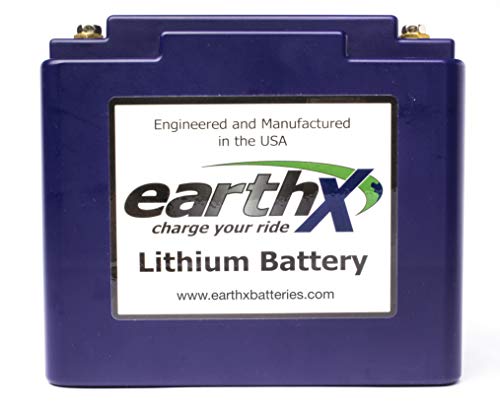
At 3.9 pounds and 680 cranking amps, the EarthX ETX36D makes a compelling case for LiFePO4 technology in a focused, purpose-built package oriented toward riders who want serious starting power without the weight penalty of lead chemistry. EarthX built its reputation specifically in the motorsport and powersport segment rather than the general consumer market, and this battery reflects that engineering focus at every level — designed for weight-conscious riders who aren't willing to compromise cranking performance in exchange for shedding pounds from the chassis. The complete elimination of acid and lead also eliminates the failure modes those materials inevitably introduce: no sulfation building up on plates over successive discharge cycles, no corrosion eating through terminal connections, no risk of freezing at low temperatures, and no risk of boiling over in extreme heat conditions.
The integrated battery management system protects against the electrical faults that shorten any lithium battery's service life prematurely, including overcharge and deep over-discharge conditions. Lithium iron phosphate chemistry is inherently more thermally stable than other lithium formulations, making it the preferred choice for powersport applications where batteries may sit in enclosed compartments near heat-radiating engine components through long summer rides. EarthX has used LiFePO4 exclusively since their founding specifically because of those thermal safety characteristics and the long cycle life the chemistry delivers.
If you're upgrading from an aging AGM battery and want to feel an immediate difference in how your bike handles — particularly on a sport bike or performance-oriented naked where every pound in the chassis affects cornering balance and steering feel — the ETX36D delivers that weight reduction without demanding any compromise on starting reliability. The 680CA figure gives you strong, confident starts across a wide temperature range, and the absence of sulfation means this battery maintains its performance characteristics across multiple riding seasons rather than gradually weakening the way lead-acid batteries do after their second or third year.
Pros:
Cons:
The Antigravity ATX12-HD occupies a category of one because of a single feature that no other battery on this list offers: built-in jump starting capability that requires no external equipment. The RE-START technology works exactly the way the name suggests — when your battery has discharged to a point where the engine won't crank, you press a button on the battery casing itself and it releases a reserve power burst that starts your bike without jumper cables, without a portable jump starter pack, and without needing another vehicle within reach. For riders who tour remote roads, commute in unpredictable conditions, or simply want a genuine insurance policy against dead-battery situations that leave you stranded far from help, that feature alone justifies this battery's place on your shortlist.
Beyond the headline capability, the ATX12-HD delivers what Antigravity describes as up to 200% larger lithium cell packs compared to competitors' batteries within the same physical group size, meaning more cranking amps and amp hours than the size category nominally implies. The comprehensive BMS provides cell balancing alongside full protection against overcharge, over-discharge, over-temperature, and short circuit conditions — the combination of protections that Antigravity credits for the longest service life in their lineup. A remote RE-START accessory is also available separately, allowing you to trigger the jump-start function from the saddle without accessing the battery compartment buried beneath your seat or tank.
This battery fits a genuinely broad range of applications — ATVs, UTVs, scooters, lawn mowers, and generators alongside motorcycles — making it a practical option if you have multiple machines to maintain. Riders who complement their setup with a quality motorcycle helmet for head protection and the ATX12-HD for electrical reliability share a common instinct: invest in the best protection available for the systems that matter most, and you'll never regret that decision on the road.
Pros:
Cons:
The EBL YTX12-BS brings LiFePO4 technology to a price point that makes lithium chemistry accessible without requiring a major budget commitment, positioning it as the practical entry point for riders who want to step up from lead-acid without spending on the established premium brands. At 12V, 8Ah, and 480CA with 240CCA, this battery targets the YTX12-BS group size but also cross-fits a remarkably wide range of extended sizes including YTX14-BS, YTX16-BS, YTX15L-BS, and several YTX20 variants — making it one of the most versatile fitment options across our entire list and a genuinely useful choice if you're managing multiple machines. It ships fully charged and ready to install with no activation procedure required, no acid handling, and no waiting period.
EBL's dynamic BMS uses bi-directional active cell balancing, which is a more sophisticated approach than the passive balancing found in many budget lithium batteries and helps maintain consistent cell voltages across the full charge and discharge cycle without requiring any user intervention. The rapid-charge capability stands out as genuinely useful in real-world situations: EBL claims enough starting power is restored within just five minutes of charging connection, meaning a brief stop near a charging source can rescue a seriously depleted battery rather than requiring a complete multi-hour recharge before the bike is rideable again. At only 3.08 pounds, you also get meaningful weight savings compared to any lead-acid battery filling the same physical space in the battery compartment.
The EBL YTX12-BS makes its strongest case for commuter bikes, smaller-displacement machines, scooters, ATVs, jet skis, and PWC applications — anywhere you want lithium's core advantages (no sulfation, zero electrolyte maintenance, extended storage shelf life) without flagship pricing. The broad fitment compatibility across multiple group sizes also makes it sensible if you're maintaining several machines and want to standardize on a single battery type across your garage without a large per-unit investment.
Pros:
Cons:
Odyssey batteries occupy a specific and well-defended niche in the powersports market: pure, documented long-term reliability with a service life that outlasts most of the competition by a substantial margin. The PC545 offers three to ten years of service life depending on usage, maintenance, and storage practices — a range that begins where most conventional batteries end and extends to a point that makes the cost-per-year arithmetic compelling regardless of the upfront price. The 150 CCA rating targets smaller to mid-size powersport applications, and the thin plate pure lead (TPPL) construction that Odyssey uses delivers better deep-cycle capability alongside its cranking performance than conventional AGM designs, making it more tolerant of the partial discharge cycles that happen when accessories draw power with the engine off.
The two-year full replacement warranty — critically, not pro-rata — backs up Odyssey's confidence in their manufacturing quality and represents a genuinely stronger commitment than what most competitors offer. Pro-rata warranty policies depreciate the replacement value over time, meaning you receive a partial credit rather than a new battery as the unit ages; Odyssey's full replacement commitment for two complete years means you get a new battery if the PC545 fails within that window, full stop. For powersport applications including ATVs, scooters, personal watercraft, and smaller motorcycles where you want to install a battery and not think about it again for multiple seasons, Odyssey's track record of longevity is the strongest selling point in this entire category.
The PC545 works particularly well for riders and owners who store their machines for extended periods between uses — seasonal boats, occasional-use ATVs, or a second bike that doesn't turn a wheel from November through April. Our tools and resources section can help you outfit your complete powersport setup, and the Odyssey PC545 anchors the electrical foundation of any occasional-use vehicle with documented, warranty-backed dependability that justifies the investment over multiple years of ownership.
Pros:
Cons:
Selecting the right motorcycle battery comes down to matching the battery's specifications to your engine's requirements, your bike's charging system, and your riding habits — not simply choosing the most powerful or most expensive option on the shelf. These are the four factors that determine the right call in 2026.
The most consequential decision you'll make is choosing between AGM lead-acid and LiFePO4 lithium chemistry, and both families have legitimate strengths. AGM batteries are proven, compatible with every motorcycle charging system ever manufactured, and available at accessible price points — they're the standard for a reason, and quality manufacturers like Yuasa supply them directly to OEM assembly lines. Lithium iron phosphate batteries weigh 60-70% less than comparable AGM units, self-discharge at a dramatically lower rate during storage, and never suffer from sulfation degradation that progressively weakens lead plates over multiple seasons. The critical compatibility caveat: lithium batteries require a lithium-compatible smart charger and benefit from a regulated charging system. If your bike runs an older unregulated charging system that delivers variable voltage, verify LiFePO4 compatibility before purchasing — AGM remains the universally safe choice for any charging system without that verification step.
Cranking amps (CA) and cold cranking amps (CCA) measure your battery's ability to deliver high current over a short burst — this specification determines whether your engine starts confidently on the first key turn. Larger displacement engines, high-compression motors, and cold-weather starting all demand higher cranking amp figures to spin the motor fast enough to fire. For a 1200cc or larger touring machine or performance V-Twin, target a minimum of 400-500 CCA; for a 600cc sport bike or mid-size cruiser, 150-250 CCA handles the demand reliably across normal temperature ranges. Amp hours (Ah) measure total stored energy capacity and determine how long accessories can run with the engine off — touring riders with heated gear, GPS, and communication systems running simultaneously need higher Ah ratings to support those continuous loads without draining the battery below a safe starting reserve.
Your motorcycle's battery compartment is engineered for a specific group size — YTZ14, YTX20L, YTX30, and so on — and you need to match the physical dimensions precisely to ensure the battery seats correctly, the hold-down bracket secures it properly, and the cables reach the terminals without strain or routing compromises. Some lithium batteries offer cross-compatibility across multiple group sizes using internal spacers and compact cell arrangements, but AGM batteries are manufactured to the exact external dimensions of their rated group designation. Check your owner's manual or read the label on your current battery before purchasing, and confirm that the terminal positions (left-positive versus right-positive orientation) match your cable routing — reversed terminal positions are workable but create unnecessary complications that the right battery avoids entirely.
Every sealed battery on this list requires zero electrolyte maintenance, but all of them benefit from periodic charging during extended storage periods to prevent deep discharge damage. AGM batteries self-discharge at roughly 1-3% per month and respond well to a compatible battery tender during winter storage; lithium batteries self-discharge at approximately 1-2% per month and tolerate storage somewhat better in general, but require a lithium-specific smart charger to avoid overcharging damage during the maintenance phase. If you store your bike for three or more months at a stretch — a realistic scenario for most riders in northern climates — factor your charger compatibility into your chemistry decision, because a lithium battery on a lithium-compatible tender will emerge from six months of storage in meaningfully better condition than an AGM battery left completely uncharged for the same period.
AGM motorcycle batteries deliver three to five years of reliable service with proper maintenance, including periodic charging during storage periods and avoiding repeated deep discharge cycles that stress the plates. Lithium iron phosphate batteries consistently outlast AGM designs, with documented service lives of five to eight years or more depending on usage patterns and charging practices. Extreme heat, frequent deep discharges, and extended storage without a maintenance tender are the primary factors that reduce service life across both chemistries regardless of brand or quality level.
A standard automotive battery charger will overcharge and damage most motorcycle batteries because the high charge current these devices deliver overwhelms the small cell capacity inside a powersport battery. Use a motorcycle-specific smart charger or a multi-stage battery tender that automatically reduces current output as the battery approaches full charge and enters float mode. For lithium batteries specifically, you need a charger explicitly rated for LiFePO4 chemistry, because standard AGM chargers may apply incorrect charge termination voltage that either undercharges or damages the lithium cells over repeated cycles.
Cold cranking amps (CCA) measures the current a battery sustains for thirty seconds at 0°F (-18°C) while maintaining voltage above a minimum threshold — it's the standardized metric for cold-weather starting performance and the most demanding test condition. Cranking amps (CA) applies the same test but at 32°F (0°C), a less demanding temperature that produces a higher number for the same physical battery. When comparing batteries across different brands, always use the same metric for an accurate comparison — a battery rated at 150 CCA and another rated at 200 CA may deliver nearly identical real-world starting performance despite the numeric difference, because the test conditions are fundamentally different.
Lithium iron phosphate batteries operate in cold weather but benefit from a brief warm-up period at very low temperatures — typically below 14°F (-10°C) — during which the BMS may limit charge acceptance to protect the cells from damage during cold charging. Many lithium batteries, including the Antigravity models on this list, perform better in extreme cold after a brief partial discharge before cranking, such as turning on your headlights for thirty seconds, which warms the cells and reduces internal resistance. Above freezing temperatures, lithium batteries consistently outperform equivalent AGM batteries in cold starts because their lower internal resistance allows faster current delivery to the starter motor.
The upgrade delivers clear, quantifiable value when weight reduction directly affects your riding experience — on sport bikes, track-day machines, and performance-oriented naked bikes, eliminating four to six pounds from the chassis improves handling balance in ways that are immediately noticeable. Lithium also makes strong sense for riders who store bikes for extended seasonal periods, because the dramatically lower self-discharge rate means the battery maintains a usable state of charge through months of inactivity. For riders who prioritize initial cost, want total certainty about charging system compatibility, or ride a cruiser where the weight difference has no practical handling impact, a quality AGM like the Yuasa YTZ14S or YTX20L-BS delivers excellent long-term value without any compatibility questions.
The most reliable indicator is slow, labored cranking on a battery that has been fully charged — if your starter motor sounds sluggish and reluctant even after a complete overnight charge, the battery's internal resistance has increased to a point where it can no longer deliver adequate current to the starter. A load test using a dedicated battery tester gives a definitive answer by measuring voltage drop under a controlled current draw that simulates starting conditions; most auto parts stores perform this test at no charge. Additional warning signs include a battery case that has bulged or deformed from excessive heat or overcharging, a battery that won't hold a charge for more than a day or two, and any battery that's more than four years old showing either of those behavioral symptoms.
The right motorcycle battery for 2026 is the one that matches your engine's cranking requirements, fits your bike's battery compartment dimensions and charging system, and suits the way you actually ride and store your machine — whether that's the proven OEM-grade reliability of a Yuasa AGM, the dramatic weight savings and long-term resilience of the EarthX ETX36D, or the genuine road-rescue capability of the Antigravity ATX12-HD's built-in RE-START technology. Take what you've learned here, compare it against your specific group size requirement and how you use your bike through the seasons, and make the call that ensures your machine starts on the first key turn every single time you need it to.
 |
 |
 |
 |

About Liam O'Brien
Liam O'Brien has spent over a decade buying, field-testing, and evaluating automotive tools with a focus on what actually performs in a real DIY garage rather than what markets well on a spec sheet. His hands-on experience spans hand tools, diagnostic equipment, floor jacks, socket sets, and specialty automotive gear across a wide range of brands and price points. At CarCareTotal, he covers automotive tool and equipment reviews, garage setup guides, and buying advice for home mechanics.
Get some FREE car parts & gear.. Or check out the latest free automotive manuals and build guides here.
Disable your ad blocker to unlock all the hidden deals. Hit the button below 🚗
| | | |
