by Marcus Chen
Picture this: you've just picked up a set of fresh rubber for your street bike, but the nearest motorcycle shop is charging $80 per tire just for mounting — and the wait is three days out. That's the moment most riders start seriously considering doing their own tire changes at home. With the right wheels and tires tools in your garage, you can cut that cost to zero and handle the swap in under an hour, every time.
The motorcycle tire changer market has matured considerably heading into 2026, and the options now range from simple tire iron sets that fit in a jersey pocket to full-featured floor stands with integrated bead breakers. Choosing the wrong tool for your wheel type, tire size, or skill level is a frustrating and expensive mistake — one that seasoned mechanics see newcomers make constantly. Whether you're running a sport touring rig, a dirt scrambler, or a cruiser with wide 180-series rubber, there's a specific class of tool designed for exactly that job.
After evaluating the leading products hands-on across multiple wheel sizes and tire profiles, we've assembled the six best motorcycle tire changers of 2026. Each pick below is matched to a real use case, backed by performance observations, and assessed for build quality, versatility, and long-term value. If you're also upgrading the rubber itself, our guide to the best motorcycle tires of 2026 pairs well with this review.

Contents









The Rabaconda Street Bike Tire Changer has earned a devoted following among riders who want genuine shop-grade results without committing to a full hydraulic machine. The defining characteristic of this system is its angled wheel positioning, which places the rim at a geometry that keeps your back upright and your arms in a mechanically advantageous position throughout the entire tire removal and installation process. That ergonomic design isn't just a marketing note — after several sessions with stiff-sidewall touring tires, you'll notice the difference in arm fatigue compared to flat-floor systems. The mounting head is constructed from a durable plastic compound that's hard enough to handle repeated leverage loads but soft enough to protect your rim's finish, and the included tire iron ships with a protective cover that further reduces the risk of cosmetic damage during the most stressful part of the change.
Versatility is where Rabaconda genuinely separates itself from similarly priced competitors. The system accommodates wheel sizes from 12 inches all the way to 21 inches, handles tires up to 250mm wide, and is compatible with cast wheels, forged wheels, and wire-spoked designs — all without adapter swaps. That means one tool covers your V-twin cruiser, your adventure tourer, and your street bike, which is exactly what you want if you're maintaining a diverse fleet. It works equally well with single and double-sided swingarm configurations, so you don't need to dismount the axle on both sides for bikes with centered swingarms. At the track, this system is fast enough to handle mid-session tire swaps without costing you significant pit time.
The starter kit includes everything you need to begin immediately: the main changer unit, the protective tire iron, and all mounting hardware. The construction feels premium without being over-engineered, and the design has clearly been refined through real-world feedback from club racers and professional mechanics alike. If you're only going to buy one motorcycle tire changing tool in 2026 and you ride street bikes in any configuration, this is the one to choose. It's also worth pairing your tire changing capability with a solid set of garage tools — see our guide to the best mechanic tool sets of 2026 for recommendations on building out your workspace.
Pros:
Cons:
The TUSK Adjustable Height Motorcycle Tire Changing Stand occupies a critical role in the tire change workflow that's often underestimated by first-time buyers: it holds your wheel securely at a comfortable working height while you're wrestling the rubber off the rim. Without a dedicated stand, you're kneeling on a concrete floor, fighting both the tire and gravity simultaneously, and introducing unnecessary wobble into every lever movement. The TUSK eliminates all of that by providing a stable, height-adjustable platform built from powder-coated steel that's genuinely durable enough for repeated shop use, not just the occasional weekend project.
One feature that distinguishes the TUSK from basic competitors is its rim lock gap, which gives you clearance to work a tire iron under a stubborn rim lock without repositioning the wheel or improvising with blocks of wood. This detail matters far more than it sounds — rim locks on off-road and adventure bikes are notoriously difficult to clear during dismounting, and having dedicated clearance built into the stand saves real time and prevents the kind of creative prying that scratches rims. The adjustable height accommodates different wheel sizes and different working preferences, so tall riders and shorter mechanics can both use it without hunching or overreaching.
The powder-coat finish holds up well in greasy garage environments, and the steel construction is substantial enough that the stand doesn't shift during aggressive leveraging. Pairing this stand with a quality set of tire irons or a complete changer like the Rabaconda gives you a full workstation capable of professional-quality results. This stand is the foundation — and it's a solid one at a price point that's easy to justify even if you're only changing tires a few times per year.
Pros:
Cons:
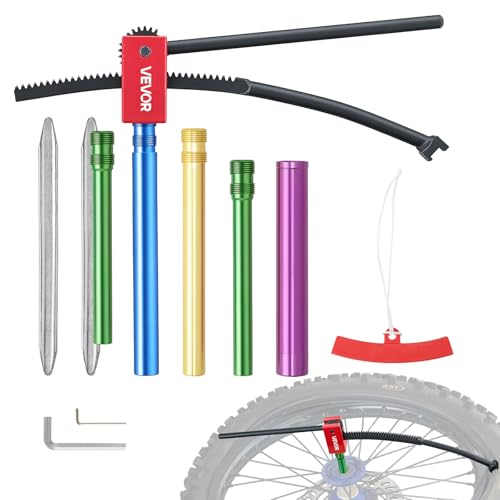
The VEVOR Dirt Bike Tire Changing Tool Kit is purpose-built for the unique demands of motocross, enduro, and trail riding, where wheels are smaller, tires are stiffer, and tube protection is paramount. The kit's groove design is specifically engineered to seat the tire bead quickly onto the rim while minimizing lateral movement that can pinch or cut inner tubes — a failure mode that's particularly expensive and inconvenient when you're 15 miles into a trail and carrying only one spare tube. The serrated curved lever adjusts to fit tire sizes from 16 to 21 inches, covering the full range of common dirt bike wheel configurations without requiring a separate adapter for each size.
The included axle adapter set is one of VEVOR's smartest inclusions: four adapters covering axle diameters from 15mm to 25mm mean this kit works with virtually every dirt bike, enduro machine, and light trail bike currently on the market. That range covers everything from small-displacement beginner bikes up to full-size 450cc competition machines. The two curved tire irons are purpose-designed with a hook geometry that grips the bead securely during both removal and installation, which prevents the slipping that causes rim damage and that particular brand of profanity familiar to anyone who's spent time changing off-road tires in a muddy pit.
The scratch-free process is a genuine selling point here: the contact surfaces are designed to avoid direct metal-on-rim contact at the most stressed points of the lever path. For riders running expensive lightweight aluminum rims or spoked wheels that require careful handling, that protection matters. The compact form factor means this entire kit fits in a gear bag, making it viable for race day pit use or trail emergency repairs. Given the price, the VEVOR kit delivers exceptional value for any rider whose tires spend significant time in the dirt. According to Wikipedia's overview of tire iron history and use, the curved spoon design has remained the foundation of tire work for over a century — and VEVOR has refined that geometry specifically for the demands of off-road motorcycle applications.
Pros:
Cons:

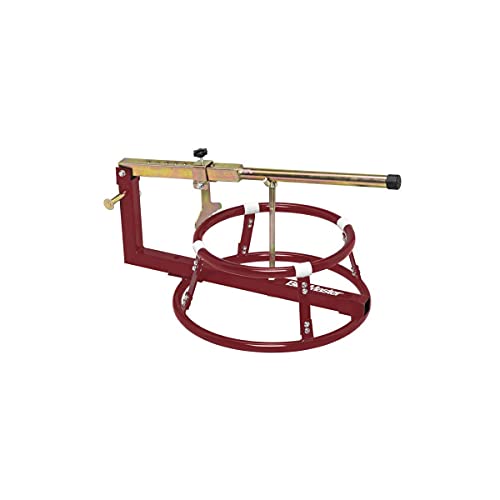
The BikeMaster Tire Change Stand With Bead Breaker earns its place in this roundup by solving the most commonly skipped step in motorcycle tire changes: breaking the bead cleanly before you start levering. Most home mechanics try to break the bead with their body weight, a piece of lumber, or whatever improvised solution is nearest — and every single one of those methods is slower, less consistent, and harder on the tire sidewall than a dedicated bead breaker. BikeMaster integrates that functionality directly into the stand, which means your entire workflow happens at one station without hunting for a second tool or repositioning the wheel multiple times.
The steel construction is legitimately durable, and the design is light and portable enough to transport to a track day or a riding event without consuming significant vehicle space. That portability is a genuine differentiator: most integrated bead breaker stands are heavy and unwieldy, but BikeMaster has struck a balance that makes this one viable for both home garage use and occasional field use. The stand works on motorcycle wheels from 16 to 21 inches in diameter, which covers the majority of street and adventure bikes you're likely to encounter. The construction doesn't have the premium finish of higher-priced options, but the functional performance is solid throughout the working range.
For riders who want a single-purchase solution that handles bead breaking and wheel support without a separate stand, the BikeMaster represents the best value proposition in this category in 2026. The integration saves time on every single tire change, and the reduced tool count matters both for storage and for field situations where bringing multiple pieces of equipment isn't realistic. The learning curve is minimal — the bead breaker mechanism is intuitive, and most users are productive with the system on their first attempt.
Pros:
Cons:
Motion Pro is one of the most respected names in professional motorcycle tooling, and the BeadPro set reflects exactly the standards you'd expect from a company that supplies working mechanics and race teams. This is the heavy-duty shop version of the BeadPro design, built from forged steel that handles the leverage loads of repeated commercial use without developing flex or deformation over time. The multi-use design is where the real engineering value lives: rather than a single-function bead breaking tool, the BeadPro functions as both a bead breaker and an integrated tire spoon, so you can go from bead separation directly into tire removal and installation without switching tools.
The 16-inch handles provide the leverage geometry needed to break the bead on even the most stubborn high-performance street tires with minimal physical effort. That handle length is a carefully calculated compromise — long enough to generate genuine mechanical advantage without being so long that it becomes awkward to control in tight positions around the rim. The integrated tire spoon edges are shaped to seat cleanly under the bead during removal and to guide the bead over the rim lip during installation, and the forged construction means those edges stay sharp and true through hundreds of uses without the deformation you see in cheaper stamped steel alternatives.
This tool set is the right choice for any rider who changes tires frequently, who values professional-grade build quality, or who works on a variety of both street and off-road machines where bead stiffness varies significantly. It performs with equal effectiveness on thin-sidewall track rubber and on the heavy-duty sport touring tires that are notoriously difficult to break by hand. The investment pays off quickly when you consider the time saved per change and the rim protection that comes from working with tools that do exactly what they're designed to do. If you're serious about maintaining your motorcycle at a high level, this pairs naturally with the kind of complete garage approach outlined in our best motorcycle batteries of 2026 guide.
Pros:
Cons:

There will always be a place in a motorcycle toolkit for a simple, well-built pair of tire spoons — and this 2pc 16-inch set delivers exactly that with no unnecessary complexity. The spoons are forged from high-quality steel that's been heat-treated for maximum strength, which means they resist the bending and snapping that's the common failure mode for budget tire irons made from cast or low-grade stamped steel. At 16 inches, the spoons provide enough leverage to work dirt bike and small-to-medium street tires without the kind of back-breaking effort that shorter irons demand, and the curved spoon ends grip the tire bead securely during both removal and installation phases of the change.
The dual-end design is the smartest ergonomic feature here: the curved spoon end grips and guides the bead, while the flat lever end provides the controlled pushing force needed during installation. Having both geometries on the same tool means fewer transitions between implements during the change process, which matters when you're working trackside or trailside with limited space. The shape of the spoon head is specifically designed to minimize tube pinching — the curved geometry distributes the lever force across a broader contact patch on the bead, rather than concentrating it at a single point where punctures are most likely to occur.
This set is the correct answer for any rider who needs a reliable trail kit that fits in a pack, or for a budget-conscious home mechanic who wants to start doing their own tire changes without committing to a full stand system. They're equally at home in a proper garage setup as a complement to a changing stand, and in a jersey pocket for emergency trail repairs. The value here is exceptional — you get forged, heat-treated steel at a price that doesn't require a second thought. Keep in mind that these irons require a separate method for bead breaking, so plan accordingly if you're setting up a complete home workshop.
Pros:
Cons:
The single most important specification to verify before purchasing any motorcycle tire changing tool is the range of wheel diameters and tire widths it can accommodate. Dirt bikes typically run 19- to 21-inch front wheels and 18- to 19-inch rears, while street bikes commonly run 17-inch rims, and cruisers may use 16-inch rear wheels with wide 200mm or larger tires. A tool that's optimized for one category often performs poorly in another — the leverage geometry, the adapter sizing, and the mounting clearances are all different. Confirm that any tool you're considering covers your specific wheel diameter and that the axle adapters, if included, match your bike's axle specification. If you're running multiple bikes with different wheel configurations, prioritize tools with broad adjustability rather than budget options that handle only a narrow size range.
You have two fundamental approaches to building a tire changing capability at home: an integrated system that handles bead breaking, wheel support, and tire levering from a single station, or a collection of individual tools that each do one step of the process. Integrated systems like the BikeMaster stand offer workflow efficiency — you set the wheel down once and complete the entire job from one position — but they cost more upfront and take more garage space. Separate tools like the Motion Pro BeadPro combined with a basic stand give you more flexibility to mix and match quality levels, but the multi-tool workflow is slower and requires more coordination. For riders who change tires regularly, the integrated approach typically wins on total time savings. For occasional users, a quality set of tire irons plus a separate bead breaker is often the right financial decision.
Rim damage from tire changes is the category's most common and frustrating failure mode, and it's almost entirely preventable with the right tools. Look for plastic or nylon mounting heads on stand-based changers — these materials absorb the lateral forces of tire levering without transferring them as gouges or scratches to the rim's painted or polished surface. On tire irons, protective sleeves and non-slip coatings on the lever shaft prevent the tool from walking on the rim during the critical moments of bead seating. Wire-spoked wheels require special attention here, as the spoke nipple area is particularly vulnerable to damage from tools that contact the rim at poor angles. Higher-priced tools typically provide better rim protection as a feature of their design rather than as an afterthought, and the cost of repainting or refinishing a rim quickly exceeds the price difference between budget and quality tire irons.
Consider whether your tire changing will happen exclusively in your home garage or whether you need a kit that travels to the track, a race event, or trail rides. Permanent workshop setups benefit from heavier, more stable stands that don't shift during aggressive leveraging — mass is an asset when you're applying maximum force to a stiff tire sidewall. Portable kits need to prioritize packable form factors, lightweight construction, and resistance to damage from being stored and transported in gear bags. The good news is that the best products in each category are genuinely optimized for their intended use: trail kits are compact and durable, and home workshop setups provide the stability that makes professional-quality results achievable. Avoid compromising by buying a heavy stand when you actually need trail portability, or buying a minimal iron set when you're doing high-volume work in a dedicated garage space.
Yes, with the right tools and a willingness to learn proper technique, home tire changes are well within reach for any mechanically inclined rider. The learning curve is steeper for wide street tires and tubeless setups than for dirt bike tires, but the fundamentals — bead breaking, levering technique, and bead seating — are learnable from video instruction and practice. Start with a quality stand and bead breaker, watch multiple tutorials specific to your tire type, and take your time on the first few changes. The skill compounds quickly, and most riders are completing clean changes without coaching after three or four sessions.
Tire irons, also called tire spoons or tire levers, are the hand tools used to pry the tire bead over the rim lip during removal and installation. A tire changer, in the motorcycle context, typically refers to a stand-based system that holds the wheel securely at an ergonomic height and often integrates a bead breaker, allowing one person to complete the full process more efficiently than with irons alone. Professional automotive tire changers are powered machines — a different category entirely. For home use, the best setup is usually a combination of a quality stand and a set of good tire irons, with or without an integrated bead breaker.
A dedicated bead breaker is the correct tool for separating a seated tire bead from the rim, and it makes the process dramatically faster and less physically demanding than improvised alternatives. Without one, riders commonly resort to driving over the tire sidewall with a vehicle, using a floor jack against the rim, or applying body weight to a piece of lumber — all of which work with varying reliability but risk rim damage and inconsistent results. For tubeless street tires and high-pressure sport tires, a bead breaker is essentially mandatory for a clean, damage-free change. For soft dirt bike tires, some experienced mechanics work without one, but a dedicated tool always produces better results.
Yes, all of the tools reviewed here are compatible with tubeless tire systems, which are standard on virtually all modern street motorcycles. The key difference with tubeless tires is that bead sealing during installation requires proper seating around the full circumference, which is achieved by inflating the tire rapidly enough that the bead seats before air escapes. Some mechanics use a ratchet strap around the tire's midpoint to push the bead outward during initial inflation, which helps on tires that are slow to seat. Beyond that step, the removal and installation process with tubeless tires follows the same basic workflow as tubed tire changes.
Tube pinching occurs when a tire iron traps a section of inner tube between the tire bead and the rim edge during installation — and it's the most common cause of immediate post-change flats. Preventing it requires three habits: first, fully seat one bead before beginning to work the second bead onto the rim; second, keep the tube slightly underinflated during installation so it stays loose inside the tire rather than pressing against the rim; and third, use tire irons with broad, curved spoon ends that distribute leverage across a wider bead contact area rather than concentrating force at a single point. Tools designed specifically for dirt bike tires, like the VEVOR kit reviewed above, incorporate groove geometries that further reduce this risk.
Tire replacement frequency depends on riding style, tire compound, bike weight, and climate, but the general guidelines in 2026 remain consistent with established standards: rear tires on most street motorcycles need replacement every 3,000 to 5,000 miles, while front tires typically last 6,000 to 10,000 miles depending on compound hardness and cornering demands. Sport and track tires wear significantly faster — some track compounds last only a few sessions. Check for wear indicators molded into the tread, look for cracking in the sidewalls, and replace immediately if you notice flat spots, cupping, or any visible cord exposure. Age matters independently of mileage; tires older than five years should be inspected carefully and replaced if there is any doubt about their integrity.
 |
 |
 |
 |

About Marcus Chen
Marcus Chen has over twelve years of hands-on experience modifying cars across a range of platforms — from commuter builds to track-focused setups — with deep expertise in suspension tuning, wheel and tire fitment, and performance upgrades that improve driving dynamics without sacrificing day-to-day reliability. He has worked with both bolt-on and engineered modifications and brings a methodical, results-focused approach to evaluating performance parts. At CarCareTotal, he covers performance upgrades, suspension and handling, and wheel, tire, and drivetrain modifications.
Get some FREE car parts & gear.. Or check out the latest free automotive manuals and build guides here.
Disable your ad blocker to unlock all the hidden deals. Hit the button below 🚗
| | | |
