by Liam O'Brien
According to the National Highway Traffic Safety Administration, backup cameras have been mandatory on all new passenger vehicles sold in the United States since May 2018 — yet the vast majority of RVs, travel trailers, and motorhomes still create enormous rear blind zones that passenger-car standards simply never addressed. A Class A motorhome can stretch 45 feet bumper to bumper, and the blind zone directly behind it can swallow a small sedan without the driver ever noticing. That reality makes choosing the right RV backup camera system one of the most safety-critical purchasing decisions you will make for your rig in 2026, and the market has expanded dramatically to meet that demand with wireless systems, multi-camera configurations, 1080P resolution, and built-in DVR recording all available at increasingly accessible price points.
What separates an adequate backup camera from a genuinely great one for RV use comes down to signal reliability over distance, image clarity in low light, and whether the system can handle the electrical environment of a large diesel coach or a bumper-pull trailer bouncing down a gravel road. Wireless range matters enormously here — a system rated for 100 feet works fine in a suburban driveway but falls apart when your trailer extends the effective distance between transmitter and monitor. If you are also thinking about other towing accessories, our guide to the best weight distribution hitches covers the hardware that keeps your rig level and controllable before you even worry about what is behind you. Similarly, for truck owners who use their vehicle for both hauling and camping, the best truck bed liners roundup addresses another layer of protection worth pairing with a solid camera setup.
We evaluated seven of the top-selling and best-reviewed RV backup camera systems available in 2026, weighing real-world wireless performance, night vision effectiveness, monitor quality, ease of installation, and overall value. Whether you are outfitting a Furrion-prepped Class C or starting from scratch on a fifth-wheel trailer, the options below give you a clear path to eliminating dangerous blind spots and backing into campsites with genuine confidence. Browse the full selection of vehicle tools and accessories at our tools section for more expert recommendations across every category.

Contents








Furrion built its Vision S system specifically around the RV ecosystem, and that intentionality shows in every detail of the package. The vast majority of modern RVs — particularly those manufactured in the last five years — come pre-wired for Furrion's camera standards, which means you are not drilling, fishing wire through walls, or improvising mounting brackets. You plug the rear sharkfin camera into the existing exterior port, mount the two side running-light cameras in place of your existing running lights, and pair everything with the 5-inch monitor, which typically takes under an hour of total installation time. That ease of integration alone makes this system stand apart from generic aftermarket options that require you to engineer your own mounting and wiring solutions from scratch.
The image quality across all three cameras is delivered at 720x480 resolution with infrared night vision and intelligent IR cut filters that automatically switch between day and night modes without producing the washed-out color shifts you see on cheaper systems. The sharkfin rear camera delivers a wide-angle view that captures traffic well beyond the trailer hitch, while the two side cameras give you the lateral coverage that a single rear camera simply cannot provide when you are threading a 40-foot coach through a narrow campground lane. Furrion tested the wireless signal up to 100 feet under driving conditions and up to 492 feet in open space, which handles the length of any production RV with comfortable overhead. The IP65 waterproofing on all cameras means rain, road spray, and pressure washing at campground stations will not compromise the hardware.
Where Furrion leans on its ecosystem advantage, it also reveals a limitation: this system is strictly not compatible with Vision S+ components, so your upgrade path within the Furrion lineup requires matching generations exactly. The 5-inch monitor is also smaller than the 7-inch displays most competitors now offer at comparable prices, which some drivers find limiting when monitoring three simultaneous camera feeds. That said, for an RV that came factory-prepped for Furrion, this system delivers the most seamless and reliable installation experience available in 2026.
Pros:
Cons:

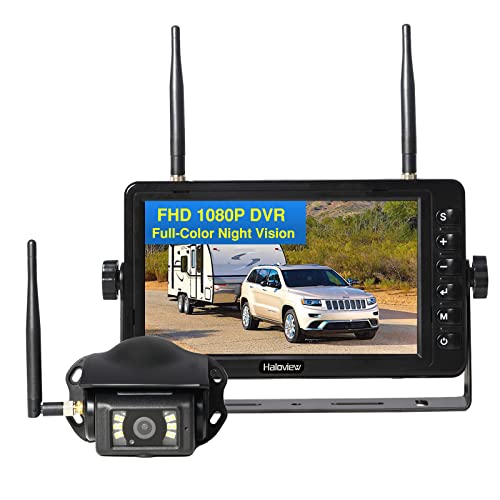
Haloview's MC7108 has earned a loyal following among serious RV operators who demand flexibility and long-distance wireless reliability, and the 984-foot line-of-sight range is the headline specification that separates this system from the crowded field of 100-to-500-foot competitors. In practical RV terms, that range means you can run this system on a fifth-wheel trailer attached to a full-size crew cab with room to spare, and the signal remains stable even when the trailer's metal body is acting as a partial radio frequency barrier between the camera transmitter and the cab-mounted monitor. The 7-inch LCD display gives you a genuinely usable viewing surface — large enough to read lane markings and identify obstacles at distance rather than squinting at a compact 5-inch screen mounted near your dashboard.
The built-in DVR recorder is a feature that many first-time backup camera buyers overlook until they realize its value during an incident or insurance claim. The MC7108 records in real time and supports video playback directly on the monitor, giving you a documented record of parking lot encounters, campground incidents, and on-road situations without requiring any external recording device. The wide-voltage input (10–32V) makes this system genuinely compatible with both 12V and 24V electrical systems, covering everything from passenger-car-based vans to heavy commercial trucks that share roads with RVs. You also get four display modes — normal, mirror, flip, and mirror-flip — so you can configure the image orientation to match your specific mounting position without relying on physical camera repositioning.
The MC7108 ships as a single-camera-plus-monitor kit, and the base package includes only 720p resolution on the camera side, which is a step behind the 1080P systems that have become increasingly common in 2026. Adding additional cameras to reach the system's four-channel capacity requires separate purchases, which can push the total cost above what the initial package price suggests. Still, for RV owners who prioritize wireless range and DVR functionality above all else, the MC7108 remains one of the most proven and capable systems available.
Pros:
Cons:

The Haloview BT7 takes everything that made the MC7108 a strong performer and upgrades the most critical weakness — camera resolution — to full HD 1080P at 30 frames per second, while adding explicit compatibility with Furrion pre-wired RVs through an included adapter that makes the installation process nearly as painless as a native Furrion product. If you own a Furrion-prepped RV but want sharper resolution than Furrion's own Vision S delivers, the BT7 is the system that directly bridges that gap, giving you the plug-in installation convenience of a purpose-built system with image quality that the Vision S cannot match at its current price point. The 7-inch LCD monitor displays that 1080P feed with noticeably more detail in edge cases — reading license plates at the edge of the frame, identifying pedestrians in marginal lighting, and judging distances to trailer hitches with precision all benefit meaningfully from the resolution jump.
Haloview's new-generation wireless technology in the BT7 addresses the latency issues that have plagued many wireless camera systems historically, delivering a low-lag signal that feels closer to a wired connection in day-to-day use. The 984-foot line-of-sight range matches the MC7108, and the system supports four wireless camera inputs while maintaining compatibility with vehicles up to 65 feet in length, which covers even the longest production Class A motorhomes on the market. The built-in DVR records at full 1080P resolution, which means your incident footage is actually detailed enough to be useful as documentation rather than being the blurry, compressed recording that 720p DVR systems tend to produce under real-world compression conditions.
Because the BT7 ships with one camera in the base configuration, you will need to budget for additional side or front cameras if you want the same multi-angle coverage that the Furrion Vision S delivers out of the box. The 7-inch monitor is excellent, but it is not a touchscreen, so navigating menus and playback settings requires the physical button controls, which some users find fiddly compared to touchscreen alternatives. Within its price range, though, the BT7 is the clearest upgrade path for anyone who owns a Furrion-prepped rig and wants 1080P wireless performance.
Pros:
Cons:

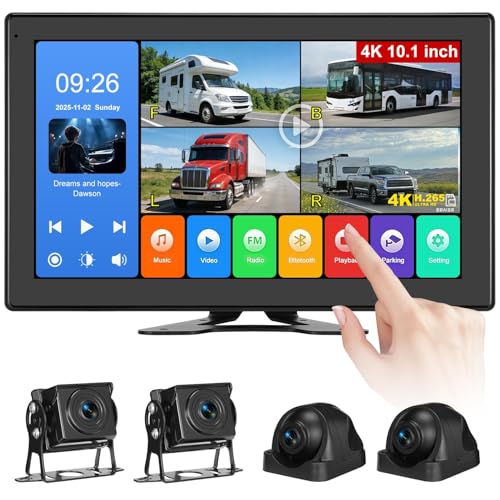
Venluna's 10.1-inch 4K touchscreen system occupies a different tier entirely from the wireless-focused options in this roundup — this is a wired, four-channel system designed for RV owners who want a permanent, truck-cab-grade monitoring solution with features that approach commercial fleet camera standards. The 10.1-inch IPS touchscreen is genuinely large enough to function as a secondary display for four simultaneous camera feeds without any individual view becoming too small to read clearly, and the 4K panel delivers color accuracy and viewing angles that competing 7-inch monitors simply cannot replicate. If you are the type of driver who wants to see precisely what is happening in every corner of your rig simultaneously during a backing maneuver, this is the system that provides that level of visibility without compromise.
Venluna incorporated Bluetooth 5.0 into the monitor, enabling hands-free calling and music playback through the built-in tweeter and microphone — functionality that transforms this from a pure backup camera into a genuine cab entertainment and communication hub. The USB 2.0 port adds media playback from drives, and the DVR records all four camera feeds simultaneously with zero signal delay, which the company achieves by eliminating the wireless transmission step entirely through wired 1080P IP69K waterproof cameras. IP69K is the highest waterproofing rating on any camera in this roundup, rated for high-pressure, high-temperature water jets, which makes these cameras genuinely impervious to pressure washing, heavy rain, and the kind of road spray that a Class A coach encounters on wet interstate highways.
The wired nature of this system is both its greatest strength and its most significant logistical challenge. Running camera cables through a large RV requires planning, proper cable management tools, and in many cases professional installation, which adds cost and complexity that wireless systems completely eliminate. The screen's free-rotation feature helps you adjust the display orientation post-installation, but getting the cameras physically routed and powered correctly is where this system demands more from the installer than any wireless option in this guide. For those who make that investment, the result is a zero-latency, four-angle monitoring system that will outlast and outperform every wireless option on this list.
Pros:
Cons:
AMTIFO's A7 has been one of the most consistently purchased RV backup camera systems on the market for several years running, and the reason is straightforward: it delivers Furrion-compatible plug-and-play installation, a 7-inch HD touchscreen monitor with four-channel capability, a built-in DVR, and a 2.4GHz wireless signal that reaches 825 feet in open air — all in a package priced well below what the Furrion native system commands. The included Furrion mounting bracket adapter and pigtail wire handle the physical installation interface, and the dual-antenna design on the monitor's receiver side actively improves signal stability compared to single-antenna budget systems that struggle to maintain lock at highway speeds or when the trailer creates multipath interference between the camera transmitter and the cab. This is the system you buy when you want capable performance without spending flagship money.
The four-channel monitor capability gives the A7 substantial flexibility beyond a simple rear camera setup. You can add a license-plate camera, a front camera for monitoring tight maneuvers at the front of the rig, or interior cameras for keeping an eye on cargo, livestock, or pets in an enclosed trailer — all displayed on the same 7-inch touch monitor with the ability to view any single feed full-screen or monitor all four in a split-screen layout. The 320-foot effective range while actively driving puts it solidly in the usable range for standard fifth-wheel and Class C configurations, though extended Class A coaches pushing 40 feet or more may find the wireless signal under more stress at highway speeds compared to the 984-foot-rated Haloview systems. Night vision operates through infrared illuminators built into the camera housing, delivering adequately detailed monochrome images in complete darkness that clearly resolve obstacles, pedestrians, and hitches at close-to-medium backing distances.
For RV travelers who also frequently use their tow vehicle independently, the A7's camera system pairs naturally with other truck-specific accessories — including the cargo organization solutions covered in our best cargo boxes and car top carriers guide. The A7's touchscreen interface is responsive by the standards of purpose-built camera monitors, though it cannot match a smartphone-grade display for smoothness or brightness in direct sunlight. At its price point, however, it represents the most comprehensive feature set per dollar of any system in this roundup, making it the default recommendation for cost-conscious buyers who own a Furrion-prepped RV.
Pros:
Cons:

AUTO-VOX engineered this system around a specific and frequently underserved RV use case: simultaneous rear and bilateral side coverage displayed on one monitor, specifically to solve the problem of backing into tight campsites where you need to see both rear obstacles and the clearance on each side of the coach at the same moment. The 7.2-inch HD display is the largest in this wireless category, and the triple split-view mode divides the screen into a rear-center feed flanked by two side views, giving you a panoramic situational awareness picture that a single rear camera cannot approximate. When you are threading a 35-foot motorhome between two occupied campsite hookup posts with two feet of clearance on each side, having both margins visible simultaneously eliminates the slow back-and-forth between mirror checks and rear camera that most drivers accept as normal.
AUTO-VOX's dual-antenna design has been tested to 500 feet of reliable wireless range, which covers the typical extended Class A motorhome with adequate margin, and the company specifically calls out performance above 60-foot rig lengths as a design target — a detail that tells you this system was actually engineered for large coaches rather than simply scaled up from a passenger-car camera platform. The 1080P cameras deliver a crisp daytime image, and the infrared night vision system reveals animals, pedestrians, and posts behind and beside the rig after dark with the kind of detail that makes late-arrival campground check-ins considerably less stressful. The triple-view configuration can also switch to full-screen mode for any single camera while driving at highway speed, making the side cameras useful for lane-change situational awareness in addition to their primary backing function.
The three-camera wireless kit comes complete out of the box, which is a meaningful distinction from the single-camera base kits that other brands in this roundup offer at nominally similar prices before you factor in the cost of adding side cameras. The trade-off is that the system is configured as a fixed three-camera array rather than the more flexible four-channel platforms that let you add a custom front or interior camera at a later date. If your primary need is rear-plus-sides coverage and you are not planning to build out an elaborate multi-angle monitoring setup, AUTO-VOX delivers the most purpose-built solution for that specific requirement of any product in this guide.
Pros:
Cons:

AMTIFO's newest 1080P wireless backup camera brings full HD resolution to the accessible end of the price spectrum, making it the most straightforward entry point for first-time RV camera buyers who want real image quality without the feature complexity or cost of the multi-camera and touchscreen systems above it. The 170-degree wide-angle lens is the widest field of view of any camera in this roundup, capturing a broader horizontal swath behind the rig than the 120-degree cameras on the Haloview systems, which translates to fewer blind-spot edges and a more complete rear picture on wide-body Class C and Class A coaches where the vehicle extends beyond the tire track. The lens distortion at extreme edges is noticeable, as is common with ultrawide angles, but the central 100-degree zone that you actually watch during backing maneuvers is clear, detailed, and accurately proportioned.
The 7-inch DVR monitor accepts split-screen input and includes the button-based menu navigation that has become standard at this price tier, and the 100-foot wireless range is stated conservatively — the system reliably maintains connection through the body of a standard travel trailer or Class C motorhome under most parking conditions. Where the 100-foot rating becomes a real limitation is in longer fifth-wheel and Class A configurations where the physical length alone approaches or exceeds that figure, making this system better suited to shorter rigs than to extended motorhomes. The IP69K waterproofing on the camera matches the Venluna system's premium-tier rating, which is genuinely impressive at this price point and means the camera housing is rated for high-pressure water jet exposure — not just rain splash protection. DIY installation requires no professional assistance, and the package includes everything you need to mount and wire the camera without sourcing additional hardware.
If you are purchasing your first RV camera and want to see what 1080P wireless monitoring actually delivers before committing to a more elaborate multi-camera system, this AMTIFO model is the correct starting point. It gives you accurate, wide-angle HD imagery, a functional DVR monitor, and IP69K camera protection for less money than any other 1080P option in this roundup, with the understanding that its 100-foot wireless range makes it best-matched to rigs under 30 feet in length.
Pros:
Cons:

Wireless range is the single most important specification to match against your specific rig length before purchasing any wireless RV backup camera system. A 100-foot wireless rating is not a comfortable operating margin for a 35-foot motorhome — it is an absolute ceiling that places the camera transmitter right at the edge of reliable reception relative to the monitor, with no headroom for the signal degradation that metal trailer bodies, electrical interference, and vehicle speed introduce in real-world conditions. The industry standard for reliable wireless RV backup camera performance in 2026 is a 500-foot-plus open-air rating, which translates to a dependable connection through even extended coach bodies at highway speeds. Systems rated below 300 feet are best reserved for travel trailers and camper vans under 25 feet in length. Dual-antenna monitor receivers consistently outperform single-antenna designs in maintaining stable lock through trailer bodies, so prioritize that specification when comparing systems at similar price points and wireless range ratings.

The resolution gap between 720p and 1080P cameras is meaningful in RV backup camera applications in ways that it is not always meaningful in other camera categories. You are making fine-distance judgments — reading the exact gap between your hitch receiver and a trailer ball, identifying whether a dark shape behind the rig is a post, a person, or a shadow — and higher resolution directly translates to better accuracy in those judgments. Full HD 1080P has become the baseline recommendation for new purchases in 2026, with 720p systems now representing a compromise you should only accept when the wireless range, installation compatibility, or multi-camera features of a specific system make it the correct choice for your situation despite the resolution trade-off. Night vision quality is equally critical: infrared illuminators should provide clean, detail-retaining monochrome images at distances of at least 20 to 30 feet, since many campground arrival situations involve low or zero ambient light. The automatic IR-cut filter switching that better cameras implement prevents the color-shift artifacts that fixed-filter cameras produce in transitional lighting conditions like dusk and dawn.
The standard 7-inch monitor size that dominates this category is large enough for single-camera monitoring and adequate for split-screen views of two cameras, but it becomes genuinely crowded when you are trying to monitor three or four feeds simultaneously in a meaningful way. If you intend to run more than two cameras, seriously consider a system with an 8-inch or larger display — the Venluna's 10.1-inch screen is the extreme end of this spectrum but illustrates what full-visibility multi-camera monitoring actually looks like at the monitor level. Four-channel expandability is worth prioritizing even if you only plan to use one or two cameras initially, because the needs of a new RV owner change rapidly as they accumulate campground experience and discover their specific blind-spot vulnerabilities. Touchscreen monitors offer faster and more intuitive navigation than button-controlled systems, though they trade off slightly in direct-sunlight readability due to the touch layer above the LCD panel.
Cameras mounted on the exterior of an RV endure conditions that dashboard electronics never face — full road spray, pressure washing, UV exposure, temperature cycling between summer desert heat and winter mountain cold, and the physical vibration transmitted through a trailer body at highway speeds on rough roads. IP65 is the minimum acceptable waterproofing rating for an exterior-mounted RV camera, providing complete dust protection and resistance to water jets from any direction. IP69K, which appears on both the Venluna and the AMTIFO budget model in this roundup, goes further with resistance to high-pressure and high-temperature water jets — the same rating used for cameras in agricultural and food-processing equipment that require steam cleaning. The camera housing material and mounting bracket rigidity also matter substantially: flimsy plastic mounts that flex under road vibration gradually degrade the camera alignment and can introduce the intermittent connection issues that owners often misattribute to wireless signal problems.
Wireless systems are the correct choice for the vast majority of RV owners in 2026 because they eliminate the need to run cables through walls, ceilings, and slide-out sections — a task that is technically demanding and labor-intensive in most RV builds. Wired systems like the Venluna offer zero signal latency and a connection that no wireless interference can disrupt, making them appropriate for operators who need absolute reliability and are willing to invest in professional installation. If your rig is under 40 feet and you are doing your own installation, wireless is the practical answer.
The rule of thumb is to take your RV's total length, double it, and look for a system rated at or above that distance in open-air testing. A 35-foot motorhome requires a minimum 70-foot practical range, but real-world conditions — metal bodies, road interference, speed — consume range headroom rapidly. For rigs up to 30 feet, a 300-foot-rated system is adequate. For rigs between 30 and 45 feet, you want a 500-foot-rated system minimum. For Class A coaches above 45 feet, the Haloview systems' 984-foot rating is the appropriate specification to meet.
Yes, and several cameras in this roundup are specifically designed for that integration. Furrion pre-wired RVs have a standardized exterior port at the rear of the coach that accepts Furrion-compatible camera transmitters directly, without any drilling or custom wiring. The Furrion Vision S, Haloview BT7, and AMTIFO A7 all support this plug-in installation approach, either natively or through an included adapter kit. Verify that the system you select explicitly states Furrion pre-wired compatibility and includes the appropriate mounting bracket adapter before purchasing.
A DVR recorder is not essential for the core backup camera function, but it provides meaningful value in two specific scenarios: incident documentation and personal security at remote campsites. When a parking lot contact, campground damage claim, or road incident occurs, having recorded footage from your rear camera frequently resolves the dispute in your favor. DVR-equipped monitors record continuously to a memory card and loop-overwrite old footage, requiring no active management on your part. Given that most systems in this price range include DVR capability at no additional cost, there is no reason to choose a system without it.
A single rear camera eliminates the most dangerous blind zone directly behind the rig and handles the majority of backing and parking situations adequately. Adding two side cameras — as the Furrion Vision S and AUTO-VOX systems provide out of the box — gives you the bilateral margin awareness that makes threading narrow campsite lanes and storage facilities dramatically safer. A front camera becomes valuable on Class A motorhomes with limited forward visibility over the nose. For most RV owners, a rear camera plus two side cameras represents the practical coverage ceiling, with a fourth channel available for interior cargo or front monitoring if your specific use case requires it.
1080P full HD is the correct resolution baseline for any new backup camera purchase in 2026. The price difference between 720p and 1080P systems has narrowed to the point where 720p is no longer a meaningful budget compromise — you are primarily choosing 720p for other system features (wireless range, compatibility, expandability) rather than for cost savings alone. For the sharpest available image in a wired system, the Venluna's 4K monitor paired with 1080P cameras represents the current ceiling for consumer-grade RV camera monitoring. Wireless 1080P systems like the Haloview BT7 and AMTIFO A7 deliver the optimal balance of resolution and practical wireless performance for most RV applications.
Match your wireless range rating to twice your rig's length, prioritize 1080P resolution, and spend the extra money on a multi-camera kit the first time — because you will always wish you had more coverage the moment you back into your first tight campsite.
 |
 |
 |
 |

About Liam O'Brien
Liam O'Brien has spent over a decade buying, field-testing, and evaluating automotive tools with a focus on what actually performs in a real DIY garage rather than what markets well on a spec sheet. His hands-on experience spans hand tools, diagnostic equipment, floor jacks, socket sets, and specialty automotive gear across a wide range of brands and price points. At CarCareTotal, he covers automotive tool and equipment reviews, garage setup guides, and buying advice for home mechanics.
Get some FREE car parts & gear.. Or check out the latest free automotive manuals and build guides here.
Disable your ad blocker to unlock all the hidden deals. Hit the button below 🚗
| | | |
