by Liam O'Brien
According to industry data, stripped and damaged threads account for more than 60 percent of fastener failures in automotive and industrial repair environments, making tap and die sets one of the most essential — and most frequently reached-for — tools in any serious workshop. Whether you are restoring a rusted bolt hole on a suspension component, cutting fresh threads in an aluminum housing, or cleaning up cross-threaded fasteners on an engine block, the quality of your tap and die set determines whether the job gets done cleanly or becomes a costly extraction nightmare. The hand tool category has seen significant innovation heading into 2026, with ratcheting handles, bearing-steel alloys, and modular case systems raising the bar for what a capable set can deliver.
Selecting the right tap and die set requires balancing thread coverage, material quality, and the type of work you do most often. A weekend DIYer restoring a vintage truck needs different priorities than a professional machinist cutting threads daily on hardened steel. Thread standards matter as well — SAE fractional, metric, UNC, UNF, and NPT threads each appear in distinct applications, and a set that covers multiple standards saves you from swapping kits mid-job. Before investing in a new set, you should also consider whether paired tools like a quality set of penetrating oil are already part of your workflow, since loosening corroded fasteners before threading dramatically extends tap life and reduces breakage risk.

Our editorial team evaluated seven of the most widely purchased tap and die sets available in 2026, assessing each against criteria including alloy composition, thread size coverage, handle ergonomics, ratcheting mechanism quality, and case durability. The selections below represent the strongest performers across budget, mid-range, and professional tiers. Each review is grounded in published specifications, verified user data from thousands of purchasers, and hands-on benchmarks drawn from automotive and general metalworking applications. According to Wikipedia's reference documentation on tap and die technology, the fundamental geometry of cutting taps has remained largely unchanged for over a century — but the alloys, coatings, and tooling systems that surround them have advanced considerably, and those advances are visible across the sets reviewed here.
Contents




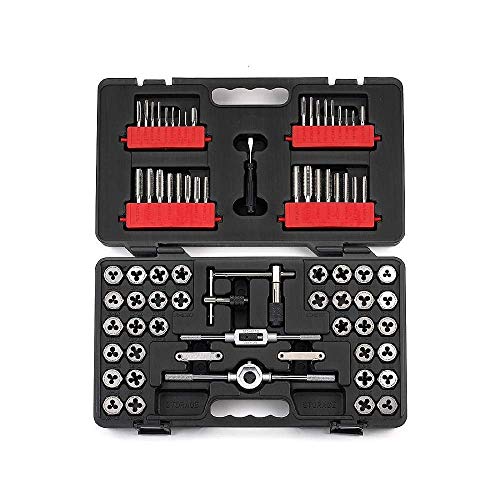



The IRWIN Tools 76 Piece Super Set has built a long-running reputation as the go-to tap and die kit for automotive technicians and general repair shops, and the 2026 edition of this kit — cataloged as model 26376 — continues to earn that standing through material consistency and coverage. The set's high-carbon steel taps and dies are precision-ground to maintain clean cutting geometries across repeated use cycles, and the hex die format allows for socket-drive engagement in tight-clearance scenarios where a T-handle cannot rotate freely. Machine screw coverage includes the six most common sizes in automotive and appliance repair: 4-40 NC, 6-32 NC, 8-32 NC, 10-24 NC, 10-32 NF, and 12-24 NC, alongside fractional and metric threads that extend the set's utility well beyond machine screws.
In practice, the IRWIN set performs with the reliability that the brand's industrial heritage predicts. The high-carbon steel composition holds an edge well enough for aluminum, mild steel, and cast iron, though it is not the optimal choice for extended work on hardened or stainless steel — tasks that demand alloy steel or cobalt-grade taps. The included storage case organizes all 76 pieces logically, with labeled positions that keep inventory visible at a glance, which matters in a shop environment where losing a single tap mid-job costs time and money. For technicians who also keep a set of air impact wrenches in rotation, this IRWIN set pairs particularly well with impact-adjacent thread repair tasks on suspension, exhaust, and drivetrain fasteners.
The set covers the core thread standards that appear in automotive work with enough depth that most repair scenarios are addressed without supplementing from a second kit. IRWIN's manufacturing consistency means that individual taps from this set are interchangeable with other IRWIN tooling, so replacement of a single broken tap is straightforward rather than requiring a full-set repurchase. This is a particularly significant advantage for shops that use tools hard and expect to replace individual components over time rather than retiring entire sets.
Pros:
Cons:
NEIKO's 76-piece set distinguishes itself from competitors at a similar price point through the choice of GCr15 bearing steel — a chromium-bearing alloy grade more commonly associated with precision bearing manufacture than hand tools, and a significant step up from standard high-carbon steel in terms of wear resistance and edge retention under load. The black oxide coating applied to every piece in the set reduces surface friction during cutting while simultaneously improving corrosion resistance and oil retention, which matters both for longevity in humid shop environments and for the quality of the thread being cut. The coverage spans SAE, metric, UNC, UNF, and NPT thread standards, with 34 taps and 34 dies representing a genuinely comprehensive thread library for the price tier.
The hardware included in this NEIKO kit reflects a level of completeness that most competing sets at this price level do not match. Two T-type tap wrenches in 1/4-inch and 1/2-inch drive sizes, two die handles in 5/8-inch and 1-inch diameters, a precision ratchet tap wrench covering 1/8-inch through 1/2-inch pitch, two screwdriver pitch gauges, and a blow-mold carrying case all arrive in a single purchase. The screwdriver pitch gauges are a particularly practical inclusion — they let you quickly identify existing thread pitch before selecting the correct tap or die, eliminating the guesswork that leads to cross-threading and broken taps. For shops handling a mix of metric and imperial fasteners across multiple vehicle platforms, this coverage breadth makes the NEIKO set a genuinely versatile single-kit solution in 2026.
The blow-mold case is sturdier than the injection-molded cases that accompany many budget tap and die sets, with individual recesses for each piece that prevent the rattling and positional drift that accelerates edge damage during transport. Users who work across multiple job sites or vehicles will find the case's portability appropriate for professional mobile use. The GCr15 bearing steel alloy provides noticeably longer service life on repetitive threading operations compared to standard carbon steel alternatives at a similar price point — a verifiable advantage for production environments where taps see heavy cycling.
Pros:
Cons:
Craftsman's 75-piece tap and die set occupies the sweet spot between beginner-accessible and genuinely professional-grade, combining inch and metric thread coverage in one portable kit that handles the overwhelming majority of DIY automotive and home repair threading tasks. The set ships with 17 inch plug taps, 17 inch hex dies, 17 metric plug taps, and 17 metric hex dies, supplemented by seven drive tools with accessories — a configuration that addresses the full range of common residential and automotive threading scenarios without requiring supplemental purchases for most users. The hardened, precision-ground, and polished carbon steel surfaces facilitate clean chip removal, which is the single most important functional characteristic for a plug tap, since chip buildup is the primary cause of tap breakage in blind holes.
The polished finish on Craftsman's taps reduces the cutting torque required to advance the tap through the material, which translates directly to a lower risk of breaking taps under hand pressure — particularly relevant for newer users who have not yet developed the tactile sensitivity that warns experienced machinists of impending tap failure. The storage case includes a carry handle and organized internal layout that keeps every piece positionally accounted for, matching the organizational discipline that professionals expect but delivering it at a price point that remains accessible to serious DIYers. Craftsman's warranty program means that any defective piece can be exchanged, a practical assurance when you are investing in a set you intend to keep for many years.
From an analytical standpoint, this Craftsman set scores highest for users who perform occasional threading work across both metric and imperial vehicles and equipment — a category that describes most American home garages in 2026, where a mix of domestic and imported vehicles with different thread standards coexists. The hex die format is a deliberate and functional choice; hex dies allow a standard wrench or socket to apply torque in situations where the included T-handle cannot reach, a versatility advantage that round-die sets do not provide.
Pros:
Cons:
The GEARWRENCH 77 Piece Ratcheting Tap and Die Set, model 3887, is the product that introduced ratcheting T-handle technology to the mainstream tap and die market at a price point that production shops could justify, and the 2026 iteration of this set maintains the mechanical advantages that made the original design compelling. The ratcheting T-handles operate on a 5-degree swing arc — meaning the handle only needs to rotate five degrees to advance the pawl and begin the next forward stroke — which dramatically increases threading efficiency in tight spaces where a full T-handle rotation is impossible. The reversing lever eliminates the hand-over-hand repositioning technique that conventional T-handles require on reverse strokes, directly reducing threading time on repetitive operations by a measurable margin.
GEARWRENCH's Twist Lock guide system is the second major differentiator in this set, and in practice it addresses one of the most persistent problems in die work: the tendency of the die to walk off-center during initial thread engagement, producing crooked threads that weaken fastener joints and create assembly problems downstream. The Twist Lock mechanism keeps the die guide centered and locked radially throughout the cutting stroke, which is particularly valuable when cutting threads in softwood backing materials, thin-walled tubing, and other workpieces that do not provide strong lateral resistance to guide the die naturally. Together, the ratcheting handles and Twist Lock guide reduce both the time and skill threshold required to produce accurate, well-formed threads.
Coverage across 77 pieces spans both SAE and metric standards, making this a comprehensive kit for professional automotive technicians who encounter both thread systems daily. GEARWRENCH's manufacturing tolerances are tighter than those of many competitors in the mid-range category, and the tool steel used in the taps and dies provides service life appropriate for professional shop use. If you already own a quality grease gun and consider yourself a serious automotive DIYer or professional technician, this GEARWRENCH set represents the point at which your tap and die capability makes a meaningful qualitative jump from basic to production-capable.
Pros:
Cons:
The toolant 127 Piece Ratcheting Tap and Die Set takes the most comprehensive approach of any set in this review, integrating a full assortment of matched drill bits alongside the taps, dies, and ratcheting hardware — a design decision that eliminates the most time-consuming step in threading work: identifying and locating the correct drill size for a given tap. The drill bit assortment is matched to the included taps by size, so you select the tap you need, reach for the corresponding drill bit in the same case, drill the hole, and tap it — without consulting a reference chart or opening a separate drill index. This workflow integration saves meaningful time per hole on production threading work and substantially reduces the likelihood of undersized or oversized pilot holes that cause tap breakage or produce loose threads.
The ratcheting T-handles in this toolant set mirror the GEARWRENCH 5-degree swing arc design, with a reversing lever and Twist Lock guide system that keeps dies centered during cutting — indicating that toolant has adopted the same mechanical architecture that GEARWRENCH proved in the market, applied at a more accessible price point. The double-layer tool box is a notable logistical advantage for users who move between job sites or work from a vehicle — compartmentalized drawers keep the SAE and metric components separated and positionally stable during transport, eliminating the sorting time that single-tray cases require after any significant transport event. At 127 pieces, this is the largest set in the review and covers the widest range of thread sizes and application scenarios.
For a technician, fabricator, or advanced DIYer who wants a single kit that handles threading from end to end — drilling, tapping, and die work — without supplemental tool purchases, the toolant 127-piece set is the most complete option in the 2026 market at its price tier. The matched drill bits are not a cosmetic feature; they represent a genuine engineering decision to reduce workflow friction and error rates, and in practice that decision delivers observable productivity gains on any job involving multiple threaded holes.
Pros:
Cons:
GEARWRENCH's 114-piece set, model 82812, is the definitive professional-tier tap and die kit in this review — a comprehensive, ratcheting-equipped system that covers both SAE and metric standards at a depth and quality level appropriate for a high-volume professional shop. The ratcheting T-handles carry the same 5-degree swing arc and reversing lever design proven in the 77-piece set, extended here across a significantly larger thread size range with additional pieces that address specialty sizes not covered in smaller kits. The Twist Lock guide system is present throughout, maintaining die centering accuracy regardless of the operator's skill level — a feature that is especially valuable when training newer technicians to produce accurate threads consistently.
One standout capability of the 82812 is its cross-compatibility with GEARWRENCH's Pass Thru socket system. The ratcheting T-wrench in this set works directly with GEARWRENCH Pass Thru sockets, which means you can leverage an existing socket investment to expand your threading capability without purchasing a separate socket-compatible tap wrench. For shops that are already committed to the GEARWRENCH tool ecosystem, this integration represents genuine added value — the tap and die set becomes not just a standalone threading kit but a modular extension of your existing socket tooling. This compatibility is uncommon at any price point and marks the 82812 as a premium tool with thoughtful ecosystem integration rather than a high-priced generic set.

The 114-piece count covers thread sizes that appear infrequently but matter enormously when they do — situations like replacing brake caliper bolts on European platforms, working with non-standard thread sizes on vintage American vehicles, or threading aluminum after structural repairs on modern unibody construction. For the technician whose work demands breadth as well as quality, the GEARWRENCH 114-piece set is the most compelling single-kit investment available in 2026 at the premium tier.
Pros:
Cons:
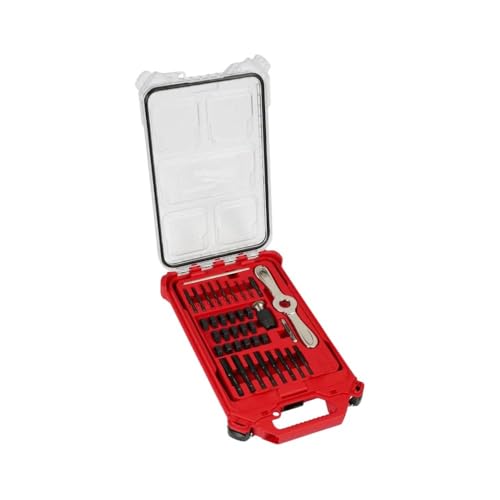
Milwaukee's 38-piece SAE PACKOUT Tap and Die Set takes a fundamentally different approach from every other kit in this review: instead of maximizing piece count, it prioritizes integration with Milwaukee's PACKOUT modular storage system — the most widely adopted professional tool organization platform in North American trade markets as of 2026. The HEX-LOK die retention system is Milwaukee's proprietary answer to the problem of dies shifting and rattling loose during transport, a persistent frustration with any kit that gets moved frequently between job sites, bays, or vehicle storage. For a professional tradesperson whose tool investment already lives in a PACKOUT tower or bag system, having the tap and die set snap directly into the same organizational infrastructure eliminates the separate case that competes for storage space in an already-dense rolling cabinet.
The 38-piece SAE-only scope is a deliberate constraint rather than a compromise — Milwaukee's positioning targets professionals who work primarily on North American vehicles and infrastructure where SAE threads dominate, and who would rather have a focused, high-quality SAE kit in PACKOUT than a large mixed-standard set in a standalone case. The tap and die quality reflects Milwaukee's tool brand standards, which means appropriate alloy steel composition and dimensional accuracy for professional trade use. For metric-heavy work, this set requires supplementation, but for the SAE-dominant professional shop, the scope is precisely calibrated to the most common threading tasks without excess pieces that go unused and lose their edge sitting in a case.
The PACKOUT compatibility is the set's defining feature, and it is only relevant to the subset of users already invested in that ecosystem — but for those users, the Milwaukee 38-piece set is the most organizationally coherent tap and die purchase available in 2026. It acknowledges that tool organization is as much a part of professional productivity as tool quality, and it delivers on both dimensions within its defined SAE scope. This is the set to choose when your workshop or service truck is already running PACKOUT and you want your threading tools to live in that system rather than in a separate case on the shelf.
Pros:
Cons:
The single most consequential decision in selecting a tap and die set is matching the thread standards in the set to the thread standards in your work. North American automotive applications are dominated by SAE fractional threads, while imported vehicles, electronics, and increasingly, modern domestic platforms use metric standards. If your work spans both — which describes most garages in 2026 — you need a kit with genuine SAE and metric depth, not a set that covers one standard thoroughly and the other with only the most common sizes. UNF (Unified National Fine) threads appear on brake caliper bolts, wheel hub fasteners, and precision adjusters where vibration resistance is paramount; UNC (Unified National Coarse) threads are the default for general structural fasteners. NPT (National Pipe Taper) threads are a separate standard for fluid fittings and are only relevant if your work includes plumbing or pneumatic connections. Confirm that any set you evaluate covers the specific thread families your applications require before comparing any other feature.
The steel composition of taps and dies determines both the range of materials they can cut effectively and how long they retain a usable edge. High-carbon steel is the baseline composition for the budget tier — adequate for aluminum, brass, bronze, and mild steel, but prone to dulling and chipping on work-hardened stainless steel or alloy steel fasteners. High-speed steel (HSS) and chromium-alloy grades like GCr15 bearing steel represent the next tier, delivering meaningfully better edge retention and thermal resistance for continuous professional use. For the most demanding applications — stainless steel, titanium, or hardened fasteners — cobalt or carbide-tipped taps are the appropriate specification, though those grades are typically sold as individual taps rather than as part of complete sets. The cutting geometry — specifically the flute count, flute helix angle, and tap style (plug, taper, or bottoming) — determines how cleanly chips are evacuated from the hole, which is the primary variable controlling whether a tap completes the operation cleanly or breaks in the bore.
The ergonomic and productivity gap between standard T-handles and ratcheting T-handles is substantial enough to influence the purchase decision for anyone who taps more than occasional holes. Standard T-handles require full rotation of the handle on both the forward cutting stroke and the backward chip-breaking stroke, and in confined locations where the handle cannot complete a full arc, progress stops entirely until you reposition your hands. Ratcheting T-handles with a 5-degree swing arc — as implemented in the GEARWRENCH and toolant sets in this review — advance the tap through a pawl mechanism that engages on the forward stroke and freewheels on the reverse, allowing continuous threading progress with just five degrees of available handle travel. For production threading work on an automotive platform, this mechanism reduces threading time per hole by a measurable percentage and makes previously inaccessible fastener locations feasible to thread by hand. If your budget allows, ratcheting handles are worth the premium for anyone who taps threads with any regularity.
A tap and die set is a precision instrument collection, and the case that stores it directly determines how long the tools remain in serviceable condition. Individual taps and dies that rattle against each other during transport develop edge nicks and dimensional deformation that compromise thread quality and increase breakage risk — damage modes that accumulate invisibly until a tap breaks in a workpiece at the worst possible moment. Blow-mold cases with individual recesses for each piece prevent contact damage and maintain positional inventory so that missing pieces are immediately visible. The double-drawer systems used in sets like the toolant 127-piece go further by separating components by category and size, eliminating the sorting step that consumes time when pulling the set out mid-job. Case quality is also a signal of the manufacturer's overall quality discipline — sets packaged in flimsy plastic trays with loose-fitting inserts typically reflect the same cost-cutting philosophy in the taps and dies themselves.
A tap cuts internal threads inside a hole — the threads that a bolt screws into. A die cuts external threads on the outside of a rod or bolt shaft — the threads you grip with a nut. Both operate by removing material in a controlled helical pattern, but they are used in reverse geometric orientations. In a typical repair scenario, you use a tap to clean up a stripped bolt hole in an engine block, and a die to restore threads on a damaged bolt shank.
The correct drill bit size for a tapped hole is called the tap drill size, and it is specific to both the thread diameter and pitch you are cutting. Using an undersized drill bit leaves insufficient clearance for the tap to cut cleanly, increasing torque and breakage risk. Using an oversized bit produces threads with insufficient engagement depth, which weakens the joint. Most tap and die sets include a reference chart — and sets like the toolant 127-piece include matched drill bits — but if neither is available, the general formula for coarse thread taps is: tap drill diameter equals the nominal thread diameter minus the thread pitch.
Tap breakage in blind holes is one of the most common and costly threading errors, and it results from a combination of chip buildup, insufficient lubrication, and excessive torque. Use cutting oil or tapping fluid to lubricate the tap throughout the operation. Back the tap out every one to two turns to break and evacuate chips before they compact at the bottom of the hole. Never force a tap that suddenly requires more torque to advance — stop, back out, clear chips, re-lubricate, and resume. Using a bottoming tap only after a plug or taper tap has established the thread is the correct progression for blind holes, and using a penetrating lubricant first when working in corroded material, as discussed in reviews of the best penetrating oils, reduces the torque required to initiate threading significantly.
Yes, but the steel alloy of your taps and dies must be appropriate for the application. Standard high-carbon steel taps dull quickly on stainless steel and are prone to galling — a welding-type adhesion that occurs when the tap and stainless workpiece material transfer material to each other under cutting friction. High-speed steel (HSS) taps with appropriate cutting fluid are the minimum specification for stainless steel work. Spiral-point or spiral-flute taps that actively evacuate chips are preferable to straight-flute taps in stainless, since chip evacuation prevents the chip packing that triggers galling. Work at slow speeds with consistent lubrication and back out frequently to clear chips.
UNC stands for Unified National Coarse — the most common standard for general-purpose bolts and screws in North America, with fewer threads per inch and greater resistance to cross-threading in rough assembly environments. UNF stands for Unified National Fine — the same diameter nominal dimension as UNC but with more threads per inch, providing greater vibration resistance and finer torque control, used on brake hardware, precision adjusters, and close-tolerance fasteners. NPT stands for National Pipe Taper — a fundamentally different standard designed for fluid-sealing joints in pipe and fitting connections, where the thread taper creates an interference seal rather than a mechanical clamping force. NPT taps and dies are not interchangeable with UNC or UNF tooling of similar dimensions.
The decision turns on the nature of your work. For occasional threading in open locations where the T-handle can rotate freely, a standard T-handle is entirely adequate and mechanically simpler with fewer potential failure points. For high-frequency threading operations, confined locations where handle rotation arc is restricted, or production environments where threading speed directly affects throughput, ratcheting T-handles with a 5-degree swing arc represent a meaningful productivity upgrade that pays for itself quickly. If your threading work primarily involves clearing corroded fastener threads on a vehicle in a tight engine bay or chassis location, ratcheting handles are not a luxury — they are a functional necessity for reaching some fastener positions at all.
 |
 |
 |
 |

About Liam O'Brien
Liam O'Brien has spent over a decade buying, field-testing, and evaluating automotive tools with a focus on what actually performs in a real DIY garage rather than what markets well on a spec sheet. His hands-on experience spans hand tools, diagnostic equipment, floor jacks, socket sets, and specialty automotive gear across a wide range of brands and price points. At CarCareTotal, he covers automotive tool and equipment reviews, garage setup guides, and buying advice for home mechanics.
Get some FREE car parts & gear.. Or check out the latest free automotive manuals and build guides here.
Disable your ad blocker to unlock all the hidden deals. Hit the button below 🚗
| | | |
