by Joshua Thomas
A trickle charger is one of the most practical tools a car owner can keep in the garage. Whether you are storing a seasonal vehicle, maintaining a motorcycle over the winter, or simply keeping a rarely-driven car ready to start, a quality trickle charger keeps your battery at full capacity without the risk of overcharging.
Unlike a standard battery charger that pushes high current to fill a battery quickly, a trickle charger delivers a low, steady current — typically 1 to 5 amps — that closely matches the battery's natural self-discharge rate. Modern smart versions automatically monitor the battery and switch to float mode once fully charged, so you can connect them and forget about them for months at a time.
If you are unsure which model is right for your needs, our review below covers seven of the best trickle chargers available in 2026, followed by a complete buying guide to help you choose with confidence.
Contents






The NOCO GENIUS1 is our top pick for drivers who want a reliable, all-in-one battery maintenance tool in a compact package. Its 1-amp output is ideal for long-term storage on cars, motorcycles, ATVs, and boats without the risk of overcharging.
This charger operates on both 6V and 12V batteries and supports all common chemistries including flooded, gel, AGM, and lithium-ion (LiFePO4). Its built-in thermal sensor automatically adjusts the charge rate based on ambient temperature, so it performs correctly in both hot summers and freezing winters.
One of its standout features is the battery repair mode, which uses pulse technology to reverse sulfation — the number-one cause of premature battery failure. The compact body is 35% smaller than previous NOCO models yet delivers up to 35% more power, making it easy to store in a glove box or trunk.
The single-LED status indicator is minimal but functional. Some users may prefer a more detailed display, but for a set-and-forget maintainer that simply works, the NOCO GENIUS1 delivers excellent value and peace of mind backed by NOCO's 5-year warranty.
Pros
Cons
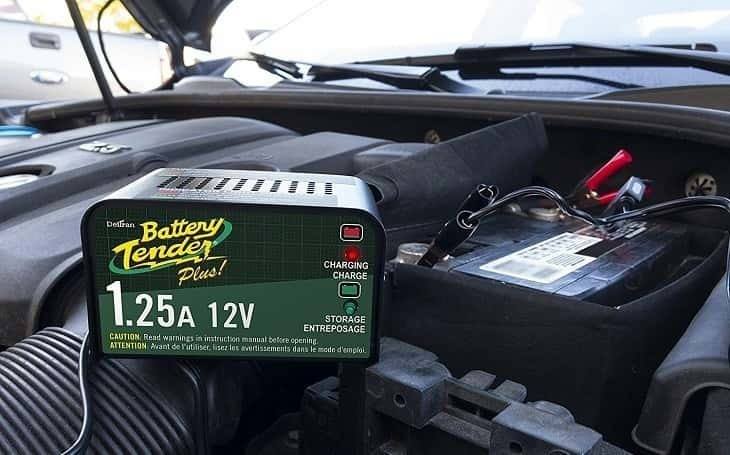
The Battery Tender Plus 021-0128 is the go-to choice for car and powersport owners who need a dependable 12V float charger. With over two decades on the market and consistent 4.6-star ratings, it has earned a reputation as one of the most reliable maintainers available.
Its 4-step charging algorithm — initialization, bulk charge, absorption, and float — ensures your battery receives the exact right amount of power at each stage. The spark-proof design and reverse polarity protection make it safe to connect even for first-time users.
The solid-state two-color LED indicator is straightforward: red for charging, green for fully charged. It includes both alligator clips and a quick-disconnect ring harness, so you can leave the ring terminals permanently on your battery terminals for fast, fumble-free connection every time.
The main limitation is its 12V-only compatibility — if you have vintage 6V equipment, you'll need a different charger. It is slightly pricier than budget options, but the build quality and the lifetime warranty from Deltran justify the investment for serious hobbyists.
Pros
Cons
For riders on a budget who still want genuine Battery Tender quality, the Junior 021-0123 offers the same trusted 4-step charging process at a lower price point and a lighter 750mA output that is perfect for smaller powersports batteries.
The Junior is designed primarily for motorcycles, ATVs, personal watercraft, and snowmobiles — vehicles with batteries in the 14–32Ah range. Its low amperage ensures it trickle charges without any risk of heat buildup, making it safe to leave connected indefinitely throughout the off-season.
Like its bigger sibling, it includes both alligator clips and a ring-terminal quick-disconnect harness. The two-color LED indicator flashes red during charging and turns solid green when the battery is fully maintained. The slim body is wall-socket friendly and won't block adjacent outlets.
The lower amperage means it charges more slowly than higher-amp units — topping up a deeply discharged battery can take 24+ hours. It is also 12V only. But if you simply need a compact, affordable, safe maintainer for a powersport battery, the Junior is hard to beat.
Pros
Cons
The MOTOPOWER MP00205A punches above its weight class as a budget-friendly 800mA maintainer that handles everyday maintenance and trickle charging duties with a clean, compact design.
Operating at 12V with an 800mA output, it supports lead-acid (flooded, sealed, VRLA), AGM, and gel cell batteries. A built-in desulfation feature runs automatically during the charge cycle to break down lead sulfate crystals that reduce battery capacity over time.
The unit features a weather-resistant housing that makes it suitable for use in garages and outdoor storage areas. It automatically switches to float mode once charging is complete, preventing overcharge and keeping the battery at full capacity indefinitely.
The MP00205A lacks a 6V mode, so owners of older vintage equipment should look elsewhere. The indicator light is basic — a single LED — but the simplicity is part of the appeal for users who want a plug-and-forget solution at an accessible price point.
Pros
Cons
The Schumacher SC1304 stands out from typical trickle chargers by offering two distinct operating modes: a rapid 15-amp charging mode that can fully charge a depleted battery in a few hours and a 3-amp maintenance mode for long-term storage.
It works with both 6V and 12V batteries, covering flooded, AGM, gel, and deep-cycle types. The fully automatic design automatically detects the battery voltage and selects the appropriate charging profile, then switches seamlessly to float mode when the battery is full.
Schumacher's patented multi-stage charging algorithm extends battery life by avoiding the overcharge damage that simple chargers can cause. The LED display shows charging status, error codes, and battery condition at a glance, making it one of the more informative units in this category.
The SC1304 is bulkier than 1-amp maintainers, which is expected given its 15-amp rapid-charge capability. If you only need a slow overnight maintainer, the extra amperage is unnecessary — but if you also want the flexibility to charge a dead battery quickly, this dual-mode design makes it uniquely versatile.
Pros
Cons
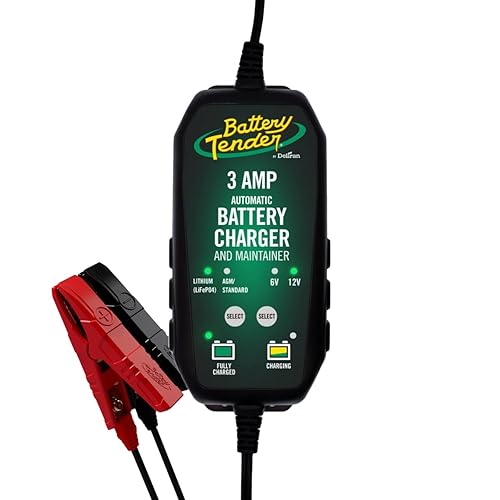
The Battery Tender 3 AMP is the sweet spot for drivers who want faster charging than the standard Junior or Plus models while still maintaining the same trusted Battery Tender reliability and safety.
Supporting both 6V and 12V batteries, it can switch voltage modes manually to accommodate vintage 6V systems as well as modern 12V vehicles. The 3-amp output is strong enough to recover a moderately discharged battery in a few hours while still being gentle enough for long-term float charging.
The familiar Battery Tender 4-step charging profile handles initialization, bulk charge, absorption, and float stages automatically. It includes both alligator clips and a ring-terminal quick-disconnect harness, and the LED indicator clearly shows charging status.
It lacks some of the smart diagnostic features found on premium units like the NOCO GENIUS5, and the 3-amp output may be insufficient for very large truck or RV batteries. However, for the majority of passenger car, SUV, and powersport owners, it hits the ideal balance of speed, safety, and simplicity.
Pros
Cons
The NOCO GENIUS5 is the step-up model for users who want faster charging times without sacrificing the smart maintenance capabilities that make NOCO chargers so popular. At 5 amps, it charges batteries up to five times faster than 1-amp maintainers.
Compatible with 6V and 12V batteries in flooded, gel, AGM, enhanced flooded (EFB), maintenance-free, and lithium-ion (LiFePO4) chemistries, it handles virtually any battery type in your garage. Like the GENIUS1, it includes a thermal sensor for temperature-compensated charging and a Force Mode for manually waking completely dead batteries.
The GENIUS5 uses precision pulse charging in its repair mode to reverse sulfation and acid stratification, restoring batteries to better-than-new performance in many cases. It charges batteries up to 120Ah, making it suitable for cars, trucks, SUVs, RVs, and marine applications.
The main downside compared to simpler units is its higher price. The GENIUS5 is a premium product, and budget-conscious buyers may not need its faster charge rate or lithium compatibility. But for users who want one charger to handle every battery in the household, it delivers exceptional capability in a compact, weatherproof package.
Pros
Cons
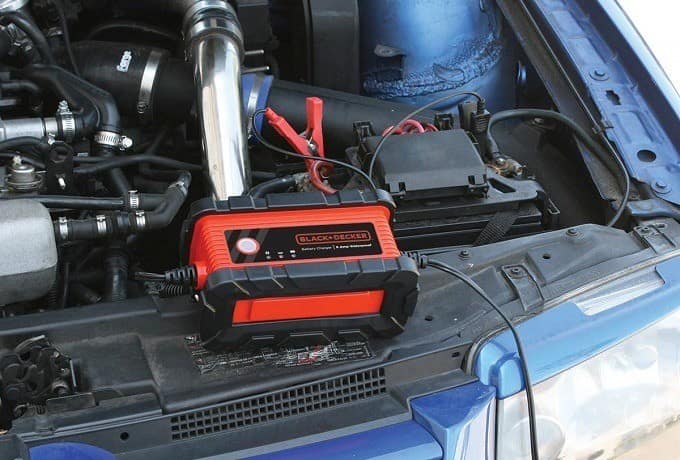
Traditional or "dumb" trickle chargers deliver a constant current regardless of the battery's state of charge. They are inexpensive and powerful but must be monitored — leaving one connected for too long will overcharge and damage the battery. They are better suited for a supervised quick top-up than for unattended long-term storage.
Smart trickle chargers include a microprocessor that monitors battery voltage and adjusts the output accordingly. They automatically switch between bulk charging, absorption, and float maintenance stages. Because they prevent overcharging by design, you can leave them connected all winter or all summer without any concern. All seven products on our list above are smart chargers.
Amperage determines how quickly the charger can replenish a battery. For pure maintenance charging on a fully charged battery, 750mA to 1A is plenty — the charger simply replaces the small amount of charge lost to self-discharge each day. For faster recovery of a partially or fully depleted battery, choose a unit with 3 to 5 amps.
As a rough guide: a 50Ah battery takes about 48 hours to charge from empty at 1A, 16 hours at 3A, and 10 hours at 5A. Large truck, RV, or marine batteries above 100Ah may benefit from a 10-amp or higher unit for reasonable charge times.
Most modern vehicles use 12V batteries, and most trickle chargers on the market are designed for 12V operation. However, if you own vintage motorcycles, classic cars, or older riding mowers, some use 6V batteries. Before buying, confirm that the charger supports the voltage system your vehicle uses. The Battery Tender 3 AMP, Schumacher SC1304, NOCO GENIUS1, and NOCO GENIUS5 all support both 6V and 12V.
Not all chargers work with all battery types. Standard flooded lead-acid batteries are supported by every charger on our list. AGM and gel cell batteries require a charger that specifically supports those chemistries — most modern smart chargers do. Lithium-ion (LiFePO4) batteries require a charger designed for lithium chemistry; only the NOCO GENIUS1 and GENIUS5 support lithium on our list.
Look for spark-proof designs, reverse polarity protection, and short circuit protection as baseline safety features. Premium units also offer overtemperature protection and desulfation modes. A charger with automatic float mode is safer for long-term storage than one that must be manually disconnected. All products on our list include reverse polarity protection and automatic float charging.
Most trickle chargers include both alligator clips for temporary connection and ring terminal harnesses for permanent mounting. The ring terminal harness lets you leave the connector attached to your battery terminals so you can plug in the charger in seconds every time you park the vehicle for storage — a significant convenience for frequently maintained vehicles like motorcycles, ATVs, or show cars.
NOCO GENIUS1 - Walmart Link
Battery Tender Plus 021-0128 - Walmart Link
Battery Tender Junior 021-0123 - Walmart Link
MOTOPOWER MP00205A - Walmart Link
Schumacher SC1304 - Walmart Link
Battery Tender 3 AMP - Walmart Link
NOCO GENIUS5 - Walmart Link
NOCO GENIUS1 - eBay Link
Battery Tender Plus 021-0128 - eBay Link
Battery Tender Junior 021-0123 - eBay Link
MOTOPOWER MP00205A - eBay Link
Schumacher SC1304 - eBay Link
Battery Tender 3 AMP - eBay Link
NOCO GENIUS5 - eBay Link
Keeping your vehicle's battery healthy during storage does not require expensive equipment — a good trickle charger is a one-time purchase that pays for itself the first time it saves you from a dead battery.
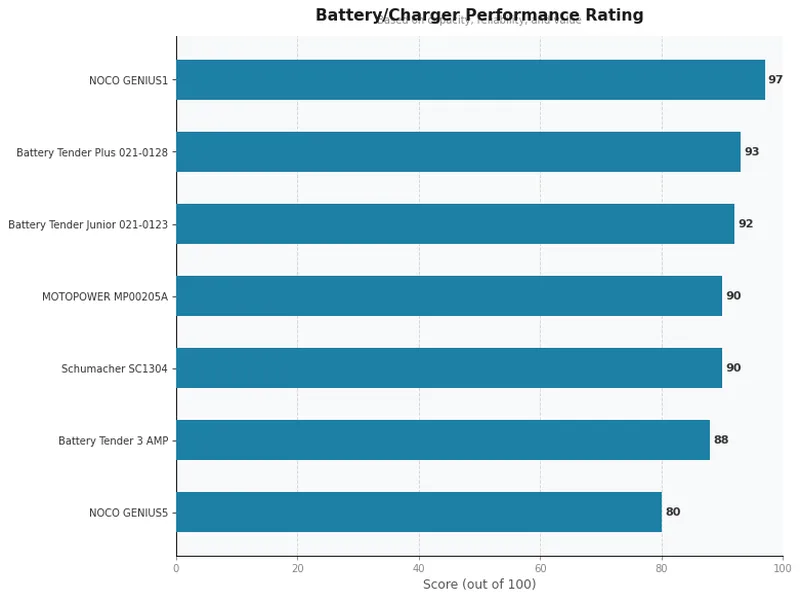
For most car and powersport owners, the NOCO GENIUS1 is our top recommendation. It handles 6V and 12V batteries, supports lithium chemistry, includes a battery repair mode, and is compact enough to fit anywhere. The Battery Tender Plus 021-0128 is an equally strong choice if you prefer a proven brand with a lifetime warranty and a 12V-focused design.
Riders on a budget will appreciate the Battery Tender Junior 021-0123 for its reliable 4-step charging and compact form. If you want faster charging alongside maintenance capability, the Schumacher SC1304 and the NOCO GENIUS5 both offer higher amperage with smart charging built in. Whichever model you choose from this list, you can count on safe, automatic battery maintenance all year long.
A trickle charger continuously delivers a small, constant charge to a battery, even when it is full. A battery maintainer is smarter — it monitors the battery voltage and only charges when the voltage drops below a set threshold. Modern smart chargers combine both functions and automatically switch between charging and float mode, making them safer for long-term use.
Yes, if it is a smart trickle charger with automatic float mode. Once the battery is fully charged, the charger switches to maintenance mode and only tops up the battery as needed. Simple "dumb" trickle chargers without automatic shutoff should not be left connected for more than a few days as they can overcharge and damage the battery.
For long-term maintenance and storage, a 1- to 3-amp charger is sufficient for most standard car batteries (40–100Ah). If you need to charge a depleted battery more quickly, a 5- to 10-amp unit will do the job in a few hours. Very large batteries in trucks, RVs, or boats may benefit from a higher-amperage charger like the Schumacher SC1304.
Most smart trickle chargers can recover batteries down to about 1 volt. Some units like the NOCO GENIUS1 and GENIUS5 include a Force Mode that manually pushes a charge into batteries that have dropped to 0 volts. However, batteries that have been fully discharged repeatedly may have permanent sulfation damage that prevents full recovery.
At 1 amp, a standard 50Ah battery takes approximately 48 hours to charge from empty to full. At 3 amps it takes about 16 hours, and at 5 amps roughly 10 hours. For maintenance charging on a battery that is already mostly full, the time is much shorter — typically 2 to 6 hours depending on how much the battery has self-discharged.
 |
 |
 |
 |

About Joshua Thomas
Joshua Thomas just simply loves cars and willing to work on them whenever there's chance... sometimes for free.
He started CarCareTotal back in 2017 from the advices of total strangers who witnessed his amazing skills in car repairs here and there.
His goal with this creation is to help car owners better learn how to maintain and repair their cars; as such, the site would cover alot of areas: troubleshooting, product recommendations, tips & tricks.
Joshua received Bachelor of Science in Mechanical Engineering at San Diego State University.


Get some FREE car parts & gear.. Or check out the latest free automotive manuals and build guides here.
Disable your ad blocker to unlock all the hidden deals. Hit the button below 🚗
| | | |
