by Liam O'Brien
Which car battery tester truly delivers reliable readings without draining the wallet or requiring a degree in electrical engineering? For most vehicle owners in 2026, the FOXWELL BT705 stands out as the strongest overall contender, thanks to its commercial-grade conductance technology, generous 5.9-foot cable, and comprehensive three-in-one diagnostics that cover batteries, starters, and alternators alike.
A dead battery remains one of the most common reasons for roadside assistance calls, and the frustrating reality is that most battery failures are entirely preventable with routine testing. Modern battery testers have evolved well beyond simple voltmeters, now offering conductance-based analysis that can detect hidden cell degradation long before a no-start event occurs. Whether maintaining a single daily driver or managing a fleet that includes trucks, boats, and RVs, having a dedicated battery tester on hand pays for itself after preventing just one tow truck visit or unnecessary replacement.
This roundup examines seven of the best car battery testers available in 2026, spanning entry-level analog load testers through Bluetooth-connected smart analyzers and professional-grade diagnostic tools. Each product has been evaluated on testing accuracy, ease of use, vehicle compatibility, build quality, and overall value to help buyers at every experience level find the right match for their specific needs.
Contents







The Schumacher BT-100 takes a decidedly old-school approach to battery testing, relying on a traditional carbon pile load test rather than modern conductance algorithms. It delivers three distinct diagnostic functions — battery analysis, charging system evaluation, and starter motor testing — all through a single analog gauge interface. With the ability to apply a 100-amp load on 12V batteries and a 50-amp load on 6V batteries, this tester handles cranking capacities up to 1,000 amps, which covers the vast majority of passenger vehicles, power sport equipment, and marine batteries.
Build quality follows the industrial Schumacher tradition, with heavy-gauge cables and robust clamps that feel like they could outlast the batteries they test. The analog needle gauge provides an immediate, intuitive readout that experienced mechanics often prefer over digital displays, since the needle's behavior under load reveals information that a single digital number sometimes cannot. However, interpreting results does require some baseline knowledge of battery specifications, as the unit does not provide pass/fail indicators the way digital testers do.
Where the BT-100 truly earns its place is in simplicity and durability — there are no circuit boards to fail, no firmware to update, and no batteries needed to power the tester itself. For buyers who maintain older vehicles, vintage motorcycles, or a mixed fleet of 6V and 12V equipment, this analog workhorse remains a genuinely practical choice in an increasingly digital market.
Pros:
Cons:
The ANCEL BST200 brings digital conductance testing to a price point that makes professional-style diagnostics accessible to virtually any vehicle owner. Supporting 12V batteries from 100 to 1,100 CCA across regular flooded, AGM flat plate, AGM spiral, and GEL chemistries, this compact analyzer covers an impressively broad range of applications for its entry-level positioning. Testing can be performed both in-vehicle and out-of-vehicle, which adds genuine flexibility for buyers who work on batteries at the bench as well as under the hood.
What separates the BST200 from other budget testers is its remarkably clear diagnostic output system, which delivers one of five plain-language results: Good Battery, Good–Recharge, Charge & Retest, Replace Battery, or Bad Cell–Replace. This eliminates the guesswork that plagues cheaper voltmeter-only devices, and it provides both State of Charge and State of Health readings that help predict remaining battery life. The upgraded reinforced clamps grip terminal posts securely, addressing a common complaint with lower-cost testers where flimsy clamps introduce resistance that skews readings.
The BST200 does have limitations that buyers should recognize — it lacks cranking and charging system tests found on more expensive units, and its 1,100 CCA ceiling may fall short for heavy-duty truck batteries. For the typical car, SUV, motorcycle, or boat owner who primarily needs reliable battery health assessments without the complexity of full system diagnostics, this tester delivers outstanding value per dollar spent.
Pros:
Cons:
The FOXWELL BT705 has earned a reputation as the sweet spot between professional capability and consumer-friendly pricing, and its 2026 iteration continues to justify that standing. Featured prominently by independent testing channels like Project Farm, this unit employs advanced conductance technology to deliver precise readings for State of Health, State of Charge, and CCA across both 12V and 24V battery systems. That 24V capability is a meaningful differentiator, extending usefulness to heavy trucks, commercial equipment, and certain marine applications that 12V-only testers simply cannot address.
The three-test diagnostic suite — battery condition, cranking system analysis, and charging system evaluation — transforms this from a simple battery checker into a genuine electrical system diagnostic tool. The cranking test reveals voltage drops and starter motor weaknesses that might otherwise be misdiagnosed as battery problems, while the charging test identifies alternator output issues that can slowly destroy even brand-new batteries. This comprehensive approach prevents the all-too-common scenario of replacing a perfectly good battery when the real culprit is a failing alternator or corroded starter cable, a misdiagnosis that can easily cost over $200 in unnecessary parts. Buyers who want to understand their entire vehicle electrical system should also consider learning how to use a multimeter on a car as a complementary diagnostic skill.
One of the BT705's most practical design features is its extra-long 5.9-foot diagnostic cable, which solves a genuine usability problem that plagues many competing testers. With shorter cables, performing a cranking test typically requires a second person — one to turn the ignition while the other reads the display at the battery. The BT705's generous cable length allows a single operator to connect to the battery, walk to the driver's seat, crank the engine, and read real-time results on the enlarged 2.8-inch screen without assistance. The CCA range of 100 to 2,000 covers everything from small motorcycle batteries to heavy commercial units, and support for AGM, EFB, flooded, and GEL chemistries ensures broad compatibility across the modern battery landscape.
Pros:
Cons:
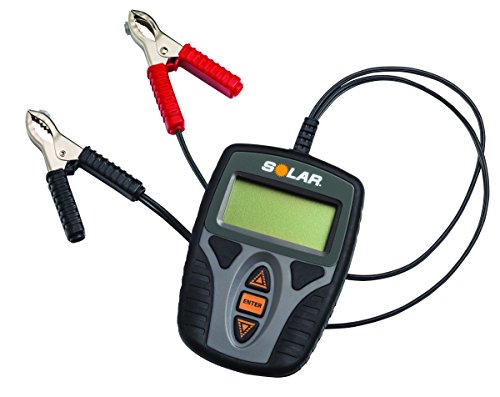
Clore Automotive has built its reputation on reliable, no-nonsense automotive electrical products, and the SOLAR BA9 digital battery and system tester reflects that philosophy perfectly. Operating within a 7 to 15 volt range with a testing capacity of 40 to 1,200 CCA, this unit handles the core battery testing needs of most passenger vehicles, light trucks, and recreational equipment without overcomplicating the experience. The compact form factor makes it easy to store in a glove box or toolbox, ready to deploy whenever a battery concern arises.
The BA9 provides both battery testing and system testing capabilities, allowing buyers to check not only the battery's health but also the charging system's performance under real operating conditions. Its straightforward interface presents results clearly, making it accessible to home mechanics who may not have extensive electrical diagnostic experience. The 40 CCA minimum threshold is notably lower than many competitors, which means this tester can accurately evaluate smaller batteries found in lawn tractors, motorcycles, and power sport equipment that larger testers sometimes struggle to read properly.
While the BA9 lacks some of the advanced features found on higher-priced units — such as 24V testing, Bluetooth connectivity, or an expansive CCA range — it delivers solid core functionality at a competitive price from a brand with genuine industry credibility. For buyers who need a dependable digital tester that handles everyday automotive and light-duty applications without unnecessary complexity, the SOLAR BA9 merits serious consideration.
Pros:
Cons:
The TOPDON BT200 positions itself as a deliberate upgrade from the company's popular BT100, and the improvements are genuinely meaningful rather than merely cosmetic. Employing advanced conductance technology with claimed 99.9% accuracy, this tester handles both 12V and 24V batteries across a generous 100 to 2,000 CCA range, supporting regular flooded, AGM, GEL, and deep-cycle battery types. That combination of dual-voltage capability and wide CCA coverage makes it one of the most versatile testers in this price bracket, particularly for buyers who maintain both passenger vehicles and heavier equipment.
Like the FOXWELL BT705, the BT200 offers complete three-in-one system diagnostics — battery health analysis, cranking system testing, and charging system evaluation. The cranking test analyzes starter motor performance by measuring voltage behavior during engine start, while the charging test monitors alternator output to detect overcharging or undercharging conditions that can significantly shorten battery life. For anyone maintaining vehicles used for RV living or towing applications, this level of system-wide electrical diagnosis proves especially valuable, since auxiliary power demands often stress charging systems beyond their typical design parameters.
The upgraded hardware includes high-quality copper clamps that secure firmly to battery terminals, a rugged housing that tolerates workshop environments, and a built-in memory function that recalls the last test result for convenient comparison over time. The BT200 works across an impressively broad vehicle range including cars, SUVs, trucks, semi-trucks, marine boats, motorcycles, lawn mowers, and golf carts, making it a genuinely versatile garage tool. Its primary limitation is the lack of Bluetooth connectivity or app integration that some buyers increasingly expect in 2026.
Pros:
Cons:
The LAUNCH BST 360 takes a fundamentally different approach to battery testing by eliminating the built-in screen entirely and routing all diagnostic data through a smartphone app via Bluetooth 5.0 connectivity. This design philosophy produces the most compact and lightweight tester in this roundup — essentially just a pair of intelligent clamps that connect to any iOS or Android device running the free BST360 application. For tech-forward buyers who appreciate having detailed test reports, historical tracking, and the ability to share results digitally, this wireless approach represents the future of consumer battery diagnostics in 2026.
Beyond basic battery testing, the BST 360 delivers an impressive six-function diagnostic suite: battery test, starter test, charging system test, voltage test, electric current test, and ripple detection. That last function is particularly noteworthy, as ripple detection can identify failing diodes in an alternator's rectifier bridge — a subtle fault that most consumer-grade testers cannot detect, but which causes premature battery degradation if left unaddressed. The unit supports both 6V and 12V batteries from 100 to 2,000 CCA across lead-acid, GEL, and AGM chemistries, with compatibility spanning ten different battery rating standards including CCA, BCI, CA, MCA, JIS, DIN, IEC, EN, SAE, and GB.
The smartphone-dependent design does introduce a practical limitation — testing requires a charged phone with the app installed, which adds a step compared to self-contained testers that are ready immediately upon connection. Bluetooth pairing is generally reliable with Bluetooth 5.0, but some buyers in professional workshop settings may prefer a dedicated screen that does not depend on a separate device. The ability to download and print detailed test reports through the app, however, makes this an excellent choice for anyone who needs documentation of battery health for fleet management, customer-facing service records, or personal maintenance tracking.
Pros:
Cons:
The Autel MaxiBAS BT508 blurs the line between battery tester and full-fledged automotive diagnostic tool, offering capabilities that extend far beyond what any other product in this roundup provides. As a dedicated upgrade from the BT506, this unit handles 6V and 12V batteries from 100 to 2,000 CCA across regular flooded, AGM flat plate, AGM spiral, GEL, and EFB chemistries, while also supporting 12V and 24V cranking and charging system diagnostics. What truly sets it apart, however, is the inclusion of Autel's adaptive conductance technology — a proprietary algorithm that the company claims improves test accuracy to 96.11% while boosting bad battery detection rates by 63.55% compared to conventional methods.
Beyond battery testing, the BT508 functions as an all-system diagnostic tool with capabilities typically found on scan tools costing significantly more. Battery registration for 53 vehicle makes allows proper coding of new batteries into the vehicle's battery management system, which is increasingly critical in modern vehicles with intelligent charging strategies that adapt behavior based on battery age and condition. Additional features include electrical system reset, automatic VIN detection, and comprehensive battery health reporting that provides actionable maintenance recommendations.
The BT508 commands a premium price that positions it firmly above the other testers in this comparison, which raises the natural question of whether the additional capabilities justify the investment. For professional mechanics, mobile service technicians, and serious enthusiasts who maintain multiple vehicles with modern electrical architectures, the answer is generally yes — the battery registration feature alone can save repeated dealer visits at $100 or more per coding session. For buyers who primarily need basic battery health checks on older vehicles without sophisticated battery management systems, the FOXWELL BT705 or TOPDON BT200 deliver the core testing functions at a substantially lower cost. Keeping battery terminals clean is equally important for accurate readings, and a guide on how to clean car battery terminals with vinegar can help ensure optimal contact during testing.
Pros:
Cons:
The most fundamental distinction between battery testers lies in how they measure battery health, and understanding this difference prevents buyers from choosing the wrong tool for their situation. Traditional load testers like the Schumacher BT-100 apply a heavy electrical draw to the battery and measure how well voltage holds up under stress, providing a direct real-world simulation of starting conditions. Conductance testers, which include every other unit in this roundup, send a small AC signal through the battery and analyze the response to calculate internal resistance and remaining capacity without significantly discharging the battery during the test.
Conductance testing has become the dominant technology in 2026 because it is safer for the battery, faster to perform, and capable of detecting subtle degradation patterns that load testing can miss. However, experienced mechanics sometimes prefer the load test's direct approach, arguing that it provides a more realistic picture of how a battery will perform under actual cranking conditions. For most home users and general maintenance applications, conductance testers offer the best combination of accuracy, convenience, and battery safety.
Cold Cranking Amps (CCA) range determines which batteries a tester can accurately evaluate, and choosing a tester with insufficient range leads to unreliable or impossible readings on certain batteries. Standard passenger car batteries typically fall between 400 and 800 CCA, while heavy-duty truck batteries can exceed 1,500 CCA, and small motorcycle or power sport batteries may drop below 200 CCA. A tester with a range of 100 to 2,000 CCA covers virtually every consumer and light commercial application, while units with narrower ranges may leave gaps in coverage.
Voltage compatibility also matters significantly for buyers who maintain diverse equipment fleets. Most passenger vehicles use 12V electrical systems, but many commercial trucks, agricultural equipment, and certain marine applications rely on 24V configurations. If testing 24V systems is a requirement, choices narrow to the FOXWELL BT705, TOPDON BT200, and Autel BT508 from this roundup, since the other units only support 12V or 6V/12V batteries.
A battery-only tester tells buyers whether the battery itself is healthy, which is valuable but incomplete information when diagnosing starting or charging problems. Full system testers add cranking analysis — measuring voltage behavior while the starter motor operates — and charging system evaluation — verifying that the alternator produces correct output under load. These additional tests can prevent the frustratingly common scenario of replacing a battery multiple times when the underlying problem is actually a weak alternator, a parasitic drain, or excessive starter motor draw.
Buyers who plan to use their tester primarily for periodic health checks on known-good vehicles may find that battery-only testing is perfectly sufficient. Those who troubleshoot no-start conditions, premature battery failures, or electrical system complaints will benefit substantially from the cranking and charging system tests that units like the FOXWELL BT705, TOPDON BT200, and Autel BT508 provide.
Modern battery testers increasingly offer digital connectivity features that extend their usefulness beyond the moment of testing. The LAUNCH BST 360 represents the most connected option with full Bluetooth smartphone integration, while the Autel BT508 provides comprehensive reporting through its built-in diagnostic platform. For individual vehicle owners, these features may seem like luxury additions, but for fleet managers, professional mechanics, and buyers who maintain detailed service records, the ability to store, share, and print test results provides genuine long-term value. Consider whether the intended use case warrants the additional cost and complexity of connected features, or whether a standalone tester with a clear display meets practical needs more efficiently.
Most automotive experts recommend testing car batteries at least twice per year — once before summer heat arrives and once before the first cold snap of winter, as both temperature extremes accelerate battery degradation. Batteries older than three years benefit from quarterly testing, since failure rates increase significantly beyond this age threshold. Any time a vehicle exhibits slow cranking, dimming headlights, or electrical accessories behaving erratically, an immediate battery test is warranted regardless of the regular schedule.
Standard battery testers cannot directly measure parasitic drain, which requires monitoring milliamp-level current flow over extended periods with the vehicle turned off. However, a battery tester can provide indirect evidence of a parasitic drain problem — if a battery consistently tests as healthy but goes dead after sitting for a few days, a parasitic drain is the likely culprit. Diagnosing the specific source of a parasitic drain typically requires a digital multimeter configured to measure DC current in the milliamp range.
CCA (Cold Cranking Amps) measures the current a battery can deliver for 30 seconds at 0°F while maintaining at least 7.2 volts, making it the most demanding and widely referenced automotive battery rating. CA (Cranking Amps) uses the same test protocol but at a warmer 32°F, which typically produces numbers 20-25% higher than CCA for the same battery. MCA (Marine Cranking Amps) is identical to CA and is used primarily in marine battery marketing — a battery rated at 1,000 MCA will have a CCA rating of approximately 750-800 amps.
All seven testers in this roundup support AGM battery testing, as AGM has become standard in many modern vehicles with start-stop systems and high electrical demands. GEL battery support is also common across most digital conductance testers, including the FOXWELL BT705, TOPDON BT200, LAUNCH BST 360, and Autel BT508. Lithium (LiFePO4) battery testing is less universally supported — buyers with lithium batteries should verify specific model compatibility before purchasing, as the internal resistance characteristics of lithium cells differ significantly from lead-acid chemistry.
Yes, testing a battery while it remains connected to the vehicle is both safe and standard practice for conductance-based testers, and in fact, some tests — particularly cranking and charging system analysis — require the battery to remain connected with the engine running. The small AC signal used by conductance testers poses no risk to the vehicle's electronic systems or the tester itself. Load testers draw significantly more current and generate more heat, so following the manufacturer's specific instructions regarding connection duration and load application timing is important when using units like the Schumacher BT-100.
A battery that tests healthy but cannot start the vehicle points to a problem elsewhere in the electrical system rather than with the battery itself. Common culprits include corroded or loose battery terminal connections that create high resistance at the contact points, a failing starter motor that draws excessive current, corroded ground cables that prevent adequate current flow, or a faulty ignition switch that does not properly engage the starter circuit. This scenario illustrates precisely why full-system testers with cranking and charging analysis provide more complete diagnostic value than battery-only testers.
 |
 |
 |
 |

About Liam O'Brien
Liam O'Brien has spent over a decade buying, field-testing, and evaluating automotive tools with a focus on what actually performs in a real DIY garage rather than what markets well on a spec sheet. His hands-on experience spans hand tools, diagnostic equipment, floor jacks, socket sets, and specialty automotive gear across a wide range of brands and price points. At CarCareTotal, he covers automotive tool and equipment reviews, garage setup guides, and buying advice for home mechanics.
Get some FREE car parts & gear.. Or check out the latest free automotive manuals and build guides here.
Disable your ad blocker to unlock all the hidden deals. Hit the button below 🚗
| | | |
