Exterior ›
by Rachel Park
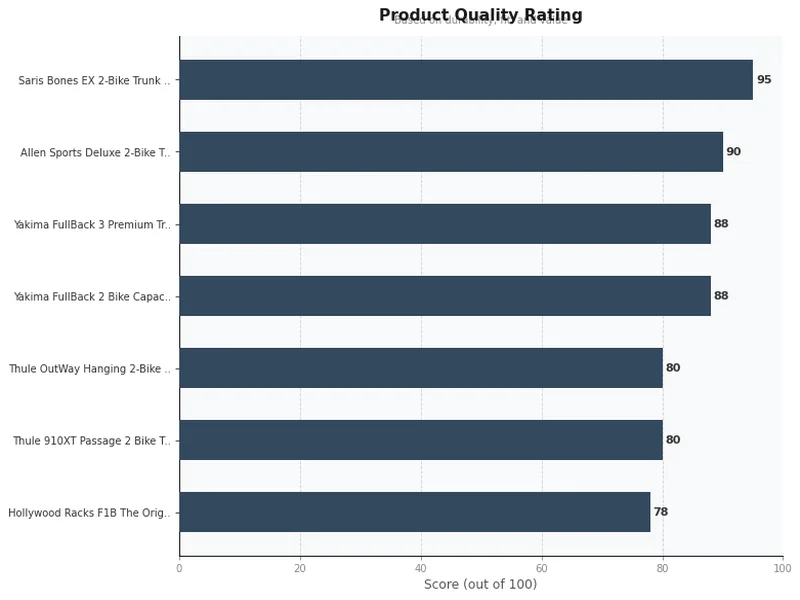
Which trunk bike rack actually delivers on its promises — and which ones leave you wrestling with straps in a parking lot? After evaluating every major contender for 2026, the Saris Bones Car Trunk Bicycle Rack earns the top spot for its unmatched combination of durability, compatibility, and ease of use that cyclists have trusted for decades.
Trunk bike racks remain the most accessible and affordable way to transport your bikes, requiring no hitch receiver and fitting the widest range of vehicles on the market today. Whether you drive a compact sedan, a sporty hatchback, or a full-sized SUV, a quality trunk rack lets you hit the trail without investing in permanent vehicle modifications. According to the National Highway Traffic Safety Administration, improperly secured cargo — including bikes — contributes to thousands of roadway incidents each year, making your choice of rack a genuine safety decision, not just a convenience one.
In this guide, you'll find in-depth reviews of the seven best trunk bike racks of 2026, a focused buying guide covering the criteria that matter most, and answers to the questions buyers ask most frequently. If you're already thinking about protecting your vehicle during transport, our guides on the best paint sealants and bug and tar removers are worth pairing with this one — road debris and strap contact are real threats to your finish. For more exterior accessories and gear, browse our full category coverage.
Contents






The Saris Bones has defined the trunk rack category for decades, and the 2026 version continues to justify that reputation with a lightweight 11-pound frame constructed from injection-molded arms and legs that Saris claims represent the strongest architecture available in any trunk-mount rack today. The arc-based design separates your two bikes on different planes, which significantly reduces frame-to-frame contact and the resulting scratches that plagued flat-style racks for years.
Compatibility is where the Bones earns its broadest praise, as the rubberized adjustable feet conform to nearly any vehicle trunk geometry, including those with integrated spoilers that typically complicate rack fitment. The ratcheting anti-sway straps lock each bike independently against lateral movement, preventing the side-to-side swinging that causes paint damage on long highway drives. At a maximum per-bike capacity of 35 pounds, this rack accommodates standard road bikes, mountain bikes, and most hybrid frames without issue.
Saris manufactures the Bones entirely in the USA from 100% recyclable materials, a detail that resonates with environmentally conscious buyers who want performance without the compromise. The coated straps resist UV degradation and surface abrasion season after season, and the rust-free construction means you can store it in a damp garage without concern. For two-bike households on a mid-range budget, this rack delivers a professional-grade experience at a price point that smaller brands struggle to match.
Pros:
Cons:
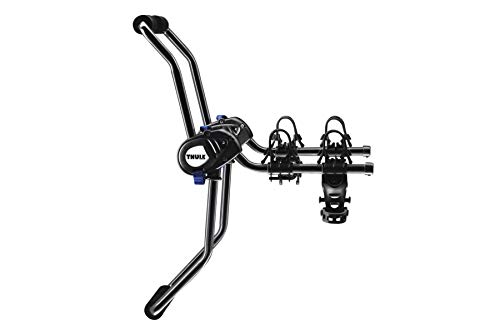
Thule has built its global reputation on precision engineering, and the 910XT Passage reflects that philosophy in every detail, from its soft rubber cradles to the patented FitDial system that delivers a customized, vehicle-specific fit with a single rotary adjustment. Where budget racks rely on trial-and-error strap tensioning, the FitDial provides tactile confirmation that your rack is seated correctly against the vehicle, removing ambiguity from a process that directly affects road safety.
The Stay-Put anti-sway cages represent one of the most effective bike-isolation systems in the trunk-rack segment, physically caging each frame so that neither bike-to-bike nor bike-to-vehicle contact occurs even on rough pavement or at highway speeds. The cradles themselves are constructed from soft-grip rubber that holds the frame securely without leaving the pressure marks or abrasions that harder cradle materials produce over time. This attention to bike protection makes the 910XT a preferred choice among riders with high-value carbon or painted alloy frames.
Installation is straightforward enough to complete without consulting the manual on subsequent uses, and the folding design stores compactly when not in active use. Thule's build quality consistently outperforms rack brands that price similarly, with the hardware, strap webbing, and cradle rubber all rated for multi-season use under heavy UV exposure and temperature cycling.
Pros:
Cons:
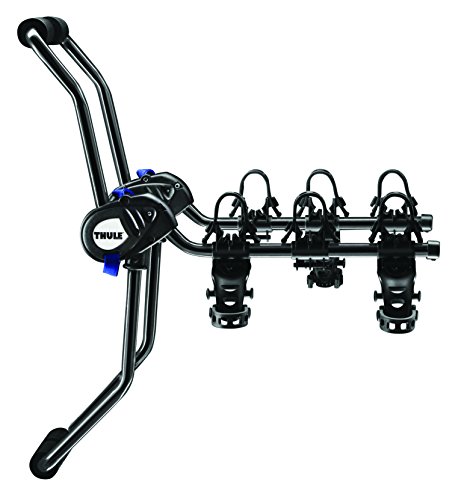
The Thule 911XT scales the Passage platform's core engineering to accommodate three bikes while retaining the soft rubber cradles and anti-sway protection that distinguish Thule's trunk racks from mass-market alternatives. The rack arms fold independently when not in use, collapsing the profile for trunk-friendly storage without the need to disassemble any components or stow hardware separately.
One of the 911XT's standout refinements is its narrow cradle arm geometry, which broadens the range of compatible frame sizes to include children's bikes and smaller adult frames that wider cradle designs fail to grip reliably. For households transporting bikes of significantly different sizes — a parent's full-size mountain bike alongside a child's 24-inch — this inclusive design eliminates the frustrating improvisation that other racks require. The anti-sway system runs across all three positions, so your innermost bike receives the same lateral restraint as the outermost one.
Fitting to the vehicle follows the same logic as the 910XT, with adjustable straps and rubber contact points engineered to protect your trunk lid finish from the chafing and micro-scratches that poorly padded hardware generates. The 911XT is the rack you purchase when you've already owned a cheaper three-bike carrier and found it wanting on a long-distance drive.
Pros:
Cons:
The Saris Bones EX takes the acclaimed architecture of the original Bones and scales it to three-bike capacity while adding the "dog leg" frame geometry specifically engineered to clear the spoilers found on popular sedans, hatchbacks, and SUVs that standard racks struggle to accommodate. Saris states that the Bones EX fits 90% of top-selling vehicles, a compatibility claim that stands as one of the broadest in the entire trunk-rack category for 2026.
At 11 pounds, the EX matches the original Bones in weight despite carrying one additional bike, a feat made possible by the same injection-molded construction that keeps structural mass low without sacrificing rigidity. The arc-based design separates all three bikes on independent planes, so your family's bikes — regardless of size or frame shape — never contact one another during transport. Premium hold-down straps with ratcheting mechanisms secure each bike individually, allowing you to load bikes of different weights without rethinking strap tension across positions.
Manufactured in the USA from fully recyclable materials, the Bones EX shares the sustainability credentials of its two-bike sibling. The rust-free construction and UV-stable strap coating make this rack a reliable long-term investment for families who ride year-round in varied weather. If your household runs three bikes of different frame geometries and you need maximum vehicle compatibility in a single rack, the Bones EX is the definitive family choice in 2026.
Pros:
Cons:
Allen Sports has supplied budget-conscious cyclists with functional trunk racks for years, and the 102DN-R continues that tradition as one of the most accessible two-bike carriers available in 2026. This rack delivers the essential functionality — secure attachment, basic frame protection, and two-bike capacity — without the price premium attached to Saris or Thule products, making it the entry point for first-time trunk rack buyers who aren't yet ready to commit to a higher investment.
The 102DN-R uses padded contact points and adjustable straps to conform to different trunk profiles, and the straightforward strap system allows most users to install it correctly on the first attempt. For occasional weekend riders who transport bikes a few times per season rather than weekly, the 102DN-R's durability level is entirely adequate, and the cost savings relative to premium racks are substantial. This is the rack you buy when the bikes themselves cost more than the budget allows for rack hardware.
Be aware that the 102DN-R's feature set reflects its price point — there is no anti-sway cage system, no patented fitment mechanism, and no premium cradle padding. On smooth roads at moderate speeds, those omissions are acceptable. On rough highways or extended trips, riders with high-value frames should consider stepping up to a Saris or Thule product that provides active frame isolation. Pair this rack with quality cargo carriers for a complete vehicle transport setup on a budget.
Pros:
Cons:
The Yakima FullBack 3 distinguishes itself from every other rack in this guide by integrating a full SKS locking system that secures both the rack to your vehicle and your bikes to the rack, a feature set that no other trunk-mount carrier in this review offers at any price. For cyclists who regularly leave their bikes unattended — at trailheads, rest stops, or urban parking — the FullBack 3's theft deterrence represents a meaningful upgrade over strap-only retention systems.
Beyond security, the FullBack 3 features a bomber external frame construction paired with SuperCush ZipStrip cradles that Yakima describes as one of the most bike-friendly loading systems available on any trunk rack today. The fully removable straps allow you to customize fitment for your specific vehicle without working around fixed attachment points, and the cushy frame padding protects both bike finishes and vehicle paint from contact damage. Fits sedans, hatchbacks, SUVs, and minivans, covering the full range of common passenger vehicles.
The FullBack 3 also includes a bottle opener — a small but characteristically Yakima detail that signals the brand's outdoor lifestyle positioning. At three-bike capacity with premium padding, integrated locks, and broad vehicle compatibility, this rack occupies the top tier of the trunk-mount category in terms of feature completeness. The price reflects that positioning, but for riders who have experienced bike theft at trailheads, the SKS locking system alone justifies the investment over unsecured alternatives.
Pros:
Cons:
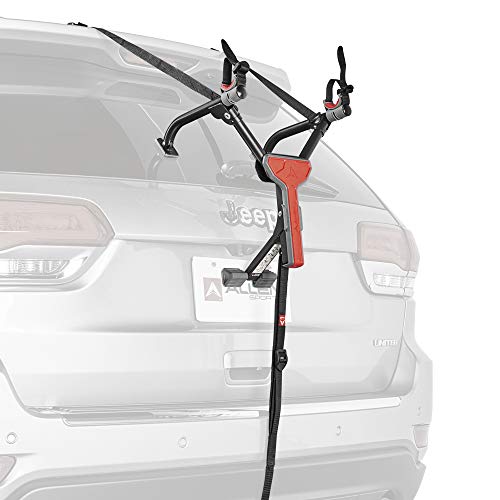
The Allen Sports MT1-B answers a specific question that most trunk rack reviews overlook: what is the best option for a solo rider who wants the smallest, lightest, most storage-friendly carrier available in 2026? The MT1-B's fully collapsible design folds into a form factor compact enough to slide under a car seat or into a backpack, making it the clear recommendation for commuters, travelers, and anyone who needs a rack that disappears completely when not in use.
At single-bike capacity with padded lower frame contact, the MT1-B covers the basic transport requirements for one standard bicycle without the bulk or weight that multi-bike designs carry by necessity. The gray powder-coated finish resists corrosion and handles the abrasion of repeated folding and unfolding without degrading the structural integrity of the collapse mechanism. Installation follows the same strap-and-hook approach as Allen's other models, allowing an experienced user to mount and dismount the rack in under two minutes.
The MT1-B is not a premium rack — it is a pragmatic tool for a specific use case, and evaluating it against the Saris Bones or Yakima FullBack misses the point entirely. You purchase this rack when you ride alone, store your gear in limited space, and prioritize packability above all other criteria. For casual solo cyclists who travel by car with their bike only occasionally, the MT1-B delivers exactly what it promises at a price that makes the decision effortless.
Pros:
Cons:
Your first evaluation criterion is whether the rack actually fits your specific vehicle without modification or improvisation. Trunk profiles vary significantly across sedans, hatchbacks, crossovers, and SUVs — and integrated spoilers, which are standard on many models built after 2015, create clearance challenges that eliminate several rack designs from consideration entirely. Look for racks that explicitly document spoiler compatibility, such as the Saris Bones EX's dog-leg geometry or Thule's FitDial adjustment system, which provide engineered solutions rather than workarounds. Always verify the manufacturer's vehicle compatibility list before purchasing, and measure your trunk angle if the rack's adjustment range is specified in degrees.
Matching rack capacity to your household's actual bike count prevents the frustrating scenario of owning a two-bike carrier when three riders want to travel together. Beyond headcount, verify that each bike you intend to transport falls within the rack's per-bike weight limit — most trunk racks specify 35 pounds per bike, which covers standard road and mountain bikes but excludes the growing category of electric bikes, which commonly weigh 45 to 70 pounds. If any member of your household rides an e-bike, you need to either select a rack with higher individual capacity ratings or mount your e-bike on a hitch rack designed for that weight class instead.
The difference between a frustrating trunk rack experience and a satisfying one often comes down to how effectively the rack isolates your bikes from each other and from your vehicle during transit. Ratcheting anti-sway straps, physical cage systems like Thule's Stay-Put cages, and arc-based designs like Saris Bones all address this problem through different mechanisms — each with real performance consequences on rough pavement and at highway speeds. Soft rubber cradles and padded contact points protect both bike frames and your vehicle's paint finish from the abrasion that hard plastic or unpadded metal hardware produces. If you drive a car with a premium paint job, the investment in a quality paint sealant pairs directly with a rack that includes proper vehicle contact padding.
Evaluate each rack against two time horizons: the security it provides when parked, and the durability it delivers over multiple seasons of use. Racks without integrated locks, including every model in this guide except the Yakima FullBack 3, rely entirely on the deterrent value of inconvenience — a determined thief with basic tools can defeat strap systems. If you regularly leave bikes on the rack in public areas, an integrated lock system or aftermarket cable lock is a non-negotiable addition. On durability, look for rust-free frame materials, UV-stable strap webbing, and rubberized feet that won't harden and crack in cold weather — all indicators of a rack designed for multi-year service rather than a single season of use.
A properly installed trunk bike rack with adequate padding does not damage your paint under normal use conditions, but contact points do create low-level abrasion over time if the rack shifts during transit. Rubberized feet and padded strap cradles — standard on all Saris and Thule products — minimize direct metal-to-finish contact. You should periodically check that all contact points remain properly positioned and that strap webbing hasn't migrated onto unprotected surfaces. Applying a quality paint sealant to your trunk lid before the riding season adds an extra layer of protection against the micro-scratches that even well-padded racks can produce over thousands of miles.
Many trunk bike racks fit vehicles with standard factory spoilers, but fitment varies significantly depending on the spoiler's profile and the rack's adjustment geometry. The Saris Bones EX is specifically engineered with a dog-leg frame design to clear most common spoilers on sedans, hatchbacks, and SUVs. The Thule Passage series documents spoiler compatibility in its vehicle fit guide. If your vehicle has an aftermarket or unusually aggressive spoiler, verify compatibility directly against the manufacturer's fit list before purchasing, as no universal spoiler solution exists across all rack designs currently on the market in 2026.
Trunk bike racks are commercially available in one-bike, two-bike, and three-bike configurations, with no trunk-mount designs currently rated for four or more bikes. Single-bike carriers like the Allen Sports MT1-B target solo commuters who need maximum packability. Two-bike racks from Saris and Thule serve couples and small households. Three-bike racks from Saris, Thule, and Yakima accommodate families or group rides. If your household consistently needs to transport four or more bikes simultaneously, a hitch-mounted platform rack or roof-mounted carrier system is a more appropriate solution than any trunk-mount design.
Yes, quality trunk bike racks are designed and tested for highway use, but safe operation requires correct installation and verified strap tension before every trip. The NHTSA recommends checking that all attachment straps are fully tightened, that bikes are not contacting each other or the vehicle, and that rear visibility — particularly your license plate and brake lights — is not obstructed. Anti-sway systems, whether ratcheting straps or physical cage designs, are critical at highway speeds where aerodynamic forces generate lateral loading that static straps alone cannot fully counteract. Never exceed the rack's rated speed limit if one is specified in its documentation.
Most trunk bike racks in the standard segment specify a per-bike capacity of 35 pounds, which accommodates the majority of road, mountain, and hybrid bicycles currently sold for recreational use. The racks in this guide — including the Saris Bones, Saris Bones EX, and Thule Passage series — all operate at this 35-pound-per-bike threshold. Electric bikes, which typically weigh between 45 and 70 pounds, exceed this limit on virtually all trunk-mount designs and should be transported on hitch racks explicitly rated for e-bike loads. Always confirm your heaviest bike's actual weight before loading, as exceeding the capacity rating stresses attachment points and creates a legitimate road safety risk.
On most vehicles, you cannot fully open the trunk lid with a trunk bike rack installed, as the rack's upper hooks engage the trunk lip or hatch opening directly. Some racks include a tilt-and-fold feature that allows limited trunk access after the bikes are removed from the cradles, but full trunk lid opening while the rack is mounted is generally not possible without disassembly. If frequent trunk access while traveling with bikes is a priority for you, a hitch-mounted rack with a swing-away feature is a better investment than any trunk-mount design currently available in 2026.
The right trunk bike rack for your situation in 2026 comes down to three variables: how many bikes you need to carry, how much you value frame protection and vehicle fitment precision, and whether security at unattended stops is a genuine concern for your riding habits. Start with the Saris Bones for the best all-around two-bike experience, step up to the Saris Bones EX or Yakima FullBack 3 if your household runs three bikes or demands integrated security, and choose the Allen Sports MT1-B if you ride solo and packability is your top priority — then get out and ride.
 |
 |
 |
 |

About Rachel Park
Rachel Park specializes in the interior and exterior upgrades that meaningfully change how a car looks, sounds, and feels on a daily basis. She has hands-on experience with head unit installations and audio system builds, LED and HID lighting conversions, interior refresh projects, and cosmetic exterior work — evaluated from both a DIY accessibility and quality-of-result perspective. At CarCareTotal, she covers car audio and electronics, lighting upgrades, and interior and exterior styling accessories.
Get some FREE car parts & gear.. Or check out the latest free automotive manuals and build guides here.
Disable your ad blocker to unlock all the hidden deals. Hit the button below 🚗
| | | |
