by Liam O'Brien
A floor jack is one of the most essential tools in any home garage. It lets you safely lift a vehicle in seconds to change tires, inspect the brakes, or perform routine maintenance without needing professional equipment. Unlike a scissor jack — the compact tool included with most cars — a hydraulic floor jack rolls smoothly under your vehicle, lifts with minimal effort, and gives you stable, controlled height.
Floor jacks come in a wide range of sizes and capacities. Compact 2-ton models are ideal for small cars and sedans, while 3-ton and 3.5-ton jacks handle full-size trucks, SUVs, and vans. Low-profile designs with a minimum height under 4 inches are essential for sports cars and lowered vehicles where a standard jack simply will not fit. Aluminum-frame models reduce the weight by 30–40% compared to steel while delivering the same rated capacity, which matters when you are moving the jack in and out of a trunk or around a garage floor.
According to the Occupational Safety and Health Administration (OSHA), improper vehicle lifting is a leading cause of workshop injuries — choosing a properly rated, safety-valve-equipped floor jack and pairing it with quality jack stands is a critical safety practice, not just a convenience.
We researched the current 2026 market and selected the 7 best floor jacks across different categories — best overall, best for SUVs, best low-profile, best value, and best portable. Every pick below is available on Amazon and verified as a live, in-production product.
Contents








The ARCAN A20019 is built for drivers who want professional-grade lifting performance without dragging a 100-pound steel jack across the garage. Its aircraft-grade aluminum frame cuts the weight to under 60 lbs while retaining a full 3-ton lifting capacity, making it one of the best floor jacks for everyday home mechanics and enthusiasts alike.
The dual pump piston design is the headline feature. Instead of pumping the handle repeatedly to crawl the saddle upward, two pistons work together to raise the jack in roughly half the strokes of a single-piston competitor. The reinforced lift arm adds structural stiffness so the jack does not twist under load, which also reduces side wear on the cylinder seals.
Minimum height of 3.5 inches gives it solid clearance on most passenger cars and light trucks. The wide stance chassis keeps the jack stable even on slightly uneven concrete, and the swivel rear casters make repositioning easy once the front wheels are locked in.
The main trade-off is price: aluminum costs more than steel. Some long-term users have also reported that the release valve can become inconsistent after years of heavy use, though Arcan backs the jack with a limited warranty. Overall, for weekend mechanics who value easy portability over absolute budget, this is a clear top pick.
Pros
Cons
Torin's Big Red T83006 has earned its popularity by doing one thing exceptionally well: lifting tall vehicles. The extra-long saddle neck extends the reach so it can comfortably get under SUVs, extended-cab pickups, and trucks where a low-profile jack's saddle simply does not reach.
The jack is built around a heavy-gauge steel chassis that is clearly designed for durability over portability. Four casters — two large fixed rollers and two 360-degree swivel casters — allow smooth navigation around a workspace without tipping. A bypass valve prevents accidental overloading, and the release mechanism is a simple twist-and-lower screw valve that most users will find intuitive.
Maximum lift height of 20.875 inches is excellent for its class, making it one of the better options for lifted trucks and tall-chassis vehicles. The saddle itself is wide and padded to distribute load evenly across a vehicle's frame contact point.
The steel construction makes it noticeably heavier than aluminum alternatives. A handful of owners have noted minor hydraulic fluid seeping at the seals after extended outdoor storage — storing it upright and indoors prevents this. For the price, it is among the most value-oriented 3-ton floor jacks on the market.
Pros
Cons
The DNA Motoring TOOLS-00234 is aimed squarely at sports car and lowered-vehicle owners who need a compact, budget-friendly jack that slides under tight ground clearance without hassle. With a minimum height of just 5.1 inches, it fits under most lowered sedans and coupes that would stump a taller jack.
Build quality is straightforward: the welded steel frame is solid for occasional home use, and the single-piston hydraulic cylinder raises the saddle smoothly up to 13 inches. The compact dimensions — under 17 inches long — mean it also works well as a trunk or bed emergency jack when you need something for roadside flat changes.
A built-in overload safety valve protects both the jack and the vehicle from accidental overloads beyond the 2-ton rated limit. Swivel rear casters keep positioning easy on smooth garage floors, and the included carrying case helps keep it clean between uses.
The 2-ton limit means it is not suitable for full-size trucks or heavy SUVs. Maximum lift height of 13 inches also limits its usefulness on taller vehicles. For city drivers and sports car owners doing routine maintenance at home, it hits an excellent price-to-capability sweet spot.
Pros
Cons
The Maxority 3-Ton Low Profile floor jack combines the lift range of a full-size jack with the low entry height of a racing-style design. A minimum of 3.34 inches is low enough for most sports cars and moderately lowered vehicles, while the 18.5-inch maximum height handles standard SUVs and minivans without straining.
Its dual-piston rapid-pump technology is the performance differentiator. Two pistons working in tandem mean the saddle climbs faster per stroke — useful when you are rotating tires and need to lift each corner repeatedly without fatigue. The heavy-duty steel chassis is thick enough to remain stable under the full 6,600-pound rated load.
The integrated safety valve shuts the hydraulic circuit before an overload can damage the cylinder or the vehicle. Four casters provide good maneuverability; the two swivel rear wheels can arc the jack into tight spaces under a work car parked close to a wall.
Being steel rather than aluminum, the Maxority is on the heavier side. Some users have noted the handle can feel slightly loose out of the box, though tightening the handle-rod connection bolt resolves the issue. For a 3-ton dual-piston jack at a mid-range price, it represents solid value.
Pros
Cons
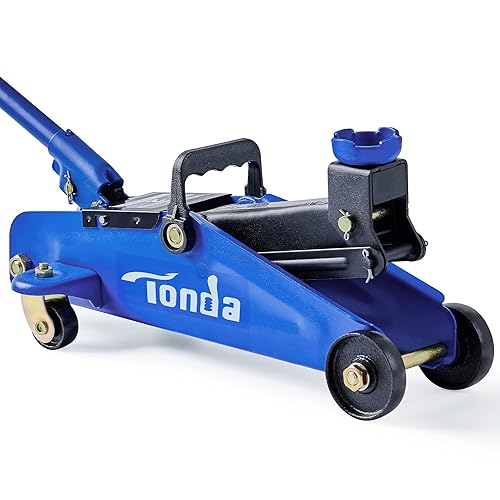
The TONDA Floor Jack is built around the concept of portability-first: it is small and light enough to sit permanently in a trunk without taking up meaningful cargo space, yet strong enough to handle a full tire swap on a midsize sedan or small SUV.
Its hydraulic pump is a single piston that steadily raises the saddle. Lift action is smooth and predictable — no sudden jerks — and the release valve lowers the vehicle in a controlled descent. The two front fixed casters and two rear swivel casters keep the jack steady when rolling it into position on a smooth road surface.
Where the TONDA excels is convenience. It can be deployed quickly in a roadside scenario and is light enough that most drivers can carry it with one hand. The compact footprint also makes it easy to store in tighter garage corners alongside other tools.
The 2-ton ceiling and modest maximum lift height mean it is not a substitute for a heavy-duty shop jack. The handle, while functional, is short enough that users with larger vehicles may find they need to crouch lower than ideal when pumping. For compact cars, sedans, and light crossovers, it is a practical choice.
Pros
Cons
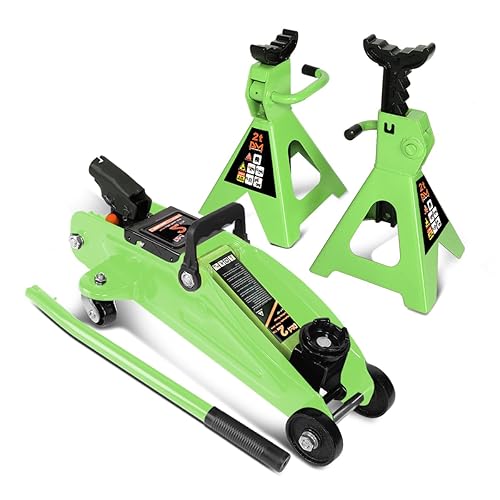
The PM PERFORMOTOR combo stands out by including two ratchet jack stands in the box alongside the floor jack — a practical bundle for anyone who needs to get under a vehicle safely without buying stands separately. Lifting is only the first step; having rated stands to hold the car while you work is equally important.
The jack itself is a 2-ton low-profile design with a 5.1-inch minimum entry height, matching the DNA Motoring in usability for compact and sports cars. The rotating 360-degree saddle is a small but genuinely useful detail that lets you position the saddle over an angled frame rail without having to reposition the entire jack.
Swivel casters and a welded steel frame give the PM PERFORMOTOR a stable, predictable feel. The overload safety system prevents use beyond the rated limit, protecting both the jack and your vehicle. The green colorway is easy to spot in a dark garage, and the unit arrives ready to use out of the box.
As with most 2-ton compact jacks, the limited lift height makes it unsuitable for tall trucks or lifted vehicles. Power users who frequently work on heavy trucks or need to lift a vehicle more than 13 inches will want to look at the 3-ton models instead. For city drivers and garage hobbyists working on smaller vehicles, the combo offers excellent value.
Pros
Cons
The LARBANKE 3 Ton Floor Jack targets mechanics who want a straightforward heavy-duty steel jack with a full 6,600-pound rating at a competitive price. Carbon steel construction gives the frame excellent resistance to bending and fatigue under repeated loading cycles, making it a strong choice for a dedicated shop or home garage.
The lift range of 5.31 to 18.11 inches suits a wide variety of vehicles from standard sedans to midsize SUVs and light trucks. A large saddle distributes load evenly across frame contact points, reducing the risk of saddle slip during lifting. Built-in safety valves prevent overload, and the dual swivel caster system makes steering the jack easy even in tight bays.
LARBANKE added reinforced wheels to the design — a combination of large load-bearing rear rollers for stability and 360-degree swivel front casters for steering flexibility. This two-mode wheel setup handles the competing demands of holding steady under load and maneuvering freely when empty.
Carbon steel adds weight compared to aluminum alternatives, and the 5.31-inch minimum height is less aggressive than the ultra-low-profile options on this list. For users who prioritize durability and 3-ton capacity over low-entry clearance, the LARBANKE delivers reliable performance at an accessible price.
Pros
Cons
Before shopping, it helps to understand the main categories of floor jacks available in 2026. Each type suits a different use case, and picking the wrong style can leave you unable to fit the jack under your vehicle or unable to lift it high enough.
The most common type found in home garages. A hydraulic cylinder extends a saddle when you pump the long handle, lifting the vehicle steadily. Most have a minimum height of 5 to 6 inches and lift up to 18 to 21 inches. The Torin Big Red T83006 in our list is a classic example — it handles SUVs and trucks with a long saddle neck and 20.875-inch maximum lift.
Designed for sports cars, lowered vehicles, and any car where the normal-height jack will not slide underneath. Minimum heights of 3 to 5 inches are common. The trade-off is that maximum lift height is often lower (13 to 19 inches), and these jacks are usually more expensive. The Maxority 3-Ton in our list has a 3.34-inch minimum — low enough for most track cars.
Uses aircraft-grade aluminum for the frame instead of steel, cutting weight by 30–40%. The ARCAN A20019 in our list weighs under 60 lbs versus 80–100 lbs for comparable steel jacks. Ideal for mechanics who transport the jack frequently or have difficulty moving heavy equipment around. Generally priced higher than steel equivalents.
A vertically oriented hydraulic cylinder in a compact housing. Bottle jacks take up very little space and can handle very high loads (often 6–20 tons), but they require more ground clearance than floor jacks and can tip under side loads. Best used in a shop on flat ground, not under most passenger cars.
Compact floor jacks sized to fit in a car trunk or truck bed. The TONDA 2-Ton in our list is a good example — small enough for roadside use, light enough for one person to carry. These jacks sacrifice maximum lift height and sometimes stability for the convenience of portability.
With so many floor jacks on the market in 2026, knowing which specs and features actually matter will save you from buying a jack that does not fit your vehicle or your garage workflow. Here is what to evaluate before purchasing.
This is the most critical specification. A floor jack rated for 2 tons (4,000 lbs) can safely lift most passenger cars. A 3-ton (6,000-lb) rating is the standard for light trucks and full-size SUVs. Never use a jack at more than its rated capacity — the bypass valve is a last resort, not a routine feature. A good rule of thumb: choose a jack rated for at least the curb weight of the heaviest vehicle you own.
This is the height of the saddle when the jack is fully lowered. If your car has a low front splitter or wide body kit, a standard 5.5-inch-minimum jack will not slide underneath. Low-profile jacks start at 3 to 4 inches. Check your vehicle's lowest undercarriage clearance before purchasing.
How high the saddle rises at full extension. For most passenger cars and standard SUVs, 18 to 21 inches is sufficient. If you have a lifted truck or need to remove suspension components requiring extra clearance, look for a jack with at least 20 inches of maximum lift.
Steel jacks are durable, affordable, and handle heavy loads consistently. Aluminum jacks are 30–40% lighter, easier to carry, and less prone to rust — but cost more. If you move the jack frequently or store it in a vehicle, aluminum is worth the premium. For a fixed shop jack, steel is the economical choice.
A dual piston pump raises the saddle faster per stroke — roughly twice as fast as a single piston. If you are doing tire rotations where you lift each corner repeatedly, the time and effort savings add up quickly. For occasional use, a single piston is perfectly adequate.
A hydraulic overload bypass valve is the standard safety feature on modern floor jacks — it prevents the jack from being used beyond its rated capacity. Ensure any jack you buy includes this. Some premium models also include a manual safety lock that prevents the jack from lowering unexpectedly if a seal fails. Always back up a floor jack with rated jack stands before going under a vehicle.
Consumer floor jacks typically carry a 1-year limited warranty. Professional-grade jacks from brands like ARCAN offer longer coverage on their industrial lines. Read the warranty terms carefully — many warranties require registration and cover only manufacturing defects, not user damage.
A quality 2-ton low-profile jack for home use can be found for $50–$80 (DNA Motoring, TONDA). A reliable 3-ton steel jack typically runs $80–$120 (Torin, LARBANKE). Premium aluminum 3-ton jacks with dual pistons range from $150–$250 (ARCAN). Avoid unbranded sub-$40 jacks — at that price point, quality control on hydraulic seals and safety valves is typically very poor.
ARCAN Tools 3-Ton Quick Rise Aluminum Floor Jack with Dual Pump Pistons & Reinforced Lifting Arm (A20019) - Walmart Link
BIG RED T83006 Torin Hydraulic Trolley Service/Floor Jack with Extra Saddle: 3 Ton (6,000 lb) Capacity, Red - Walmart Link
DNA MOTORING TOOLS-00234 Low Profile Hydraulic Trolley Service/Floor Jack, 2 Ton (4000 lbs) Capacity, Lifting Range 5.1"-13", Black - Walmart Link
Maxority 3-Ton (6600lbs) Low Profile Hydraulic Heavy-Duty Steel Floor Jack with Dual Piston Quick Lift, Lift Range 3.34"-18.5" - Walmart Link
TONDA Floor Jack, Hydraulic Portable Car Jack, 2 Ton (4,000 lb) Capacity, Blue - Walmart Link
PM PERFORMOTOR Low Profile Hydraulic Trolley Service/Floor Jack Combo with 2 Ratchet Jack Stands, 2 Ton (4000 lbs) Capacity, Green - Walmart Link
LARBANKE Fast Lift 3 Ton Floor Jack, 6600 LBS Heavy Duty Hydraulic Floor Jack with Wheels, Lift Range 5.31"-18.11", Carbon Steel - Walmart Link
ARCAN Tools 3-Ton Quick Rise Aluminum Floor Jack with Dual Pump Pistons & Reinforced Lifting Arm (A20019) - eBay Link
BIG RED T83006 Torin Hydraulic Trolley Service/Floor Jack with Extra Saddle: 3 Ton (6,000 lb) Capacity, Red - eBay Link
DNA MOTORING TOOLS-00234 Low Profile Hydraulic Trolley Service/Floor Jack, 2 Ton (4000 lbs) Capacity, Lifting Range 5.1"-13", Black - eBay Link
Maxority 3-Ton (6600lbs) Low Profile Hydraulic Heavy-Duty Steel Floor Jack with Dual Piston Quick Lift, Lift Range 3.34"-18.5" - eBay Link
TONDA Floor Jack, Hydraulic Portable Car Jack, 2 Ton (4,000 lb) Capacity, Blue - eBay Link
PM PERFORMOTOR Low Profile Hydraulic Trolley Service/Floor Jack Combo with 2 Ratchet Jack Stands, 2 Ton (4000 lbs) Capacity, Green - eBay Link
LARBANKE Fast Lift 3 Ton Floor Jack, 6600 LBS Heavy Duty Hydraulic Floor Jack with Wheels, Lift Range 5.31"-18.11", Carbon Steel - eBay Link
The best floor jack for you depends on what you drive and how you work. For the majority of home mechanics who own a standard car or midsize SUV and want the easiest lifting experience, the ARCAN 3-Ton Aluminum Floor Jack is the clear Best Overall pick. Its under-60-lb weight, dual piston speed, and reinforced lift arm make tire changes and brake jobs noticeably faster and less physically demanding than steel alternatives.
If you work on trucks or tall SUVs where maximum lift height matters more than minimum entry height, the Torin Big Red T83006 delivers 20.875 inches of lift and a wide extra-long saddle neck at a price that is hard to beat in the 3-ton category.
For sports car and lowered-vehicle owners, the Maxority 3-Ton Low Profile offers a 3.34-inch entry height and a dual-piston rapid lift in a steel-frame design that handles the full 6,600-lb rated load. Budget-focused buyers who primarily need a jack for compact cars and occasional roadside use will find the DNA Motoring TOOLS-00234 or the TONDA 2-Ton deliver solid value at entry-level prices.
No matter which jack you choose, always pair it with quality rated jack stands. A floor jack is a lifting tool, not a supporting tool — it was never designed to hold a vehicle for extended periods. Stay safe, buy within your rated capacity, and the right floor jack will serve you reliably for years of maintenance work.

The ARCAN 3-Ton Aluminum Floor Jack is our top pick for home garage use. It is lightweight at under 60 lbs, lifts up to 3 tons, and the dual pump pistons make raising and lowering fast. For budget-focused users, the Torin Big Red T83006 is a reliable, heavy-duty steel option at a lower price point.
Most consumer floor jacks are rated between 1.5 tons (3,000 lbs) and 3.5 tons (7,000 lbs). A 2-ton jack handles most passenger cars and smaller SUVs. A 3-ton jack covers the majority of pickup trucks and full-size SUVs. Always use the weight capacity rating as a maximum limit, never exceed it.
A low-profile floor jack has a minimum lifting height of 3 to 5 inches, allowing it to slide under sports cars and lowered vehicles with very little ground clearance. A standard floor jack typically starts at 5 to 6 inches minimum height, which works for most regular-height vehicles. If you drive a lowered car, a low-profile jack is essential.
Each has trade-offs. Aluminum floor jacks are lighter — typically 55 to 65 lbs versus 80 to 100 lbs for steel — making them easier to carry and position. Steel jacks are generally less expensive and highly durable for heavy-duty shop use. For home mechanics who move the jack often, aluminum is worth the extra cost. For a stationary shop jack used daily, steel is more economical.
Always lift on a flat, level, and solid surface. Place the saddle under the manufacturer-designated jack points — usually marked in your owner's manual. Never get under a vehicle supported only by a floor jack; always back it up with rated jack stands. Keep bystanders clear of the lift area and never exceed the jack's rated weight capacity.
 |
 |
 |
 |

About Liam O'Brien
Liam O'Brien is a tools and equipment specialist who has been buying, breaking, and reviewing automotive tools for over a decade. He focuses on what actually holds up in real-world DIY garage use, not just what looks good on a workbench.
Get some FREE car parts & gear.. Or check out the latest free automotive manuals and build guides here.
Disable your ad blocker to unlock all the hidden deals. Hit the button below 🚗
| | | |
