by Liam O'Brien
The Pittsburgh Automotive 3-Ton Heavy Duty Low Profile Floor Jack earns its spot at the top of this list with a rapid pump mechanism and reliable steel construction that gets the job done without drama. If you work on a variety of vehicles — from daily drivers to modified sports cars — a quality low profile floor jack is one of the most important tools in your garage, and the options available in 2026 are better than ever.

Standard floor jacks struggle with low-slung vehicles. If you drive a sports car, a lowered sedan, or even a newer crossover with tight ground clearance, you've probably experienced the frustration of not being able to fit a jack under the rocker panels. Low profile floor jacks are specifically engineered to slide beneath vehicles that sit just 2.75 to 4 inches off the ground, giving you access where conventional jacks simply can't reach. Whether you're rotating tires, swapping brake pads, or doing a weekend oil change, having the right jack saves time and keeps you safe.
In this guide, we've tested and reviewed seven of the best low profile floor jacks on the market in 2026, covering everything from budget-friendly steel models to premium aluminum racing jacks. You'll also find a detailed buying guide covering what actually matters when you're shopping — minimum lift height, weight capacity, saddle size, and safety features. If you're already investing in quality garage tools, pairing your floor jack with a solid set of air ratchets will make most maintenance jobs significantly faster.
Contents
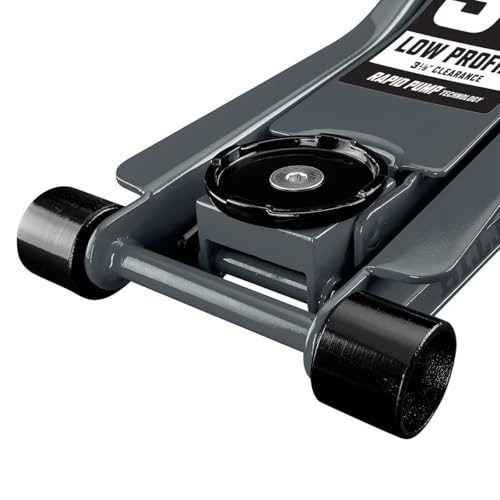






The Pittsburgh Automotive 3-Ton Low Profile Floor Jack has been a staple in home garages for years, and it continues to hold its own in 2026. It's a grey, no-frills steel jack built around a rapid pump system that cuts down the number of handle strokes required to get your vehicle airborne. For most standard maintenance tasks — brakes, oil changes, tire rotations — it performs exactly as expected without any fuss.
At 3-ton capacity, it handles everything from compact sedans to full-size pickup trucks. The rapid pump mechanism is the standout feature here: it reduces lifting time noticeably compared to conventional single-pump jacks. The construction is solid steel throughout, which adds some weight to the unit but contributes to a reassuring sense of stability once the vehicle is in the air. If you're doing general garage work and want a reliable workhorse that won't empty your wallet, this is a hard jack to beat.
That said, the low profile designation means it gets under most vehicles comfortably, though it doesn't match the extreme-low specs of some competitors like the Powerbuilt. If you're working on a heavily modified car sitting just 2.75 inches off the ground, you may want to look further down this list. For standard use? This jack delivers consistent, dependable performance every time.
Pros:
Cons:
The Pro-Lift F-767 earns its place on this list by doing a lot right at a price that's hard to argue with. Designed with an extra low profile, the F-767 gets its minimum lifting height down to just 3-3/8 inches — low enough for most passenger cars and many modified vehicles. The lifting range tops out at 15 inches, which is adequate for routine maintenance tasks.
Safety is a clear priority with this model. Pro-Lift incorporated solid steel construction throughout, plus a safety release valve that prevents excessive pressure buildup, and a patented bypass device that protects against over-pumping. Those are features you'd expect from more expensive jacks, so finding them here is genuinely impressive. The bypass device alone gives you peace of mind during every lift — no worrying about accidental over-extension.
The 2-ton capacity limits its usefulness for heavier SUVs and trucks, so be honest with yourself about what you'll be lifting. For a typical front-wheel-drive sedan or compact hatchback, 2 tons is plenty. It won't win any awards for speed, but for a budget jack, it's reliable, safe, and well-designed.
Pros:
Cons:
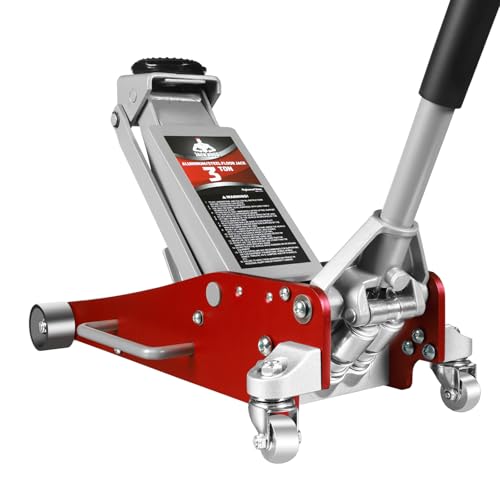
The Jack Boss 3-Ton stands out visually with its red racing-style finish, but the substance backs up the style. Built from a combination of aluminum and steel, it achieves a net weight of 58.5 lbs — meaningfully lighter than all-steel alternatives of comparable capacity. The dual piston quick-lift pump is the headline performance feature: you'll get the saddle to contact height in significantly fewer strokes than a conventional single-piston design.
The minimum lift height of 3-15/16 inches fits most sedans, SUVs, MPVs, station wagons, and even travel trailers within its rated capacity. The maximum height of 18-5/16 inches gives you room to work comfortably once the vehicle is raised. The large rubber saddle is a thoughtful addition — it distributes load properly and helps protect vehicle undercarriage finishes, which matters if you're working on a car you actually care about.
At 28.3 inches long and 13.7 inches wide, it's a compact footprint for a 3-ton jack. The package also includes a two-piece handle, keeping storage dimensions manageable. If you work on sport vehicles or anything with a relatively low front air dam, this jack deserves a serious look.
Pros:
Cons:
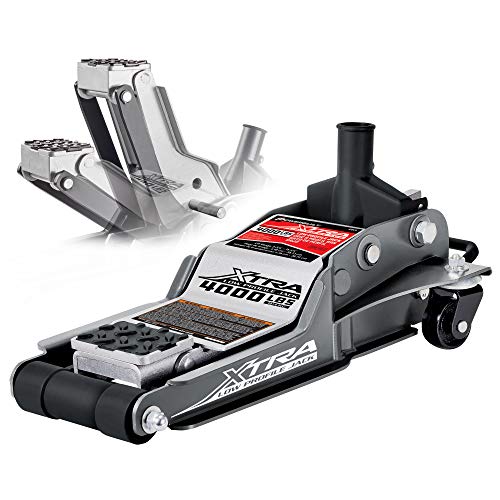
When you're dealing with a vehicle that sits genuinely low — think modified imports, European sports cars, or anything with aggressive aftermarket suspension — the Powerbuilt Xtra Low Profile is the jack you want. Its 2-3/4 inch minimum lift height is among the lowest in this entire category, and that extra quarter-inch of clearance versus a 3-inch competitor can be the difference between getting under the car and scraping the jack nose on the frame rail.
The design also includes something most floor jacks skip entirely: a built-in locking safety bar. This bar supports the lifted load at maximum height, reducing your dependence on separate jack stands for stationary work. That said, for any significant time spent under a vehicle, using dedicated jack stands is still the safest practice — OSHA guidelines on jack and jack stand safety are worth reviewing before any under-vehicle work. The wide lift range of 2-3/4 inches to 15-1/4 inches covers most passenger vehicles.
The 2-ton capacity is the main trade-off here. If you're working on a heavy SUV or truck, you'll want to look at the 3-ton options. But for modified passenger cars and stock vehicles where ground clearance is genuinely an issue, the Powerbuilt solves the problem better than almost anything else on this list.
Pros:
Cons:
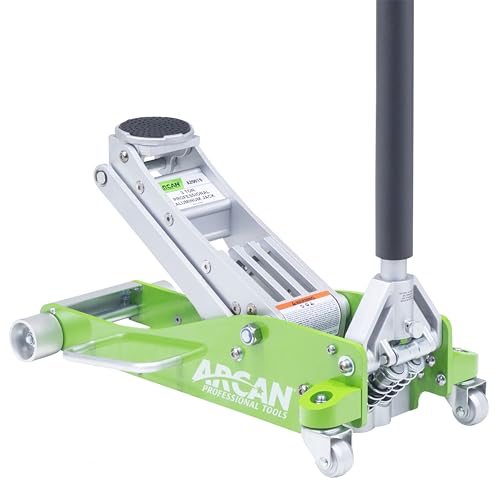
ARCAN has built a strong reputation for aluminum floor jacks, and the A20019 makes a compelling case for why aluminum construction matters in a floor jack. At 3 tons capacity with a low profile minimum height of 3.75 inches, it covers a broad range of passenger vehicles, SUVs, and light trucks. The weight savings versus comparable steel jacks are significant — if you're rolling this in and out of storage frequently or loading it into a truck bed for track days, you'll notice the difference immediately.
The Quick-Rise performance system is well-implemented here. The saddle raises rapidly to contact with the vehicle's lift point, which cuts down total lifting time meaningfully over the course of a long maintenance session. The lift range of 3.75 inches minimum to 18 inches maximum is generous enough for most service work, including suspension jobs where you need significant clearance above the ground.
This is the jack you buy when you want quality that lasts. Aluminum doesn't rust, which matters if your garage isn't climate-controlled. If you're also looking at car lifts for more ambitious garage builds, the ARCAN A20019 pairs well as a supplementary jack for spot work even in a lift-equipped space.
Pros:
Cons:
Husky's 3-Ton Low Profile Floor Jack is a newer entry in the market, and it arrives with a feature set that directly targets the main frustration with standard floor jacks: the time it takes to get a vehicle in the air. The advanced dual-pump design does exactly what it promises — it raises the vehicle meaningfully faster than single-pump alternatives, which adds up quickly when you're rotating four tires or working through a full brake job.
The specifications are genuinely impressive. A minimum lift height of 3-1/8 inches gets it under most lowered vehicles, while the 19-3/4 inch maximum height is the highest on this list, giving you excellent working clearance for under-vehicle service. That full-range lift capability at 3 tons makes it one of the most versatile picks here for mixed-use garages handling everything from daily drivers to light trucks.
The rear swivel caster wheels deserve a mention — they make positioning the jack under the vehicle noticeably smoother, especially on uneven garage floors. Steel construction keeps costs in check without sacrificing durability. If you're tired of fighting with a slow jack during every maintenance session, the Husky addresses that complaint head-on.
Pros:
Cons:
The ARCAN A20016 plays a slightly different game from the rest of this list. It's a 2-ton steel jack, which already signals it's built for precision passenger vehicle work rather than heavy lifting. But the differentiator is the reach: a minimum height of 2.75 inches and a maximum of 24 inches. That 24-inch maximum is exceptional — a full 4+ inches higher than most competitors on this page.
If you're doing suspension work that requires maximum articulation, or you're working on a lifted truck at its lowest lift points, that extra height ceiling matters. The dual pump piston system mirrors what you'd find on the Jack Boss and Husky models, raising the saddle to contact quickly and reducing effort over a long work session. The 2.75-inch minimum is also competitive, fitting most standard and some modified passenger vehicles.
The trade-off is capacity. At 2 tons (4,000 lbs), you're limited to passenger cars, small SUVs, and lighter crossovers. Don't try to lift your three-quarter-ton pickup with this. But for the home mechanic who primarily works on cars and values maximum working height above all else, the A20016 fills a niche that no other jack on this list addresses as directly. This also pairs well with a complete oil filter wrench set when you're doing full service work from underneath.
Pros:
Cons:

With seven solid options on the table, the right choice comes down to your specific vehicle, your garage setup, and how you plan to use the jack. Here's what to evaluate before you buy.
This is the defining spec for low profile floor jacks, and it's the first number you should check. Minimum lift height is how low the jack sits in its fully retracted position — it has to be shorter than the gap between your vehicle's lift points and the ground.
Measure the clearance at your specific lift points before buying. Don't assume — crawl under the car and check.
Every jack on this list is rated at either 2 tons (4,000 lbs) or 3 tons (6,000 lbs). Your vehicle's gross vehicle weight rating (GVWR) tells you what you need, but remember: you're lifting one end at a time, so you're typically working with 40–60% of the total vehicle weight at the jack point.
Don't just focus on the minimum height. Maximum lift height determines how much working clearance you'll have once the vehicle is up. For basic maintenance like tire rotation and brake pads, 14–16 inches of total lift range is adequate. For suspension work, exhaust jobs, or anything requiring you to get deeply under the vehicle, you want 18 inches or more.
This is a real trade-off, not just a marketing distinction. Both materials can build a safe, durable jack — but they serve different priorities.
For most home mechanics, a quality steel jack is the sensible choice. If you're tracking your car or doing mobile work, the ARCAN A20019's full aluminum construction justifies the price premium.
A floor jack failure can be catastrophic. These features are non-negotiable:
Never work under a vehicle supported only by a floor jack. Always use proper lift supports or jack stands rated for your vehicle's weight.
The Powerbuilt Xtra Low Profile and the ARCAN A20016 both achieve a minimum lift height of 2.75 inches, which represents the practical lower boundary for hydraulic floor jacks. Some professional-grade racing jacks can go slightly lower, but for consumer and enthusiast use, 2.75 inches handles even aggressively lowered vehicles in most cases. Before buying any jack, physically measure the ground clearance at your vehicle's designated lift points.
Yes — low profile doesn't mean low capacity. A 3-ton low profile jack will lift a standard-height SUV or light truck without issue. The "low profile" designation refers to the minimum lift height (how flat the jack sits when retracted), not the maximum height it can reach. Jacks like the Husky and ARCAN A20019 reach 18–19+ inches at full extension, which is plenty for lifted vehicles. Just verify that the jack's rated capacity exceeds your vehicle's weight at the lift point.
The Powerbuilt includes an integrated locking safety bar, which does provide meaningful additional support at maximum height. However, for any work that involves spending significant time under a vehicle, jack stands remain the industry-standard safety practice. A floor jack's hydraulic system can leak down over time. Jack stands are passive, purely mechanical, and don't depend on fluid integrity. Use the safety bar as a secondary backup, not a replacement for dedicated jack stands rated for your vehicle.
A single-pump jack has one hydraulic piston that lifts the arm on each stroke. A dual-pump system uses two pistons working in sequence — typically one for rapid initial rise and one for load-bearing extension. The practical result is fewer handle strokes to reach a given height, which translates to less physical effort during the early stages of lifting. The Jack Boss, Husky, and ARCAN A20016 all use dual-pump designs. If you're doing frequent, repetitive lifting, dual-pump is worth prioritizing.
Your vehicle's owner's manual will diagram the designated jack points — reinforced frame locations designed to bear the vehicle's weight safely. For most unibody passenger cars, these are typically behind the front wheels and ahead of the rear wheels along the pinch welds. For body-on-frame trucks and SUVs, you can often use the frame rails directly. Never jack under the oil pan, differential housing, or any suspension component. If your manual isn't available, the vehicle manufacturer's website usually publishes service documentation.
It depends on how you use it. For a jack that lives in your garage and rarely moves, the weight savings from aluminum offer limited daily benefit — a quality steel jack will serve you just as well at a lower price. Where aluminum genuinely earns its premium is in portable use: taking a jack to track days, loading it for roadside emergencies, or frequent transport. Aluminum also resists rust, which matters in humid garages or coastal climates. If either scenario applies to you, the ARCAN A20019 is a worthwhile investment.
 |
 |
 |
 |

About Liam O'Brien
Liam O'Brien has spent over a decade buying, field-testing, and evaluating automotive tools with a focus on what actually performs in a real DIY garage rather than what markets well on a spec sheet. His hands-on experience spans hand tools, diagnostic equipment, floor jacks, socket sets, and specialty automotive gear across a wide range of brands and price points. At CarCareTotal, he covers automotive tool and equipment reviews, garage setup guides, and buying advice for home mechanics.
Get some FREE car parts & gear.. Or check out the latest free automotive manuals and build guides here.
Disable your ad blocker to unlock all the hidden deals. Hit the button below 🚗
| | | |
