by Liam O'Brien
The U.S. Consumer Product Safety Commission records over 4,800 jack-related injuries annually — a number that makes hydraulic floor jack selection a genuine safety decision, not merely a purchasing one. The Powerzone 380044 3 ton floor jack review landscape is crowded with opinions, but the engineering data tells a more precise story. This unit competes directly against jacks priced 30 to 50 percent higher, offering a dual-piston rapid-rise pump and a 3-ton (6,000-pound) capacity in a steel-frame package that covers the majority of home-mechanic applications. If you are assembling or upgrading your workshop, browse the complete range of lifting and service equipment in our tools category before narrowing your selection.
The 380044 is not a professional shop jack. It is an engineered home-use unit built for mechanics who demand reliability across routine maintenance cycles. Understanding where it excels, where it concedes to the competition, and how to operate it correctly determines whether it becomes a cornerstone of your garage or a liability.

Contents
The Powerzone 380044 is purpose-built for the home mechanic performing regular maintenance on passenger vehicles, crossovers, and light trucks. Its 3-ton rated capacity covers vehicles up to 6,000 pounds, which includes the vast majority of daily drivers and half-ton pickups. The dual-piston pump reduces lift cycles by approximately 50 percent compared to single-piston units in the same bracket — a meaningful efficiency gain when you are cycling the jack multiple times per session.
This jack earns a firm recommendation for the following applications:
The rapid-rise design compounds its value across a full workday. Fewer pump strokes per lift translates to less physical fatigue and faster throughput on multi-vehicle service days.

The 380044 has clear operational boundaries. Exceeding them does not trigger a gradual performance decline — it triggers a safety event. Pass on this jack if your application falls into any of these categories:
For operations requiring a permanent two-post or four-post installation, the Powerzone 380044 functions as a complement — not a replacement. Review the structural and cost tradeoffs in the 2-post vs. 4-post lift comparison before committing your shop layout to either format. A floor jack and a fixed lift serve different operational roles, and conflating the two is a common and costly error.
The 380044 operates on the same fundamental principle as all hydraulic jacks — Pascal's law applied through a sealed dual-pump circuit. A small force on the input piston generates a proportionally amplified force on the larger output ram. The 380044 implements this through a dual-piston rapid-rise mechanism with a bypass valve that prevents circuit overload when the rated capacity is exceeded.
Core specifications:
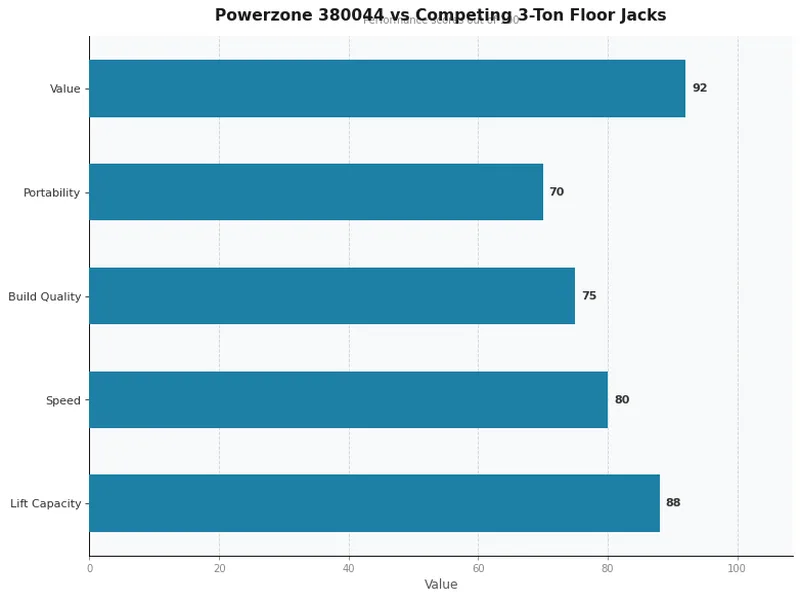
The table below positions the Powerzone 380044 against two commonly compared units in the 3-ton category. Each competes at a similar or higher price point. The comparison surfaces where the 380044 leads on value and where it concedes on weight or material grade.
| Feature | Powerzone 380044 | Pittsburgh 56617 | Arcan ALJ3T |
|---|---|---|---|
| Rated Capacity | 3 tons / 6,000 lbs | 3 tons / 6,000 lbs | 3 tons / 6,000 lbs |
| Min. Saddle Height | 3.5 in | 3.75 in | 3.5 in |
| Max. Saddle Height | 20 in | 18.5 in | 20 in |
| Unit Weight | ~68 lbs | ~72 lbs | ~56 lbs |
| Pump Type | Dual-piston rapid-rise | Single-piston | Dual-piston rapid-rise |
| Frame Material | Steel | Steel | Aluminum/Steel hybrid |
| Price Tier | Budget | Budget | Mid-range |
The Arcan ALJ3T saves 12 pounds via its aluminum frame — a genuine portability advantage. Its price premium, however, is substantial. The Pittsburgh 56617 matches the Powerzone 380044 on price but delivers a slower single-piston pump and a lower maximum saddle height of 18.5 inches, which limits its usefulness on taller truck frames. For raw value per pound of rated capacity, the 380044 holds the strongest position in its bracket.
New hydraulic jacks ship with air trapped in the circuit. This causes spongy lift response and inconsistent saddle behavior on early uses. Bleed the circuit before the first real lift:
Never position the saddle beneath a pinch weld, fuel line, or brake line without a proper rubber puck adapter — incorrect saddle placement is the single most common cause of unibody frame deformation during home maintenance.
Align the jack perpendicular to the jack point on every lift. Angled approaches introduce lateral stress on the saddle pivot, accelerate seal wear, and increase the probability of the vehicle shifting under load. Proper alignment costs nothing and pays compounding safety dividends across the life of the unit.
Hydraulic fluid condition governs long-term reliability. Inspect the fluid level through the fill port every six months. Drain and replace with ISO 32 hydraulic jack oil annually on a unit that sees regular use. These indicators signal fluid or seal degradation:
When performing undercar diagnostics — such as tracing the source of a car oil leak — inspect the jack itself as a potential contamination source before attributing any pooled fluid exclusively to the vehicle. A leaking floor jack positioned directly under an oil pan creates a diagnostic false positive.
The 380044's bypass valve blocks lifts exceeding the rated capacity under static conditions. It does not protect against dynamic overloading. Sudden lateral forces, uneven weight distribution at the saddle, or attempting to reposition a vehicle while it rests on the jack create failure vectors the bypass system cannot anticipate or prevent.
Eliminate these placement errors from your workflow immediately:
A 60-second visual check before every lift session catches the majority of mechanical failures before they become incidents. These four checkpoints cover the critical failure modes:
A jack that clears all four points is operationally ready. One that fails any single checkpoint requires diagnosis and remediation before it contacts a vehicle. No service task justifies bypassing a jack with a confirmed deficiency.
Completing the following steps before the first real lift validates the 380044's condition after shipping and establishes your baseline for all future inspections. Budget 20 minutes at unboxing:
These steps take less time than a standard oil change. They eliminate the ambiguity of not knowing whether a new unit arrived in correct working order after transit handling.
Three low-cost additions maximize the Powerzone 380044's utility from the first session and extend its service life materially:
All three accessories cost under $45 combined. Purchase them at the same time as the jack. Treating them as afterthoughts following a close call is a pattern that experienced mechanics universally regret.
Yes, provided the SUV's curb weight does not exceed 6,000 pounds. The 380044's 3-ton rated capacity covers most mid-size and full-size SUVs on the market. Always confirm your vehicle's gross vehicle weight rating in the owner's manual and identify the manufacturer-designated jack points before positioning the saddle.
On a properly bled unit, the dual-piston rapid-rise pump typically reaches maximum saddle height in 4 to 7 strokes. A single-piston jack of equivalent capacity generally requires 12 to 18 strokes for the same extension — the pump type difference is the primary source of the Powerzone 380044's efficiency advantage.
Use ISO 32 hydraulic jack oil exclusively. Automatic transmission fluid and brake fluid are chemically incompatible with the internal seals used in this jack. Substituting either accelerates seal degradation, causes internal leakage, and voids any applicable warranty coverage.
Yes. Level concrete in any surface condition is the ideal operating surface for this jack. On sealed or epoxy-coated floors, place a rubber mat beneath the rear wheels to prevent slipping during pump strokes. The mat also protects the coating from scuff marks caused by wheel movement under load.
 |
 |
 |
 |

About Liam O'Brien
Liam O'Brien has spent over a decade buying, field-testing, and evaluating automotive tools with a focus on what actually performs in a real DIY garage rather than what markets well on a spec sheet. His hands-on experience spans hand tools, diagnostic equipment, floor jacks, socket sets, and specialty automotive gear across a wide range of brands and price points. At CarCareTotal, he covers automotive tool and equipment reviews, garage setup guides, and buying advice for home mechanics.
Get some FREE car parts & gear.. Or check out the latest free automotive manuals and build guides here.
Disable your ad blocker to unlock all the hidden deals. Hit the button below 🚗
| | | |
